Industries
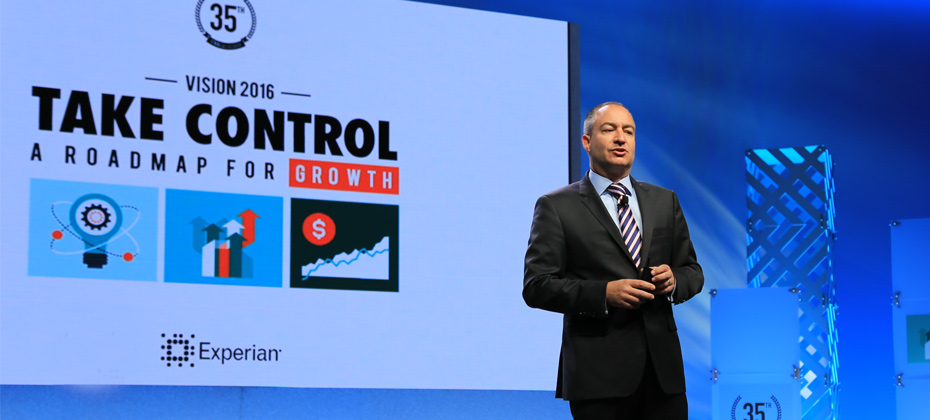
It’s impossible to capture all of the insights and learnings of 36 breakout sessions and several keynote addresses in one post, but let’s summarize a few of the highlights from the first day of Vision 2016. 1. Who better to speak about the state of our country, specifically some of the threats we are facing than Leon Panetta, former Secretary of Defense and Director of the CIA. While we are at a critical crossroads in the United States, there is room for optimism and his hope that we can be an America in Renaissance. 2. Alex Lintner, Experian President of Consumer Information Services, conveyed how the consumer world has evolved, in large part due to technology: 67 percent of consumers made purchases across multiple channels in the last six months. More than 88M U.S. consumers use their smartphone to do some form of banking. 68 percent of Millennials believe within five years the way we access money will be totally different. 3. Peter Renton of Lend Academy spoke on the future of Online Marketplace Lending, revealing: Banks are recognizing that this industry provides them with a great opportunity and many are partnering with Online Marketplace Lenders to enter the space. Millennials are not the largest consumers in this space today, but they will be in the future. Sustained growth will be key for this industry. The largest platforms have everything they need in place to endure – even through an economic downturn.In other words, Online Marketplace Lenders are here to stay. 4. Tom King, Experian’s Chief Information Security Officer, addressed the crowds on how the world of information security is growing increasingly complex. There are 1.9 million records compromised every day, and sadly that number is expected to rise. What can businesses do? “We need to make it easier to make the bad guys go somewhere else,” says King. 5. Look at how the housing market has changed from just a few years ago: Inventory continues to be extraordinarily lean. Why? New home building continues to run at recession levels. And, 8.5 percent of homeowners are still underwater on their mortgage, preventing them from placing it on the market. In the world of single-family home originations, 2016 projections show that there will be more purchases, less refinancing and less volume. We may see further growth in HELOC’s. With a dwindling number of mortgages benefiting from refinancing, and with rising interest rates, a HELOC may potentially be the cheapest and easiest way to tap equity. 6. As organizations balance business needs with increasing fraud threats, the important thing to remember is that the customer experience will trump everything else. Top fraud threats in 2015 included: Card Not Present (CNP) First Party Fraud/Synthetic ID Application Fraud Mobile Payment/Deposit Fraud Cross-Channel FraudSo what do the experts believe is essential to fraud prevention in the future? Big Data with smart analytics. 7. The need for Identity Relationship Management can be seen by the dichotomy of “99 percent of companies think having a clear picture of their customers is important for their business; yet only 24 percent actually think they achieve this ideal.” Connecting identities throughout the customer lifecycle is critical to bridging this gap. 8. New technologies continue to bring new challenges to fraud prevention. We’ve seen that post-EMV fraud is moving “upstream” as fraudsters: Apply for new credit cards using stolen ID’s. Provision stolen cards into mobile wallet. Gain access to accounts to make purchases.Then, fraudsters are open to use these new cards everywhere. 9. Several speakers addressed the ever-changing regulatory environment. The Telephone Consumer Protection Act (TCPA) litigation is up 30 percent since the last year. Regulators are increasingly taking notice of Online Marketplace Lenders. It’s critical to consider regulatory requirements when building risk models and implementing business policies. 10. Hispanics and Millennials are a force to be reckoned with, so pay attention: Millennials will be 81 million strong by 2036, and Hispanics are projected to be 133 million strong by 2050. Significant factors for home purchase likelihood for both groups include VantageScore® credit score, age, student debt, credit card debt, auto loans, income, marital status and housing prices. More great insights from Vision coming your way tomorrow!

Four Experian employees reflect on financial lessons and challenges learned during their time served in the military.

Credit invisibles often want access to credit, but are not easily scored via tradition credit models, and thus fall through the cracks. So how can lenders grow this population?

Ensuring the quality of reported consumer credit data is a top priority for regulators, credit bureaus and consumers, and has increasingly become a frequent headline in press outlets when consumers find their data is not accurate. Think of any big financial milestone moment – securing a mortgage loan, auto loan, student loan, obtaining low-interest rate interest credit cards or even getting a job. These important transactions can all be derailed with an unfavorable and inaccurate credit report, causing consumers to hit social media, the press and regulatory entities to vent it out. Add in the laws and increased scrutiny from the Consumer Financial Protection Bureau (CFPB), and Federal Trade Commission (FTC) and it is clear data furnishers are seeking ways to manage their data in more effective ways. At Vision 2016, I am hosting a session, Achievements in data reporting accuracy – maximizing data quality across your organization, with several panel guests willing to share their journeys and learnings attached to the topic of data accuracy. Our diverse panel features leaders from varying industries: Jodi Cook, DriveTime Alissa Hess, USAA Bank Tom Danchik, Citi Julie Moroschan, Experian Each will speak to how they’ve overcome challenges to introduce a data quality program into their respective organizations, as well as best practices around assessing, monitoring and correcting credit reporting issues. One speaker will even touch on the challenging topic of securing funding for a data quality program, considering budgets are most often allocated to strategies, products and marketing directly tied to driving revenue. All lenders are advised to maintain a full 360-degree view of data reporting, from raw data submissions to the consumer credit profile. Better data input equals fewer inaccuracies, and an overarching data integrity program, can deliver a comprehensive view that satisfies regulators, improves the customer experience and provides better insight for internal decision making. To learn more about implementing a data quality plan for your organization, check out Vision 2016.

Who sports higher scores, less debt and more on-time payments? According to Experian’s latest analysis, women take the credit title.

The numbers are staggering: more than $1.2 trillion in outstanding student loan debt, 40 million borrowers, and an average balance of $29,000. With Millennials exiting college and buried in debt, it’s no surprise they are postponing marriage, having babies, home purchases and other major life events. While the student loan issue has been looming for years, the magnitude is now taking center stage. All of the 2016 presidential contenders have an opinion, and many are starting to propose solutions – some going as far as to call for “debt-free college.” The issue has also caught the eye of the Consumer Financial Protection Bureau (CFPB). In its 2014 report, the CFPB stated one in four recent college graduates is either unemployed or underemployed. They also stated when faced with the inability to repay their debt, students lack payment options and are unclear as to how to resolve their debt. There is a bright spot. Experian reported new findings stating that among adults 18 to 34 years of age, the average credit score of those who had at least one open student loan account was 640, 20 points higher than others in their age group. So, if paid in a timely manner, student loans can help younger people establish a decent credit history before they go on to buy things like homes and cars. Still, education is key. Today, only 24 U.S. states require some form of financial literacy to be included in their high school course work, with only four states (Utah, Montana, Tennessee and Virginia) devoting a full semester to a personal finance course. Education is needed before students start diving into the student loan scene, and also after they graduate, to ensure they understand their repayment options and obligations. The CFPB is calling on all parties (universities, colleges, private lenders, advocates, policy makers and even family members) to get involved. Providing financial education, financial literacy, repayment options, deferral methods and income calculators are all needed to tackle this growing problem. The Great Recession and slow recovery brought home the importance of a college degree in today’s economy for many Americans. Bachelor’s degree recipients fared much better than their counterparts who only finished high school. The question becomes how to fund it, and make sure students who rely on loans understand the finances attached to this milestone investment. Learn more about Experian’s student debt trends and credit education in The Increasing Need for Consumer Credit Education: A Review of Student Debt.

The financial services industry continues to face mounting pressures to meet the highest standards of data reporting and accuracy. New regulations and mandates are introduced regularly, impacting the way companies do business. And a more credit-educated consumer base is seeking insights into their own credit data, providing a separate second of eyes that demand accuracy. Not only has the Fair Credit Reporting Act (FCRA) set requirements on dispute investigation and response, but the Consumer Financial Protection Bureau (CFPB) is also paying close attention. Recent announcements indicate the CFPB wants more information about the credit eco-system to gain more data about consumer disputes. According to the CFPB, it’s a joint problem – “the NCRAA’s, data furnishers, public record providers, and consumers all play roles which affect the accuracy of the information with credit reports.” And it’s not just the big banks that are being targeted with fines. The CFPB has made it clear it will also direct attention to certain nonbanks and financial products. In today’s data-driven environment, there are roughly 12,000-plus data furnishers, resulting in more than one billion pieces of information being updated on a monthly basis. Over 220 million consumers have some form of credit information attached to them, and transactional data is flowing all the time. Fail to update and a furnisher will quickly see flaws in their reporting. In fact, a recent study revealed an estimated 2.1% of contact info goes bad if unattended for more than one month. Clearly, achieving data quality is an ongoing investment for any organization, but companies often lack a clean plan. Some data furnishers fail to report, or elect to report to just one bureau, even though providing better data will result in a more complete and accurate credit profile. So how do you tackle the challenge of data quality? Organizations should consider implementing these six steps: Review data governance. Correct errors in data submissions. Complete an audit of data submissions. Evaluate disputes and resolutions. Compare data to peers and the industry. Review existing policies and processes. Follow these steps and your organization will earn a reputation among both regulators and consumers for clean, credible data. Plus, the investment in better data will reduce the need to resolve future disputes and fines. To learn more about meeting your FCRA responsibilities and best practices around data quality, check out our on-demand webinar or data integrity services site.

It’s official. Millennials have surpassed Baby Boomers in population size, according to the US Census. And while they are quick to adopt the “selfie” and all things social, they have been slow to embrace the world of credit. Sure, there’s been increased regulation over the past decade, and coming into adulthood in the midst of the Great Recession hasn’t helped. But don’t count Millennials out of the credit game just yet. A deeper, more segmented view of this digital-dependent generation shows a very diverse population with plenty of opportunity for lenders. Plus, their sheer size in numbers and $200 billion in annual buying power demand financial institutions evolve to accommodate this massive market. As Gen Y comes of age, there is growing evidence they are open to building and growing their personal credit history. But if financial institutions wish to capture the attention and business of this demographic, they must adapt, leveraging deeper segmentation insights with more effective prospecting strategies to reach them. Experian's data reveals key trends in terms of how this generation is utilizing credit, tips and tools to find the most credit-ready individuals, and strategies to grow the thin-file Millennials as they come of age. “Given the significance millennials play in financial services and the credit marketplace, it is crucial to understand this influential consumer segment and how they use credit as a tool,” said Michele Raneri, vice president of analytics and business development. “While this generation may not look like they are on the right track financially, it’s important to keep in mind that credit scores are built on credit experiences, and while this generation has been slower to use credit, they have plenty of opportunities to build a positive credit history.” To learn more about Millennials and credit, visit Experian.com/millennials.

Small Business Fraud When you hear the word “fraud” it’s unlikely that small business fraud comes to mind. However, in terms of potential losses, business identity theft could be considered as big if not a larger threat than consumer identity theft. Just like consumers, businesses face a broad- range of first- and third-party fraud behaviors, varying significantly in frequency, severity and complexity. Small businesses are especially vulnerable, because they typically do not have the layers of security and oversight, an alert accounting or I.T. department, or the sophisticated security technology that larger businesses may have. Over $8 billion is lost or stolen from small businesses each year and 60% of businesses who suffer business identity fraud close their doors within one year. A first-party, or victim-less, fraud profile is characterized by having some form of material misrepresentation (for example, manipulation or falsification of business filings and records) by the business owner without that owner’s intent or immediate capacity to pay the loan item. Historically, during periods of economic downturn or misfortune, this type of fraud is more common. This intuitively makes sense — individuals under extreme financial pressure are more likely to resort to desperate measures, such as misstating financial information on an application to obtain credit. Third-party commercial fraud occurs when a third party steals the identification details of a known business or business owner in order to open credit in the business victim’s name. With creditors becoming more stringent with credit-granting policies on new accounts, we’re seeing seasoned fraudsters shift their focus on taking over existing business or business owner identities. The rising trend of commercial fraud is illustrated by several key reasons including: One of the most common reasons for this is that commercial fraud doesn’t receive the same amount of attention as consumer fraud. Thus, it’s become easier for fraudsters to slip under the radar by perpetrating their crimes through the commercial channel. Keep in mind that businesses are often not seen as victims in the same way that consumers are. For example, victimized businesses aren’t afforded the protections that consumers receive under identity theft laws, such as access to credit information. Another factor is that most businesses are eager to open a new account for a business, after all businesses spend more than consumers. In some cases, opening a new business account can be even easier than opening a new consumer account. Business also have higher credit limits and the invoicing and payment terms allows identity thieves the opportunity to receive products and services without early detection. Finally, it is much easier to get information on a business versus a consumer. Unlike the protections provided to consumers to protect their identity, their credit information much of a business’s information is public record. Armed with the just a business name, address and EIN (employer identification number) fraudulent accounts can be opened and the game of theft begins. These factors, coupled with the fact that business-to-business fraud is approximately three-to-ten times more “profitable” per occurrence than consumer fraud, play a role in leading fraudsters increasingly toward commercial fraud. To learn more about how to protect your business view our interactive Fraud e-book.

According to the latest Experian-Oliver Wyman Market Intelligence Report, mortgage originations for Q2 2015 increased 56% over Q2 2014 — $547 billion versus $350 billion.

Understanding shelf companies and shell companies In our world of business challenges with revenues level or trending down and business loans tougher than ever to get, “shelf” and “shell” companies continue to be an easy option for business opportunities. Shelf companies are defined as corporations formed in a low-tax, low-regulation state in order to be sold off for its excellent credit rating. Click on the internet and you will see a plethora of vendors selling companies in a turn-key business packages. Historically off-the-shelf structures were used to streamline a start-up, where an entrepreneur instantly owns a company that has been in business for several years without debt or liability. However, selling them as a way to get around credit guidelines is new, making them unethical and possibly illegal. Creating companies that impersonate a stable, well established companies in order to deceive creditors or suppliers in another way that criminals are using shelf companies for fraudulent use. Shell companies are characterized as fictitious entities created for the sole purpose of committing fraud. They often provide a convenient method for money laundering because they are easy and inexpensive to form and operate. These companies typically do not have a physical presence, although some may set up a storefront. According to the U.S. Department of the Treasury’s Financial Crimes Enforcement Network, shell companies may even purchase corporate office “service packages” or “executive meeting suites” in order to appear to have established a more significant local presence. These packages often include a state business license, a local street address, an office that is staffed during business hours, a conference room for initial meetings, a local telephone listing with a receptionist and 24-hour personalized voice mail. In one recent bust out fraud scenario, a shell company operated out of an office building and signed up for service with a voice over Internet protocol (VoIP) provider. While the VoIP provider typically conducts on-site visits to all new accounts, this step was skipped because the account was acquired through a channel partner. During months one and two, the account maintained normal usage patterns and invoices were paid promptly. In month three, the account’s international toll activity spiked, causing the provider to question the unusual account activity. The customer responded with a seemingly legitimate business explanation of activity and offered additional documentation. However, the following month the account contact and business disappeared, leaving the VoIP provider with a substantial five figure loss. A follow-up visit to the business showed a vacant office suite. While it’s unrealistic to think all shelf and shell companies can be identified, there are some tools that can help you verify businesses, identify repeat offenders, and minimize fraud losses. In the example mention above, post-loss account review through Experian’s BizID identified an obvious address discrepancy – 12 businesses all listed at the same address, suggesting that the perpetrator set up numerous businesses and victimized multiple organizations. It is possible to avoid being the next victim and refine and revisit your fraud best practices today. Learn more about Experian BizID and how to protect your business.
According to the latest Experian-Oliver Wyman Market Intelligence Report, mortgage originations increased 25% year over year in Q1 2015 to $316 billion.