Data & Analytics
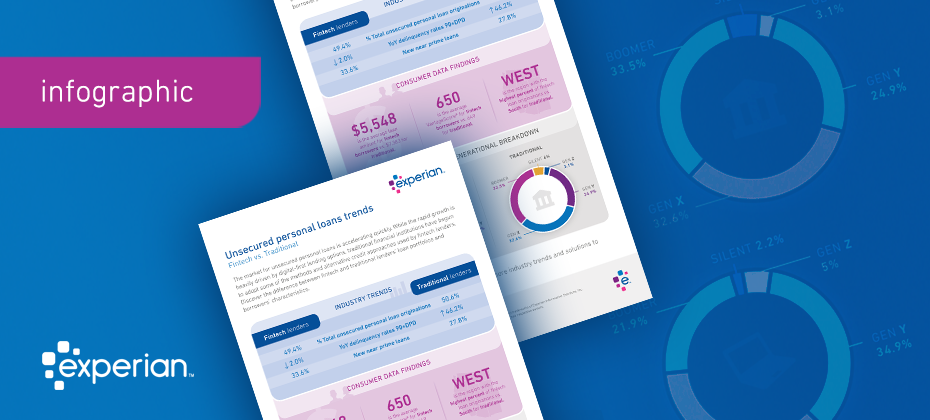
How are fintechs faring against traditional FIs? Our latest infographic uncovers industry trends and key metrics in unsecured personal installment loans.

Experian has been named one of the 10 participants, and only credit bureau, in the initial rollout of the SSA's new eCBSV service.

Experian Boost provides a unique opportunity to help dealers build loyalty while helping consumers.

What do Adam Sandler, Hugh Grant, Michael Bublé, Leo Tolstoy and Colonel Sanders have in common? They're all born on the most common birth date in the U.S.

Pickups are the most common vehicle in operation at 20% share today and hold 16.5% of new vehicle registrations in the market in Q1 2019.

Our Attribute Toolbox provides maximum flexibility and multiple data sources you can use in the calculation and management of attributes.

Today is National Fintech Day, a day that recognizes the important role that fintech companies play in revolutionizing the financial services landscape.

Big data is now in reach for financial institutions for all sizes amid the expansion of Experian's platform to drive faster, better decisions.

Collections strategies demand diverse approaches, which is where collections analytics and collections models come into play. Read more!

Experian and Oliver Wyman have joined forces to launch Ascend CECL Forecaster to help financial institutions of all sizes forecast lifetime credit losses.

How well can you identify and rank your current customer population? Are you leveraging that insight to acquire new customers, manage current customers and prioritize collections efforts? If so, you’re probably using custom models in your business strategy. But if your organization is like many businesses, you may use a more traditional approach. In our highly competitive market, strategy and decisions must be based on the right data and insights. No excuses. The data is there, and we can help you turn it into actionable insights. Implementing a custom model can maximize your return on investment and help you make more profitable business decisions — now and in the future.

A new free photo editor has taken the internet by a storm, offering an AI-powered image-altering application that allows users to see their “future self.”

It’s important for lenders to get a comprehensive view to find the most qualified candidates. Using alternative credit data can expand your choices.

There were 276 million vehicles on the road in Q1 2019.

Once you have kids, your bank accounts will never be the same. From child care to college, American parents spend, on average, over $233,000 raising a child from birth through age 17. While moms and dads are facing the same pile of bills, they often don’t see eye to eye on financial matters. In lieu of Father’s Day, where spending falls $8 million behind Mother’s Day (sorry dads!), we’re breaking down the different spending habits of each parent: Who pays the bills? With 80% of mothers working full time, the days of traditional gender roles are behind us. As both parents share the task of caring for the children, they also both take on the burden of paying household bills. According to Pew Research, when asked to name their kids’ main financial provider, 45% of parents agreed they split the role equally. Many partners are finding it more logical to evenly contribute to shared joint expenses to avoid fighting over finances. However, others feel costs should be divvied up according to how much each partner makes. What do they splurge on? While most parents agree that they rarely spend money on themselves, splurge items between moms and dads differ. When they do indulge, moms often purchase clothes, meals out and beauty treatments. Dads, on the other hand, are more likely to binge on gadgets and entertainment. According to a recent survey on millennial dads, there’s a strong correlation between the domestic tasks they’re taking on and how they’re spending their money. For instance, most dads are involved in buying their children’s books, toys and electronics, as well as footing the bill for their leisure activities. Who are they more likely to spend on? No parent wants to admit favoritism. However, research from the Journal of Consumer Psychology found that you’re more likely to spend money on your daughter if you’re a woman and more likely to spend on your son if you’re a man. The suggested reasoning behind this is that women can more easily identify with their daughters and men with their sons. Overall, parents today are spending more on their children than previous generations as the cost of having children in the U.S. has exponentially grown. How are they spending? When it comes to money management both moms and dads claim to be the “saver” and label the other as the “spender.” However, according to Experian research, there are financial health gaps between men and women, specifically when it pertains to credit. For example, women have 11% less average debt than men, a higher average VantageScore® credit score and the same revolving debt utilization of 30%. Even with more credit cards, women have fewer overall debts and are managing to pay those debts on time. There’s no definite way to say whether moms are spending “better” than dads, or vice versa. Rather, each parent has their own strengths and weaknesses when it comes to allocating money and managing expenses.