
This is the second post in a three-part series. Imagine the circumstances of a traveler coming to a never before visited culture. The opportunity is the new sights, cuisine and cultural experiences. Among the risks is the not before experienced pathogens and the strength of the overall health services infrastructure. In a similar vein, all too frequently we see the following conflict within our client institutions. The internal demands of an ever-increasing competitive landscape drive businesses to seek more data; improved ease of accessibility and manipulation of data; and acceleration in creating new attributes supporting more complex analytic solutions. At the same time, requirements for good governance and heightened regulatory oversight are driving for improved documentation and controlled access, all with improved monitoring and documented and tested controls. As always, the traveler/businessman must respond to the environment, and the best medicine is to be well-informed of both the perils and the opportunities. The good news is that we have seen many institutions invest significantly in their audit and compliance functions over the past several years. This has provided the lender with both better insights into its current risk ecosystem and the improved skill set to continue to refine those insights. The opportunity is for the lender to leverage this new strength. For many lenders, this investment largely has been in response to broadening regulatory oversight to ensure there are proper protocols in place to confirm adherence to relevant rules and regulations and to identify issues of disparate impact. A list of the more high-profile regulations would include: Equal Credit Opportunity Act (ECOA) — to facilitate enforcement of fair lending laws and enable communities, governmental entities and creditors to identify business and community development needs and opportunities of women-owned, minority-owned and small businesses. Home Mortgage Disclosure Act (HMDA) — to require mortgage lenders to collect and report additional data fields. Truth in Lending Act (TLA) — to prohibit abusive or unfair lending practices that promote disparities among consumers of equal creditworthiness but of different race, ethnicity, gender or age. Consumer Financial Protection Bureau (CFPB) — evolving rules and regulations with a focus on perceptions of fairness and value through transparency and consumer education. Gramm-Leach-Bliley Act (GLBA) — requires companies to give consumers privacy notices that explain the institutions’ information-sharing practices. In turn, consumers have the right to limit some, but not all, sharing of their information. Fair Debt Collections Practices Act (FDCPA) — provides guidelines for collection agencies that are seeking to collect legitimate debts while providing protections and remedies for debtors. Recently, most lenders have focused their audit/compliance activities on the analytics, models and policies used to treat consumer/client accounts/relationships. This focus is understandable since it is these analytics and models that are central to the portfolio performance forecasts and Comprehensive Capital Analysis and Review (CCAR)–mandated stress-test exercises that have been of greater emphasis in responding to recent regulatory demands. Thus far at many lenders, this same rigor has not yet been applied to the data itself, which is the core component of these policies and frequently complex analytics. The strength of both the individual consumer–level treatments and the portfolio-level forecasts is negatively impacted if the data underlying these treatments is compromised. This data/attribute usage ecosystem demands clarity and consistency in attribute definition; extraction; and new attribute design, implementation to models and treatments, validation and audit. When a lender determines there is a need to enhance its data governance infrastructure, Experian® is a resource to be considered. Experian has this data governance discipline within our corporate DNA — and for good reason. Experian receives large and small files on a daily basis from tens of thousands of data providers. In order to be sure the data is of high quality so as not to contaminate the legacy data, rigorous audits of each file received are conducted and detailed reports are generated on issues of quality and exceptions. This information is shared with the data provider for a cycle of continuous improvement. To further enhance the predictive insights of the data, Experian then develops new attributes and complex analytics leveraging the base and developed attributes for analytic tools. This data and the analytic tools then are utilized by thousands of authorized users/lenders, who manage broad-ranging relationships with millions of individuals and small businesses. These individuals and businesses then have rights to reproach Experian for error(s) both perceived and actual. This demanding cycle underscores the value of the data and the value of our rigorous data governance infrastructure. This very same process occurs at many lenders sites. Certainly, a similar level of data integrity born from a comprehensive data governance process also is warranted. In the next and final blog in this series, we will explore how a disciplined business review of an institution’s data governance process is conducted. Discover how a proven partner with rich experience in data governance, such as Experian, can provide the support your company needs to ensure a rigorous data governance ecosystem. Do more than comply. Succeed with an effective data governance program.
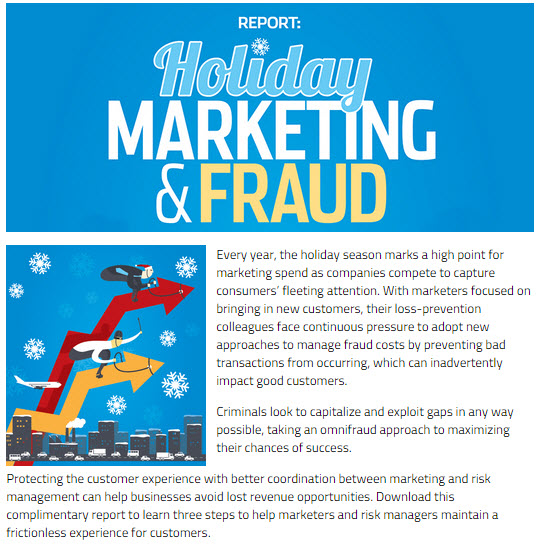
41st Parameter, a part of Experian, surveyed 250 marketers to understand the relationship between omnichannel retailing, fraud prevention and the holiday shopping season. The findings show that few marketers understand the full benefit of fraud-prevention systems on their activities as 60% of marketers were unsure of the cost of fraud to their organization. The survey also indicated that 40% of marketers said their organization had been targeted by hackers or cybercriminals. Download the Holiday Marketing Fraud Survey: http://snip.ly/JoyF With holiday shopping in full stride, 35% of businesses said they planned to increase their digital spend for the 2014 holiday season. Furthermore, Experian Marketing Services reported that during 2014, 80%t of marketers planned on running cross-channel marketing campaigns. As marketers integrate more channels into their campaigns, new challenges emerge for fraud-risk managers who face continuous pressure to adopt new approaches. Here are three steps to help marketers and risk managers maintain a frictionless experience for customers: Marketers should communicate their plans early to the fraud-risk team, especially if they are planning to target a new or unexpected audience. Making this part of the process will reduce the chances that risk management will stop or inhibit customers. Ensure that marketers understand what the risk-management department is doing with respect to fraud detection. Chances are risk managers are waiting to tell you. Marketers shouldn’t assume that fraud won’t affect their business and talk to their risk-management division to learn how much fraud truly costs their company. Then they can understand what they need to do to make sure that their marketing efforts are not thwarted. “Marketers spend a great deal of time and money bringing in new customers and increasing sales, especially this time of year, and in too many cases, those efforts are negated in the name of fraud prevention,” said David Britton, vice president of industry solutions, 41st Parameter. “Marketers can help an organization’s bottom line by working with their fraud-risk department to prevent bad transactions from occurring while maintaining a seamless customer experience. Reducing fraud is important and protecting the customer experience is a necessity.” Few marketers understand the resulting impact of declined transactions because of suspected fraud and this is even more pronounced among small businesses, with 70% saying they were unsure of fraud’s impact. Fifty percent of mid-sized business marketers and 67% of large-enterprise marketers were unsure of the impact of fraud as well An uncoordinated approach to new customer acquisition can result in lost revenue affecting the entire organization. For example, the industry average for card-not-present declines is 15%. However, one to three percent of those declined transactions turn out to be valid transactions, equating to $1.2 billion in lost revenue annually. Wrongfully declined transactions can be costly as the growth of cross-channel marketing increases and a push towards omnichannel retailing pressures marketers to find new customers. “Many businesses loosen their fraud detection measures during high peak time because they don’t have the tools to review potentially risky orders manually during the higher-volume holiday shopping period,” said Britton. “Criminals look to capitalize on this and exploit these gaps in any way possible, taking an omnifraud approach to maximizing their chances of success. Striking the right balance between sales enablement and fraud prevention is the key to maximizing growth for any business at all times of the year.” Download Experian’s fraud prevention report to learn more about how businesses can address these new marketing challenges.

Opening a new consumer checking account in the 21st century should be simple and easy to understand as a customer right? Unfortunately, not all banks have 21st century systems or processes reflecting the fact that negotiable order of withdrawal (NOW) accounts, or checking accounts, were introduced decades ago within financial institutions and often required the consumer to be in person to open the account. A lot has changed and consumers demand simpler and transparent account opening processes with product choices that match their needs at a price that they’re willing to pay. Financial institutions that leverage modernized technology capabilities and relevant decision information have the best chance to deliver consumer friendly experiences that meet consumer expectations. It is obvious to consumers when we in the financial services industry get it right and when we don’t. The process to open a checking account should be easily understood by consumers and provide them with appropriate product choices that aren’t “one size fits all”. Banks with more advanced core-banking systems incorporating relevant and compliant decision data and transparent consumer friendly approval processes have a huge opportunity to differentiate themselves positively from competitors. The reality is that banking deposit management organizations throughout the United States continue to evolve check screening strategies, technology and processes. This is done in an effort to keep up with evolving regulatory expectations from the consumer advocacy regulatory bodies such as the Consumer Financial Protection Bureau (CFPB) and designed to improve transparency of checking account screening for new accounts for an increased number of consumers. The CFPB advocates that financial institutions adopt new checking account decision processes and procedures that maintain sound management practices related to mitigating fraud and risk expense while improving consumer transparency and increasing access to basic consumer financial instruments. Bank shareholders demand that these accounts be extended to consumers profitably. The CFPB recognizes that checking accounts are a basic financial product used by almost all consumers, but has expressed concerns that the checking account screening processes may prevent access to some consumers and may be too opaque with respect to the reasons why the consumer may be denied an account. The gap between the expectations of the CFPB, shareholders and bank deposit management organization’s current products and procedures are not as wide as they may seem. The solution to closing the gap includes deploying a more holistic approach to checking account screening processes utilizing 21st century technology and decision capabilities. Core banking technology and checking products developed decades ago leave banks struggling to enact much needed improvements for consumers. The CFPB recognizes that many financial institutions rely on reports used for checking account screening that are provided by specialty consumer reporting agencies (CRAs) to decision approval for new customers. CRAs specialize in checking account screening and provide financial institutions with consumer information that is helpful in determining if a consumer should be approved or not. Information such as the consumer’s check writing and account history such as closed accounts or bounced checks are important factors in determining eligibility for the new account. Financial institutions are also allowed to screen consumers to assess if they may be a credit risk when deciding whether to open a consumer checking account because many consumers opt-in for overdraft functionality attached to the checking account. Richard Cordray, the CFPB Director, clarified the regulatory agency’s position as to how consumers are treated in checking account screening processes within his prepared remarks at a forum on this topic in October 2014. “The Consumer Bureau has three areas of concern. First, we are concerned about the information accuracy of these reports. Second, we are concerned about people’s ability to access these reports and dispute any incorrect information they may find. Third, we are concerned about the ways in which these reports are being used.” The CFPB suggests four items they believe will improve financial institution’s checking account screening policies and practices: Increase the accuracy of data used from CRA’s Identify how institutions can incorporate risk screening tools while not excluding potential accountholders unnecessarily Ensure consumers are aware and notified of information used to decision the account opening process Ensure consumers are informed of what account options exist and how they access products that align with their individual needs Implementing these steps shouldn’t be too difficult to accomplish for deposit management organizations as long as they are fully leveraging software such as Experian’s PowerCurve customized for deposit account origination, relevant decision information such as Experian’s Precise ID Platform and Vantage Score® credit score combined with consumer product offerings developed within the bank and offered in an environment that is real-time where possible and considers the consumer’s needs. Enhancing checking account screening procedures by taking into account consumer’s life-stage, affordability considerations, unique risk profile and financial needs will satisfy expectations of the consumers, regulators and the financial institution shareholders. Financial institutions that use technology and data wisely can reduce expenses for their organizations by efficiently managing fraud, risk and operating costs within the checking account screening process while also delighting consumers. Regulatory agencies are often delighted when consumers are happy. Shareholders are delighted when regulators and consumers are happy. Reengineering checking account opening processes for the modern age results in a win-win-win for consumers, regulators and financial institutions. Discover how an Experian Global Consultant can help you with your banking deposit management needs.
- List 1
- List 2
- List 3
<iframe width=”560″ height=”315″ src=”https://www.youtube.com/embed/35exOG0jSJ0?si=amHCm-pJmzhZc9TT” title=”YouTube video player” frameborder=”0″ allow=”accelerometer; autoplay; clipboard-write; encrypted-media; gyroscope; picture-in-picture; web-share” referrerpolicy=”strict-origin-when-cross-origin” allowfullscreen></iframe>
Testing the Border Radius
Changing the heading Page
This is the second post in a three-part series. Imagine the circumstances of a traveler coming to a never before visited culture. The opportunity is the new sights, cuisine and cultural experiences. Among the risks is the not before experienced pathogens and the strength of the overall health services infrastructure. In a similar vein, all too frequently we see the following conflict within our client institutions. The internal demands of an ever-increasing competitive landscape drive businesses to seek more data; improved ease of accessibility and manipulation of data; and acceleration in creating new attributes supporting more complex analytic solutions. At the same time, requirements for good governance and heightened regulatory oversight are driving for improved documentation and controlled access, all with improved monitoring and documented and tested controls. As always, the traveler/businessman must respond to the environment, and the best medicine is to be well-informed of both the perils and the opportunities. The good news is that we have seen many institutions invest significantly in their audit and compliance functions over the past several years. This has provided the lender with both better insights into its current risk ecosystem and the improved skill set to continue to refine those insights. The opportunity is for the lender to leverage this new strength. For many lenders, this investment largely has been in response to broadening regulatory oversight to ensure there are proper protocols in place to confirm adherence to relevant rules and regulations and to identify issues of disparate impact. A list of the more high-profile regulations would include: Equal Credit Opportunity Act (ECOA) — to facilitate enforcement of fair lending laws and enable communities, governmental entities and creditors to identify business and community development needs and opportunities of women-owned, minority-owned and small businesses. Home Mortgage Disclosure Act (HMDA) — to require mortgage lenders to collect and report additional data fields. Truth in Lending Act (TLA) — to prohibit abusive or unfair lending practices that promote disparities among consumers of equal creditworthiness but of different race, ethnicity, gender or age. Consumer Financial Protection Bureau (CFPB) — evolving rules and regulations with a focus on perceptions of fairness and value through transparency and consumer education. Gramm-Leach-Bliley Act (GLBA) — requires companies to give consumers privacy notices that explain the institutions’ information-sharing practices. In turn, consumers have the right to limit some, but not all, sharing of their information. Fair Debt Collections Practices Act (FDCPA) — provides guidelines for collection agencies that are seeking to collect legitimate debts while providing protections and remedies for debtors. Recently, most lenders have focused their audit/compliance activities on the analytics, models and policies used to treat consumer/client accounts/relationships. This focus is understandable since it is these analytics and models that are central to the portfolio performance forecasts and Comprehensive Capital Analysis and Review (CCAR)–mandated stress-test exercises that have been of greater emphasis in responding to recent regulatory demands. Thus far at many lenders, this same rigor has not yet been applied to the data itself, which is the core component of these policies and frequently complex analytics. The strength of both the individual consumer–level treatments and the portfolio-level forecasts is negatively impacted if the data underlying these treatments is compromised. This data/attribute usage ecosystem demands clarity and consistency in attribute definition; extraction; and new attribute design, implementation to models and treatments, validation and audit. When a lender determines there is a need to enhance its data governance infrastructure, Experian® is a resource to be considered. Experian has this data governance discipline within our corporate DNA — and for good reason. Experian receives large and small files on a daily basis from tens of thousands of data providers. In order to be sure the data is of high quality so as not to contaminate the legacy data, rigorous audits of each file received are conducted and detailed reports are generated on issues of quality and exceptions. This information is shared with the data provider for a cycle of continuous improvement. To further enhance the predictive insights of the data, Experian then develops new attributes and complex analytics leveraging the base and developed attributes for analytic tools. This data and the analytic tools then are utilized by thousands of authorized users/lenders, who manage broad-ranging relationships with millions of individuals and small businesses. These individuals and businesses then have rights to reproach Experian for error(s) both perceived and actual. This demanding cycle underscores the value of the data and the value of our rigorous data governance infrastructure. This very same process occurs at many lenders sites. Certainly, a similar level of data integrity born from a comprehensive data governance process also is warranted. In the next and final blog in this series, we will explore how a disciplined business review of an institution’s data governance process is conducted. Discover how a proven partner with rich experience in data governance, such as Experian, can provide the support your company needs to ensure a rigorous data governance ecosystem. Do more than comply. Succeed with an effective data governance program.
41st Parameter, a part of Experian, surveyed 250 marketers to understand the relationship between omnichannel retailing, fraud prevention and the holiday shopping season. The findings show that few marketers understand the full benefit of fraud-prevention systems on their activities as 60% of marketers were unsure of the cost of fraud to their organization. The survey also indicated that 40% of marketers said their organization had been targeted by hackers or cybercriminals. Download the Holiday Marketing Fraud Survey: http://snip.ly/JoyF With holiday shopping in full stride, 35% of businesses said they planned to increase their digital spend for the 2014 holiday season. Furthermore, Experian Marketing Services reported that during 2014, 80%t of marketers planned on running cross-channel marketing campaigns. As marketers integrate more channels into their campaigns, new challenges emerge for fraud-risk managers who face continuous pressure to adopt new approaches. Here are three steps to help marketers and risk managers maintain a frictionless experience for customers: Marketers should communicate their plans early to the fraud-risk team, especially if they are planning to target a new or unexpected audience. Making this part of the process will reduce the chances that risk management will stop or inhibit customers. Ensure that marketers understand what the risk-management department is doing with respect to fraud detection. Chances are risk managers are waiting to tell you. Marketers shouldn’t assume that fraud won’t affect their business and talk to their risk-management division to learn how much fraud truly costs their company. Then they can understand what they need to do to make sure that their marketing efforts are not thwarted. “Marketers spend a great deal of time and money bringing in new customers and increasing sales, especially this time of year, and in too many cases, those efforts are negated in the name of fraud prevention,” said David Britton, vice president of industry solutions, 41st Parameter. “Marketers can help an organization’s bottom line by working with their fraud-risk department to prevent bad transactions from occurring while maintaining a seamless customer experience. Reducing fraud is important and protecting the customer experience is a necessity.” Few marketers understand the resulting impact of declined transactions because of suspected fraud and this is even more pronounced among small businesses, with 70% saying they were unsure of fraud’s impact. Fifty percent of mid-sized business marketers and 67% of large-enterprise marketers were unsure of the impact of fraud as well An uncoordinated approach to new customer acquisition can result in lost revenue affecting the entire organization. For example, the industry average for card-not-present declines is 15%. However, one to three percent of those declined transactions turn out to be valid transactions, equating to $1.2 billion in lost revenue annually. Wrongfully declined transactions can be costly as the growth of cross-channel marketing increases and a push towards omnichannel retailing pressures marketers to find new customers. “Many businesses loosen their fraud detection measures during high peak time because they don’t have the tools to review potentially risky orders manually during the higher-volume holiday shopping period,” said Britton. “Criminals look to capitalize on this and exploit these gaps in any way possible, taking an omnifraud approach to maximizing their chances of success. Striking the right balance between sales enablement and fraud prevention is the key to maximizing growth for any business at all times of the year.” Download Experian’s fraud prevention report to learn more about how businesses can address these new marketing challenges.
Opening a new consumer checking account in the 21st century should be simple and easy to understand as a customer right? Unfortunately, not all banks have 21st century systems or processes reflecting the fact that negotiable order of withdrawal (NOW) accounts, or checking accounts, were introduced decades ago within financial institutions and often required the consumer to be in person to open the account. A lot has changed and consumers demand simpler and transparent account opening processes with product choices that match their needs at a price that they’re willing to pay. Financial institutions that leverage modernized technology capabilities and relevant decision information have the best chance to deliver consumer friendly experiences that meet consumer expectations. It is obvious to consumers when we in the financial services industry get it right and when we don’t. The process to open a checking account should be easily understood by consumers and provide them with appropriate product choices that aren’t “one size fits all”. Banks with more advanced core-banking systems incorporating relevant and compliant decision data and transparent consumer friendly approval processes have a huge opportunity to differentiate themselves positively from competitors. The reality is that banking deposit management organizations throughout the United States continue to evolve check screening strategies, technology and processes. This is done in an effort to keep up with evolving regulatory expectations from the consumer advocacy regulatory bodies such as the Consumer Financial Protection Bureau (CFPB) and designed to improve transparency of checking account screening for new accounts for an increased number of consumers. The CFPB advocates that financial institutions adopt new checking account decision processes and procedures that maintain sound management practices related to mitigating fraud and risk expense while improving consumer transparency and increasing access to basic consumer financial instruments. Bank shareholders demand that these accounts be extended to consumers profitably. The CFPB recognizes that checking accounts are a basic financial product used by almost all consumers, but has expressed concerns that the checking account screening processes may prevent access to some consumers and may be too opaque with respect to the reasons why the consumer may be denied an account. The gap between the expectations of the CFPB, shareholders and bank deposit management organization’s current products and procedures are not as wide as they may seem. The solution to closing the gap includes deploying a more holistic approach to checking account screening processes utilizing 21st century technology and decision capabilities. Core banking technology and checking products developed decades ago leave banks struggling to enact much needed improvements for consumers. The CFPB recognizes that many financial institutions rely on reports used for checking account screening that are provided by specialty consumer reporting agencies (CRAs) to decision approval for new customers. CRAs specialize in checking account screening and provide financial institutions with consumer information that is helpful in determining if a consumer should be approved or not. Information such as the consumer’s check writing and account history such as closed accounts or bounced checks are important factors in determining eligibility for the new account. Financial institutions are also allowed to screen consumers to assess if they may be a credit risk when deciding whether to open a consumer checking account because many consumers opt-in for overdraft functionality attached to the checking account. Richard Cordray, the CFPB Director, clarified the regulatory agency’s position as to how consumers are treated in checking account screening processes within his prepared remarks at a forum on this topic in October 2014. “The Consumer Bureau has three areas of concern. First, we are concerned about the information accuracy of these reports. Second, we are concerned about people’s ability to access these reports and dispute any incorrect information they may find. Third, we are concerned about the ways in which these reports are being used.” The CFPB suggests four items they believe will improve financial institution’s checking account screening policies and practices: Increase the accuracy of data used from CRA’s Identify how institutions can incorporate risk screening tools while not excluding potential accountholders unnecessarily Ensure consumers are aware and notified of information used to decision the account opening process Ensure consumers are informed of what account options exist and how they access products that align with their individual needs Implementing these steps shouldn’t be too difficult to accomplish for deposit management organizations as long as they are fully leveraging software such as Experian’s PowerCurve customized for deposit account origination, relevant decision information such as Experian’s Precise ID Platform and Vantage Score® credit score combined with consumer product offerings developed within the bank and offered in an environment that is real-time where possible and considers the consumer’s needs. Enhancing checking account screening procedures by taking into account consumer’s life-stage, affordability considerations, unique risk profile and financial needs will satisfy expectations of the consumers, regulators and the financial institution shareholders. Financial institutions that use technology and data wisely can reduce expenses for their organizations by efficiently managing fraud, risk and operating costs within the checking account screening process while also delighting consumers. Regulatory agencies are often delighted when consumers are happy. Shareholders are delighted when regulators and consumers are happy. Reengineering checking account opening processes for the modern age results in a win-win-win for consumers, regulators and financial institutions. Discover how an Experian Global Consultant can help you with your banking deposit management needs.