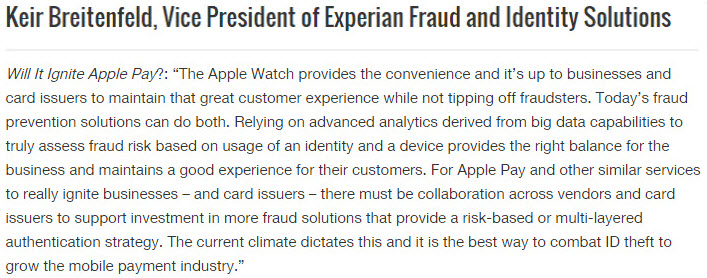
Apple Pay fraud solution Apple Pay is here and so are increased fraud exposures, confirmed losses, and customer experience challenges among card issuers. The exposure associated with the provisioning of credit and debit cards to the Apple Pay application was in time expected as fraudsters are the first group to find weaknesses. Evidence from issuers and analyst reports points to fraud as the result of established credit/debit cards compromised through data breaches or other means that are being enrolled into Apple Pay accounts – and being used to make large value purchases at large merchants. Keir Breitenfeld, our vice president of Fraud and Identity solutions said as much in a recent PYMNTS.com story where he was quoted about whether the Apple Watch will help grown Apple Pay. The challenge is that card issuers have no real controls over the provisioning or enrollment process so they currently only have an opportunity to authenticate their cardholder, but not the provisioning device. Fraud exposure can lie within call centers and online existing customer treatment channels due to: Identity theft and account takeover based on breach activity. Use of counterfeit or breached card data. Call center authentication process inadequacies. Capacity and customer experience pressures driving human error or subjectively lax due diligence. Existing customer/account authentication practices not tuned to this emerging scheme and level of risk. The good news is that positive improvements have been proven with bolstering risk-based authentication at the card provisioning process points by comparing the inbound provisioning device to the device that is on file for the cardholder account. This, in combination with traditional identity risk analytics, verifications, knowledge-based authentication, and holistic decisioning policies vastly improve the view afforded to card issuers for layered process point decisioning. Learn more on why emerging channels, like mobile payments, call for advanced fraud identification techniques.

The follow blog is by Kyle Enger, Executive Vice President of Finagraph With the surge of alternative lenders, competition among banks is stronger than ever. But what exactly does that mean for the everyday banker? It means business owners want more. If you’re only meeting your clients once a year on a renewal, it’s not good enough. In order to take your customer service to the next level, you need to become a trusted advisor. Someone who understands where your clients are going and how to help them get there. If you’re not investing in your clients’ business by taking the following actions, they may have one foot out the door. 1. Understand your clients’ business One of the biggest complaints from business owners is that bankers simply don’t understand their business. A good commercial banker should be well-versed in their borrower’s company, competitors and the industry. They should be willing to get to know their business, commit to them, stop by to check-in and provide a proactive plan to avoid future risks. 2. Utilize technology for your benefit The majority of recent bank innovations have been used to make the customer experience more convenient, but not necessarily the more helpful. We’ve seen everything from mobile remote deposit capture to online banking to mobile payments – all of which are keeping customers from interacting with the bank. Contrary to what many think, technology can be used to create strong relationships by giving bankers information about their customers to help serve them better. Using new software programs, bankers can see information like the current ratio, quick ratio, debt-to-equity, gross margin, net margin and ROI within seconds. 3. Heighten financial acumen Banks have access to a vast amount of customer financial data, but sometimes fail to use this information to its full potential. With insight into consumer purchasing behavior and business’ financial history, banks should be able to cater products and services to clients in a personalized manner. However, many lenders walk into prospect meetings without knowing much about the business. Their mode of operation is solely focused on trying to secure new clients by building rapport – they are what we call surface bankers. A good banker will educate clients on what they need to know such as equity, inventory, cash flow, retirement planning and sweep accounting. They should also know about new technology and consult borrowers on intermediate financing, terming out loans that are not revolving, or locking in with low interest rates. Following, they will bring in the right specialist to match the product according to their clients’ needs. 4. Go beyond the price Many business owners make the mistake of comparing banks based on cost, but the value of a healthy banking relationship and a financial guide is priceless. So many bankers these days are application gatherers working on a transactional basis, but that’s not what business owners need. They need to stop looking at the short-term convenience of brands, price and location, and start considering the long-term effects a trusted financial advisor can make on their business. 5. A partner in your business, not a banker “Sixty percent of businesses are misfinanced using short-term money for long-term use,” according to the CEB Business Banking Board. In other words, there are many qualified candidates in need of a trusting banker to help them succeed. Unbeknownst to many business owners, bankers actually want to make loans and help their clients’ business grow. Making this known is the baseline in building a strong foundation for the future of your career. Just remember to ask yourself – am I being business-centric or bank-centric? To view the original blog posting, click here. To read more about the collaboration between Experian and Finagraph, click here.

Gift cards have risen in popularity over the last few years both for consumers and for fraudsters, causing a huge increase in gift card fraud