
As we approach 2024, marketers must grasp the evolving landscape of digital activation. Understanding emerging audience trends and activation strategies is key to developing impactful marketing initiatives and positioning your brand for success.
In Experian’s 2024 Digital audience trends and predictions report you’ll find:
- Data-driven insights that will empower you to confidently develop marketing strategies that resonate with your audience and drive meaningful results.
- Insights from Experian experts and our industry-leading data.
- Our outlook for 2024 marketing trends.
In this blog post, we’ll provide a sneak peek of the 2024 marketing trends you can expect in our full report.
Digital activation
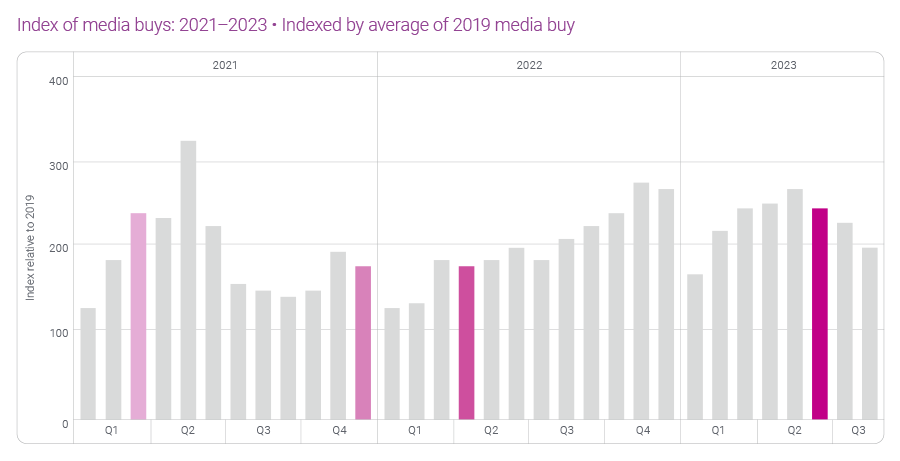
Digital activation grew by 63% between 2022 and 2023. We expect digital activation to increase in 2024 but at a slower rate than in 2023 due to economic uncertainty caused by high-interest rates, recent state privacy regulations, and work stoppages in the entertainment and automotive industries.
Top digital audiences
Which digital audiences are advertisers purchasing from Experian?
We are seeing growth in four major data categories: Automotive, Demographics, Lifestyle and Interests, and Retail Shoppers: Purchase Based audiences. Here are a few audiences within these categories that you can activate on-the-shelf of your preferred platform:
- Automotive: Autos, Cars, and Trucks > In Market-Make and Models
- Demographics: Demographics > Homeowners/Renters > Renter
- Lifestyle and Interests: Lifestyle and Interests (Affinity) > Activities and Entertainment > Wine Lovers
- Retail Shoppers: Purchase Based: Retail Shoppers: Purchase Based > Food and Drink > Restaurants: Fast Food/QSR Chicken Frequent Spenders
Top digital audiences by industry
What are the top digital audiences being activated by industry? Download our 2024 Digital audience trends and predictions report to discover the top digital audiences in the following industries:
- Automotive
- Health
- Financial Services
- Retail & CPG
Download our new 2025 Digital trends and predictions report
Marketers, agencies, and platforms are facing new challenges as privacy regulations evolve, AI technology advances, and consumer behaviors shift. Our latest report highlights actionable strategies for navigating these changes and improving how you connect with audiences, measure impact, and deliver results.
What you’ll learn
- Navigating signal loss: Explore the rise of alternative IDs and contextual targeting as privacy regulations and signal loss reshape data-driven advertising.
- Connected TV (CTV): Understand the growth of connected TV (CTV), the importance of frequency capping, and strategies for effective audience activation.
- Omnichannel campaigns: Learn how marketers are moving from channel-specific strategies to audience-led omnichannel campaigns that tell a more cohesive story.
- Retail media networks: Learn how retail media networks (RMNs) are capitalizing on enriched first-party data to learn more about their customers and reach them across on-site and off-site inventory.
- Curation: Examine how curation is transforming programmatic campaigns by combining audience, contextual, and supply chain signals to deliver premium inventory packages that maximize addressability, efficiency, and performance.
Latest posts

The holiday season is right around the corner and retailers are gearing up for a massive influx of customers, both new visitors and returning loyal patrons. But, organizations need to make sure they’re prepared to handle the influx of business. Data quality should be a priority for retailers at any time of year, but even more so as the holiday season approaches. During this time, it’s important for companies to provide customers with relevant shopping offers. When consumers shop for holiday gifts for their friends and families, they have countless directions to which they can turn. In order to prevail in competition, retailers need to provide customers with relevant offers and messages. Unfortunately, many businesses fall short in this regard. According to recent research from Experian QAS, organizations feel that, on average, 25 percent of their data is inaccurate. Consumers are frantically looking to find deals on products that meet their holiday needs, but loyalty offers may not be reaching consumers. One reason for the difficulty is the messy nature of companies’ customer databases. Retail businesses are working hard to gather as much information as possible about the consumers who patronize them, but all too often, information is riddled with errors. These errors have become more prevalent in recent years due to the proliferation of mobile apps, web interfaces and social media channels. There are so many different channels that companies now interact with people through an average of 3.27 channels. This poor data quality is hurting organizational bottom lines. Experian QAS found that an average of 12 percent of departmental budgets are wasted due to inaccuracies in contact data. During the 2013 holiday season, consumer spending is expected to increase by at least 11 percent. Retailers need to be certain that they improve data quality prior to the holiday season to ensure communications reach consumers and resources are maximized in order to take advantage of the expected increase. Be sure to check out our new data quality infographic.

Experian Marketing Services’ Head of Global Research Bill Tancer appeared recently on Fox Business News to talk about new holiday shopping trends, including why both retailers and consumers are starting the 2013 season earlier this year. “We are seeing the eventual extinction of Black Friday,” says Tancer. “What we see in our data is that retail is really changing. The consumer is relentlessly searching for that deal.” In fact, as Tancer notes, the hyper-connected, digital consumer is already searching for holiday deals. Hear more from Tancer in this clip. Watch the latest video at video.foxbusiness.com Tancer and other Experian Marketing Services data experts will discuss holiday marketing trends at an upcoming webinar; register for more insights and tips.

On some level, collecting data and analyzing it to find meaningful conclusions has always been part of how marketers go about connecting with consumers. Their strategies have improved dramatically over time, though. Perhaps in a previous era, marketing executives were only able to make sweeping generalizations about large swathes of the population. But, as marketers have gathered more data on individual consumers, they’ve found ways to fine-tune their searches. They’re no longer messaging to groups in vague terms. Smart Data Collective recently examined the marketing world’s transition away from broad stereotyping toward better targeted forms of data mining. Josh Brown, a member of the marketing team at business and IT consulting company Iconic Mind, argues that this era of overgeneralization is coming to an end. We now have the capability to zoom in on the specific customer. “Big data is how successful companies are building more detailed models of consumer behavior,” Brown wrote. “Instead of relying on the traditional demographic models that marketers used when we were operating in a mass consumption environment and had nothing better, big data capitalizes on developing market trends to allow businesses to become far more specific when segmenting their customers.” Brown cited Amazon.com as an example. The online superstore is notable for its targeted recommendations of products that shoppers see every time they log on to the site – the advisements are impressive because they’re usually right up the customer’s alley. Amazon doesn’t generate these ideas by making guesses based on whether the consumer is old or young, male or female – instead, the site takes in specific information about people’s buying histories and looks for similar products. This approach is quickly becoming mainstream. It’s not hard to understand why – people don’t like being reduced to profiles of their demographic characteristics. Consumers are expecting more from the companies they do business with. Thanks to the rapidly improving technologies that companies use for data collection, marketers can be more targeted and make more intelligent interactions. However, to take advantage of these new technologies, marketers need to maintain high quality data. Without a data quality strategy, customer information will be spread out across the organization, making it difficult to make intelligent marketing offers. To learn more about improving your understanding of consumers, check-out our infographic on building a single customer view.