At A Glance
Pharma marketers can support more informed health journeys when patient and HCP messaging is relevant, privacy-forward, and optimized against meaningful outcomes. In this Ask the Expert conversation, Experian and DeepIntent discuss how health marketers can coordinate education, CTV, activation workflows, and measurement without entering private clinical decisions.Privacy-forward pharma media supports more informed healthcare journeys
Effective pharma marketing depends on reaching patients, caregivers, and healthcare professionals (HCPs) with useful information in appropriate, privacy-forward ways. The goal is to make relevant education easier to find, support more informed conversations, and help brands understand how media contributes across the health journey.
In this Ask the Expert session, Natalie Mancuso, SVP, Data Partnerships at DeepIntent, joins Sheila Wirick, who leads the health team at Experian, to discuss how to craft patient and HCP campaigns, privacy-safe activation workflows, connected TV (CTV), and measurement approaches built for pharma.
Why should your media plan start with understanding the patient and provider
The patient-and-provider journey should inform your media plan, as treatment decisions in pharma are increasingly informed, personal, and patient-driven. With more health information available than ever, patients are playing a more active role in understanding their options and participating in treatment conversations. As other industries become more customer-centric, pharma media planning needs to become more patient-centric.

“We’ve got patients who are more informed, more involved in their treatment decisions than ever. The accessibility of data and information and the ways we can consume it with just AI alone is so vast that if we’re not arming people with the right information in real time, we’re missing the boat.”
DeepIntentNatalie Mancuso, SVP, Data Partnerships
This means media should be aligned to where a patient or provider is in the decision journey and what they need at that moment. Early on, media may play an educational role by building awareness of a condition, symptom, or treatment category. Later, it may help support more specific questions, treatment consideration, access, affordability, or adherence.
The patient-provider conversation remains the key boundary. That exchange should stay private and clinically led. Media can play a valuable role before and after those moments by offering information that helps patients and providers feel more informed.
How can brands connect patient and HCP messaging responsibly?
It’s critical for agencies and brands to deliver relevant messaging to inform each stakeholder’s needs throughout the treatment journey, especially ahead of key clinical milestones. To execute this, brands must exercise privacy-forward activation, keeping patient and HCP identity, activation, and measurement paths separate, while using a common workflow layer to support the same brand goal.
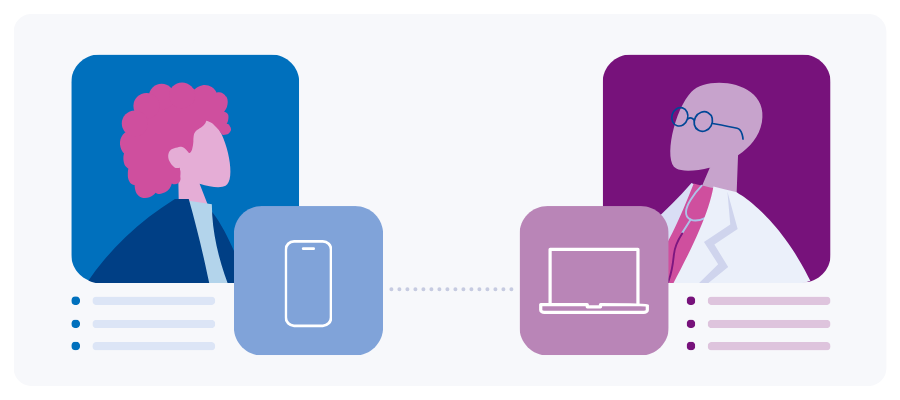
Experian helps pharma marketers do this by acting as an independent, privacy-forward identity, data, and workflow layer. We bring together high-fidelity matching, governed onboarding, and non-clinical consumer context, so patient and HCP engagement can be activated more accurately across channels and connected to reporting.
The distinction is not only where each audience is reached. HCPs may be engaged in both professional and personal environments, but their needs are different from patients’. For example, an HCP may receive messaging about co-pay savings for eligible patients, while a patient may receive information about patient support programs. These are different messages for different audiences, but they ladder up to the same goal: informing both parties in a privacy-forward, relevant way.
Hear from Natalie Mancuso in our 2026 State of advertising report
In our 2026 State of advertising report, Natalie shares why identity serves as the connective infrastructure that links planning, activation, and measurement across connected TV (CTV), programmatic, commerce media, and walled garden environments.
What does privacy-forward activation look like in pharma?
Pharma brands often start with fragmented patient and HCP signals. Privacy-forward activation turns those inputs into usable audiences by first confirming that the data can be used, then translating identity in controlled environments that protect personally identifiable information through tokenization or other methodologies.
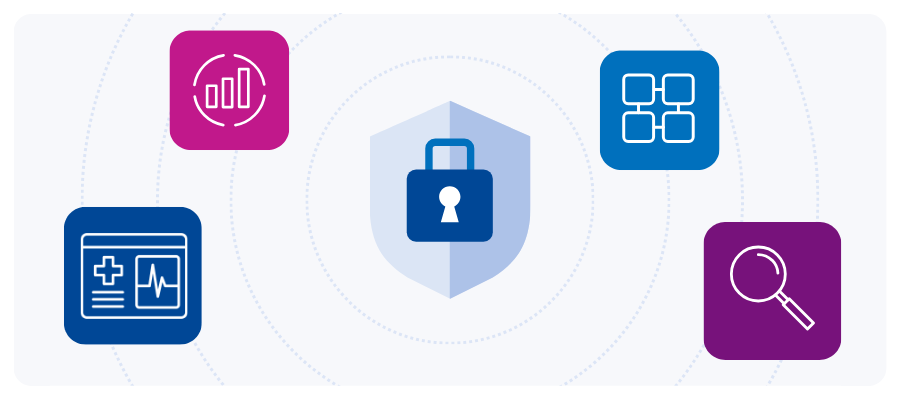
For DTC, that means building and matching audiences without relying on inferred health conditions from browsing behavior. For HCPs, it means connecting professional identity to verified sources in a way that supports activation and measurement. In a category shaped by HIPAA, state privacy laws, internal review, and consumer sensitivity, building privacy in from sourcing through activation is what makes responsible health media possible.
How can CTV play a more useful role in pharma?
CTV can play a more useful role in healthcare when it’s connected to a larger, privacy-forward plan and not treated as just an awareness channel.
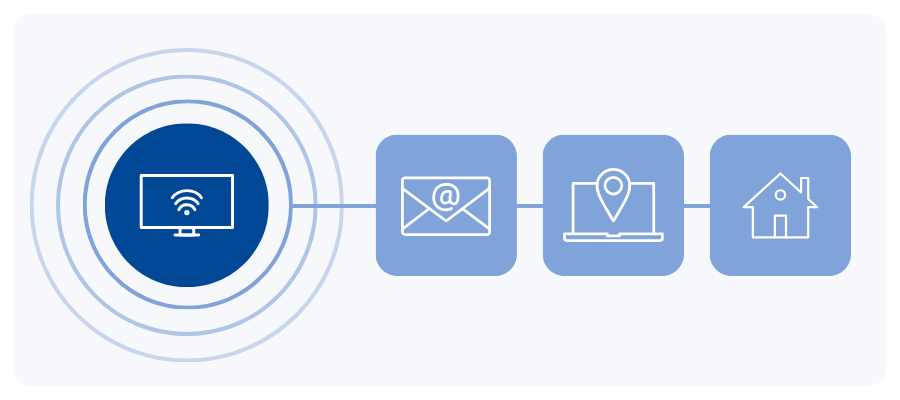
DeepIntent connects CTV and digital exposure data using identity signals, such as National Provider Identifiers (NPIs), hashed email addresses, IP addresses, device IDs, and household signals, where permitted and reviewed. That identity layer helps support sequencing and suppression across streaming, endemic, mobile, and digital settings.
In practice, CTV can introduce targeted education or broad brand awareness, and later touchpoints can provide sequential information in the right channels. Instead of repeating the same message, brands can make pivots based on engagement and context.
“For us, it starts with identity and not panels. When we’re resolving CTV and digital exposures to the same person, we’re leveraging signals so that every touchpoint across streaming, endemic, and mobile is recognized as the same individual, not model lookalikes.”
DeepIntentNatalie Mancuso, SVP, Data Partnerships
For pharma, campaign performance should not be measured by reach alone. A stronger approach looks at whether sequenced engagement contributes to meaningful downstream signals, including:
- Prescription activity
- Provider engagement
- Referral patterns
- Patient compliance
- Adherence signals, where measurement is permitted
Why should messaging and reporting change in pharma?
Pharma campaigns are journeys with changing information needs. Reporting should guide the campaign optimization.
“If I’m launching into a market with a new class of drug, I’m asking what education needs to be put into the market – from both an HCP and a consumer standpoint – to build awareness?”
DeepIntentNatalie Mancuso, SVP, Data Partnerships
Clicks and website visits still have a place, but they can’t tell the full pharma story. DeepIntent processes data in real time, giving brands an up-to-date read on how media connects to campaign engagement. Campaign signals can help teams optimize audience logic, creative, channel mix, or sequencing during a live campaign.

Heading Test for Media & Text Block
Content Test for Media &Text Block
Heading Test for Media & Text Block
Content Test for Media &Text Block
Heading Test for Media & Text Block
Content Test for Media &Text Block
Explore how privacy-safe pharma activation can make an impact
Experian brings marketing data and identity expertise for health marketing and DeepIntent adds pharma-specific activation experience. Together, we help brands connect patient and HCP strategies responsibly, with privacy built in from the start.
Watch the full video with our experts to hear Sheila Wirick and Natalie Mancuso discuss patient and HCP messaging, CTV, privacy-safe activation, and outcome measurement for pharma brands.
About our experts
Natalie Mancuso
SVP, Data Partnerships, DeepIntent
Natalie Mancuso is SVP, Data Partnerships at DeepIntent and a leader in health-focused AdTech and DSP strategy. With over 20 years of experience growing billion-dollar healthcare brands, she turns complex data into scalable, performance-driven solutions that keep marketers ahead of industry change.
Sheila Wirick
Director of Health Sales, Experian
Sheila Wirick is the Director of Health Sales at Experian with more than 20 years of experience in data and analytics. As Director of Health Sales at Experian Marketing Services, she collaborates with healthcare, pharmaceutical, and nonprofit organizations to apply data and insights that enhance customer retention, brand awareness, and acquisition. She is committed to helping organizations use data to deliver measurable results and meaningful impact.
FAQs
A pharma audience is activation-ready when patient or HCP inputs can be translated into usable audiences with the right accuracy, controls, interoperability, and destination readiness. For patient engagement, that may include privacy-safe cohort construction, caregiver logic, non-clinical enrichment and appropriate exclusion rules. For HCP engagement, it may include governed identity inputs such as NPI, specialty, practice location, professional address and other verified attributes where appropriate.
Pharma brands can sequence messages responsibly by giving each channel a clear role and using audience logic to maintain continuity. CTV and out-of-home can support awareness, social can reinforce the message, search can capture active research and point-of-care or rep-triggered channels can support decision moments. The workflow should preserve separation between patient and HCP identity strategies.
Pharma marketers should measure whether media connects to outcomes such as audience quality, prescription activity, qualified HCP engagement, verified delivery, referral patterns, therapy starts or adherence signals where permitted. These outcomes often depend on partner-enabled workflows, clean rooms, and aggregated outputs rather than direct end-to-end tracking.
Experian acts as an independent privacy-first identity, data, and workflow layer for pharma marketers. We help brands bring together identity, high-fidelity matching, governed onboarding, non-clinical consumer context, and partner interoperability so patient and HCP engagement can be activated more accurately across channels and connected more cleanly to partner-enabled measurement.
Latest posts

Forward thinking marketers leverage the power of social networking sites like Facebook, MySpace, Twitter and more to connect to consumers in a more personal and meaningful way. That’s why Experian Simmons is focusing on social networking in this issue of Consumer Insights, featuring the freshest insights available from the latest Simmons New Media Study. The 2010 Social Networking Report provides the hard data behind this consumer revolution, including the fact that fully 66% of online Americans use social networking sites today, up from just 20% in 2007. Social networking is an increasingly addictive activity, with nearly half of those who access such sites (43%) reporting that they visit them multiple times per day. While users of social networking sites may have initially signed up to better keep in touch with friends, a growing number say they now use sites like Facebook to connect with family members. An astounding 70% of social networkers keep in touch with family via their various online networks, up from 61% a year ago. Fully two-thirds of all online adults today have visited a social networking site in the last 30 days, up from 53% in 2008 and 20% in 2007. Social networks have most thoroughly penetrated the young adult market, as nearly 9-in-10 online 18-to 34-year-olds visit such sites today. But even older Americans are tapping into social networks, with 41% of online adults age 50 and older making monthly visits to sites like Facebook, MySpace and Twitter. The rise of social networking tracks closely with that of Facebook. As of April 26, 2010, 46% of the U.S. online adult population reported having visited Facebook in the past 30 days. While keeping in touch with others is an important part of social networking, the popularity of games like Farmville and Mafia Wars illustrate that fun is a big part of the appeal of social networking. Whether it’s keeping in touch with others, playing games, debating politics or any of the other reasons people use social networking sites, it cannot be denied that there’s a sense of addictiveness to it all. Visiting social networking sites multiple times a day is up 28% over last year, while less frequent visits are down across the board. As social networking sites extend their reach across generations, Americans are increasingly using such sites to connect with more than just their friends. Today, 17% of social networkers communicate with their parents via those sites and 22% connect with their kids, up from 9% and 15%, respectively, a year ago. An astounding two-thirds of social networking site visitors (68%) say they have shown their support of a product, service, company or musical group by becoming a “fan” or a “friend” on a social networking site. One year earlier, only 57% of social networkers had publicly declared their “like” for a product, service, company or musical group. Knowing that social networkers are comfortable connecting with products and brands they support, it’s important to understand which brands have the best opportunity to connect with this group. Top retail brands among Facebook users, for instance, include H&M, Hot Topc and Forever 21. Specifically, Facebook users are full twice as likely as the average American adult to shop at H&M. Twitter visitors are 3.7 times more likely to shop at Nordstrom. Heavy users of social networking sites are primarily concentrated in the Northwest and markets that are heavily influenced by major colleges or universities.
The vast majority of Facebook visitors—like most Internet users—say they like websites that take special care to protect their privacy. Yet as the popularity of Facebook grew during 2009 among both younger and older adults, there was a general waning in visitors’ advocacy of online privacy. In fact, the share of Facebook visitors sensitive to privacy protection experienced a 9% relative decline between January and November of 2009. That decline may have continued, were it not for a series of privacy policy updates issued by the social networking giant. In November 2009, Facebook changed its default settings to publicly reveal a larger than before amount of its users’ information. Then in December 2009, the privacy settings were entirely removed from certain categories of users’ information. And lastly, in April 2010, users’ General Information became publicly exposed whenever they connected to certain applications or websites, a move that seriously angered many Facebook adherents. Following these changes, the share of Facebook users who are sensitive to privacy protection rose. Specifically, between November 2009 and April 2010, the percent of users who like sites that protect their privacy increased a relative 7%. Facebook’s decision to return, and even simplify, control over privacy settings to account holders may appease users, but whether a subsequent drop in support of online privacy will ensue down the line is far from certain.
Same-sex marriage is a hot button topic no matter on which side of the issue you stand. But there can be no denying that same-sex couples are finding an expanding number of options in the U.S. and abroad should they decide to legally wed. The 2010 LGBT Consumer Report explores the household arrangements and behaviors of America’s LGBT consumers—in particular, those associated with marriage—compared to America’s heterosexual population. You will learn that despite being less than half as likely to be married, lesbian, gay and bisexual adults are 22% more likely than their “straight” counterparts to have recently wed or to be planning nuptials for the next year. Looking for that perfect gift for the newly wed couple? You will also get some shopping tips for identifying favored retailers of lesbian, gay and bisexual shoppers. We’ll start by sizing the LGBT market. An estimated 3.7% of the non-Hispanic adult population (7.1 million adults) self-identifies as LGBT, which can be broken down as follows: The average heterosexual adult lives in a household with 1.9 other individuals, including adults and kids. By comparison, the average lesbian shares her home with only 1.6 other people. Gay men live in the smallest households, sharing their home with only one other person, on average. Over a third of gay or bisexual men (38%) share their home with at least one other adult male, compared with only 24% of heterosexual men who live under the same roof as another adult male. Thirty-five percent of gay or bisexual men say they live with one (and only one) other adult male, a living arrangement that has a higher chance of consisting of a same-sex, co-habiting couple. Over half of lesbians or bisexual women (53%) share their home with at least one other adult female, compared with only 23% of heterosexual women who live under the same roof as another adult female. Forty-three percent of lesbian or bisexual women say they live with one (and only one) other adult female, a living arrangement that has a higher chance of consisting of a same-sex, co-habiting couple. Lesbian, Gay and Bisexual adults (LGB) as a group are less than half as likely as heterosexuals to be married. Only 26% of LGB adults are wed, compared with 57% of “straight” adults. Of all LGB adults, bisexuals are the most likely group to be married, with over 4 in 10 reporting they are presently wed. Lesbians are more than four and a half times more likely than gay men to be married, with 23% of lesbians having tied the knot versus only 5% of gay men. Lesbian, gay and bisexual adults as a group are 22% more likely than heterosexual adults to have either tied the knot in the last 12 months or have plans to wed in the coming year. 5.7% of lesbian, gay or bisexual adults are newly weds or “soonly” weds vs. 4.6% of heterosexual adults. Lesbian, gay and bisexual adults are twice as likely to shop at Neiman Marcus, making the department store the number one retailer with a wedding registry program among LGB shoppers. With many retailers ending their registry programs in favor of gift cards, we looked at how stores without registry programs stack up among lesbian, gay and bisexual shoppers. LGB adults are almost twice as likely to shop at J. Crew, making the store the number one retailer without a wedding registry program among LGB shoppers.