As Earth Day approaches, it’s the perfect opportunity for marketers to explore innovative ways to engage with eco-conscious customers. With a strong and growing interest in sustainable business practices worldwide, green audiences are becoming increasingly influential. In addition to being good for the planet, engaging these customers is great for any brand or organization striving to become more eco-friendly and socially responsible. By taking advantage of this timely event and using appropriate tools, you can create personalized campaigns that will both promote your brand and increase customer loyalty.
Eco-conscious audiences
In this blog post, we’ll cover three eco-conscious audiences to target this Earth Day:
- Solar energy
- GreenAwareTM
- Electric vehicles
Solar energy
Our first eco-conscious audience is Solar energy. Consumers in this audience show an inclination toward harnessing the power of the sun as a clean, renewable energy source. Our audience data can provide valuable insights into the Solar energy consumer base, including their age, education level, occupation, household income, and communication preferences. Let’s explore these metrics to better understand how to reach this group effectively.
Age and living situation
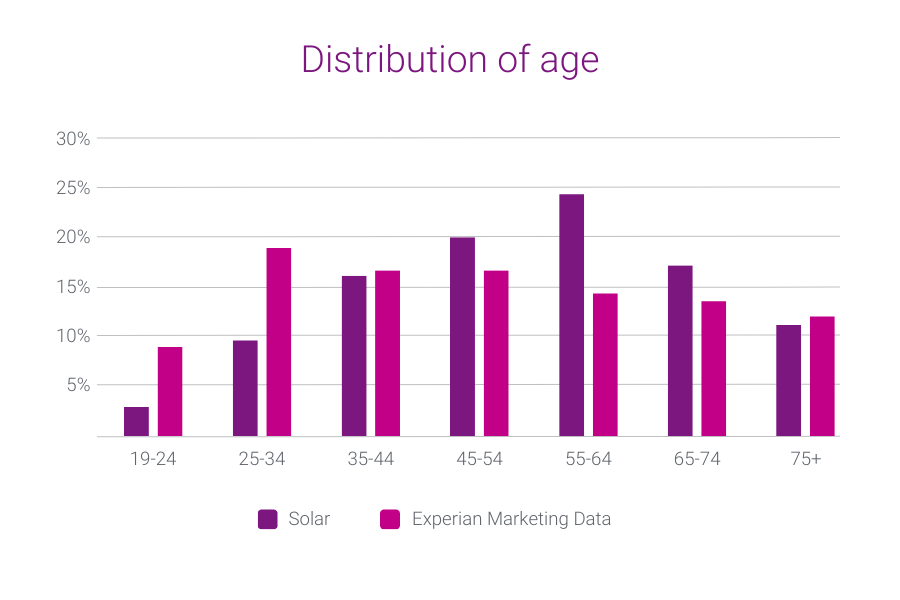
Consumers in our Solar energy audience are more likely to live in a home with two or more adults and are between the ages of 45-74.
Education level and occupation
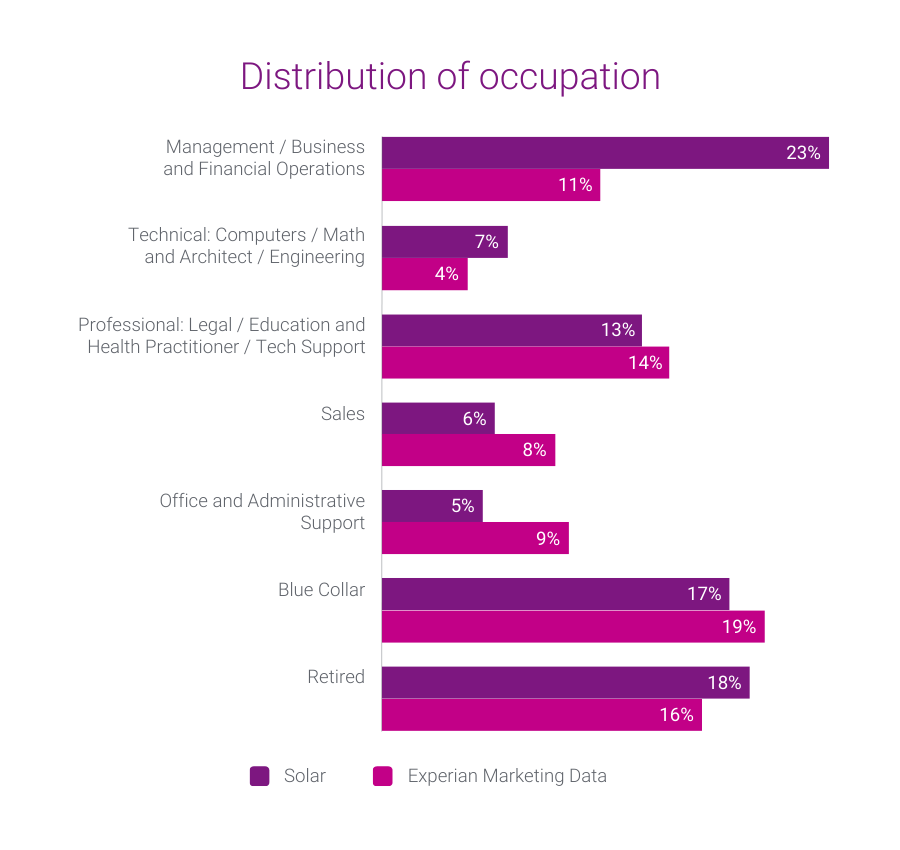
Consumers in our Solar energy audience are more likely to have graduated from college or graduate school and work in management-level occupations.
Household income
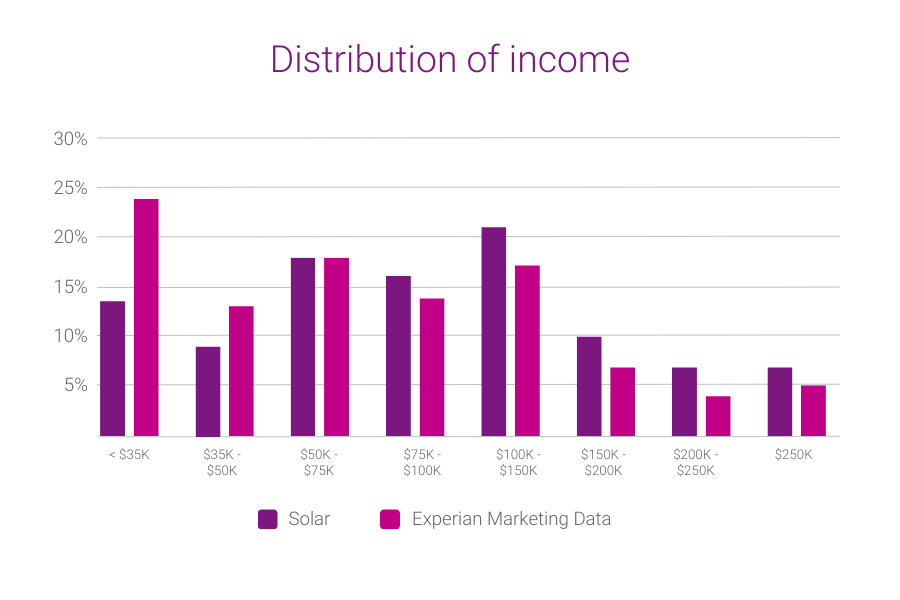
Consumers in our Solar energy audience have household incomes of more than $75,000 and their homes are valued at over $550,000.
Preferred engagement channels
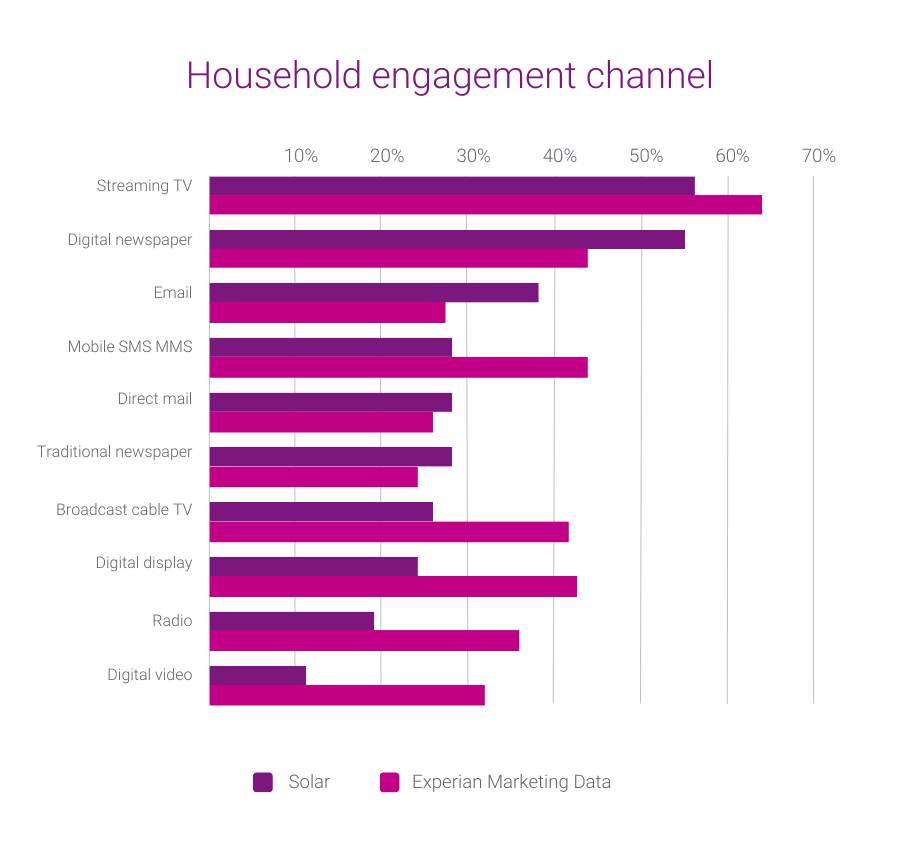
Consumers in our Solar energy audience are most receptive to ads served through digital channels like digital newspapers and email.
Solar energy audience pairings
Consumers in our Solar energy audience also belong to three of our Mosaic® USA groups:
- Power Elite
- Flourishing Families
- Booming with Confidence
Our consumer segmentation portal of 126 million households and 650 lifestyle and interest attributes empowers marketers like you to precisely target your ideal audience and communicate with them on a personal level. Mosaic’s data segments the U.S. into 19 overarching groups and 71 underlying types, giving you the insights needed to anticipate the behavior, attitudes, and preferences of your most profitable customers and communicate with them on their preferred channels, with messaging that resonates.
GreenAware
Our second eco-conscious audience is GreenAware.
GreenAware segments the 126 million U.S. households within Consumer View into four distinct groups. Each group differs in their attitudes and behaviors toward purchasing products that are environmentally safe and working with companies that are eco-conscious. We created these groups using an enhanced application of traditional statistical clustering techniques based on environmentally relevant measurements in Simmons’ National Consumer Study.
Based on the distinctive mindset of consumers toward the environment, you can learn how environmental concerns fit into their lives through four major consumer segments:
- Eco-Friendly Enthusiasts
- Sustainable Spectators
- Passive Greenies
- Eco Critics
Let’s dive deeper into each group to understand their unique perspective on the environment and how this impacts their attitudes and behaviors.
Eco-Friendly Enthusiasts
This eco-conscious segment prioritizes a green lifestyle and takes pride in avoiding products that harm the planet. With traditional and liberal values, they embrace optimism and prioritize family. With their children out of the house, they take the time for some well-deserved rejuvenation and are committed to a healthy lifestyle. Some members of this group are transitioning into retirement and welcoming a new chapter in their life.
- Mature adults and retirees
- College graduate or more
- Above average income
- May be married or single
- Typically own their homes
Sustainable Spectators
This segment aspires to be more sustainable, but they struggle with translating their green ideas into action. They have a soft spot for a cozy home. While their love for interior design and taking care of their own space is evident, they’re always looking for new experiences and opportunities to learn. Staying healthy and active is a top priority for this group, so it’s no surprise that they’re always looking for ways to stay fit and feel their best.
- Established and mid-life adults
- College graduate or more
- High income
- Typically married
- Likely to own their homes
Passive Greenies
This is the largest and one of the most youthful groups. Known for their love of exploration and self-discovery, they may not have fully embraced eco-conscious behaviors yet, but they are eager to stay current with the latest technology and trends. With their incredible ability to multitask, they’re always on-the-go, and constantly seek the next best thing.
- Mainly young adults and diverse
- Education ranges from high school through some college
- Below average income
- More likely to be single or divorced
- Typically rent
Eco Critics
This group is not likely to be eco-conscious and may have negative attitudes about the environment. They are confident, driven, and focused on their personal growth. They crave instant gratification, seeking out quick and easy solutions to their everyday decisions. They place a high value on entertainment, their social life, and carefully curate their image.
- Young and established adults
- Education ranges from high school through post-graduate studies
- High income
- Married or single
- Typically own their homes
Let’s take a look at how the GreenAware segments stack up against each other in terms of age, household income, education level, and media preference. How do they compare? Let’s find out.
Age
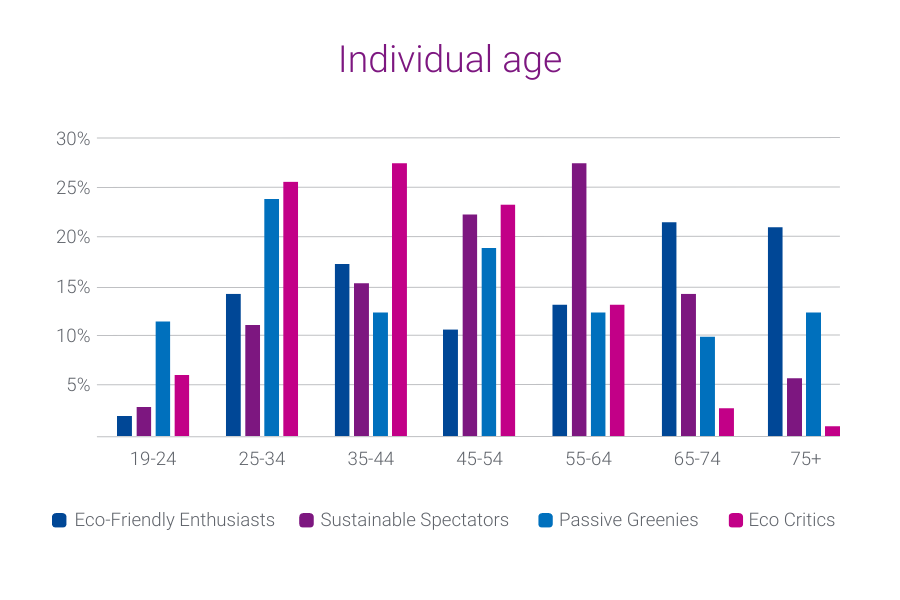
Consumers in the Eco-Friendly Enthusiasts segment are the oldest of the four GreenAware segments – about half of the consumers are 65 or older. Eco Critics are the youngest segment, with over half of consumers in this group between ages 25-44.
Household income
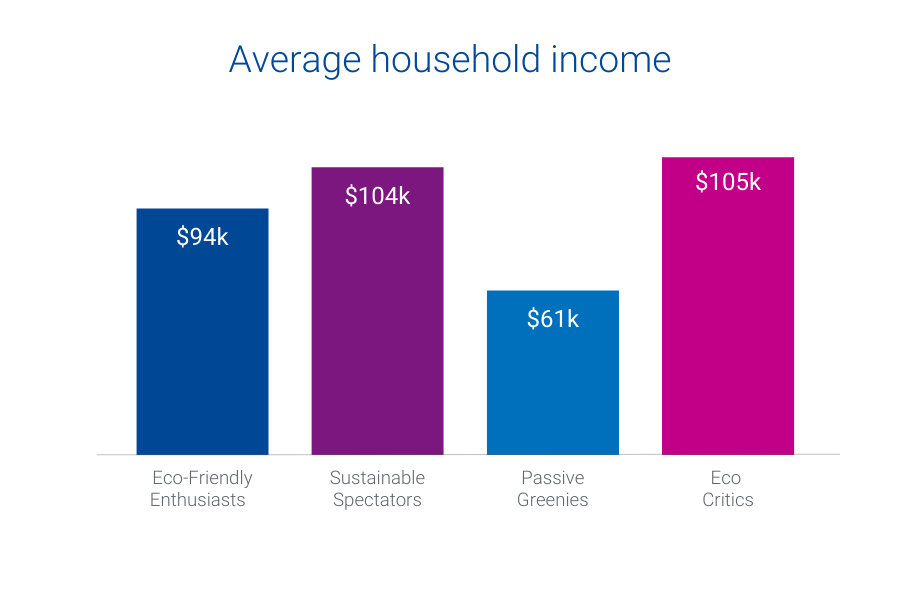
Sustainable Spectators and Eco Critics are the wealthiest GreenAware segments. The average household income of consumers in these segments is above $100,000. Passive Greenies have the lowest household income, with a majority below $50,000.
Education level and occupation
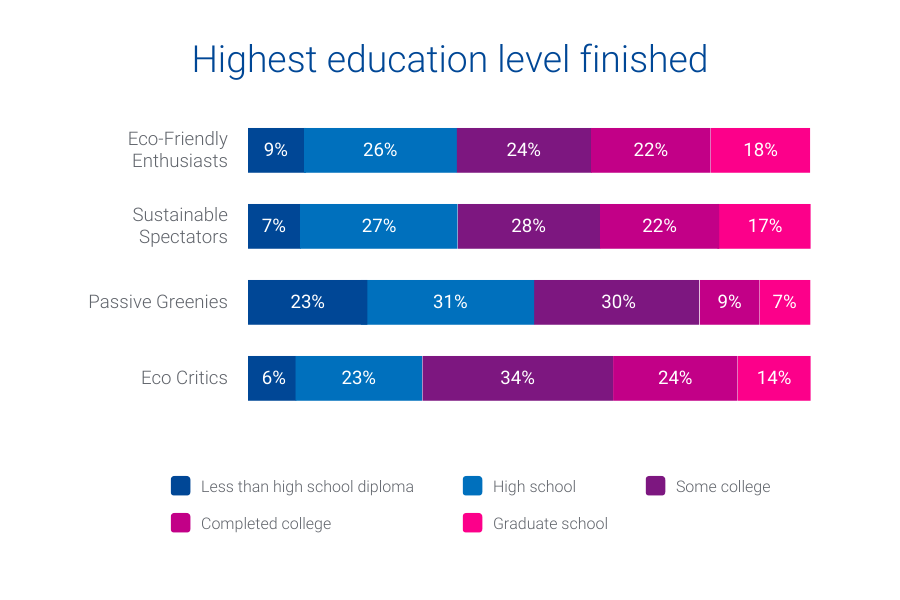
Passive Greenies are more likely to work Blue Collar jobs and have the lowest level of education. As the wealthiest segments, Sustainable Spectators and Eco Critics have the highest levels of college degrees and work in management, business, and financial operations. Eco-Friendly Enthusiasts are the most likely to be retired and out of the workforce.
Preferred engagement channels
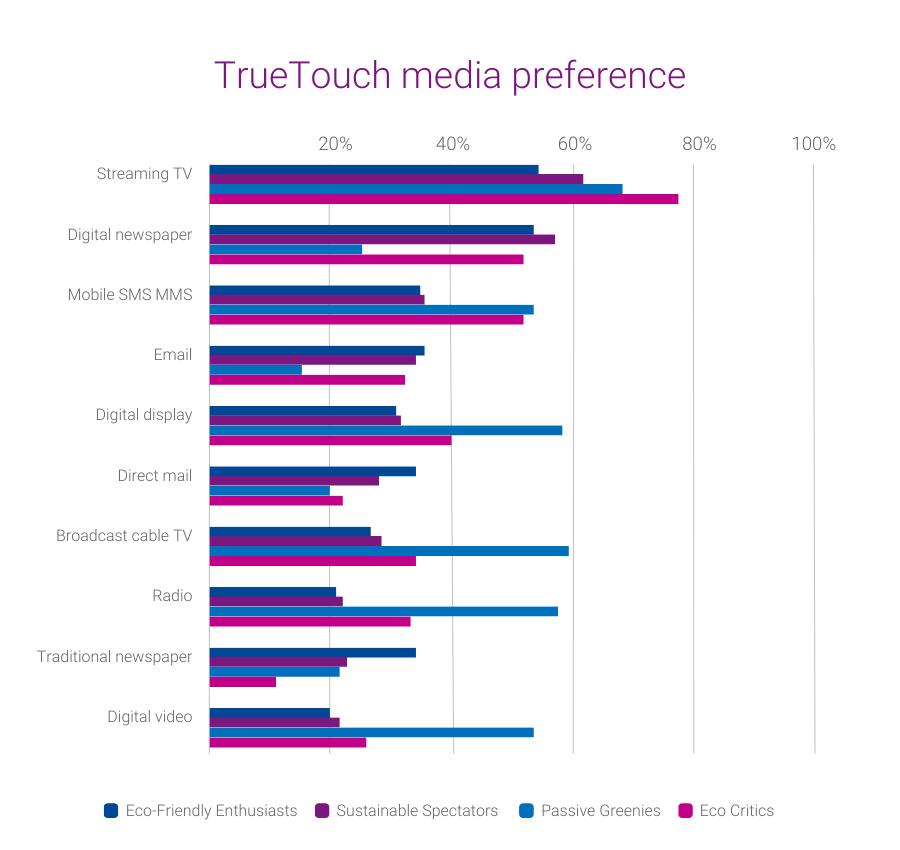
Streaming TV is the preferred engagement channel for all GreenAware segments.
Eco-Friendly Enthusiasts prefer digital channels like digital newspapers, mobile SMS, and email. They also engage with traditional channels like direct mail and newspaper.
Passive Greenies have a high preference for digital display, mobile SMS, digital video, broadcast cable TV, and radio.
Eco Critics have a high preference for digital channels like digital newspapers, mobile SMS, and digital display.
Sustainable Spectators strongly prefer digital newspapers. They don’t show as strong of a preference for mobile SMS and digital display as Eco Critics and Passive Greenies.
GreenAware audience pairings
Six of our Mosaic groups have at least one GreenAware segment with 10% or more of the population. For more precise targeting, below are suggested Mosaic audiences you can pair with each GreenAware segment:
| Eco-Friendly Enthusiasts | Sustainable Spectators | Passive Greenies | Eco Critics |
| Booming with Confidence | Power Elite | Singles and Starters | Power Elite |
| Autumn Years | Booming with Confidence | Golden Year Guardians | Suburban Style |
| Golden Year Guardians | Singles and Starters |
Electric vehicles
Our third eco-conscious audience is electric vehicles.
Electric vehicles (EVs) are having a major moment in the automotive industry. This is no surprise given that new EV models are being released and an increasing number of charging stations are popping up around the country. As EVs become more prominent, it’s essential to stay up to date on relevant trends to make informed decisions about what lies ahead.
The demand for electric vehicles (EVs) is on the rise
Consumers are embracing the EV revolution, showing their desire for a cleaner, greener future. Automotive marketers are increasingly looking to reach in-market EV shoppers and current alternative fuel vehicle owners due to the growing availability of electric vehicles, improved infrastructure, and rising popularity. In 2022, EVs charged up the market and accounted for a remarkable 6% of new retail registrations.
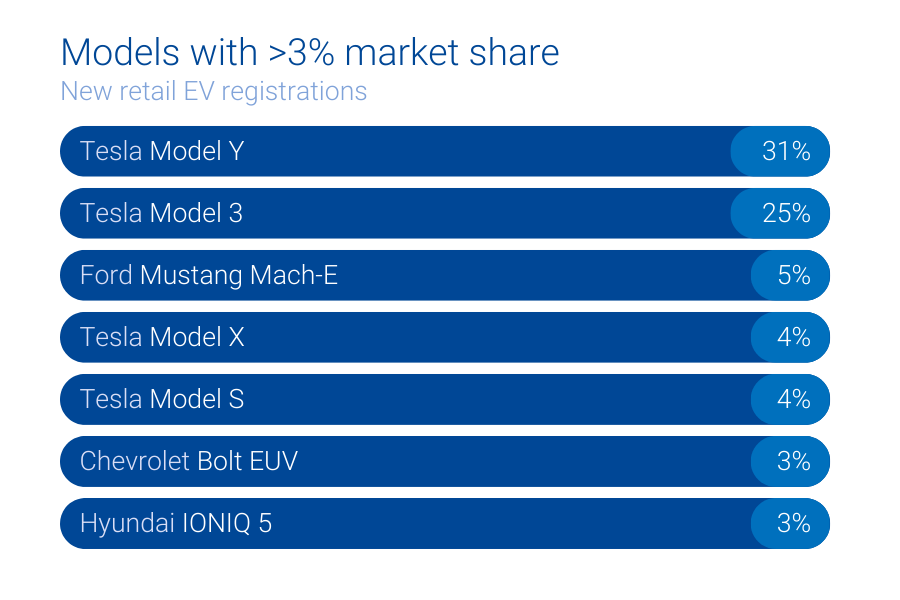
While Tesla continues to dominate the EV market, Ford, Chevrolet, and Hyundai are starting to compete, each holding more than 3% of the market share of new retail EV registrations.
Geography
Where are we seeing the most new retail EV registrations? The top designated market areas (DMAs) for new retail EV registrations are mostly located in heavily populated, coastal cities like Los Angeles, CA and New York, NY.
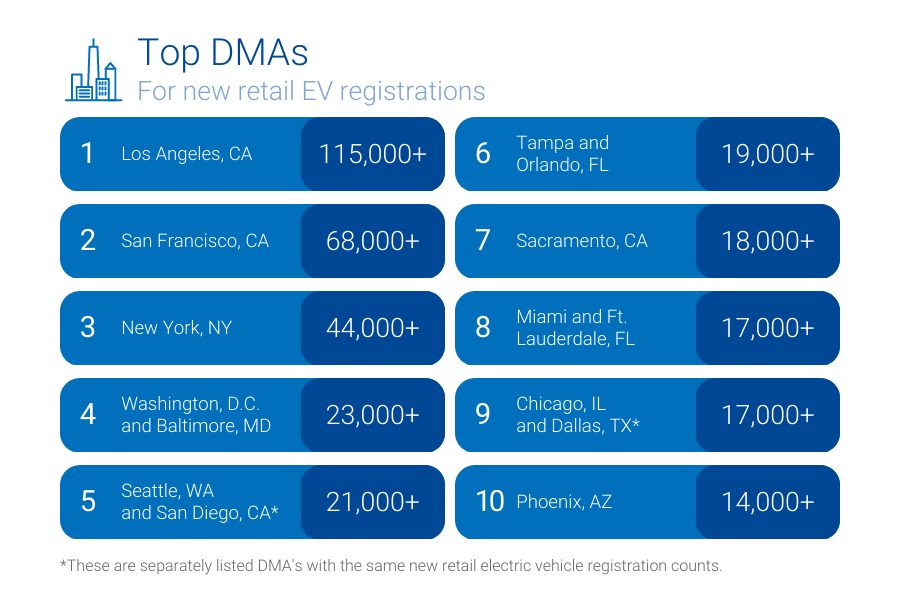
The fastest growing DMAs, however, are in smaller cities like Tucson, AZ and Oklahoma City, OK.
Generational demographics
Gen X and Millennials make up the largest percentage of new retail EV buyers at 37.5% and 34.4%. Gen Z and the Silent generation represent the smallest shares at 5% and 2.1%. Boomers hover between Gen X and Millennials’ share and account for 20.6% of new EV retail purchases.
EV audience pairings
Our top five Mosaic groups for new EV buyers include:
- American Royalty
- Cosmopolitan Achievers
- Philanthropic Sophisticates
- Couples with Clout
- Fast Track Couples
How to target consumers in-market for electric vehicles
We offer 70+ audiences that are focused on likely buyers and owners of EV and plug-in hybrid (PHEV) vehicles. We also offer a subset of 28 audiences focused on individual EV/PHEV vehicle models.
Below is how you can find a few of these audiences on-the-shelf of most trusted advertising platforms:
- Autos, Cars, and Trucks > In Market-Fuel Type > Electric
- Autos, Cars, and Trucks > In Market-Fuel Type > Used Electric
- Autos, Cars, and Trucks > In-Market Make and Models > Tesla
- Autos, Cars, and Trucks > In-Market Make and Models > Chevrolet Bolt EV
We can help you reach eco-conscious consumers
Earth Day is a great opportunity to get creative with your marketing efforts with our three eco-conscious audiences: Solar energy, GreenAware, and electric vehicles. To find out how you can add eco-conscious audiences to your marketing plan, contact us.
Latest posts

Published in AdExchanger. “Data-Driven Thinking" is written by members of the media community and contains fresh ideas on the digital revolution in media. Today’s column is written by Tom Manvydas, vice president of advertising strategy and solutions at Experian Marketing Services. The proliferation of connected electronics has spurred new interest in device-recognition technologies even though they have been in use since the 1990s. As we enter the “Internet of Things” era, device recognition will significantly impact the ad tech ecosystem. Many network advertising technologies are becoming obsolete as cookie blocking grows and the Internet becomes more mobile and device-centric. Device recognition will be yet another technology challenge for marketers but has the potential to overcome many key tracking, measurement and privacy issues with which data-driven marketers have struggled. By leveraging device recognition technologies, marketers can protect their investments in Web 2.0 ad tech, like multitouch attribution, and improve their overall digital marketing programs. Device Recognition Vs. Cookies Device recognition attempts to assign uniqueness to connected devices. By focusing on the device, you are able to “bridge” between browsers and apps, desktop to mobile and across OS platforms like iOS and Android. Device-recognition IDs function like desktop cookies for devices but with four important differences: 1. Coverage: Device-recognition methods are largely immune from cookie limitations. About half of mobile engagements on the Web do not involve cookies, while third-party blocking impacts up to 40% of desktop engagements. 2. Persistency: Device-recognition IDs can be more persistent and less fragmented than most desktop cookies. For example, Apple’s UDID or Android ID are permanent, and network node IDs like MAC addresses are near-permanent. Proxy IDs such as IDFA are persistent but can be updated by the device owner or ID provider. 3. Uniqueness: Devices are unique and cookies are fragmented. The digital media industry incurs substantial overhead cost and loss of efficiency when dealing with fragmented profiles and obsolete data caused by cookie churn. However, device-recognition methods are limited in their ability to recognize multiple profiles on shared devices. 4. Universality: Device-recognition technologies are universal and generally work across devices and networks. However, interoperability issues across device operating systems, such as iOS and Android, can limit the universal concept. There are many types of device-recognition technologies but two basic approaches to device recognition: deterministic and probabilistic, each with their pros and cons. Deterministic Approach: Accurate And Persistent But Complicated Deterministic device recognition primarily uses the collection of various IDs. While the mobile developer is familiar with the variety of IDs, it’s important that marketers become better-versed in this area. Examples include hardware IDs (including serial numbers), software-based device IDs (such as Apple’s UDID or the Android ID), digital data packet postal codes or proxy IDs (such as MAC addresses for WiFi or Bluetooth, IDFA for both iOS and Android and open-source IDs). Deterministic methods improve the accuracy of tracking, targeting and measurement over current cookie-based methods. They can improve the ability to more persistently manage consumer opt-outs. But the proliferation of device types limits the universality of deterministic device recognition. Without uniform standards across platforms, marketers need to account for multiple ID types. Also, deterministic device-recognition methods are not well developed for desktop marketing applications. The lack of interoperability across deterministic device IDs makes execution too complicated. Deterministic device IDs were meant for well-intentioned uses, such as tracking the carrier billing for a device. However, they present privacy and data rights challenges, leading to blocking or limited access by companies that control IDs. Probabilistic Device Recognition: A ‘Goldilocks’ Solution Probabilistic device recognition may be the ideal solution for a connected world that does not rely on cookies nor wants to use overly intrusive deterministic device recognition. Probabilistic device recognition is not a replacement for deterministic IDs. Instead, it complements their function and provides coverage when they are not available. The probabilistic approach is based on a statistical probability of uniqueness for any single device profile. This approach creates a unique profile based on a large number of common parameters, such as screen resolution, device type and operating system. This process can uniquely identify a device profile with 60% to 90% accuracy, compared to 20% to 85% accuracy for cookie-based identification methods. Probabilistic IDs are more persistent than cookies with better coverage, but less persistent than deterministic device IDs. The natural evolution of the device takes place over time and prevents persistent identification. Probabilistic device recognition can be universal and is not impacted by interoperability issues across platforms — the technology used to generate a probabilistic ID on one network can be the same technology on another network. Unlike some deterministic device recognition approaches, there is no device fingerprinting. Probabilistic device recognition accurately identifies profiles in aggregate, rather than a single device. That’s the inherent beauty of probabilistic device recognition: It can generate more accurate targeting results than cookie-based methods without explicitly identifying single devices. This is more than good enough for most marketers and significantly better than what’s available today. Another benefit is the absence of any residue on the device — no cookie files, flash files or hidden markers. Probabilistic methods can work on devices that block third-party cookies or connect to the Web without using any cookies. For example, you might have a hard-to-reach but valuable audience segment. Probabilistic device recognition could effectively increase your reach on this segment by 40% to 50% and increase the overall targeting accuracy by two times. Let’s say the actual population for this segment is 100,000 members. The typical cookie-based approach might reach 28,000 members but the typical probabilistic device-recognition approach could reach 65,000 members. A Decline In Hardware Entropy If you take a close look at the emitted data from today’s devices, it is not easy to analyze it for device identification. That’s because the data footprint of one device looks a lot like another. Device recognition augmentation methods can address this, such as device usage profiles, geo location clustering, cross-device/screen analytics or ID linkage for first-party data owners. In the short term, device-recognition technologies, particularly probabilistic methods, can greatly improve today’s digital marketing programs. Marketers should become fluent in their use cases and benefits. If 2013 was the year of mobile, I think we’ll see a surge in marketing applications based on device-recognition technologies in 2014. Follow Experian Marketing Services (@ExperianMkt) and AdExchanger (@adexchanger) on Twitter.

According to Experian Marketing Services’ 2014 Digital Marketer: Benchmark and Trend Report, social media Websites are playing an increasingly important role in driving traffic to other Websites, including retail sites and even other social networking sites, at the expense of search engines and portal pages. For instance, as of March 2014, social media sites account for 7.72 percent of all traffic to retail Websites, up from 6.59 percent in March 2013. Further, Pinterest, more than Facebook or YouTube, is supplying the greatest percentage of downstream traffic to retail sites. According to the Digital Marketer Report, more retailers are directing their customers to social media within their email campaigns. In fact, 96 percent of marketers now promote social media in their emails, and it shows. In 2013, for instance, email Websites generated 18 percent more clicks to social networking pages than the year prior. Social drives more traffic to other social Websites Social media Websites are driving more and more traffic to other social sites. In 2013, 15.1 percent of clicks to social networking and forum sites came from other social networking sites, up from a 12.5 percent click share reported in 2012. Despite driving the greatest share of traffic to social networking sites with 39.1 percent of clicks, search engines’ share of upstream traffic to social declined a relative 13 percent year-over-year. Among the other top referring industries to social, only the portal front pages industry — which includes sites like Yahoo!, MSN and AOL and is closely affiliated with search engines — showed a drop in upstream click share providing further evidence that increasingly all (or most) roads lead to social. To learn more about key trends in social media traffic, including downstream traffic from social sites and the share of consumers accessing social media across multiple channels, download the free 2014 Digital Marketer: Benchmark and Trend Report.

Mother’s Day may not exactly be right around the corner, but the time to send your Mother’s Day emails sure is! Based on our analysis of 186 brands that sent Mother’s Day mailings in 2013, 75 percent of email volume and 80 percent of email-generated revenue occurred between May 1st and Mother’s Day (May 12, 2013). The highest revenue-producing days were five days before the holiday (Wednesday, May 8, 2013) and Mother’s Day itself. This year, the sentimental holiday falls one day sooner than last year (May 11), but you still have more than enough time consider these quick tips for easy wins while planning and executing your campaigns. Tip 1: Give them what they’re searching for Last year, online searches five weeks before Mother’s Day were dominated by searches for the date of the holiday. As such, we recommend including the date of Mother’s Day in your email subject lines, particularly those early in the season, when customers are searching online for, and opening emails with, that information. Tip 2: Set the tone early with your subject lines A sample of early season subject lines that outperformed the overall unique open rate included: Remember Mom on Mother’s Day, May 12 Get a head start on Mother’s Day (plus a gift for you) Just arrived: Mother’s Day Gift Sets To Mother, With Love Tip 3: When it comes to timing, it’s the thought that counts Think through the timing of your emails depending on order delivery deadlines. On May 8th of last year, the largest revenue producers for email were orders for flowers and gifts placed in time to be delivered by Mother’s Day. Email subject lines on May 8th included reminders of the delivery deadlines: Last Chance: Free Shipping/No Service Charge for Mother’s Day! ENDS TODAY: Enjoy Complimentary Second Day Delivery in Time for Mother’s Day Tip 4: Let them treat themselves On Mother’s Day, the top email revenue generators were “self-gifting” (treat yourself on Mother’s Day only), Mother’s Day online sales and free shipping, as well as e-gift cards: Free Shipping Today Only! Happy Mother’s Day You deserve a treat yourself! HAPPY MOTHER’S DAY! Treat yourself to 30% off today only Last Chance: eGift Cards in Time for Mother’s Day Other email performance highlights: Note: All email performance highlights are based on comparisons to Mother’s Day mailings without the highlighted feature from matched brands. To all those in the midst of Mother’s Day campaign planning, good luck and happy sending!
