Loading...

Experian launches innovative new Geo-Indexed audiences

Published: November 28, 2023 by James Esquivel

Introducing Experian's geo-based targeting solution.

Experian is excited to introduce our new Geo-Indexed audiences. Our Geo-Indexed audiences use a new advanced indexing classification technology to identify and reach consumers based on their geo-regional attributes. These audiences can help you discover, segment, and craft messaging for consumers without the use of sensitive personal information, so you can confidently reach your target audience without sacrificing data privacy.

In this blog post, we’ll review how our new Geo-Indexed audiences can help you reach your audience while balancing data privacy and accuracy.

How we collect and use data is changing

The AdTech industry is undergoing a transformation as various forces shape its trajectory. One significant factor is legislation, with as many as 26 states currently considering data privacy laws. Consumer preferences also play a crucial role, as more individuals look to brands for responsible and ethical data handling practices. According to Forbes, 82% of people view brands positively when they consciously opt to refrain from using personal data for personalized ads. Major players in the field such as Apple and Google are actively pushing for a shift away from traditional methods like cookies and other identifiers in data collection and usage. These developments mark a considerable shift in how we use data.

Many brands are seeking a few solutions to continue to find and reach their target audience online, but at Experian, we see a great opportunity for innovation and impact within geo-based targeting solutions.

“We predict that over the next year, you will begin to see innovations in geo-based targeting methodologies that satisfy the industry’s need for audience targeting with responsible data strategies. By embracing innovations in geo-based targeting and adhering to responsible data strategies, you can not only comply with these laws but continue to reach your intended audiences effectively.”

jeremy meade, vp, marketing data & operations

Introducing Experian’s Geo-Indexed audiences

Geo-Indexed audiences from Experian allow brands to reach consumers and households based on geographic regions that over-index for a common set of attributes.

Our Geo-Indexed audiences give brands the ability to:

  • Stay connected: Maintain a touchpoint with consumers as other audience targeting solutions disappear or reduce scale due to new legislation.
  • Expand your audience reach: With our sophisticated geo-indexing methodology, you will be reaching your target audience’s circle of influence within the geo-region.
  • Execute where you want: By linking our Geo-Indexed audiences to Experian’s persistent identifiers, you can activate these audiences on the shelf of your platform of choice.
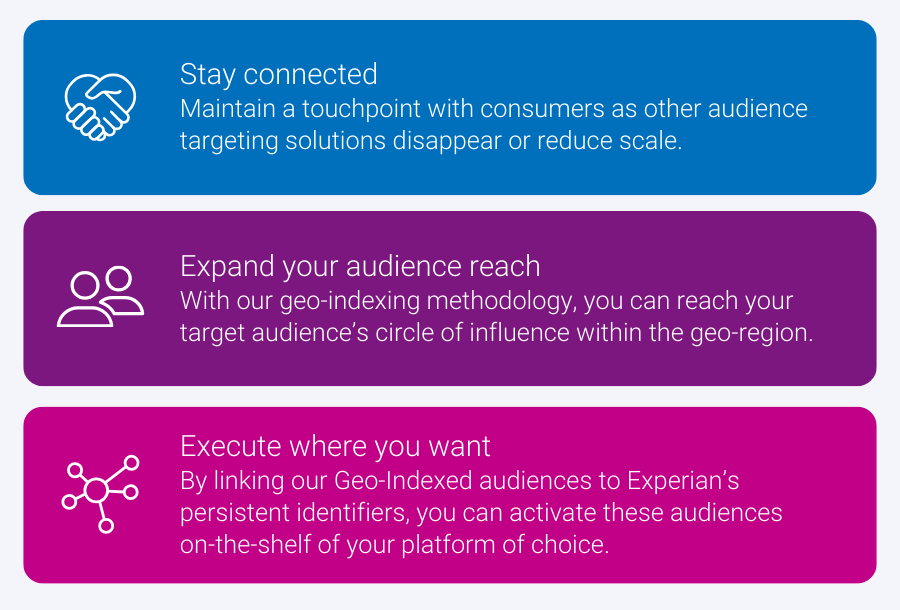
Three reasons to use Geo-Indexed audiences.

As a part of the release of Geo-Indexed audiences, we will be rolling out three main categories:

  1. Language
  2. Ethnic Group
  3. Demographics which include:
    • Education
    • Household Income
    • Marital Status
    • Occupation
    • Presence of Children

Over the next year, we will continue to release new audiences within Geo-Indexed audiences.

How you can use Geo-Indexed audiences

An Auto brand has a new corporate policy restricting the use of sensitive personal information in audience targeting but would like to reach high-income earners. To reach their target audience they use the Geo-Indexed audiences to reach households who are in geographic regions that index highly for income ranges ‘$175,000 – $199,999’ and ‘$200,000+.’

Prioritize privacy without sacrificing accuracy with Experian’s Geo-Indexed audiences

Our Geo-Indexed audiences are available in most major data and demand-side platforms. Visit our partner page for more information.

Don’t see our audiences on your platform of choice? We can help you build and activate an Experian audience on the platform of your choice.


Latest posts

Loading…
Top TV shows for reaching key voters

The Republican and Democratic parties are gathering in the coming days to officially launch the Presidential campaigns of Mitt Romney and Barack Obama. In doing so, the candidates, the parties and their support groups will unleash unprecedented amounts of cash in an effort to influence American voters through advertising, much of it on TV. As such, Experian Simmons has released a new list of the top 20 television programs for reaching party loyals as well as three key swing voter segments. The segments come from the PoliticalPersonas consumer segmentation system, which classifies U.S. adults into one of 10 unique segments based on the individual’s political outlook and party ID as well as their attitudes and opinions towards key topics. The segments we will focus on in this post include the Super Democrats and Ultra Conservatives segments, which represent the most party loyal voters for Democrats and Republicans, respectively. We will also profile the TV preferences of three important swing voter segments during this election cycle, including: Mild Republicans, On the Fence Liberals and Green Traditionalists. For more information about the PoliticalPersonas segments, download the PoliticalPersonas Report. The shows in each list include those cable and broadcast TV shows with the highest concentration of viewers from each segment. For example, The Daily Show with Jon Stewart on Comedy Central has the highest concentration of Super Democrats of any non-news cable or broadcast show on TV. Likewise, Rules of Engagement on CBS has the highest concentration of Mild Republicans. Candidates, political organizations, and even traditional advertisers trying to connect with any of these voting segments would be wise to consider advertising on the programs listed below. For more information on PoliticalPersonas, watch our Webcast.

Aug 28,2012 by

Developing real-time marketing intelligence

Marketers have always struggled to target the right consumer with the right offer. And with more than 313 million people live in the United States according to the U.S. Census, the challenge is more difficult than ever. With the proliferation of the Internet and mobile technology, today’s consumer operates differently and expects more from their favorite brands. To adapt to that new American consumer, marketers are using highly targeted strategies to drive interest. These can be messages that are relevant to a few hundred consumers or detailed one-on-one communications that target individuals at the point of sale or online. But some marketers struggle to execute these tactics effectively. Most segmentation is currently done prior to a campaign, meaning that marketers determine which message a consumer will receive before ever interacting with that individual. Unfortunately, with the rapid nature of purchasing decisions and buying transactions, businesses often miss opportunities because it takes too long to get the right message to the right consumer. To keep up, marketers need to collect intelligence at the point of contact so they can understand each individual consumer’s habits and preferences during that connection. This intelligence can then feed modeling algorithms that enable automatic offers based on an individual’s preferences. To develop a strategy around real-time marketing intelligence, marketers should take the following steps: Clean existing data – at the root of any intelligence strategy is data. Information determines a company’s ability to reach target individuals – and understand who they are and what they’re interested in. Unfortunately, if the data that feeds intelligence efforts is inaccurate, marketers are simply unable to communicate with or understand consumers. Ensuring the validity of contact information, internal records and third-party data elements helps organizations target consumers and ensures that sophisticated analysis is as precise as possible. Identify strategies – organizations should analyze their target markets and determine which communication channels could benefit from a more personalized customer experience. Marketers should decide how they want to change each communication to help drive the desired action from each consumer. Consider personalizing website displays based on geographic regions, customizing an introductory message or revamping loyalty campaigns based on purchase history and consumer interests. Real-time intelligence – marketers should build models to help predict the best offers for each target audience. These models can be designed to take into account demographic and behavioral information, as well as purchase history and internal data. Marketers can feed these models with intelligence gained at the point of contact to prompt consumers in real time with specific, relevant offers. As marketers continue to enhance and refine targeting efforts, it’s important to gain customer insight. Those who leverage these advanced technologies and strategies will create stronger customer engagement. Segmenting customers and taking measurable action in real time are advanced techniques that appeal to many marketers today. Achieving this level of interaction allows organizations to optimize marketing efforts and provide the right offer at the right time to the right consumer.

Aug 20,2012 by

Traditional direct marketing needs a fresh face

In a youth-obsessed world where fresh faces sell products, despite all efforts it’s a cruel reality that fashion models will eventually have to look for a new job. While they may try to self preserve with plastic surgery, Botox and laser treatments, let’s face it – they can’t be models forever. The advertising industry knows that a fresh face can’t be overlooked to sell products, so why should it be different for traditional direct marketers? Customers are the lifeblood of any business, yet businesses lose anywhere from 10-30% of them per year. Today’s “always on” shopper makes decisions in every channel – direct, online and in-store. In looking for better ways to sell more products to current and new customers, marketers seek out ways to expand their prospect universe to improve customer acquisition levels. Why? Customers are the lifeblood of any business, yet businesses lose anywhere from 10-30% of them per year. This makes new customer acquisition extremely important to both protect and grow business year over year. The acquisition challenge is that traditional prospect universe expansion is becoming increasingly difficult. Many marketers have exhausted list and co-op rental names, and optimization strategies. They’ve been using the same predictive prospecting models against compiled prospect data or co-ops for a long time. But these tools, which are based on traditional demographics, are increasingly leading to a decline in good prospect identification and acquisition. We know that in prospecting, there is no customer behavioral data to drive higher performing analytics – no plastic surgery or proverbial fountain of youth. In today’s multi-channel shopping world, the fresh face of online behavior can’t be overlooked. While direct marketers in self-preservation mode have leveraged traditional acquisition models for years, the reality is that if they do not consider fresh new data and modeling solutions, they will be looking for their next, new job. So, what can marketers do to overcome prospect universe expansion hurdles with online insight to increase acquisition and ROI? Meet direct marketing’s fresh new face: online behavioral data and modeling. Online behavioral data addresses a key challenge of traditional direct marketers: profitable prospect universe expansion. By incorporating online behavioral data (website traffic and behavior, search, demographics, lifestyle data) into offline marketing strategies, marketers can: Identify previously untapped prospect universes Suppress likely non-responders Enhance offline prospecting Where else do consumers so actively demonstrate their purchase interest and behavior? Where else do we go when we want to learn about something? Anything? We go online. But most direct marketers have not enhanced their offline marketing efforts with online data, missing the opportunity to incorporate online behavior into targeting efforts. With this fresh new data source, direct marketers are able to: Better understand customer behavior across channels Refresh their current models Develop better models, built from true, multi-channel data Ultimately, direct marketers will be able to identify new pockets of high-value prospects that traditional response models miss, resulting in an increase in revenues and profit. Fashion models and trends change, and sometimes that’s for the best, otherwise we might still be wearing parachute pants and slap bracelets. Luckily, you now know what the new face of marketing is and can begin integrating online behavior into your existing customer data today to leverage new marketing opportunities. Discover the new fresh face of direct marketing; learn more about online behavioral profiling and modeling.

Aug 02,2012 by

Subscribe to our newsletter

Enter your name and email for the latest updates

This site is protected by reCAPTCHA and the Google Privacy Policy and Terms of Service apply.

About Experian Marketing Services

At Experian Marketing Services, we use data and insights to help brands have more meaningful interactions with people. As leaders in the evolution of the advertising landscape, Experian Marketing Services can help you identify your customers and the right potential customers, uncover the most appropriate communication channels, develop messages that resonate, and measure the effectiveness of marketing activities and campaigns.

Visit our website

Subscribe to our newsletter

Stay up to date on the latest industry news and receive expert tips from our marketing experts.
Subscribe now!