Originally appeared on MediaPost
As the digital ecosystem becomes more complex, managing multiple identifiers for consumers has emerged as a significant challenge. From cookies and IP addresses to mobile IDs and universal IDs, marketers and platforms face increasing difficulty in maintaining a unified view of their consumers. Without a coherent identity strategy, campaigns can suffer from poor targeting, limited personalization, and flawed attribution.
Experian understands these challenges and offers solutions to help our partners navigate the complexities of a multi-ID landscape. By utilizing both digital and offline data, we provide the tools to unify fragmented identifiers and maintain a persistent view of consumers. As a result, marketers and platforms get rich insights, accurate cross-device targeting, improved addressability, and measurable advertising.
The shifting identity landscape
For years, the industry has relied on cookies to identify consumers across devices and platforms. However, with ongoing signal loss, including the uncertainty around cookies, and the evolution of privacy regulations, the digital identity landscape has grown more complicated. As consumers hop from one device to another, they are now represented by multiple signals, each tied to a different aspect of their digital behavior.
While this shift brings complexity, it also opens the door for innovation. Marketers and ad platforms now have the opportunity to rethink their identity strategies and adopt more flexible approaches that are not reliant on a single identifier.
This is where Experian comes in.
Connecting the dots: A holistic view of the customer journey
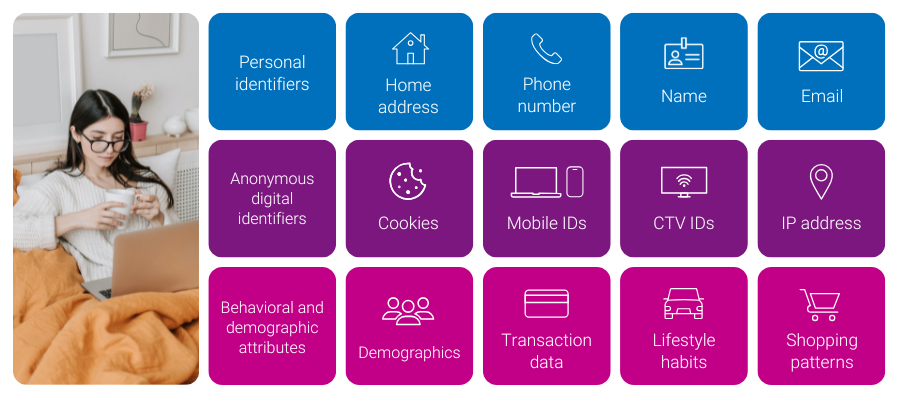
Our identity solutions are designed to help manage today’s multi-ID ecosystem by connecting digital and offline identifiers to a single customer profile. This creates a unified view of the consumer, and when combined with our understanding of customer behavior (e.g. demo, interests, shopping patterns) marketers and platforms get both insights about their customers and the addressability to reach them across channels.
Four examples of what you can do with a strong identity foundation
- If an advertiser wants to make its first-party data more addressable, it can utilize our Digital Graph with universal IDs, hashed emails (HEMs), and connected TV (CTV) IDs to extend its reach.
- A publisher who wants to gain further insights into their audiences and create private marketplaces (PMPs) can achieve this goal with the use of our Digital Graph with hashed emails, universal IDs, mobile ad IDs (MAIDs), CTV IDs, and IPs. The publisher can use this in concert with Marketing Attributes to understand age, gender, household income, buying behavior, and more. The publisher can connect marketing attributes to the Digital Graph via our Living Unit ID (LUID) to understand more about consumers that fall into their segments.
- A demand-side platform (DSP) who wants to extend first-party and third-party audience reach across all digital devices on their platform will use the Digital Graph with all digital IDs to allow users of their platform to select cross-device extension against first-party and third-party audiences.
- A retail media network (RMN) can use our Offline and Digital Graphs to connect in-store and online purchases to a household profile—even when purchases are made by different people. The RMN can then reach that household across digital media platforms and accurately attribute the in-store purchase back to digital ad exposure.
Identity as a strategic asset: Today and in the future
In our paradoxical world where consumers are represented by multiple identifiers, yet marketers and platforms face signal loss, identity is more than a technical issue—it’s a strategic asset. The ability to unify identity data into a single profile provides marketers with the customer intelligence needed to drive growth and stay competitive. Here’s how we do it:
- Deep, persistent customer understanding: With roots in offline, deterministic data like names, addresses, and emails, we provide an accurate and persistent view of identity to our customers. This allows you to maintain a consistent and comprehensive understanding of your customers and their marketing attributes over time.
- Highly accurate and refreshed digital identities: Our signal-agnostic graph is not reliant on any one signal as it includes HEMs, cookies, MAIDs, IPs, Universal IDs, and CTV IDs. Our Digital Graph is updated weekly, ensuring the data is always fresh and addressable. This persistent linkage of individuals and households to their identifiers and devices means your campaigns are always targeting the right people.
- Connected offline and digital graphs for holistic insights: We connect offline and digital identities by following privacy-first best practices, such as preventing re-identification, to allow insights from the offline world to be used in the online world. This integrated approach, enriched with marketing data, gives you better insights, more addressable advertising, and the ability to engage customers across multiple devices while accurately measuring campaign impact.
Transform challenges into opportunities
The rise of the multi-ID landscape presents both challenges and opportunities for the advertising industry. We stand as the trusted partner to navigate this complexity, utilizing insights from the offline world to inform decisions in the online world, enabling personalized marketing and accurate attribution, and helping you achieve your current and future goals.
Latest posts
Marketers are under more pressure than ever before to prove ROI and efficiency of marketing activities in relation to business performance. On top of that, there are new privacy regulations and uncertainty around what new technologies will have to be implemented in order to replace the granular level targeting and measurement the industry historically has used third-party cookies for. It’s clear marketers are going to need the right tech stack and partners to continue to prove their team’s efficacy. We recently partnered with Forrester Consulting to evaluate the current state of customer data-driven marketing and surveyed over 300 global marketing decision makers at the brand and agency levels. We found that marketing is facing increased demands today, insights from the study include: Consumers expect brands to deliver engaging experiences across highly fragmented journeys. Seventy-two percent of decision-makers reported that customers demand more relevant, personalized experiences at the time and place of their choosing. Marketing runs on data, but the rules governing customer data usage are changing quickly. More than 70% of study participants stated that consumer data is the lifeblood of their marketing strategies, fueling the personalized, omnichannel experiences customers demand. These demands paint a challenging picture. Just as marketers are poised (and tasked) with delivering greater value to their organizations and customers, the ground rules are changing and threatening their ability to deliver. Indeed, 62% of respondents said that the forces of data deprecation will have either a “Significant” (40%) or “Critical” (21%) impact on their marketing strategies over the next two years. Effective identity resolution can help brands prepare for data deprecation challenges Marketers face a daunting landscape, but they can leverage the data, technology, and processes that comprise identity resolution to address business objectives, combat ecosystem complexity, and future-proof customer engagement efforts. By utilizing identity resolution, marketers will be able to match and connect multiple identifiers across devices and touchpoints. This allows for a cohesive, omnichannel view that enables brands to continue to deliver personalized and contextually relevant messages throughout the customer journey and without the use of cookies. The identity graph is the underlying infrastructure that defines connections between the numerous, fluid, and disparate identifiers created during moments of consumer engagement, turning disparate signals into addressable and actionable steps. These connections enable brands to bolster their ability to gain deeper customer insights and power audience building, attribution, and connected measurement. Identity resolution encompasses a wide range of capabilities that support an equally diverse set of marketing use cases. These include the targeting, personalization, and measurement of both known and pseudonymous audiences in the offline and digital worlds, which enables marketers to improve customer data management, drive more effective personalization, and gain insights and efficiencies through measurement across touchpoints. By taking the time to vet the privacy procedures and data collection processes of identity solutions you can reduce your regulatory risk and maintain customer trust. In an open-ended survey response, a marketer shared, “We’ve found that users are willing to volunteer data when they understand what it’s being used for and are asked for clear consent.” Finding the right partners to help navigate the changes The scramble to find an alternative to third-party cookies has slowed down since Google announced they will be delaying their cookie removal until late 2023. However, this gives marketers a unique opportunity to take advantage of the additional time and feel more prepared and confident in their solutions. With the delay, marketers can now test ID solutions and compare apples to apples with data from the third-party cookie while it’s still active and addressable. Test and find a solution that works now, so there are no surprises once cookies have finally made their way out the door in 2023. At Tapad, a part of Experian, we’ve developed a solution that provides agnostic interoperability for the myriad of cookieless identifiers emerging in the market. As a new module in the Tapad Graph, Switchboard will connect traditional digital identifiers to cookieless IDs to support the entire ad ecosystem with privacy-safe future-proof identity resolution. Get started with The Tapad Graph For personalized consultation on the value and benefits of The Tapad Graph for your business, email Sales@tapad.com today!

Identity is being constrained, forcing the industry to rethink the way it has operated for 27 years. Industry, regulatory, technology and data trends are leading to a fundamental shift in the way that data is permissioned, accessed, and used for marketing purposes. How the industry defines digital identity moving forward, consumer trust and transparency need to be at the forefront. We, as an industry, have the opportunity to build a more effective advertising framework that puts consumers and data privacy at its core, a framework that won’t rely on a single prevailing identifier. That approach requires all of us to be upfront and transparent about our data practices and usage and make it easy for consumers to opt-out of the use of their information for advertising and marketing solicitations. We, at Experian, also believe that there are a lot of ways to improve the experience for consumers, who are becoming more aware and apprehensive of giving away their data. We believe we can ease the minds of consumers and work within these new constraints by offering better controls and practices around the ways data is shared and utilized. There will be new approaches that come to the market as well that include modeled, non-identifiable information, cohorts, contextual

It’s no secret that the COVID-19 Delta variant is threatening holiday plans across the country. As CDC mandates change and the flu season matures, we’re asking big questions that impact businesses and marketers across the country: Will customers mostly stay at home and order online? Or will people drive to the store and fly to family gatherings? The answer is probably both—but, as we’ve learned, a lot can change overnight. And we want to be prepared this time around. While many of us make vacation plans with a “wait and see” attitude, we want firmer footing at work. To cope with uncertainty, holiday marketing strategies straddle assumptions and require agility. To protect some of the biggest campaigns of the year, marketers need the ability to: Monitor changing customer behaviors during flu season. Track marketing KPIs for campaign performance and quick adaptability. Pivot audience targeting strategy when safety guidelines change. We built Discovery Platform to give you all three so that you can execute your marketing strategy with confidence. Discovery is built on top of robust consumer data and the best-in-class Identity graph that Experian is known for. It offers turn-key activation capability to keep your marketing campaigns agile and efficient this holiday season. Here’s how you can use Discovery Platform to protect your marketing interests from rapidly changing safety guidelines. Track store traffic against competitors Discovery Platform enables Experian clients to keep a tap on their store traffic and relate it to how competitors and overall business category is doing. Monitoring these trends can help marketers adapt to changing consumer behaviors as flu season evolves. Track marketing KPIs Tracking and adjusting ongoing campaign targeting strategy remains a top priority throughout the pandemic, especially during colder, winter months. Discovery enables you to evaluate your campaign targeting strategy in relation with your loyalty card shoppers and in-flight campaign KPIs to drive higher return on ad spend and Customer Lifetime Value. With Discovery’s OmniImpact integration clients can even conduct control test measurement studies. Pivot campaigns quickly You can use Discovery’s Audience Engine integration to build and deploy custom audiences to social, digital, email and Connected TV partners. This gives you the ability to quickly pivot campaign channels once you detect changes in consumer behavior or dips in campaign performance. The sales and customer data flowing into Discovery Platform puts all the insights you need in one place to inform your team’s next marketing strategy. Watch our Discovery Platform demo or contact us to learn how Experian can help you create more effective, agile marketing campaigns for the holidays.