Originally appeared on MediaPost
As the digital ecosystem becomes more complex, managing multiple identifiers for consumers has emerged as a significant challenge. From cookies and IP addresses to mobile IDs and universal IDs, marketers and platforms face increasing difficulty in maintaining a unified view of their consumers. Without a coherent identity strategy, campaigns can suffer from poor targeting, limited personalization, and flawed attribution.
Experian understands these challenges and offers solutions to help our partners navigate the complexities of a multi-ID landscape. By utilizing both digital and offline data, we provide the tools to unify fragmented identifiers and maintain a persistent view of consumers. As a result, marketers and platforms get rich insights, accurate cross-device targeting, improved addressability, and measurable advertising.
The shifting identity landscape
For years, the industry has relied on cookies to identify consumers across devices and platforms. However, with ongoing signal loss, including the uncertainty around cookies, and the evolution of privacy regulations, the digital identity landscape has grown more complicated. As consumers hop from one device to another, they are now represented by multiple signals, each tied to a different aspect of their digital behavior.
While this shift brings complexity, it also opens the door for innovation. Marketers and ad platforms now have the opportunity to rethink their identity strategies and adopt more flexible approaches that are not reliant on a single identifier.
This is where Experian comes in.
Connecting the dots: A holistic view of the customer journey
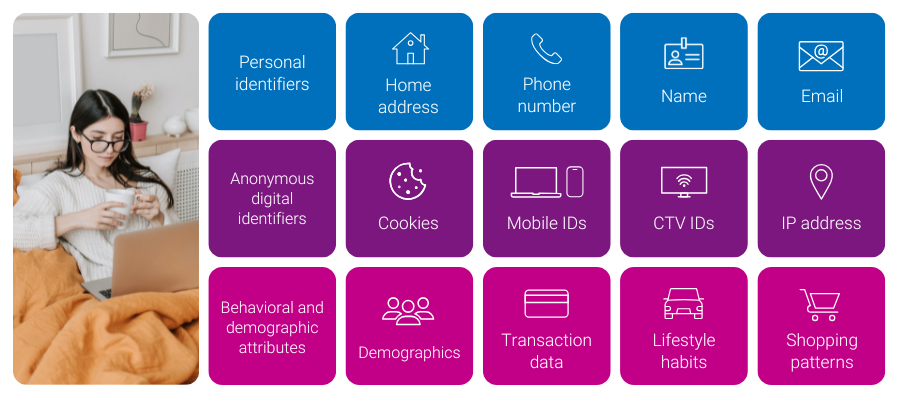
Our identity solutions are designed to help manage today’s multi-ID ecosystem by connecting digital and offline identifiers to a single customer profile. This creates a unified view of the consumer, and when combined with our understanding of customer behavior (e.g. demo, interests, shopping patterns) marketers and platforms get both insights about their customers and the addressability to reach them across channels.
Four examples of what you can do with a strong identity foundation
- If an advertiser wants to make its first-party data more addressable, it can utilize our Digital Graph with universal IDs, hashed emails (HEMs), and connected TV (CTV) IDs to extend its reach.
- A publisher who wants to gain further insights into their audiences and create private marketplaces (PMPs) can achieve this goal with the use of our Digital Graph with hashed emails, universal IDs, mobile ad IDs (MAIDs), CTV IDs, and IPs. The publisher can use this in concert with Marketing Attributes to understand age, gender, household income, buying behavior, and more. The publisher can connect marketing attributes to the Digital Graph via our Living Unit ID (LUID) to understand more about consumers that fall into their segments.
- A demand-side platform (DSP) who wants to extend first-party and third-party audience reach across all digital devices on their platform will use the Digital Graph with all digital IDs to allow users of their platform to select cross-device extension against first-party and third-party audiences.
- A retail media network (RMN) can use our Offline and Digital Graphs to connect in-store and online purchases to a household profile—even when purchases are made by different people. The RMN can then reach that household across digital media platforms and accurately attribute the in-store purchase back to digital ad exposure.
Identity as a strategic asset: Today and in the future
In our paradoxical world where consumers are represented by multiple identifiers, yet marketers and platforms face signal loss, identity is more than a technical issue—it’s a strategic asset. The ability to unify identity data into a single profile provides marketers with the customer intelligence needed to drive growth and stay competitive. Here’s how we do it:
- Deep, persistent customer understanding: With roots in offline, deterministic data like names, addresses, and emails, we provide an accurate and persistent view of identity to our customers. This allows you to maintain a consistent and comprehensive understanding of your customers and their marketing attributes over time.
- Highly accurate and refreshed digital identities: Our signal-agnostic graph is not reliant on any one signal as it includes HEMs, cookies, MAIDs, IPs, Universal IDs, and CTV IDs. Our Digital Graph is updated weekly, ensuring the data is always fresh and addressable. This persistent linkage of individuals and households to their identifiers and devices means your campaigns are always targeting the right people.
- Connected offline and digital graphs for holistic insights: We connect offline and digital identities by following privacy-first best practices, such as preventing re-identification, to allow insights from the offline world to be used in the online world. This integrated approach, enriched with marketing data, gives you better insights, more addressable advertising, and the ability to engage customers across multiple devices while accurately measuring campaign impact.
Transform challenges into opportunities
The rise of the multi-ID landscape presents both challenges and opportunities for the advertising industry. We stand as the trusted partner to navigate this complexity, utilizing insights from the offline world to inform decisions in the online world, enabling personalized marketing and accurate attribution, and helping you achieve your current and future goals.
Latest posts

With the increase in alternate channels such as social media, many may think that email is no longer a valuable way to create engagement with consumers. On the contrary, email marketing is still one of the most effective tools for marketers — especially when it is paired with mobile. Experian Marketing Services sends more than 10 billion emails each month on behalf of major brands around the world, which gives us the unique ability to monitor trends in email performance and engagement over time. We report email marketing trends as well as the key performance indicators that shaped the success of the Experian Marketing Services clients’ email programs each quarter in our email benchmark reports. Mobile holds potential for email engagement One of the most noticeable trends that we’ve found in our research is that both mobile device usage and email engagement have increased. According to our Q3 2014 Email Benchmark report, the research also states that 53 percent of emails were opened on a mobile or tablet device in Q3. Although we can see an increase in both engagement and mobile usage, it is too early to tell if they are directly correlated. However, marketers should be paying attention — make mobile your priority, and you may have the ability to stay ahead of upcoming trends. “Because people are so connected with their devices today, it only makes sense that they would want to use their mobiles and tablets to check their emails in real time,” says Shelley Kessler, Manager, Reporting and Analytics, Experian Marketing Services. “This is why it is so important for marketers to adopt mobile optimization into their marketing plans. Without it, their overall engagement and click rates will significantly drop and they may ultimately lose their audience.” Catalog brands see email success with tablets To put the importance of mobile into perspective, let’s dig deeper: During Q3 2014, the majority of email opens occurred on mobile phones or tablets for catalogers, consumer products and multichannel retailers. Specifically, for multichannel retailers, 60 percent of all of their emails occurred on a mobile phone or tablet and 50 percent of their total clicks. Meanwhile, catalogers had the highest percentage of tablet use with 18 percent of email opens and 13 percent of clicks occurring on tablets. Mobile can help create a relationship On a daily basis, a digitally connected customer’s inbox will be overwhelmed with hundreds or even thousands of different messages from marketers. To stick out from the crowd, marketers should be thinking of other ways to engage consumers. Shelley Kessler suggests creating a direct mobile messaging program: “Start a mobile messaging program if you have not already done so. If you have not developed a mobile database, start asking for customers’ mobile numbers in addition to email addresses and other basic information.” By utilizing mobile in ways that have not been done before, marketers have endless opportunities to get ahead of the curve. To learn more about these trends as well as others, download a free copy of our Q3 2014 Email Benchmark Report. Keep an eye out for the upcoming Q4 2014 Email Benchmark Report from Experian Marketing Services which will publish at the end of February.

Marketers: personalization is our duty Customers willingly give brands a lot of information. Some brands collect names, birthdays, message preferences and location in addition to contact information like email address, phone number and physical address. Brands that connect through Facebook and other social media accounts gain access to even more information – a person’s likes, friends/followers, age, demographics and more. Why are so many consumers willing to share this information? In a recent webinar, Ed Kowalski, Senior Director of Strategic Services at Experian Marketing Services refers to this phenomenon as the equitable exchange – customers provide companies with personal information because they believe it will enhance their brand experience. In return, marketers have a duty to responsibly use that data to benefit the customer. Personalization is an oft-discussed strategy in marketing, but many marketers struggle to make it a reality. In fact, a recent study found that 94 percent of companies have challenges relating to personalization. Yet marketers continue to collect more customer data – without a clear plan to utilize any of the data in a personalized context. Consider a brand that collects birthdate as part of its subscription process. As a consumer, I will only provide my birthdate if I can imagine a benefit to doing so. And I can – the brand may send me personalized well-wishes or even a special offer on my birthday each year. Because I’m willing to share my birthdate, I expect that the brand will use that data to engage me on a personal level. If they don’t, I’m likely to feel that the data I shared was not used productively, which will damage my perception of the brand and make me more reluctant to share information with them in the future. This concept extends to behavioral data too. Consumers often realize that companies may have data on their past purchases, browsing behavior and more. With this assumption in mind, they expect this data to be used to create more relevant brand experiences as well. Remarketing campaigns like abandoned cart emails and display ads targeted by browse behavior are increasing in popularity, as 69 percent of marketers in our most recent survey run these types of campaigns. This means customers are coming to expect them. So what does this mean for marketers? Not only is it a best-practice to personalize messaging based on customer data, but it’s often a requirement. Consumers are saying, “Show me that you know me.” As marketers, we need to make good on the unspoken promise of this equitable exchange. It doesn’t need to be hard. Check out the slides below or watch the webcast to learn how brands can begin to implement more personalized, relevant messages today.

John Fetto, our Senior Research and Marketing Analyst, explored the top five lessons from the 2014 holiday season and provided tips to help marketers revamp their 2015 holiday campaigns. 1. Move over desktops, consumers are using mobile to search for deals Deal seeking is moving to mobile where consumers have access to pricing and coupons while they are on-the-go and closer to making a purchase decision. In fact, searches for “mobile coupons” are up 14 percent since July when mobile search data was incorporated. As for timing, peak deal-seeking searches typically occur during the holiday shopping season, but the past two years, holiday and back-to-school were nearly equal. For marketers to not leave money on the table, it is critical to target deals and discounts strategically to consumers who need and want them most. 2. The must-have gifts of 2014 2014 was the year of the "Internet of Things," the rapidly growing trend in devices — beyond smartphones, tablets and computers — that connect to the Internet. In particular there was a big leap this season in searches for portable fitness devices and smart watches were up 235 percent year-over-year. Additionally, searches for smart televisions were up 30 percent and searches for smart home automation devices were up 67 percent year-over-year. Savvy marketers will use these insights to reach customers in a myriad of new channels in 2015. 3. Reach consumers later in the week It’s no surprise that the three busiest shopping days this past holiday season were Cyber Monday, Thanksgiving and Black Friday, each capturing more than 225 million online visits to the Hitwise Retail 500. Diving deeper into significant peak days in December, we found that Tuesday and Wednesday earned top spots as key online shopping days. This gives marketers the ability to reach consumers with more relevant messages later in the week and drive in-store sales for the weekend ahead. 4. Email is the second biggest driver of traffic Email continues to be a strong driver of online traffic. In 2014, search engines drove 41 percent of the traffic to the Hitwise Retail 500, followed by email with 8.15 percent. Looking at the performances by key peak days, email was a strong driver of traffic on Thanksgiving and Black Friday, and social media drove the most traffic on Cyber Tuesday, the Tuesday after Thanksgiving. 5. Mobile is a strong driver of traffic to retail sites Much of the mobile activity on retail sites comes from browsing while shopping, whether it’s for price comparison, inventory analysis or to find store hours or locations. In fact, a new study from Experian Marketing Services found that 83 percent of cell phone owners now engage in shopping activities on their phone immediately before, during or after visiting a store. In addition, 53 percent of smartphone owners visit shopping websites from their phone during a given month versus 41 percent who use shopping apps during the same time frame. While mobile apps are great ways for marketers to interact with existing customers, mobile web is critical for reaching potential new customers. Marketers who focus their mobile efforts on developing mobile apps at the expense of mobile optimized sites are likely missing the opportunity to attract new shoppers. Learn more about the 2014 holiday season to prepare for next year Watch the Five things we learned this holiday season webcast for deeper insights into these trends: What branded products and product categories were hot this season Mobile shopping trends, including how much consumers are shopping and buying online Consumers’ deal-seeking tendencies and the trend of omnipresent sales, discounts and coupons Analysis of the peak online shopping days and seasonal traffic trends Which retailers were successful this season and the digital channels that were effective in driving traffic
