In our Ask the Expert Series, we interview leaders from our partner organizations who are helping lead their brands to new heights in AdTech. Today’s interview is with Ben Smith, VP of Product, Data Products at Infillion.
Adapting to signal loss
What does the Experian–Infillion integration mean for advertisers looking to reach audiences as signals fade?

As cookies and mobile identifiers disappear, brands need a new way to find and reach their audiences. The Experian integration strengthens Infillion’s XGraph, a cookieless, interoperable identity graph that supports all major ID frameworks, unifying people and households across devices with privacy compliance, by providing a stronger identity foundation with household- and person-level data. This allows us to connect the dots deterministically and compliantly across devices and channels, including connected TV (CTV). The result is better match rates on your first-party data, more scalable reach in cookieless environments, and more effective frequency management across every screen.
Connecting audiences across channels
How does Experian’s Digital Graph strengthen Infillion’s ability to deliver addressable media across channels like CTV and mobile?
Experian strengthens the household spine of XGraph, which means we can accurately connect CTV impressions to the people and devices in that home – then extend those connections to mobile and web. This lets us plan, activate, and measure campaigns at the right level: household for CTV, and person or device for mobile and web. The outcome is smarter reach, less waste from over-frequency, and campaigns that truly work together across channels.
The value of earned attention
Infillion has long championed “guaranteed attention” in advertising. How does that philosophy translate into measurable outcomes for brands?
Our engagement formats, such as TrueX, are based on a simple principle: attention should be earned, not forced. Viewers choose to engage with the ad and complete an action, which means every impression represents real, voluntary attention rather than passive exposure. Because of that, we consistently see stronger completion rates, deeper engagement, and clearer downstream results – like lower acquisition costs, improved on-site behavior, and measurable brand lift.
To take that a step further, we measure attention through UpLift, our real-time brand lift tool. UpLift helps quantify how exposure to a campaign influences awareness, consideration, or purchase intent, providing a more complete picture of how earned attention translates into business impact.
Creative innovation and location insights
Beyond identity resolution, what are some of Infillion’s capabilities, like advanced creative formats or location-based insights, that set you apart in the market?

One key area is location intelligence, which combines privacy-safe geospatial insights with location-based targeting through our proprietary geofencing technology. This allows us to build custom, data-driven campaigns that connect media exposure to real-world outcomes – like store visits and dwell time – measured through Arrival, our in-house footfall attribution product.
We also build custom audiences using a mix of zero-party survey data, first-party location-based segments, and bespoke audience builds aligned to each advertiser’s specific strategy.
Then there’s creative innovation, which is a major differentiator for us. Our high-impact formats go beyond static display, such as interactive video units that let viewers explore products through hotspots or carousels, rich-media ads that feature polls, quizzes, dynamic distance, or gamified elements, and immersive experiences that encourage active participation rather than passive viewing. These creative formats not only capture attention but also generate deeper engagement and stronger performance for a variety of KPIs.
Future ready media strategies
How does Infillion’s ID-agnostic approach help brands future-proof their media strategies amid ongoing privacy and tech changes?
We don’t put all our eggs in one basket. XGraph securely unifies multiple durable identifiers alongside our proprietary TrueX supply to strengthen CTV household reach. This agnostic design allows us to adapt as platforms, regulations, and browsers evolve – so you can preserve reach and measurement capabilities without getting locked into a single ID or losing coverage when the next signal deprecates.
Raising the bar for media accountability
Looking ahead, how is Infillion evolving its platform to meet the next wave of challenges in audience engagement and media accountability?
From an engagement standpoint, we’re expanding our ability to support the full customer journey, offering ad experiences that move seamlessly from awareness to consideration to conversion. That includes smarter creative that adapts to context, intelligent targeting and retargeting informed by real data, and formats designed to drive measurable outcomes rather than just impressions.
When it comes to accountability, we’re ensuring that measurement is both flexible and credible. In addition to our proprietary tools, we partner with leading third-party measurement providers to validate results and give advertisers confidence that their investment is truly performing. Within our DSP, we emphasize full transparency and log-level data access, ensuring advertisers can see exactly what’s happening on every impression.
All of this builds toward the next era of agentic media buying – one enabled by our MCP suite and modular, component-based tools. This evolution brings greater accountability and next-generation audience engagement to an increasingly automated, intelligent media landscape. Our goal is to help brands connect more meaningfully with audiences while holding every impression – and every outcome – to a higher standard of transparency and effectiveness.
Driving impact across the funnel
What is a success story or use cases that demonstrate the impact of the Experian–Infillion integration?
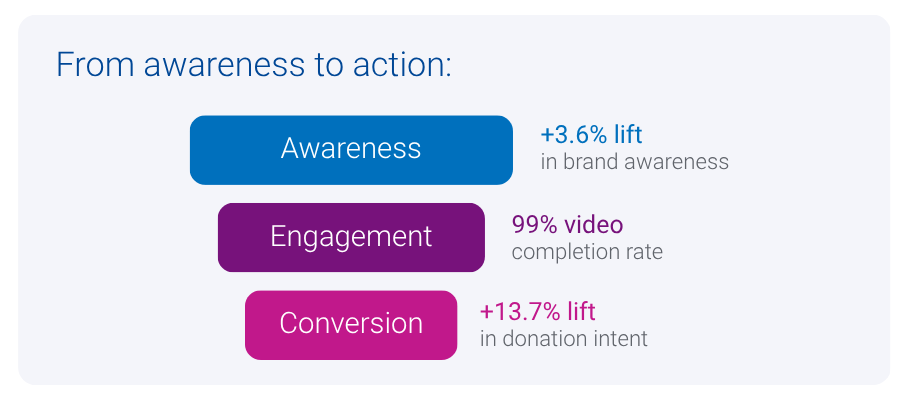
We recently partnered with a national veterans’ organization to raise awareness of its programs for injured or ill veterans and their families. Using the Experian integration, we combined persistent household- and person-level identifiers with cross-device activation to reach veteran and donor audiences more precisely across CTV, display, and rich media. The campaign achieved standout results – industry-leading engagement rates, a 99% video completion rate, and measurable lifts in both brand awareness (3.6 % increase) and donation consideration (13.7% lift). It’s a clear example of how stronger identity and smarter activation can drive meaningful outcomes across the full funnel.
Contact us
Identity resolution FAQs
Identity resolution ensures accurate connections between devices, households, and individuals. Experian’s Offline Identity Resolution and Digital Graph strengthen these connections for improved targeting and consistent measurement across CTV, mobile, and web.
Solutions like Experian’s Digital Graph enable brands to connect first-party data to household and person-level identifiers, ensuring scalable reach and compliant audience targeting legacy signals fade.
Focusing on earned attention (where audiences actively choose to engage) leads to stronger completion rates, improves on-site behavior, and drives measurable increases in brand awareness and consideration.
By linking CTV impressions to households and extending those connections to mobile and web, Experian’s identity solutions ensure campaigns work together seamlessly, reducing over-frequency and improving overall reach.
About our expert

Ben Smith
VP Product, Data Products, Infillion
Ben Smith leads Infillion’s Data Products organization, delivering identity, audience, and measurement solutions across the platform. Previously, he was CEO and co-founder of Fysical, a location intelligence startup acquired by Infillion in 2019.
About Infillion

Infillion is the first fully composable advertising platform, built to solve the challenges of complexity, fragmentation, and opacity in the digital media ecosystem. With MediaMath at its core, Infillion’s modular approach enables advertisers to seamlessly integrate or independently deploy key components—including demand, data, creative, and supply. This flexibility allows brands, agencies, commerce and retail media networks, and resellers to create tailored, high-performance solutions without the constraints of traditional, all-or-nothing legacy systems.
Latest posts

Retailers have always known that building a loyal customer base is the key to success. But whether they’d successfully done so or were still working towards their customer loyalty goals in Q1 of 2020, the global pandemic changed everything. With shoppers shifting purchasing habits almost solely online, retailers with an established online presence were able to navigate stay-at-home orders and other business restrictions. As of June 9, 2020, according to Experian’s Consumer Sentiment Index, half of Americans (47%) are buying more online than they did in the past. So those who previously relied on their brick and mortar business may have had difficulty staying afloat. Undeniably, the landscape has shifted dramatically, and it’s about to do so again as stay-at-home orders are lifted and retailers are being given the green light to re-open, albeit with guidelines and restrictions they’ve never faced before. With so many different messages that need to be shared, and the need to stand out among thousands of other retailers working to grab the attention of the same audience, mobile location data is an important tool in a retail marketer’s arsenal. For example, so much of the in-store experience moved online at the start of the pandemic. As a result, a lot of consumers have gotten comfortable with that format and may be apprehensive about the in-store experience, especially with all the changes required for re-opening. Using mobile location data, retailers can identify audiences that are more likely to return to in-store visits, and tailor messaging to address their questions and concerns to encourage their patronage. They can effectively communicate information surrounding the rules for in-store shopping, including face masks, social distancing, how they plan to protect their clientele, and more. If, after sharing their re-opening information, retailers find customers aren’t coming to them but are instead visiting competitors, mobile location data can help them determine consumer patterns based on competitor shopping to gain a greater understanding of why they’re shopping elsewhere. Using this information, retailers can adjust their outreach to better speak to their target customer and their needs, and encourage their visit with more relevant messaging. And of course, there will still be some customers who feel more comfortable continuing with online shopping. Mobile location data can also assist brands in identifying those audiences so that they can adjust their communications strategies and messages accordingly. Meanwhile, many retailers have shifted from a buy online pick up in store (BOPIS) model to buy online pick up at curbside (BOPAC), both for convenience and safety. As restrictions lift, some will soon be shifting back to BOPIS. Mobile location data can help you determine if this is a more preferred method of shopping by analyzing consumer behavior. If customers aren’t ready for an in-store visit but still have needs that could be met by a particular retailer, that brand can create messaging that supports their desire to do their shopping online and pick up their purchase—whether they come inside or opt for curbside pickup. The more retailers know about their customer’s habits, behaviors and interests, the more they can address their needs and concerns with personalized messaging that can make an impact. Additionally, because so much of life moved online during the pandemic, consumer data may be even more fragmented than before, with their attention spread across multiple devices and channels. Using mobile location data—in combination with demographic and psychographic data—retailers can learn more about consumer behavior, including stores visited, shopping preference insights, hobbies, and more. While the retail industry is facing incredible challenges in the wake of unprecedented change, the right data can help them bridge the gap between where they were, and where they want to be—especially when it comes to nurturing consumer connections. And as retail marketers work on new messaging that shares their unique plans for re-opening and emerging post-pandemic, how that communication is delivered, and who it’s delivered to, could make all the difference in a successful re-opening plan. Contact us today to find out how more about Experian’s retail marketing solutions. And be sure to check out our other retail blog posts as well.

Article written by Jill Canetta, Experian Marketing Services’ Chief Data Officer, and Mark Pryzbylski, Experian Automotive’s Senior Director of Product Management At this point, it’s indisputable that the COVID-19 pandemic has completely changed everything for everyone on a multitude of levels. And now that the country is moving toward easing stay-at-home restrictions and people are starting to venture out into the world, auto marketers are faced with unique challenges amid an uncertain future and customers who aren’t sure of the best step to take next in their ownership experience or potential vehicle purchase journey. However, that uncertainty provides an opportunity for brands to make deeper connections with current customers and interested consumers—provided they can understand and address their customer’s needs in a supportive way. You need to lead with empathetic messaging that directly addresses their needs and offers support during this challenging time. Data is the starting point, and Experian is ready to help. First, you need to understand what consumer outlook looks like on a national scale, in real time. Using insights gleaned from consumers across the country, Experian created a US Consumer Sentiment Index built on daily survey findings that outlines what customers are thinking and how they’re feeling during COVID-19. As of June 10th, 2020: 44% have automobile payments they need to make monthly, with Millennials and Gen X leading the pack at 50% 21% are considering buying a new vehicle within the next few months, with Millennials at the forefront of this drive at 16% Of those considering a new vehicle, 63% will continue with their purchase as planned, 42% will buy something less expensive, and 18% will consider leasing, with Gen Z leading the last two these categories Certainly, this data can help auto marketers glean the information they may need to begin targeted outreach, especially when sentiment shows there’s still a need and desire to own, lease or rent a vehicle. But this is only part of the picture. To create a complete view of the customer, marketers need to fill in the blanks so they can thoroughly address their needs and let them know they’re both ready to help, and capable of doing so. For example, due to the changing landscape, it’s unlikely that dealership walk-in traffic is going to present the same opportunities for purchase that it once did. This means marketers will have to leverage new avenues to execute their outreach. Using the power of data, auto marketers can identify those who are most likely to be in the market for a new vehicle, such as those coming to end of lease or those who are soon to be in equity on their current vehicles. But how can this information help you in your outreach efforts? Demographic, behavioral, life event, lifestyle, automotive and attitudinal data can help you tailor a compelling message to address their stage of ownership—and potentially address their new or emerging needs as a consumer. Perhaps their child is starting college in the fall and needs a vehicle. Or maybe they’ve downsized and don’t need an SUV anymore, so a compact car would better fit their needs. When it comes to leaseholders, data can show you which leases are coming up for renewal or termination. Regardless of their situation, leaseholders will need to decide on their future vehicle needs whether it means buying their car, leasing another, or going in an entirely new direction—one that may potentially be more cost effective to address the issues they may suddenly be facing. Beyond identifying your target audience, you need to understand how to reach them. We also offer the opportunity for multi-channel media activation, leveraging our relationships with more than 100 media partners and digital platforms to launch and optimize your one-to-one marketing campaign across all channels. And to help you determine the ROI of your offline and online campaigns, our measurement tools help you gain actionable insights for future campaigns with easily digestible dashboards and reports. As we all adjust to the new landscape and find different ways to navigate the current environment, marketers need to be cognizant of how they’re targeting new consumers—especially when the landscape appears to be unstable. By addressing consumers with relevant and thoughtful messaging that supports their needs, marketers now have the opportunity to create deeper connections that can create loyalty that lasts a lifetime. Learn more about how the Experian Marketing Engine for automotive marketers can help.

It’s been more than two months since COVID-19 was declared a national emergency on March 13 and since that time, consumers have dealt with a lot of uncertainty and fear—ranging from the health and safety of their families to financial stability and beyond. With the prospects of returning to normal changing every day, consumers’ feelings around the pandemic and how they’ve adjusted have also shifted and will continue to do so in the months ahead. But just as the situation has been unprecedented for consumers, businesses are also in uncharted territory. Many have had to adapt operational strategies, while maintaining their ability to service their customers. Now, with stay-at-home orders beginning to lift and the easing of business restrictions in most states across the country, organizations will need to listen to their customers to help inform strategy moving forward, including reopening and operating in a post-pandemic environment. To help, we instituted a survey of the general population to better assess how consumer sentiment is shifting during the pandemic. In the five weeks since the data was made available on April 1, we’ve identified trends across a number of key areas of interest. General observations Less than a third of Americans (29%) are satisfied with their current situation; which has been fairly consistent throughout the five weeks.Women appear to have been quicker to grasp the seriousness of COVID-19 and feel the impact of the pandemic on their livelihood. Overall sentiment among women has improved but still remains lower than men. Americans experiencing minimal impact tend to be:Millennial males, residing in western urban areas who rent.Those less likely to watch the media and spend more time on entertainment.Only 10% of Americans are still willing to take on risk—buying investments and assets. Millennials tend to be more optimistic and actively taking on debt, seeking financial advice, buying assets/investments, considering new vehicle purchases. Retail spending heavily impacted 43% of consumers are cutting back on overall retail spend.Groceries and entertainment are the only categories that have experienced increases in retail spending compared to the past month throughout the five-week period. Spending on discretionary purchases like clothing, shoes, accessories, beauty and wellness has been significantly down for the past month.Baby Boomers and to a lesser extent, Generation X have been cutting back spending everywhere except groceries, but Generation Z respondents increased spending in most categories compared to the past month in the most categories. Americans experiencing financial hardship Half of American households are experiencing financial hardship; though the percentage has improved slightly from the beginning of April. Of those experiencing financial hardship, 74% have concerns about their ability to access food and essentials in the next month.More Americans have a financial reserve they can draw on than a month ago, suggesting consumers are adjusting and reducing their risk. The percentage of Americans who believe their situation will get better in the next month or so has increased. Feelings about healthcare remain consistent 62% of respondents are concerned about visiting the doctor, and 37% are evaluating alternative care methods. Health concerns remain prevalent, but Americans are a little less concerned about filling prescriptions than a month ago. A little more than half of Americans are confident of their ability to pay medical expenses if a family member contracts COVID-19 and requires hospitalization—a small improvement since the survey began (46%). Increased media consumption 58% of respondents are spending more time on home entertainment, including streaming services, social media and video games.The survey shows Netflix has benefitted the most from increased TV/movie consumption; but other services have experienced strong gains. Nearly one-third of Americans have increased their video game play during the COVID-19 pandemic; though the percentage is down from its peak in mid-April.Baby Boomers are more likely to have increased their viewing of Cable TV, but much less likely to have increased consumption of any other media sources.Generation Z and Millennials are increasing consumption of a broader array of media, including Instagram, YouTube, video games, Snapchat, Spotify and Tik Tok. How do businesses move forward? Using insights to inform strategy With much of the focus for politicians, local community leaders and health experts shifting to reopening businesses and public establishments, we have to keep in mind, the post-pandemic environment will look much different than what it was just a few months ago. Just because businesses get the green light to open, there may be hurdles to return to “business as usual.” Consumers’ appetite to resume normal engagement with businesses will vary. For instance, some may opt for curbside pickup or delivery options for retail purchases or telehealth services for routine medical needs. Businesses need to adapt to the customer. In an ecosystem driven the customer experience and human connection, gauging consumer sentiment and preference will be a crucial first step. The road ahead will be long, but the more businesses understand their customers, the better positioned they will be to deliver effective communications and also make strategic investments. What programs and initiatives can be started to better serve customers? What areas can be cut to save costs? Our world was turned upside down the last two months and continues to change every day with still many unknowns. As businesses plan for the next few months and beyond, it’ll be critical to understand how consumer mindsets and behaviors are shifting. Relevancy has always been mission critical, but now, more than ever, businesses need to have consumers at the center of their strategies.