
Loading...

Three insights from our 2023 Holiday spending report

Published: September 14, 2023 by Hayley Schneider

Three expert holiday spending insights for 2023

The holiday season is just around the corner, and retailers and marketers are gearing up for the busiest shopping period of the year. It’s crucial to understand how consumer behavior is evolving and what emerging trends to expect. Experian’s 2023 Holiday spending trends and insights report analyzes recent trends, consumer spending habits, and anticipates what’s to come in 2023 to help you deliver a top-notch shopping experience this holiday season.

In this blog post, we’ll cover three key insights from our report.

1. Consumers are shopping earlier

It’s no secret that December has always been the go-to month for consumers when it comes to holiday spending. However, holiday shopping now starts earlier, particularly with online sales.
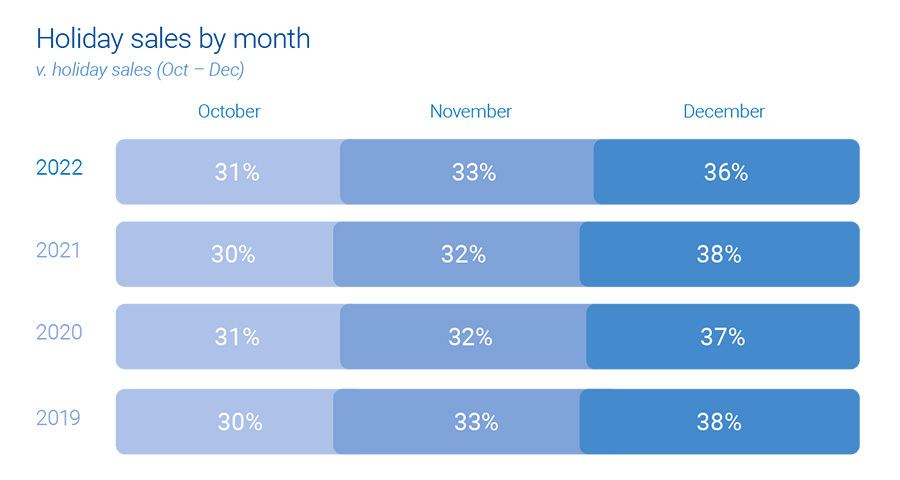
A chart that shows holiday sales by month (October-December) from 2019-2022.

This can be attributed to a surge in promotions and deals, enticing shoppers to open their wallets ahead of time, giving a significant boost to holiday sales. Notably, Cyber Week sales have proven to be an influential factor, accounting for 8% of total consumer holiday spending.

Experian tip

Reach the right shoppers with your promotions with sell-side targeting. This powerful approach gives you control over where your ads are placed while ensuring maximum visibility through direct connections with publishers. Whether on mobile, web, or CTV, this seamless ad experience will engage your audience effectively.

2. Online sales are on the rise

The popularity of online holiday sales is continuously growing, surpassing in-store shopping. There has been a consistent 1% year-over-year increase in online sales, while in-store sales have seen a 1% decrease.

“It’s easier for consumers to comparison shop for large ticket items online that they might find at a mass retailer or office supply store. Consumers prefer to have larger, bulkier items shipped directly to their home for minimal cost. By shopping online, consumers can save time since they don’t need to wait in checkout lines.”

Anna Liparoto, Sr. Account Executive, Retail & CPG
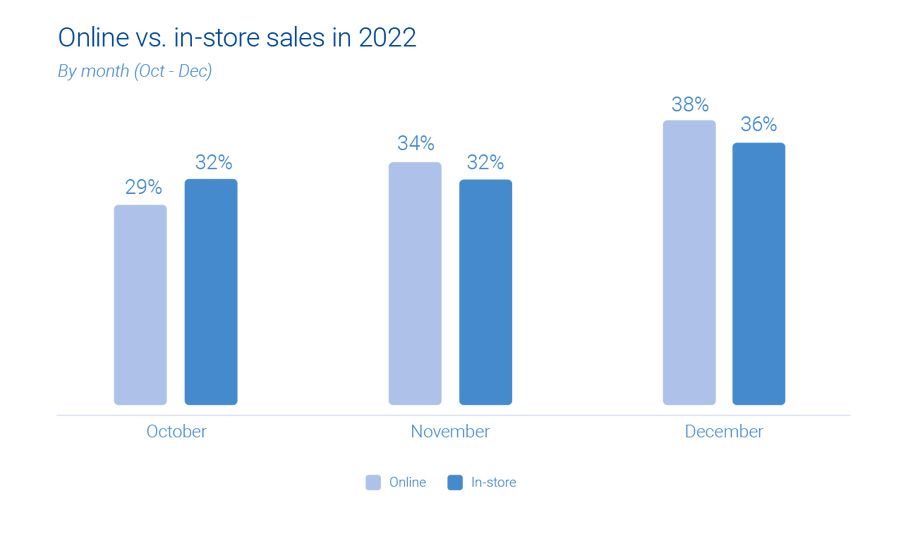
A chart that shows online vs. in-store sales in 2022 from October-December.

Although online sales currently make up only one-third of all holiday shopping, there is immense potential for further expansion. Mass retailers and office, electronics, and games industries particularly excel in online holiday sales. While in-store purchases remain the primary choice for holiday shoppers, consumer online and offline activities intersect before the final purchase.

Experian tip

Take advantage of the surge in online shopping by diversifying your marketing channels. An agnostic identity graph can bring together device and media data, capturing valuable user insights. By gaining a holistic view of your target audience, you’ll be able to optimize your ad spend and allocate resources effectively, ultimately boosting your return on investment.

“Omnichannel targeting during the upcoming holiday season will continue to prove to be the best way to reach scale and maximize ROI across all marketing channels.”

Joe LigÉ, Head of Enterprise Demand Partnerships

3. 2023 holiday spending will be on par with 2022

During the holiday season in 2022, consumer spending showed an anticipated increase, although the growth rate was slightly lower compared to previous years. October saw a surge in average consumer spending, indicating a swift response to early discounts and promotions offered by retailers.
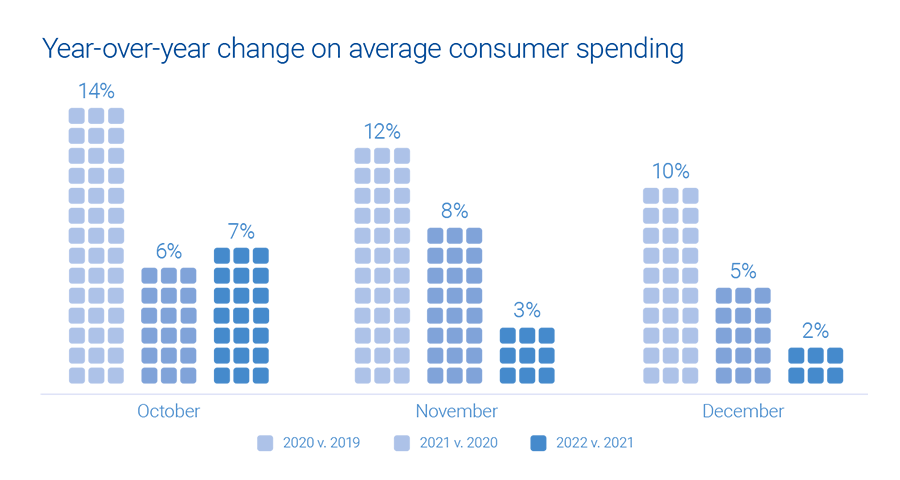
A chart that shows the year-over-year change in consumer spending from 2019-2022 from October-December.

As the holiday season progressed, holiday spending gradually slowed down and reached a level similar to that of the previous year. Overall, there was a modest 2% growth. Looking into the future, if economic conditions remain stable in the second half of 2023, we can expect holiday spending to align with the figures from last year.

Experian tip

To truly maximize impact, consider data enrichment. By diving deeper into your target audience’s preferences and behaviors, you can better tailor your strategies and seamlessly integrate the enriched data across various channels. This allows you to unlock the true potential of your ad inventory, creating more meaningful connections with your audience.

Download our 2024 report

Get ready for the holiday shopping season with Experian’s 2024 Holiday spending trends and insights report. Inside you’ll find:

  • Analysis of past trends and what they mean for 2024
  • Exclusive predictions for the upcoming holiday season
  • The top audiences to activate this holiday season

To access to all of our predictions for this year’s holiday shopping season, download our 2024 Holiday spending trends and insights report today.


Latest posts

Loading…
Checking off my shopping list

Hi, Dana here with an update on my holiday shopping post from before Thanksgiving. Like I thought, I was able to get most of my shopping done that Black Friday weekend. It was all pretty fast and easy, but I did have one not so great experience too. My sister knew I was going to get something for my niece, so when she got an email from Toy World that everything would be 50% off on Black Friday she forwarded it to me to let me know. I was thrilled. I had done some searching for good toys this year and had some ideas. While I normally would shop online, the Toy World coupon said the 50% off was in-store only so I braved the crowds for a good deal. Unfortunately, when I got there I learned that the email was wrong – only select items were 50% off and others were buy one, get one 50% off. I was pretty upset because the hottest toys were the ones excluded from the deal. I came all that way based on the email. I wound up getting a gift, but I could have saved myself the hassle and long lines, especially since I didn’t get a deal that was different from any other day. That was a rough start to the shopping weekend, but, no worries, things improved. I have to tell you about my best shopping experience – I’ve been telling everyone! This year I used Pinterest to see what my mom has had her eye on lately. One of her pins is a food processor and I think that’s a perfect gift for her. I’m a card holder and reward member at Aaron’s department store and I know they carry some really nice kitchen appliances. They also happened to send me great Cyber Monday coupons in the mail – it was perfect timing. I went online on Cyber Monday, used the promo codes from the coupons and not only got great deals, but got free shipping too! How easy was that?! They also sent me shipping notifications so I knew exactly when to expect the package. I am really happy that I got something great for everyone on my list and now have time to enjoy the rest of 2012. I hope you enjoy it too! XOXO, Dana   Editor’s note: You can tell that Aaron’s knows Dana. They used their direct mail piece to send her online offers because they know that’s her preferred purchase method. They’ve won her over once again and created a brand advocate. Learn where your company stands in your marketing efforts today, and how you can help move efforts forward to ensure your customers have good experiences like Dana had with Aaron’s, and avoid bad ones like her trip to Toy World.

Dec 17,2012 by

Online retail visits increase 5% year over year week of Dec 2 – 8

With the busy holiday marketing season in full swing, Experian Marketing Services has released its online retail round-up for the week ending December 8. The online traffic to the top 500 retail sites increased 5% for the period of December 2 – 8, compared to the same week in 2011. Additionally, Amazon remained the top visited site among retailers, followed by Walmart and Target.   The chart below includes the top 10 results: Experian Marketing Services also tracks top product searches.  Listed below are the top 5 product searches for the week ending December 8: Uggs iPad mini iPad Beats by dre Ipod touch We will continue to publish weekly retail site data and insights through this holiday season.  Please leave us a comment below if you have any specific questions along the way. Learn more about the author, Matt Tatham

Dec 14,2012 by Experian Marketing Services

Young adults: Texting is just as meaningful as a phone call

Twenty years ago this week, the first mobile text message, or SMS, was sent by British engineer Neil Papworth. Today, Americans are texting more than ever and among young adults, many of whom were not yet born when the first message was sent, texting is almost as common a mobile activity as talking. And why wouldn’t it be? According to the latest Simmons National Consumer Study, 48% of adults ages 18-to-24 say that a conversation via text message is just as meaningful as a telephone call. A similar share of adults ages 25-to-34 feel the same way. Regardless of age, texting is still, technically, the second most common activity that Americans engage in on their cell phone after talking. During a typical week, 95% of mobile adults talk on their mobile phone, while 59% text. Among adults ages 18-to-24, however, 89% talk on their phone and 85% text. Despite the increasing availability of mobile chat or instant message applications, texting remains the dominant means for exchanging short messages. Only 8% of all mobile adults use their phone to IM or chat. The fastest thumbs To get a more in-depth understanding of the texting habits of adults today, we leveraged data from the Simmons Connect mobile panel of 1,485 U.S. smartphone owners. Hands down, young adults text more than any age other age group. During a typical month, in fact, smartphone-owners ages 18-to-24 send 2,022 mobile text messages and receive another 1,831 for a combined total of 3,852 texts sent and received. With every age bracket we move up, the number of mobile texts drops by roughly 40%. For instance, smartphone owners ages 25-to-34 send, on average, 1,110 text messages a month and receive another 1,130 for a combined total of 2,240 messages. We are also able to leverage the Simmons Connect smartphone panel to understand mobile calling behaviors. The data shows that while young adults hold the record for the most text messages sent and received, they actually make and receive few calls, by comparison. During a typical month, smartphone owners ages 18-to-24 make 119 calls on their mobile phone and answer another 64 calls. Adults ages 35-to-44 make and receive the most calls on their mobile phones in a given month. (Call counts do not include inbound and outbound calls that go unanswered.) Text around the clock Unlike television and radio, which have peak hours for reaching consumers, mobile text messages reach Americans throughout the day, providing advertisers with a medium to connect with consumers any time they want or need. No surprise, young adults are the most likely to send and receive mobile text messages throughout the day. The smartphone panel data shows that during every hour between 8:00 A.M. and midnight, more than half of young smartphone owners are both sending and receiving mobile text messages. Even when most of us are asleep, young adults’ smartphones continue buzzing from inbound texts. In fact, 37% of 18-to-24 year-old smartphone owners receive texts at 4:00 in the morning. By comparison, just 20% of smartphone-owners ages 25-to-34 years-old receive texts at this late (or early) hour as do 17% of those 35-to-44, 15% of those 45-to-54 and 10% of those ages 55 and older. Better to send or to receive? During overnight hours, the share of young smartphone owners who send texts surpasses the share who receives them. However, by 8:00 A.M., the difference between those two figures narrows to the point that they are nearly equal. In fact, from noon until 11:00 P.M., young adults are more likely to send mobile text messages than they are to receive them. Call or text? While texting is still a secondary use of mobile phones after calling, that’s not the case all day, especially among young adults. In fact, while smartphone owners ages 18-to-24 are more likely to make an outbound call than they are to send a text from their phone between 7:00 A.M. and 10:00 P.M., they are more likely to send a text between 11:00 P.M. and 6:00 A.M., during hours when they might understandably wake the recipient. That should help us all sleep a little better.

Dec 03,2012 by

Subscribe to our newsletter

Enter your name and email for the latest updates

This site is protected by reCAPTCHA and the Google Privacy Policy and Terms of Service apply.

About Experian Marketing Services

At Experian Marketing Services, we use data and insights to help brands have more meaningful interactions with people. As leaders in the evolution of the advertising landscape, Experian Marketing Services can help you identify your customers and the right potential customers, uncover the most appropriate communication channels, develop messages that resonate, and measure the effectiveness of marketing activities and campaigns.

Visit our website

Subscribe to our newsletter

Stay up to date on the latest industry news and receive expert tips from our marketing experts.
Subscribe now!