
Loading...

Three insights from our 2023 Holiday spending report

Published: September 14, 2023 by Hayley Schneider

Three expert holiday spending insights for 2023

The holiday season is just around the corner, and retailers and marketers are gearing up for the busiest shopping period of the year. It’s crucial to understand how consumer behavior is evolving and what emerging trends to expect. Experian’s 2023 Holiday spending trends and insights report analyzes recent trends, consumer spending habits, and anticipates what’s to come in 2023 to help you deliver a top-notch shopping experience this holiday season.

In this blog post, we’ll cover three key insights from our report.

1. Consumers are shopping earlier

It’s no secret that December has always been the go-to month for consumers when it comes to holiday spending. However, holiday shopping now starts earlier, particularly with online sales.
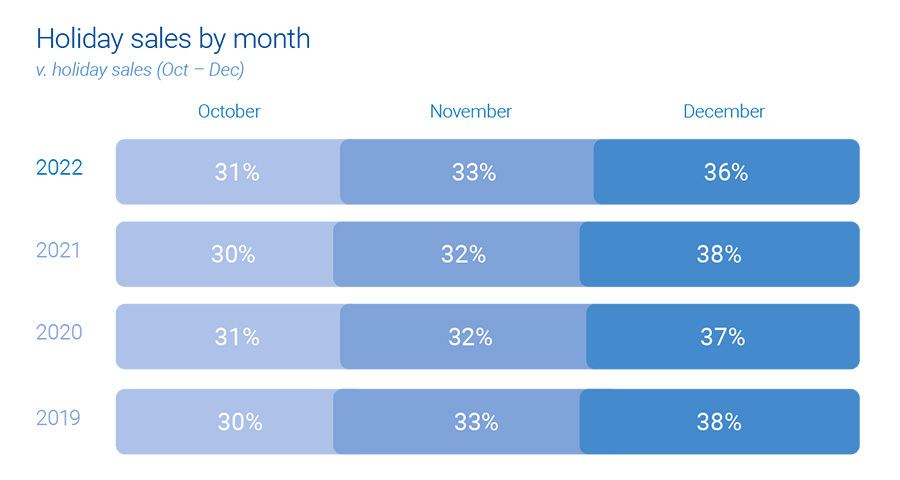
A chart that shows holiday sales by month (October-December) from 2019-2022.

This can be attributed to a surge in promotions and deals, enticing shoppers to open their wallets ahead of time, giving a significant boost to holiday sales. Notably, Cyber Week sales have proven to be an influential factor, accounting for 8% of total consumer holiday spending.

Experian tip

Reach the right shoppers with your promotions with sell-side targeting. This powerful approach gives you control over where your ads are placed while ensuring maximum visibility through direct connections with publishers. Whether on mobile, web, or CTV, this seamless ad experience will engage your audience effectively.

2. Online sales are on the rise

The popularity of online holiday sales is continuously growing, surpassing in-store shopping. There has been a consistent 1% year-over-year increase in online sales, while in-store sales have seen a 1% decrease.

“It’s easier for consumers to comparison shop for large ticket items online that they might find at a mass retailer or office supply store. Consumers prefer to have larger, bulkier items shipped directly to their home for minimal cost. By shopping online, consumers can save time since they don’t need to wait in checkout lines.”

Anna Liparoto, Sr. Account Executive, Retail & CPG
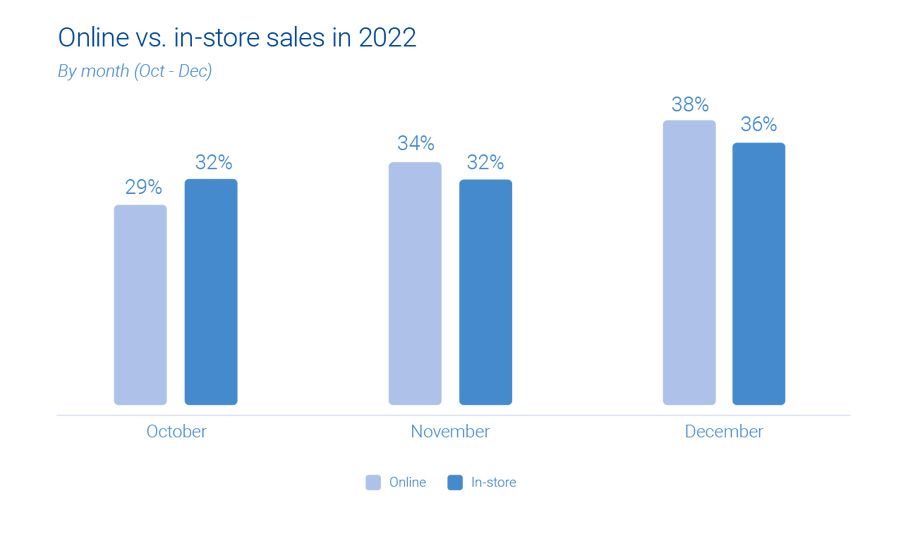
A chart that shows online vs. in-store sales in 2022 from October-December.

Although online sales currently make up only one-third of all holiday shopping, there is immense potential for further expansion. Mass retailers and office, electronics, and games industries particularly excel in online holiday sales. While in-store purchases remain the primary choice for holiday shoppers, consumer online and offline activities intersect before the final purchase.

Experian tip

Take advantage of the surge in online shopping by diversifying your marketing channels. An agnostic identity graph can bring together device and media data, capturing valuable user insights. By gaining a holistic view of your target audience, you’ll be able to optimize your ad spend and allocate resources effectively, ultimately boosting your return on investment.

“Omnichannel targeting during the upcoming holiday season will continue to prove to be the best way to reach scale and maximize ROI across all marketing channels.”

Joe LigÉ, Head of Enterprise Demand Partnerships

3. 2023 holiday spending will be on par with 2022

During the holiday season in 2022, consumer spending showed an anticipated increase, although the growth rate was slightly lower compared to previous years. October saw a surge in average consumer spending, indicating a swift response to early discounts and promotions offered by retailers.
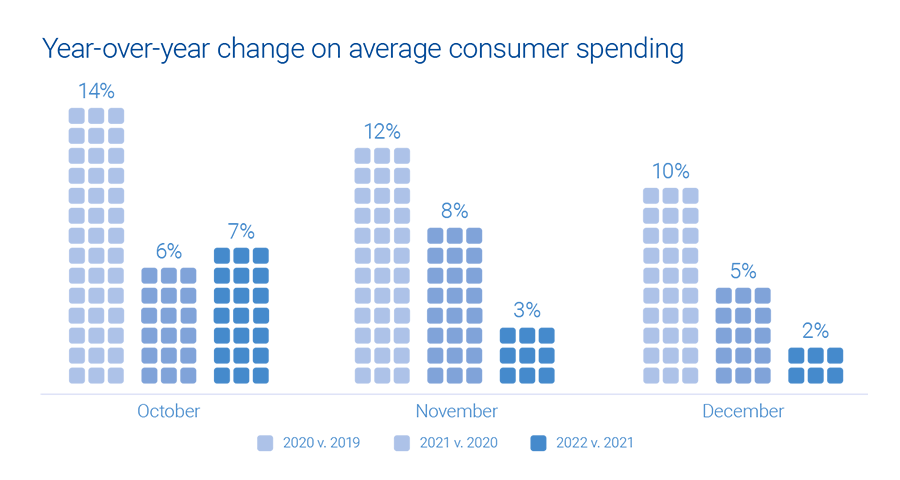
A chart that shows the year-over-year change in consumer spending from 2019-2022 from October-December.

As the holiday season progressed, holiday spending gradually slowed down and reached a level similar to that of the previous year. Overall, there was a modest 2% growth. Looking into the future, if economic conditions remain stable in the second half of 2023, we can expect holiday spending to align with the figures from last year.

Experian tip

To truly maximize impact, consider data enrichment. By diving deeper into your target audience’s preferences and behaviors, you can better tailor your strategies and seamlessly integrate the enriched data across various channels. This allows you to unlock the true potential of your ad inventory, creating more meaningful connections with your audience.

Download our 2024 report

Get ready for the holiday shopping season with Experian’s 2024 Holiday spending trends and insights report. Inside you’ll find:

  • Analysis of past trends and what they mean for 2024
  • Exclusive predictions for the upcoming holiday season
  • The top audiences to activate this holiday season

To access to all of our predictions for this year’s holiday shopping season, download our 2024 Holiday spending trends and insights report today.


Latest posts
Loading…
One million more households became cord-cutters last year

With online video viewing at an all-time high and television networks and system providers increasingly making video content available to those who don’t pay for television, many are wondering if we’re on the cusp of a massive spike in cord-cutting numbers. In our recent Cross-Device Video Analysis, Experian Marketing Services found that that 7.3 percent of all U.S. homes are cord-cutters, meaning they have high-speed Internet but don’t pay for TV. And the pace is increasing. In the last year alone, one million more homes joined the cord-cutter ranks bringing the total to 8.6 million households. It should come as little surprise that cord-cutting is on the rise. As we reported in our video viewing habits post, 57 percent of all American adults and 75 percent of Millennials now watch some sort of digital video during a typical week with the smartphone being the most commonly used device for watching video either streamed or downloaded from the Internet. Consumers thinking about cutting the cord will find an industry increasingly working to remove barriers that typically stand between cord-cutters and programming from their favorite networks — in exchange for a small fee. For instance, CBS recently announced the launch of CBS All Access, a digital subscription service that provides live and on demand viewing of CBS programming. And Dish Network launched Sling TV, an over-the-top pay service that allows cord-cutters to stream live and recorded programming from networks like ESPN, Univision, CNN, HGTV and more. With HBO announcing an April launch of their digital-only streaming service, HBO Now, March may be the last month that many pay for cable or satellite. If the cord-cutting ranks are, in fact, about to swell, a common question is: by how much? Experian Marketing Services estimates that there are currently 13.8 million Americans — representing 5.6 million homes — who are prime to cut the cord. Many of those individuals already have one foot out the door, if you will, given that they are more likely than average to say that they watch less television today because of the Internet. They are also more likely to watch HBO and be fans of at least one major professional sport making them good targets for Sling TV and HBO Now. Given that many cord-cutters already pay for Netflix and/or Hulu Plus, the net savings to those on the fence may be smaller than they think once they add up the costs they’ll assume from piecing together, à la carte, the various subscriptions and downloads required to keep watching their favorite programs. Whether or not we’re on the cusp of a major spike in cord-cutting, the fact is that consumers are increasingly getting their video content from digital sources and marketers need to understand where, how, when and what consumers are watching to ensure that their video campaigns are optimized for today’s digital consumer. For more information about cord-cutters and cross-device video consumption, including consumer receptivity to digital video advertising, download the Cross-Device Video Analysis.

Mar 06,2015 by

The digital consumer in 2015: Smartphone activities, TV multitasking and cord cutting

Advertising Age recently released their annual Marketing Fact Pack, featuring data from Experian Marketing Services that looks at habits of digital consumers. This post highlights some of these findings.  In the 2015 AdAge Marketing Fact Pack, we featured stats on key marketing and consumer trends impacting the advertising industry. Highlights include the lifestyle of the digitally connected consumer, including the habits of smartphone and television users, household and personal use of smart devices and the choice between becoming a cord-cutter and staying connected. An estimated 7.3 percent of U.S. households (8.6 million homes) today are considered “cord-cutters,” meaning they have high speed Internet but no cable or satellite television service. That number is up from 4.5 percent of households (5.1 million homes) in 2010, a comparative increase of 60 percent. Despite the growing number of consumers who use digital devices to watch video (as opposed to viewing on a television), it has not been enough to overwhelmingly convince all households to cut the cord. Instead, it seems as if the ability to stream or download video directly to the television is what ultimately seals the deal. As streaming devices like Roku, Apple TV, Amazon Fire TV and Google Chromecast become more common and as televisions themselves are increasingly connected to the Internet directly, we can only expect the number of cord-cutters to grow. To learn more about video viewing behaviors to improve your strategies for reaching digital consumers, register to join our upcoming webinar Online video: engaging consumers in a multi-screen world.

Feb 11,2015 by

Meet today’s 5 distinct mom segments

The next generation of mothers have emerged and they are under more pressure than ever before. In addition to balancing work and family life, moms have the added stress of making sure they are keeping their children safe in our digital-focused society. Moms today have access to a myriad of online information including communities where members can address everything from the elimination of processed foods from their family’s diet to whether or not to vaccinate their children. In a recent in-depth analysis, Experian Marketing Services identified five distinct segments of moms and revealed their attitudes, behaviors, motivations and media and consumer preferences. With these insights, marketers can effectively target and engage each segment with more personalized messages. Striving Moms – This segment accounts for 27 percent of moms. They are predominantly young, diverse, often single women who have confidence and aspirations of success. Fast facts: They commonly view money as the best measure of success They are more likely to have kids under the age of five They are tech-savvy and the segment most likely to say they need to be connected to the Internet from the minute they wake up until the moment they go to sleep They have a keen sense of fashion and are tuned in to current styles and consumer trends Conventional Moms – This segment accounts for 20 percent of moms. Although most of them have full-time jobs, family still comes first and faith plays an important role in their life. Fast facts: They are the most likely to drive an SUV or mini-van While discretionary income is plentiful, they have little interest in shopping They are active on social media; they like to post photos, write product reviews and read articles shared by friends They often turn to prepared foods or simple recipes to put food on the table due to their busy schedules Alpha Moms – This segment accounts for 19 percent of moms. They are high octane lean-in moms, early adopters and trendsetters with full-time jobs and packed calendars. Fast facts: They wear designer clothes, drive the latest model car or SUV and have the latest electronics They will do whatever it takes to keep a youthful appearance The environment is important is to them, and they are supporters of the arts They are heavy users of social media and leverage it to interact with brands and share opinions Modest Moms – This segment accounts for 16 percent of moms. Like conventional moms, they are family and faith-oriented but they have more modest means and prefer a simple life. Fast facts: They prefer to indulge their kids with the funds they have rather than buy shiny new gadgets Family and faith are the most important things to them Nearly one-third are stay-at-home mothers Their main source of entertainment is watching television They are heavy users of social media and leverage it to interact with brands and share opinions Maverick Moms – This segment accounts for 18 percent of moms. They are independent trailblazers who are not afraid to make unconventional life choices. Fast facts: They are environmentally conscious, spiritual and prefer to buy organic and natural products While they are the most likely to be stay-at-home moms, they are also the most likely to own their own business They lead uncomplicated lives and use technology and social media with caution They prefer to postpone purchases for special occasions and have no trouble saying no to their kids Want more insights? Check out The Mom Report for deeper insights into the attitudes, behaviors, motivations and media and preferences of these five types of moms. You’ll discover tips to help target your best customers and craft messaging and offers that are sure to resonate.  

Jan 29,2015 by

Subscribe to our newsletter

Enter your name and email for the latest updates

This site is protected by reCAPTCHA and the Google Privacy Policy and Terms of Service apply.

About Experian Marketing Services

At Experian Marketing Services, we use data and insights to help brands have more meaningful interactions with people. As leaders in the evolution of the advertising landscape, Experian Marketing Services can help you identify your customers and the right potential customers, uncover the most appropriate communication channels, develop messages that resonate, and measure the effectiveness of marketing activities and campaigns.

Visit our website

Subscribe to our newsletter

Stay up to date on the latest industry news and receive expert tips from our marketing experts.
Subscribe now!