
At Experian, we know a credit score is the gatekeeper to better financial opportunities, which is why we are committed to developing products and services that support consumers in their financial journey. Six months ago, we hit a major milestone in bringing this commitment to life with the launch of Experian Boost. This innovative tool gave consumers the ability to add positive telecom and utility payment history directly to their credit file for an opportunity to instantly increase their credit scores for the first time. When we launched Experian Boost, we knew there were more than 100 million Americans who didn’t have fair access to credit because of a limited credit history or a subprime score. We also knew these consumers were often forced to pay higher interest rates and fees for financial services. Today, as we look at our Experian Boost results, we know we’re helping to change that. To date, for consumers who’ve used Experian Boost, we’ve seen: More than 11 million cumulative FICO Score points boosted FICO Scores increased for 2 out of 3 users with an average increase of more than 10 points Of those who boosted their credit scores, an average of 13% moved up a credit tier and of those in the “poor” credit tier, 24% moved to a “fair” tier Approximately 90% of “thin” file consumers who improve their credit scores saw an average increase of 19 points California, Texas and Florida rank 1-2-3 in number of consumers who have boosted their scores and total points boosted To say we’re pleased with the positive feedback we’ve received about Experian Boost to date would be an understatement, but we’re not surprised. For years, lenders have been seeking new means to identify creditworthy consumers. At the same time, consumers have been asking for more control of their data and credit where credit is due. This is exactly what we’re providing with Experian Boost. We’re helping to level the playing field and reward positive behavior and it’s not going unnoticed. Members of the credit counseling and advocacy community have reached out with excitement about Experian Boost. This solution is giving many of their clients a tangible way to impact their credit scores and improve their financial lives. Improving consumer financial health is a core part of our sense of purpose and we’re just getting started. We’ll continue to enhance Experian Boost and develop new products and solutions to improve financial access to for more consumers. To find out more about the Experian Boost, please visit www.experian.com/boost.

Eva lets out a deeply frustrated exhale as she navigates moving boxes in her new apartment towards a nearby chair. She was just trying to update her address online and take care of some online banking money transfers. Now her accounts are frozen, and she has received a message to call the bank's fraud department. How could she be a fraudster? She was only guilty of taking a job and moving to Chicago. Maybe it's time to start thinking about changing banks… Meanwhile, in the bank's Texas-based fraud department, Robert spots Eva's case in his fraud investigations list. He noticed some suspicious activities and leaves Eva a voicemail, wanting to ask her a few questions to verify her identity or otherwise confirm this is in fact a fraudster infiltrating Eva's account. To prevent this potential risk of fraud from escalating, Robert decides it is better to freeze Eva's accounts while he confirms that it's actually Eva who is trying to change her address and not a fraudster using a stolen password. As both Robert and Eva work to connect and clear up this mix-up, Robert isn't getting to spend his time finding actual fraud and protecting his bank from any potential losses. Fraud hubs bring together advanced authentication technology and risk mitigation systems into a single platform As fraud attacks grow more frequent and complex, new technologies have sprung up to help meet the challenge, using a variety of tactics and tools to detect fraud. This is the case of device recognition, malware detection, identity verification, behavioural biometrics, and document verification, just to name a few. Regardless of their choice of tools and techniques, businesses across banking, retail, telecommunications, healthcare, and services industries need to know that the person interacting with them online is who they say they are. Combating fraud with layered tools strengthens businesses' defenses. But without an intelligent approach to connecting those tools, businesses catch too many good customers (like Eva) in their fraud-mitigation nets. By bringing together different types of fraud mitigation and risk management systems on a single technology platform, fraud hubs provide a solid solution to this challenge. How do fraud hubs like CrossCore help both businesses and consumers? CrossCore brings together into a single platform best-in-class tools and services such as advanced analytics, data consortium, device recognition, endpoint malware, and bot detection, behavioural biometrics, and document verification. Experian has also been named by Gartner as a representative vendor in online fraud detection in their April 2019 Market Guide for Online Fraud Detection, for its CrossCore solution.* Our flagship identity and fraud hub connects various functionalities together in a smart, orchestrated way, leveraging machine learning-driven decisioning to deliver a single fraud decision across multiple tools and enabling businesses worldwide to improve their fraud detection capabilities. CrossCore equips businesses with the most applicable tools to combat the specific fraud threats they face in their organisation. The 100 million cumulative transactions we have run on CrossCore to date show us that while one client may need additional protection against synthetic identity fraud, another may face frequent bot attacks in their account opening application, therefore requiring different approaches. It also means that if one tool can't validate a user's identity, another system can provide evidence that this is, in fact, a real customer. It's precisely the advanced analytics underpinning data modeling what gives our clients greater confidence in their identity and fraud decisions. But let's go back to Eva. In her case, CrossCore's fraud risk engine would have fired rules when she was making a change of address, as this action elevates the potential for fraud. But CrossCore's device intelligence would have shown that Eva was logging in from a known mobile phone. She was also using her phone to type information in a way that a normal user (non-fraudster) would do. In that case, CrossCore would have asked for a step-up authentication where Eva is prompted to take a selfie for biometric authentication. Now, Eva can continue to do her banking and access her accounts as she would normally do. This is a relief as Eva checks off more moving-related tasks and can enjoy her new life in a new city. Back in the bank's fraud investigation office, Robert and his colleagues would have never seen a case for their customer, Eva. Instead, they would have been able to focus their energies on high-risk cases, mitigating any emerging fraud threats. They would have also treated Eva as the good, valued customer she is and helped ensure her business in the long run. Whether it's an automotive client in South Africa, a healthcare organisation in the U.S., an insurance company in the UK, a fintech in Australia or a bank in Brazil, CrossCore is helping to solve one of the greatest challenges in decision analytics today: identifying good customers, while reducing fraud. Download the 2019 Global Identity & Fraud Report. *Gartner does not endorse any vendor, product or service depicted in its research publications, and does not advise technology users to select only those vendors with the highest ratings or other designation. Gartner research publications consist of the opinions of Gartner's research organization and should not be construed as statements of fact. Gartner disclaims all warranties, express or implied, with respect to this research, including any warranties of merchantability or fitness for a particular purpose.

As a member of the Forbes Technology Council, I get to publish articles on some of the latest technology trends and best practices. A recent piece, entitled “Are we comfortable with machines having the final say?”, deals with the sensitive issue of decisions being made by complex algorithms and how it impacts all areas of our lives. The article takes a closer look at high-impact decisions, such as loan determinations and health diagnosis, where the lack of understanding how algorithms may be used is becoming of increasing concern. In this context, it raises the importance of Explainable AI (XAI). This is a concept where technology and science are being used to explain how an algorithm or machine reaches a decision and tries to do this in a way that is transparent to users. However, this approach is still being tested and is only used in certain limited circumstances. As humans, we are taught to explain our decisions but we all know how difficult it is – and science has repeatedly shown how easily biased we are. XAI still has some way to go, but we can inspect, test and pick machines apart in a way we can never do with the human mind. So perhaps one day we will find a way to truly explain a machine’s decision. Whether that would make us comfortable with the machines having the final say, is still to be seen. Check out the full article here.
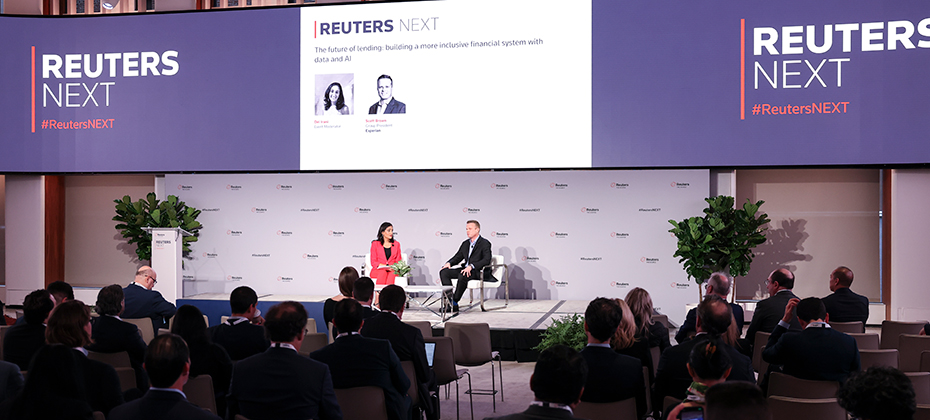
Today, we stand at the forefront of a digital revolution that is reshaping the financial services industry. And, against this backdrop, financial institutions are at vastly different levels of maturity; the world’s biggest banks are managing large-scale infrastructure migrations and making significant investments in AI while regional banks and credit unions are putting plans in place for modernization strategies, and fintechs are purpose-built and cloud native. To explore this more, I recently had the privilege of attending the annual Reuters NEXT live event in New York City. The event gathers globally recognized leaders across business, finance, technology, and government to tackle some of today’s most pressing issues. On the World Stage, I joined Del Irani, a talented anchor and broadcast journalist, to discuss the future of lending and the pivotal role of data and AI in building a more inclusive financial system. Improving financial access Our discussion highlighted the lack of access to traditional financial systems, and the impact it has on nearly 100 million people in North America alone. Globally, the problem affects over one billion people. These people, who are credit invisible, unscoreable, or have subprime credit scores, are unable to secure everyday financial products that many of us take for granted. What many don’t realize is, this is not a fringe subset of the population. Most of us, myself included, know someone who has faced the challenges of financial exclusion. Everyday Americans, including young people who are just starting out, new immigrants and people from diverse communities, often lack access to mainstream financial products. We discussed how traditional lending has a limited view of a consumer. Like looking through a keyhole, the lender’s understanding of the person in view is often incomplete and obstructed. However, with expanded data, technology, and advanced analytics, there is an opportunity to better understand the whole person, and as a result have a more inclusive financial system. At Experian, we have a unique ability to connect the power of traditional credit with alternative data, bringing a more holistic understanding of consumers and their behaviors. We are dedicated to leveraging our rich history in data and our expertise in technology to create the future of credit and ultimately bring financial power to everyone. The future of lending After spending two days with over 700 industry leaders from around the world, one thing is abundantly clear: much like the early days of the internet, today, we are at the cutting-edge of a technical revolution. Reflecting on my time at Reuters NEXT, I am particularly excited by the collective commitment to drive innovative, and smarter ways of working. We are only beginning to scratch the surface of how data and technology can transform financial services, and Experian is positioned to play a significant role. As we look to the future, I am excited about the ways we will create new opportunities for businesses and consumers alike.
The advertising ecosystem has seen significant transformation over the past few years, with increased privacy regulation, changes in available signals, and the rise of channels like connected TV and retail media. These changes are impacting the way that consumers interact with brands and how brands understand and continue to deliver relevant messages to consumers with precision. Experian has been helping marketers navigate these changes, and as a result, our marketing data and identity solutions underpin much of today’s advertising industry. We’re committed to empowering marketers and agencies to understand and reach their target audiences, across all channels. Today, we are excited to announce our acquisition of Audigent—a leading data and activation platform in the advertising industry. With Audigent’s combination of first-party publisher data, inventory and deep supply-side distribution relationships, publishers, big and small, can empower marketers to better understand their customers, expand the reach of their target audiences and activate those audiences across the most impactful inventory. I am excited to bring together Audigent’s supply-side network as a natural extension to our existing demand-side capabilities. Audigent’s ability to combine inventory with targeted audiences using first-party, third-party and contextual signals provides the best of all worlds, allowing marketers to deliver campaigns centered on consumer choices, preferences, and behaviors. The addition of Audigent further strengthens our strategy to be the premier independent provider of marketing data and identity, ultimately creating more relevant experiences for consumers. To learn more about Experian and Audigent, visit https://www.experian.com/marketing/ and https://audigent.com/.
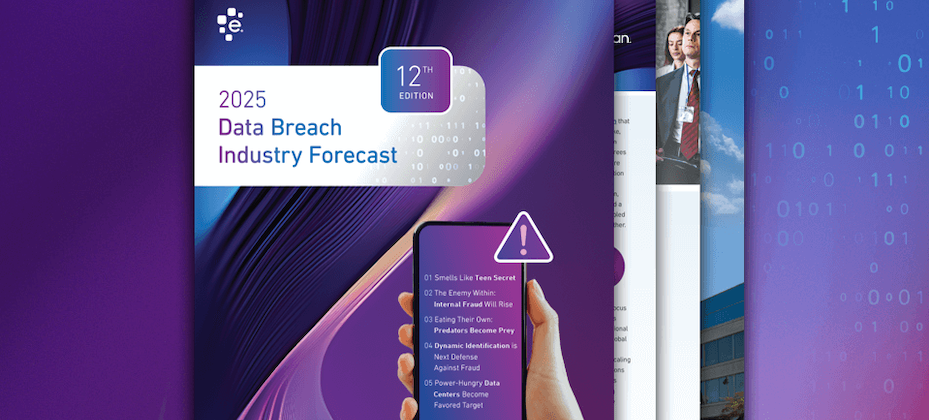
When it comes to cybercriminals and threat vectors, we need to expect the unexpected. Experian’s 12th annual Data Breach Industry Forecast highlights several potential trends for 2025, with AI playing a central role. This year has already seen more data breaches and impacted consumers than 2023, indicating that global data breaches are not slowing down. Some things to watch out for next year includes the potential for more internal fraud. As companies train employees on AI, there is a growing risk that some will misuse their knowledge for internal theft and sourcing sensitive information. Another trend may be cyberattackers targeting large data centers, with the growth of generative AI introducing power as a new attack vector. It’s reported that a single ChatGPT query uses significantly more electricity than a standard Google search, making data centers and cloud infrastructure vulnerable, especially in countries with varying security standards. We expect AI-related attacks to dominate the headlines next year and investments in cybersecurity will increase to tackle this emerging threat, as hackers leverage AI for phishing, password cracking, malware, and deepfakes. Jim Steven, Head of Crisis and Data Response Services at Experian Global Data Breach Resolution in the UK, anticipates that global data breaches will persist at their current rate next year. He notes that ransomware attacks are likely to become even more sophisticated with the integration of AI. Additionally, Steven predicts that threat actors will escalate their tactics to achieve greater rewards, and the misuse of consumer data to damage reputations will increase in 2025. To access the complimentary report, click here.