
FY19 proved to be a great year for Experian – one of our best ever. We just announced results, with organic revenue growth of 9%. But that is only part of our story. Behind the company’s success is a strategy that puts consumers first. We have looked to respond to the challenge of financial exclusion around the world, by using data and innovation to bring more people into the mainstream financial system. And we have responded to rapid digitisation of the world by helping organisations of all shapes and sizes to respond and adapt, all through the power of data. Fintech and digital disruption have revolutionised the way people engage with their finances. At Experian we help to speed up applications for credit, check for fraudulent impersonators and improve access to credit at fair and affordable rates. During the course of this financial year, we delivered some major and exciting milestones in our markets: In North America, we launched Experian Boost, an industry-first, game changing offer that is reshaping the credit landscape by putting individuals in control of their credit score. In the UK, we are introducing a range of new innovations, Ascend, Credit 3D and Experian One, which deploy our advanced analytics, predictive data and SaaS-based platforms. We were the first in our industry to be granted approval to supply Open Banking and PSD2 services by the Financial Conduct Authority and we have rolled out new services which help to assess whether loans are affordable. In Asia Pacific, we are building out our data Marketplaces with our strategic investment and partnerships with C88 in Indonesia and Jirnexu in Malaysia. This move will help to increase levels of financial inclusion in the region by improving matching to eligible credit products. In South Africa, we agreed to the acquisition of Compuscan, which will mean we are better positioned to serve the people and businesses of Africa and be an enabler of growth in consumer and business credit, identity management and financial inclusion. To sum up, the financial performance is strong. Our commitment to using data and analytics to help consumers, businesses and society at large is even stronger.

For the past several years, Experian has been on a journey to help drive financial inclusion for millions of people around the world. This has required significant changes in how we operate, who we partner with, and the products and solutions we offer —and with those changes comes a renewed sense of purpose. What we do and the actions we take have the potential to improve lives. We are actively seeking out unresolved problems and creating products and technologies that will help transform the way businesses operate and consumers thrive in today’s society. But we know we can’t do it alone. That’s why over the last year, we have built out an entire team of account executives and other support staff that are fully dedicated to developing and supporting partnerships with leading fintech companies. We’ve made significant strides that will help us pave the way for the next generation of lending, while improving the financial health of more people around the world. Earlier this week, I attended the FinovateSpring conference in San Francisco to speak with fintechs and financial institutions about ways to put financial health at the center of an organization’s plans to build trust, reach new customers and ultimately grow business. We are developing platforms that are designed to play to the strengths of fintechs and disrupt the industry. In the past, we have looked at unresolved problems and asked ‘why?’ Today, with our fintech partners, we look at potential solutions to these unresolved challenges and say, ‘why not.’ As part of our concentration on fintech, Experian has made significant investments in alternative data, such as the game-changing Experian Boost platform, which was launched just two months ago and is already reshaping the way consumers gain access to credit. Since we launched Experian Boost, consumers across America have instantly increased their credit score by sharing their bill payment history for things like utilities, mobile phones and cable TV payments – payments which had never been factored into a credit score before. And, yes, this platform came to fruition as a result of a fintech partnership. We have partnered with fintechs in other powerful ways, too. Our new Ascend Analytical Sandbox – a first-of-its-kind data and analytics platform – gives companies instant access to more than 17 years of depersonalized credit data on more than 220 million U.S. consumers. This creates better opportunities for consumers by allowing our clients to provide more tailored solutions. It’s a great example of the power of analytics and we’re very proud of it. During our time at Finovate, we were able to engage in meaningful conversations with fintech leaders who were united in our goal of helping more consumers access the financial services they need. We’re more inspired than ever before to continue to build and explore strategic partnerships that will ultimately improve the lives of American consumers.

It gives me great pleasure to announce that Experian has won the Consensus Economics Forecast Accuracy Award 2018 for the UK. Our UK Economics Team was recognised for their high-quality research, their commitment to regular forecasts and their ability to identify most accurately the trends and levels of key indicators over the 24-month forecasting cycle. The Forecast Accuracy Award program recognises the achievements of a select group of expert country economic forecasters who have most accurately predicted the performance of GDP growth and Consumer Price Inflation for their targeted economies over a 24-month forecasting cycle. Experian were the most accurate UK forecaster out of pool of 36 organisations. Mohammed Chaudhri, Head of UK Macro Forecasting, said: “We’re thrilled to win this award. We spent a lot of time analysing the UK economy following the referendum vote in 2016 and, at the time, many forecasters were expecting an immediate recession. However, we felt that the UK economy would prove more resilient in the coming years. We are pleased that our forecast for 2018 was so close to the actual development.” The award underlines the wealth of knowledge across the UK Economics Team, with over 30 years of macro-economic forecasting experience to their name. The accuracy of our economic forecasts is a real benefit when understanding how the UK economy will impact businesses in the future. By embedding our forecasts into the decision-making process organisations can embrace the opportunities presented by an ever-changing economics landscape. I’d like to congratulate Mohammed and his team on a well-deserved award win, along with all the other winners from across the globe. To find out more, click here.
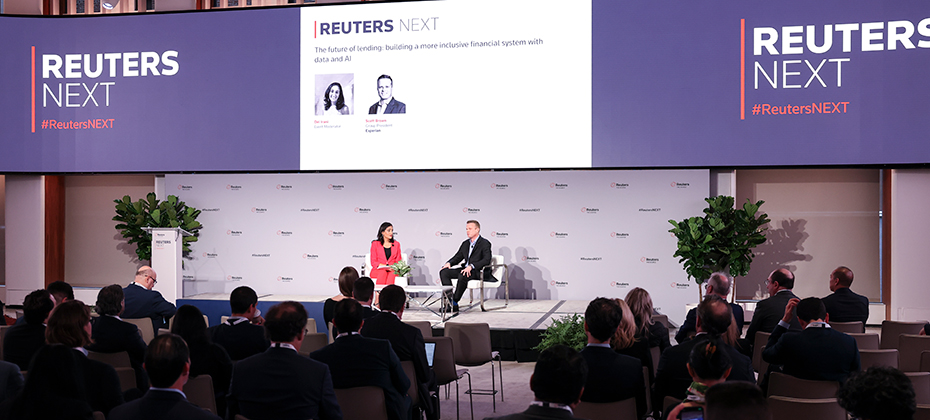
Today, we stand at the forefront of a digital revolution that is reshaping the financial services industry. And, against this backdrop, financial institutions are at vastly different levels of maturity; the world’s biggest banks are managing large-scale infrastructure migrations and making significant investments in AI while regional banks and credit unions are putting plans in place for modernization strategies, and fintechs are purpose-built and cloud native. To explore this more, I recently had the privilege of attending the annual Reuters NEXT live event in New York City. The event gathers globally recognized leaders across business, finance, technology, and government to tackle some of today’s most pressing issues. On the World Stage, I joined Del Irani, a talented anchor and broadcast journalist, to discuss the future of lending and the pivotal role of data and AI in building a more inclusive financial system. Improving financial access Our discussion highlighted the lack of access to traditional financial systems, and the impact it has on nearly 100 million people in North America alone. Globally, the problem affects over one billion people. These people, who are credit invisible, unscoreable, or have subprime credit scores, are unable to secure everyday financial products that many of us take for granted. What many don’t realize is, this is not a fringe subset of the population. Most of us, myself included, know someone who has faced the challenges of financial exclusion. Everyday Americans, including young people who are just starting out, new immigrants and people from diverse communities, often lack access to mainstream financial products. We discussed how traditional lending has a limited view of a consumer. Like looking through a keyhole, the lender’s understanding of the person in view is often incomplete and obstructed. However, with expanded data, technology, and advanced analytics, there is an opportunity to better understand the whole person, and as a result have a more inclusive financial system. At Experian, we have a unique ability to connect the power of traditional credit with alternative data, bringing a more holistic understanding of consumers and their behaviors. We are dedicated to leveraging our rich history in data and our expertise in technology to create the future of credit and ultimately bring financial power to everyone. The future of lending After spending two days with over 700 industry leaders from around the world, one thing is abundantly clear: much like the early days of the internet, today, we are at the cutting-edge of a technical revolution. Reflecting on my time at Reuters NEXT, I am particularly excited by the collective commitment to drive innovative, and smarter ways of working. We are only beginning to scratch the surface of how data and technology can transform financial services, and Experian is positioned to play a significant role. As we look to the future, I am excited about the ways we will create new opportunities for businesses and consumers alike.
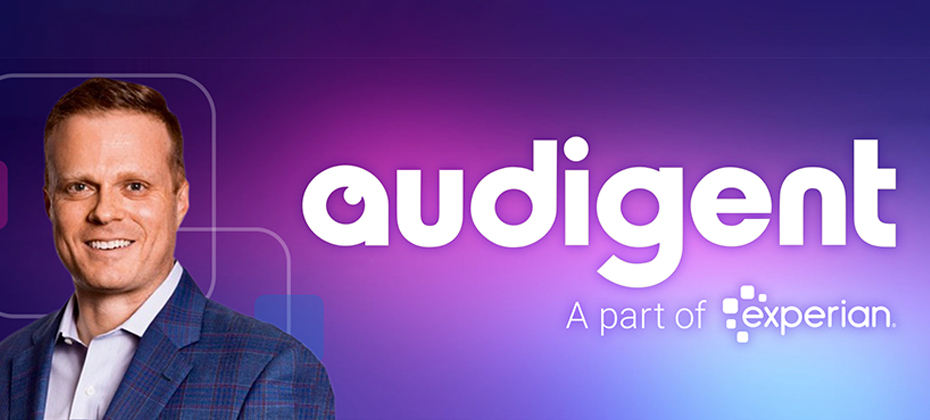
The advertising ecosystem has seen significant transformation over the past few years, with increased privacy regulation, changes in available signals, and the rise of channels like connected TV and retail media. These changes are impacting the way that consumers interact with brands and how brands understand and continue to deliver relevant messages to consumers with precision. Experian has been helping marketers navigate these changes, and as a result, our marketing data and identity solutions underpin much of today’s advertising industry. We’re committed to empowering marketers and agencies to understand and reach their target audiences, across all channels. Today, we are excited to announce our acquisition of Audigent—a leading data and activation platform in the advertising industry. With Audigent’s combination of first-party publisher data, inventory and deep supply-side distribution relationships, publishers, big and small, can empower marketers to better understand their customers, expand the reach of their target audiences and activate those audiences across the most impactful inventory. I am excited to bring together Audigent’s supply-side network as a natural extension to our existing demand-side capabilities. Audigent’s ability to combine inventory with targeted audiences using first-party, third-party and contextual signals provides the best of all worlds, allowing marketers to deliver campaigns centered on consumer choices, preferences, and behaviors. The addition of Audigent further strengthens our strategy to be the premier independent provider of marketing data and identity, ultimately creating more relevant experiences for consumers. To learn more about Experian and Audigent, visit https://www.experian.com/marketing/ and https://audigent.com/.
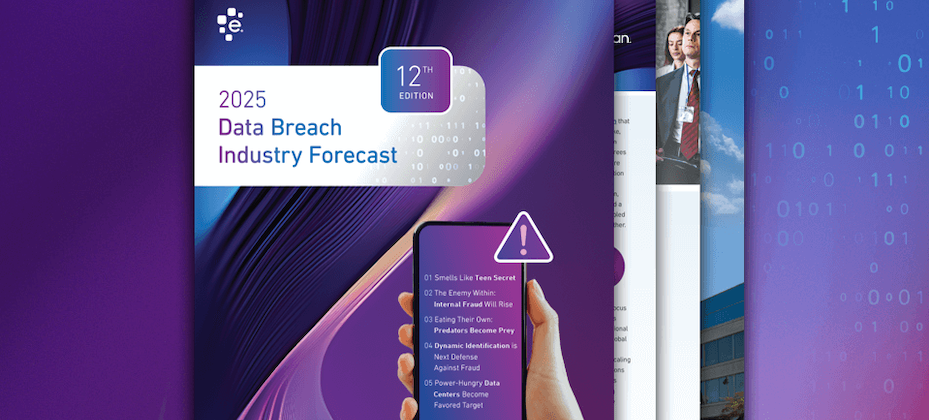
When it comes to cybercriminals and threat vectors, we need to expect the unexpected. Experian’s 12th annual Data Breach Industry Forecast highlights several potential trends for 2025, with AI playing a central role. This year has already seen more data breaches and impacted consumers than 2023, indicating that global data breaches are not slowing down. Some things to watch out for next year includes the potential for more internal fraud. As companies train employees on AI, there is a growing risk that some will misuse their knowledge for internal theft and sourcing sensitive information. Another trend may be cyberattackers targeting large data centers, with the growth of generative AI introducing power as a new attack vector. It’s reported that a single ChatGPT query uses significantly more electricity than a standard Google search, making data centers and cloud infrastructure vulnerable, especially in countries with varying security standards. We expect AI-related attacks to dominate the headlines next year and investments in cybersecurity will increase to tackle this emerging threat, as hackers leverage AI for phishing, password cracking, malware, and deepfakes. Jim Steven, Head of Crisis and Data Response Services at Experian Global Data Breach Resolution in the UK, anticipates that global data breaches will persist at their current rate next year. He notes that ransomware attacks are likely to become even more sophisticated with the integration of AI. Additionally, Steven predicts that threat actors will escalate their tactics to achieve greater rewards, and the misuse of consumer data to damage reputations will increase in 2025. To access the complimentary report, click here.