
I feel that part of Experian’s responsibility as a global information services company is to build and bolster community involvement initiatives that help others. I’m currently a manager of our Fraud Resolution Team and Credit Educator Department in Allen, Texas, but I also have the honor of managing all outreach programs for our branch, bringing together Experian employees to give back to the community. Taking on a volunteer project on top of regular work can be daunting. As the point person for my office’s volunteerism, I’m in charge of communications about upcoming events and drumming up interest and excitement among employees, be it through flyers, silly videos, emails or even free t-shirts. I know a lot of my fellow employees, but I don’t know everyone, so spreading the word isn’t always easy. Despite these challenges, I continue doing this important work because I care about the impact Experian makes in its local communities. My first volunteer experience with Experian was working alongside Stop Hunger Now – an international hunger relief nonprofit – several years ago. I was amazed at the impact we had. Shortly thereafter, I also participated in a canned food drive, rallying Experian employees to visit the Texas Food Bank. After these two chaotic, inspirational, behind-the-scenes experiences, my interest was permanently piqued in on-site volunteer days within the Allen community. Since then, I’ve organized volunteer days with many other nonprofit programs. The amount of organization and work that goes into each volunteer day is much more than you might think. For every Stop Hunger Now event, we package 10,000 meals for those in need, which requires about 100 volunteers dedicating their time. When we worked with Habitat for Humanity, a nonprofit organization devoted to building homes for those who need them, our first two scheduled events were rained out – and it never rains in Texas! I was worried that no one would show up the third time, when we had to reschedule for 7 a.m. on a Saturday. Luckily, every single volunteer spot was filled. We got to meet the family we were building a house for, and we all signed a piece of wood from the house for them. Their gratitude made all the frustration and extra work worth it. It takes a village to get some of these events off the ground, but I have a strong support structure at Experian. And learning to empathize with people through volunteering helps me in my day-to-day work. People who are dealing with fraud can be very emotional, and fraud is unexpected by nature. My volunteering experience has equipped me with the skills needed to empathize with others better and think on my feet.

It’s my great pleasure to announce that, for the second successive year, Experian has been certified as a ‘Top Employer’ by the Top Employers Institute. The annual research programme recognises leading employers around the world. Awarding only those that provide the kind of conditions where their employees can develop, both professionally and personally, nurturing and developing talent throughout all levels of the organisation. Being recognised as a Top Employer two years in a row is a significant achievement, but I am also aware that the journey doesn’t end here. This isn’t the time to take our foot off the pedal. We will continue to develop our working culture, listening to feedback from our team and pushing the boundaries to create the best possible working environment for our people. After our initial recognition in 2017, we set ourselves a challenge to not only retain our Top Employer status this year, but also to improve our overall performance against the institute’s tough certification criteria. It’s down to the ongoing dedication of our UK team that we have managed to achieve this challenging objective. Experian is all about its people. We are committed to providing a working environment that people love, giving them access to the best training, the greatest opportunities and the latest tools – everything they need to progress their career. This award demonstrates that we are clearly on the right path, but we won’t stop here. We’re always looking for new ways to do things and to improve as a business. So by listening to our people and actively encouraging new ideas, together we will continue developing Experian as an outstanding place to work.

Real stories about helping people, businesses and society as told by Experian employees around the world. It’s a simple concept and, as the first year of our #ExperianStories series showed, a powerful one as well. What began as a call to action in support of our global brand refresh last January has become an employee-driven chronicle of our ongoing journey as a company. These stories tell how employees are helping more people access the financial services they need, helping them protect their identities, and how we are making a difference in our communities. A new Experian story is added here to the Experian Global News Blog site every few weeks and shared via social media channels like Facebook, Twitter and LinkedIn. Below is a sampling from the more than 40 #ExperianStories employees have contributed so far: In India, we shared how we are using biometrics to help people with thin credit files, including those in rural areas with little or no formal identification, to prove their identities and secure the loans they need. In the U.K., one of our data scientists told how her own educational and professional journey gave her the passion to help more girls explore a STEM education. As she puts it, “No one should have to automatically rule them out of a career path based on gender.” In Brazil, we are addressing fraud by working with financial technology (fintech) organizations, including online lenders, to overcome the high fraud rate in Brazil to “help the right people to get the money they need at a fair price, faster.” It’s been a year since we started sharing our #ExperianStories and we’ve reached 20 million people so far. Given what our company is doing and the innovative approaches to solving society’s problems, this second year promises to be every bit as informative and impactful. And beyond the stories themselves, I am equally proud of how our employees are making a difference and how they work every single day to use data, analytics and technology to help improve lives around the world. Stories matter. Our employees matter. And the work they are doing makes a difference. I hope you continue to join us on our #ExperianStories journey.
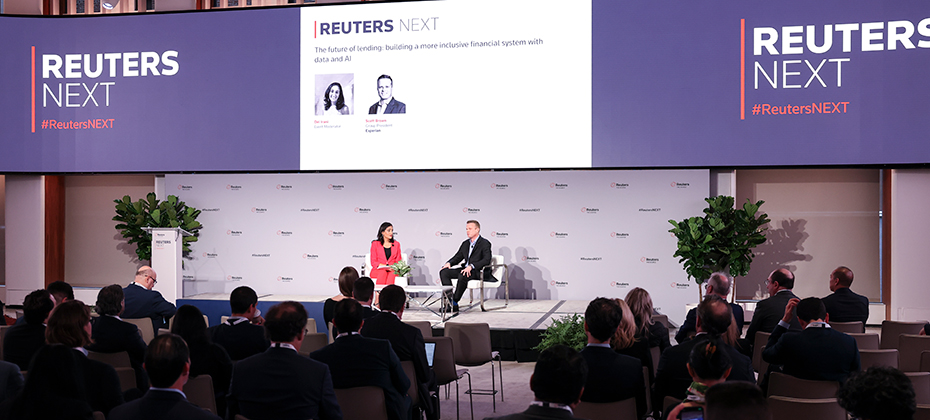
Today, we stand at the forefront of a digital revolution that is reshaping the financial services industry. And, against this backdrop, financial institutions are at vastly different levels of maturity; the world’s biggest banks are managing large-scale infrastructure migrations and making significant investments in AI while regional banks and credit unions are putting plans in place for modernization strategies, and fintechs are purpose-built and cloud native. To explore this more, I recently had the privilege of attending the annual Reuters NEXT live event in New York City. The event gathers globally recognized leaders across business, finance, technology, and government to tackle some of today’s most pressing issues. On the World Stage, I joined Del Irani, a talented anchor and broadcast journalist, to discuss the future of lending and the pivotal role of data and AI in building a more inclusive financial system. Improving financial access Our discussion highlighted the lack of access to traditional financial systems, and the impact it has on nearly 100 million people in North America alone. Globally, the problem affects over one billion people. These people, who are credit invisible, unscoreable, or have subprime credit scores, are unable to secure everyday financial products that many of us take for granted. What many don’t realize is, this is not a fringe subset of the population. Most of us, myself included, know someone who has faced the challenges of financial exclusion. Everyday Americans, including young people who are just starting out, new immigrants and people from diverse communities, often lack access to mainstream financial products. We discussed how traditional lending has a limited view of a consumer. Like looking through a keyhole, the lender’s understanding of the person in view is often incomplete and obstructed. However, with expanded data, technology, and advanced analytics, there is an opportunity to better understand the whole person, and as a result have a more inclusive financial system. At Experian, we have a unique ability to connect the power of traditional credit with alternative data, bringing a more holistic understanding of consumers and their behaviors. We are dedicated to leveraging our rich history in data and our expertise in technology to create the future of credit and ultimately bring financial power to everyone. The future of lending After spending two days with over 700 industry leaders from around the world, one thing is abundantly clear: much like the early days of the internet, today, we are at the cutting-edge of a technical revolution. Reflecting on my time at Reuters NEXT, I am particularly excited by the collective commitment to drive innovative, and smarter ways of working. We are only beginning to scratch the surface of how data and technology can transform financial services, and Experian is positioned to play a significant role. As we look to the future, I am excited about the ways we will create new opportunities for businesses and consumers alike.
The advertising ecosystem has seen significant transformation over the past few years, with increased privacy regulation, changes in available signals, and the rise of channels like connected TV and retail media. These changes are impacting the way that consumers interact with brands and how brands understand and continue to deliver relevant messages to consumers with precision. Experian has been helping marketers navigate these changes, and as a result, our marketing data and identity solutions underpin much of today’s advertising industry. We’re committed to empowering marketers and agencies to understand and reach their target audiences, across all channels. Today, we are excited to announce our acquisition of Audigent—a leading data and activation platform in the advertising industry. With Audigent’s combination of first-party publisher data, inventory and deep supply-side distribution relationships, publishers, big and small, can empower marketers to better understand their customers, expand the reach of their target audiences and activate those audiences across the most impactful inventory. I am excited to bring together Audigent’s supply-side network as a natural extension to our existing demand-side capabilities. Audigent’s ability to combine inventory with targeted audiences using first-party, third-party and contextual signals provides the best of all worlds, allowing marketers to deliver campaigns centered on consumer choices, preferences, and behaviors. The addition of Audigent further strengthens our strategy to be the premier independent provider of marketing data and identity, ultimately creating more relevant experiences for consumers. To learn more about Experian and Audigent, visit https://www.experian.com/marketing/ and https://audigent.com/.
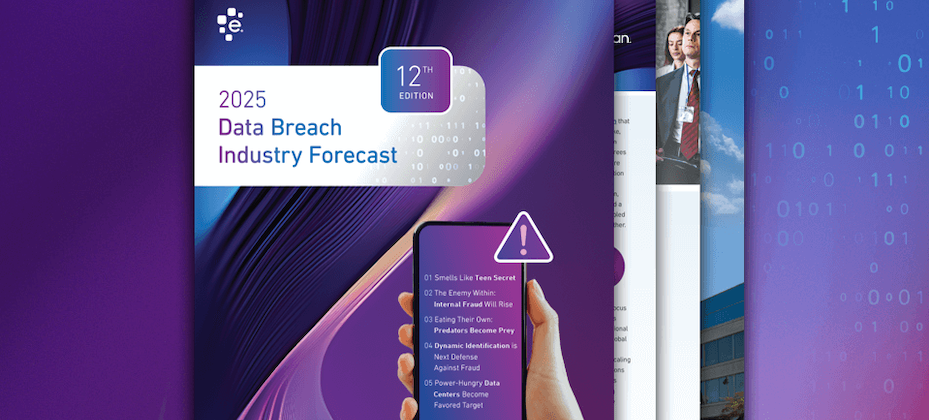
When it comes to cybercriminals and threat vectors, we need to expect the unexpected. Experian’s 12th annual Data Breach Industry Forecast highlights several potential trends for 2025, with AI playing a central role. This year has already seen more data breaches and impacted consumers than 2023, indicating that global data breaches are not slowing down. Some things to watch out for next year includes the potential for more internal fraud. As companies train employees on AI, there is a growing risk that some will misuse their knowledge for internal theft and sourcing sensitive information. Another trend may be cyberattackers targeting large data centers, with the growth of generative AI introducing power as a new attack vector. It’s reported that a single ChatGPT query uses significantly more electricity than a standard Google search, making data centers and cloud infrastructure vulnerable, especially in countries with varying security standards. We expect AI-related attacks to dominate the headlines next year and investments in cybersecurity will increase to tackle this emerging threat, as hackers leverage AI for phishing, password cracking, malware, and deepfakes. Jim Steven, Head of Crisis and Data Response Services at Experian Global Data Breach Resolution in the UK, anticipates that global data breaches will persist at their current rate next year. He notes that ransomware attacks are likely to become even more sophisticated with the integration of AI. Additionally, Steven predicts that threat actors will escalate their tactics to achieve greater rewards, and the misuse of consumer data to damage reputations will increase in 2025. To access the complimentary report, click here.