Loading...

Latest Post Related Post

Published: March 27, 2025 by qamarketingtechnologists

Loading…
Data Science is Helping People in India with Thin Credit Files Secure the Loans They Need #ExperianStories

I recently attended a conference in Alwar, India, hosted by Experian and the International Finance Corporation. During one of the sessions, I met a single mother of two who had recently moved to a rural village in India. Her husband had left her and she was hoping to pick up work as a tailor once she purchased a sewing machine to support her family. As we talked, she confided in me that she was having trouble securing a loan from microfinance institutions because she didn’t have papers to prove her identity. And since she was new to the village, no one knew who she was. Without a proven identity, she couldn’t qualify for a loan and get the money she needed to support herself and feed her children. Indian banks predominantly serve urban customers whose credit reports are extensive. However, most customers from smaller districts and rural towns – like this woman – can fit their credit history on less than a page. Identification may be the only way they can verify their character to secure a loan. As I sat with this woman, I started telling her about our Prove ID tool that I had recently helped to develop. Using an individual’s biometrics, the tool would search her credit history, bank card and any information that can prove she is who she claimed to be. I explained that by using this tool, she could now prove what village she’s from, that she was a permanent resident in her new village and that she was likely to repay her loan. She was stunned and overwhelmed. In that moment, I realized that rural clients often need human connection to clearly understand what a bank or microfinance institution requires in order to obtain a loan. Many rural customers can’t read the brochures or pamphlets sitting in a bank, but by engaging them in conversation, you can effectively educate them about how to prove their identities and build their credit profiles to successfully access the finances they need. As a Product Developer for banks, I sometimes get so caught up on how to make products run that I lose sight of how the work I do impacts the community. Helping one woman discover Prove-ID to secure a loan and provide for her family inspired me. I want to continue being more involved in my community to help others who may not be literate learn how to prove their identities so they can better support their families.

Apr 09,2017 by

Experian’s Gift to Chapman University to Advance Data Science

The field of data science is still in its infancy.  Every day, new advancements are helping to yield more exciting results. We’re learning how data can allow cities to provide more effective services for residents, how it can help to solve vexing health riddles, and how companies can leverage data to better serve consumers. But for advancements to be achieved, collaboration between research institutions and the private sector is essential. Even more essential is ensuring that the next generation of data scientists are equipped with the latest knowledge and resources to continue to advance the field. That’s why we are excited to announce Experian’s $750,000 gift to create the Experian Assistant Professorship in Machine Learning at Chapman University, which will be used to expand machine learning opportunities at Chapman University’s Machine Learning and Assistive Technology Lab (MLAT), where Chapman researchers use big data and technology to address challenges of social significance like autism. We believe this investment is a necessary step in an ongoing commitment to ensure our Southern California community continues to fuel economic growth by ensuring that businesses like Experian have the talent to advance field of information services. The assistant professorship will be held by Erik Linstead, Ph.D., the director of the undergraduate computing programs in computer science, software engineering, and data analytics. Dr. Linstead, one of the nation’s leading authorities on big data, is also the principal investigator MLAT. Experian has learned the value of attracting data scientists with a wide degree of interests, backgrounds, and professional experiences to help assist our clients best serve consumers. Similarly, MLAT seeks to do the same. Projects that they take on range from bioinformatics and molecular biology to machine learning and artificial intelligence. Experian’s gift will help MLAT to expand their data science-focused efforts into new fields. This gift is the latest of a long series of collaborations between Chapman and Experian. Several years ago, Experian and Chapman began a partnership that involved placing graduate students training to become data scientists in internships within Experian to provide them real-world, hands on training. Since then, the partnership has blossomed to include embedding a Chapman faculty member within Experian to better ground the academic community on how data scientists work within the private sector to better shape their curriculum. We’ve also supported scholarships and programs at Chapman to ensure that the field of data science remains inclusive, diverse, and talented. Data science will inevitably continue to have a growing impact on our lives. This gift is a commitment to the future of data science and the promise of a better tomorrow that it holds. We wish a congratulations to Dr. Linstead, and look forward to a continued stream of talent emerging from Chapman to continue to advance the field and produce better outcomes for everyone. Photo of the check presentation courtesy of Christopher Simonson. Pictured (L-R): Dean of Schmid College of Science and Technology Andrew Lyon, EVP of University Advancement Sheryl Bourgeois, President of Experian Consumer Services Guy Abramo and Principal Investigator of the MLAT Lab Erik Linstead.

Apr 05,2017 by

Data Science is Key to Protecting Banks & People from Credit Fraud #ExperianStories

Spanish Translation I’m a Senior Product Manager in Experian’s Fraud and Identity Solutions department, which means I partner with data scientists to protect banks and their customers from fraud. When most people think of fraud, they envision someone trying to open a bank account in someone else’s name. However, it wasn’t until I did a series of customer visits with big banks to understand their struggles and discovered a pervasive form of fraud in the finance industry called “bust-out” fraud. In a "bust-out" fraud, an individual applies for a credit card in their own name, establishes a normal usage pattern and builds a solid repayment history. Then, when they’re ready to execute their scam, they max out all their available lines of credit from various lenders, disappear and leave the banks with the losses. Meanwhile, the money could be funneled into funding many types of organized crime, from human trafficking to drug trading and other illicit activities. What makes this type of crime all the harder to identify and catch before it occurs is that the person applying for a credit card is who they say they are. So it’s not about identity theft. To address this issue, my team and I created a solution called BustOut ScoreSM. We began by reviewing data from different banks to identify patterns where bust-outs occurred. From there, we built a score that predicts the likelihood that an individual will execute the scam — months before the scam occurs. Our clients now use this tool both when opening new accounts and as part of account management. The tool flags suspicious-looking accounts, which our team then manually reviews to evaluate if the account is truly at risk for a bust-out. If it is, we work with our clients to freeze or close out those suspicious accounts. Finding solutions to a fraud problem that hasn’t been solved is probably my favorite part of the job. I love seeing products that solve real issues affecting real people come to life — from inception to launch. Helping protect people from identity theft and fraud is what gives me purpose and meaning in my work. I am proud to use the power of data as a force for good.

Apr 02,2017 by

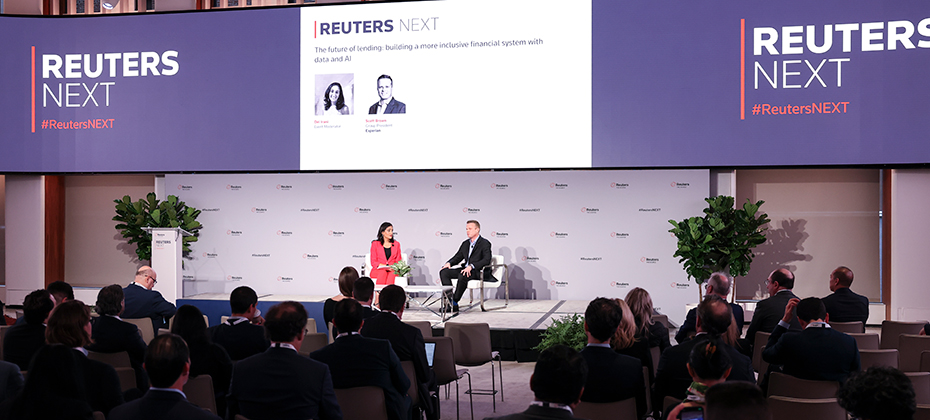
Insights from Reuters Next: Building a More Inclusive Financial System with Data and AI

Today, we stand at the forefront of a digital revolution that is reshaping the financial services industry. And, against this backdrop, financial institutions are at vastly different levels of maturity; the world’s biggest banks are managing large-scale infrastructure migrations and making significant investments in AI while regional banks and credit unions are putting plans in place for modernization strategies, and fintechs are purpose-built and cloud native.  To explore this more, I recently had the privilege of attending the annual Reuters NEXT live event in New York City. The event gathers globally recognized leaders across business, finance, technology, and government to tackle some of today’s most pressing issues.  On the World Stage, I joined Del Irani, a talented anchor and broadcast journalist, to discuss the future of lending and the pivotal role of data and AI in building a more inclusive financial system. Improving financial access Our discussion highlighted the lack of access to traditional financial systems, and the impact it has on nearly 100 million people in North America alone. Globally, the problem affects over one billion people. These people, who are credit invisible, unscoreable, or have subprime credit scores, are unable to secure everyday financial products that many of us take for granted.  What many don’t realize is, this is not a fringe subset of the population. Most of us, myself included, know someone who has faced the challenges of financial exclusion. Everyday Americans, including young people who are just starting out, new immigrants and people from diverse communities, often lack access to mainstream financial products.  We discussed how traditional lending has a limited view of a consumer. Like looking through a keyhole, the lender’s understanding of the person in view is often incomplete and obstructed. However, with expanded data, technology, and advanced analytics, there is an opportunity to better understand the whole person, and as a result have a more inclusive financial system.  At Experian, we have a unique ability to connect the power of traditional credit with alternative data, bringing a more holistic understanding of consumers and their behaviors. We are dedicated to leveraging our rich history in data and our expertise in technology to create the future of credit and ultimately bring financial power to everyone. The future of lending After spending two days with over 700 industry leaders from around the world, one thing is abundantly clear: much like the early days of the internet, today, we are at the cutting-edge of a technical revolution. Reflecting on my time at Reuters NEXT, I am particularly excited by the collective commitment to drive innovative, and smarter ways of working.  We are only beginning to scratch the surface of how data and technology can transform financial services, and Experian is positioned to play a significant role. As we look to the future, I am excited about the ways we will create new opportunities for businesses and consumers alike.    
Dec 13,2024 by Scott Brown

Powering the Advertising Ecosystem with Our Identity and Activation Capabilities

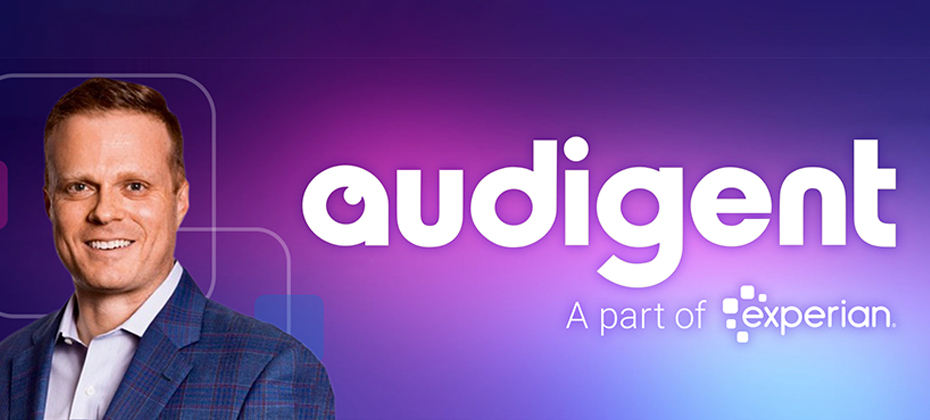
The advertising ecosystem has seen significant transformation over the past few years, with increased privacy regulation, changes in available signals, and the rise of channels like connected TV and retail media. These changes are impacting the way that consumers interact with brands and how brands understand and continue to deliver relevant messages to consumers with precision.   Experian has been helping marketers navigate these changes, and as a result, our marketing data and identity solutions underpin much of today’s advertising industry. We’re committed to empowering marketers and agencies to understand and reach their target audiences, across all channels. Today, we are excited to announce our acquisition of Audigent—a leading data and activation platform in the advertising industry.   With Audigent’s combination of first-party publisher data, inventory and deep supply-side distribution relationships, publishers, big and small, can empower marketers to better understand their customers, expand the reach of their target audiences and activate those audiences across the most impactful inventory.      I am excited to bring together Audigent’s supply-side network as a natural extension to our existing demand-side capabilities. Audigent’s ability to combine inventory with targeted audiences using first-party, third-party and contextual signals provides the best of all worlds, allowing marketers to deliver campaigns centered on consumer choices, preferences, and behaviors.    The addition of Audigent further strengthens our strategy to be the premier independent provider of marketing data and identity, ultimately creating more relevant experiences for consumers.   To learn more about Experian and Audigent, visit https://www.experian.com/marketing/ and https://audigent.com/.  
Dec 04,2024 by Scott Brown

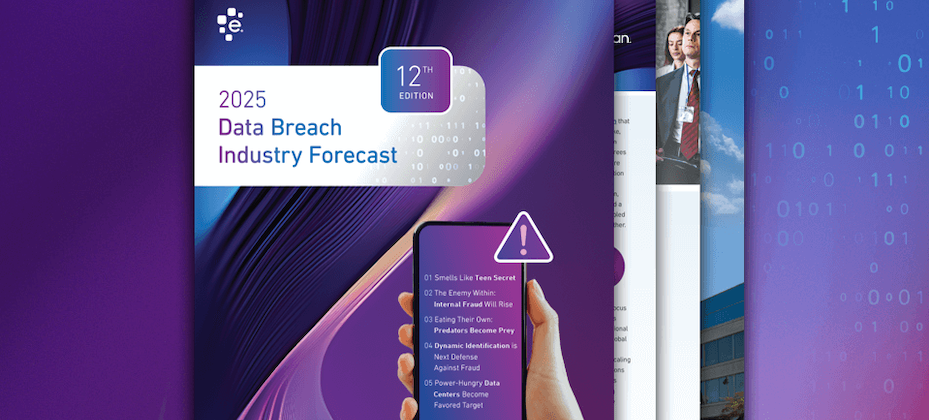
Experian Releases its 12th Annual Data Breach Industry Forecast Highlighting Five Predictions for 2025

When it comes to cybercriminals and threat vectors, we need to expect the unexpected. Experian’s 12th annual Data Breach Industry Forecast highlights several potential trends for 2025, with AI playing a central role. This year has already seen more data breaches and impacted consumers than 2023, indicating that global data breaches are not slowing down. Some things to watch out for next year includes the potential for more internal fraud. As companies train employees on AI, there is a growing risk that some will misuse their knowledge for internal theft and sourcing sensitive information. Another trend may be cyberattackers targeting large data centers, with the growth of generative AI introducing power as a new attack vector. It’s reported that a single ChatGPT query uses significantly more electricity than a standard Google search, making data centers and cloud infrastructure vulnerable, especially in countries with varying security standards. We expect AI-related attacks to dominate the headlines next year and investments in cybersecurity will increase to tackle this emerging threat, as hackers leverage AI for phishing, password cracking, malware, and deepfakes. Jim Steven, Head of Crisis and Data Response Services at Experian Global Data Breach Resolution in the UK, anticipates that global data breaches will persist at their current rate next year. He notes that ransomware attacks are likely to become even more sophisticated with the integration of AI. Additionally, Steven predicts that threat actors will escalate their tactics to achieve greater rewards, and the misuse of consumer data to damage reputations will increase in 2025. To access the complimentary report, click here.

Dec 03,2024 by Michael Bruemmer