
I grew up in a major industrial city in Communist China just east of Beijing in a world where information was scarce. I was born into a pretty traditional Chinese family back in the 1960s and lived with my five siblings and parents in a small, crowded house. When the Cultural Revolution hit in 1966, the schools never officially shut down, but essentially nothing was taught at the time since students were expected to participate in the revolution. Throughout that period, almost all novels and movies were banned because they were not considered appropriate for educating students. But rather than causing me to lose my interest in learning, the ban led me to develop a habit for reading anything I could get my hands on, and my natural hunger for information grew. As my love for collecting and consuming information continued, I decided to become a data scientist. I moved to the U.S. to complete my Master’s degree and Doctoral Program. Today I work with “Big Data” at Experian, developing analytical solutions for financial telecommunication and insurance companies. What’s amazing to me about my job is the fact that 90 percent of the data in the world has been created in just the last two years. Data Scientists like myself retrieve, sift, analyze, process and store all the data according to a business or consumer’s needs. I believe that data tells a story; it’s business intelligence that can help an individual or business identify where they may need to change or adjust in order to move forward. For consumers, it can help them improve their credit scores and secure an affordable loan. It can help protect identities by detecting and stopping suspicious activity. For businesses, the data can mitigate risk, help prevent fraudulent transactions or even ensure they’re marketing to proper audiences. I believe that data has the power to transform lives and societies for the better. My job is to help clients and consumers understand the story of their data so they can take financial control, achieve their goals, and help meet the needs of customers. I have always told myself, “no matter the situation, do your best.” For me, doing my best is using this lifelong passion to help others succeed.

When it comes to credit for small businesses, it’s a classic chicken-and-egg situation: you can’t get credit until you have credit history, and you can’t get credit history until someone grants you credit. I know this first-hand because my own parents were small-business owners in California. My parents had built an independent insurance agency. I distinctly remember as a kid sitting in the backseat of our car and overhearing the discussions they would have about their struggles to grow the business or how they would make payroll that month. Many small businesses don’t have access to small-business loans or business credit cards, so they rely entirely on the business owner’s personal credit to make purchases. This means that while there may be a credit history for the individual, there is none for the business itself. This also means that whenever my parents needed money to get through the month, they essentially had to put their livelihood at risk because there was no separation between personal and business loans. The lack of access to funds, and the consolidation happening in the insurance industry at the time, led my parents to take another big risk – they sold the business and our house, and they liquidated their retirement accounts and put everything into a restaurant franchise. They felt there would be more stability representing an established brand owned by someone else. When I graduated from my MBA program years later, one of the things that first attracted me to Experian was the opportunity I had to ease the burdens of small business owners through my work here. The work I do really hits home, because I’m working every day to open up small-business credit, using different types of data. In today’s economy, a lot of great business ideas – profitable ones, at that – never get a chance to see the light of day simply because they don’t have the capital they need to grow. Experian is making business ideas a reality by gathering, analysing, combining and processing a breadth of new data that allows us to develop credit scores for more people and paint the most realistic picture of a situation. By verifying a business’s history, its social media accounts, its website sophistication and traffic, and customer reviews, we can measure a small business’s legitimacy, how long they’ve been operating and how they’re growing. This information, coupled with transaction data, all help determine a business’s credit worthiness and allow us to give its owners greater access to capital. Data is a huge enabler for positive change because it can give small-business owners access to credit that they wouldn’t receive otherwise. When used in the right ways, data can empower and enable small businesses to get the funding they need to hire employees, invest in their business or open a new location. In many ways, I’m helping people just like my parents.

Spring clean your credit during Financial Literacy Month with our finances in order. #FLM2017 is dedicated to teaching Americans healthy credit habits.
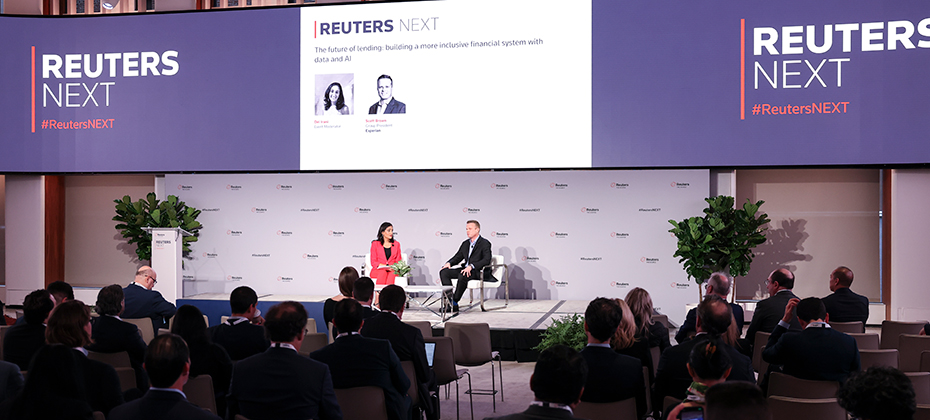
Today, we stand at the forefront of a digital revolution that is reshaping the financial services industry. And, against this backdrop, financial institutions are at vastly different levels of maturity; the world’s biggest banks are managing large-scale infrastructure migrations and making significant investments in AI while regional banks and credit unions are putting plans in place for modernization strategies, and fintechs are purpose-built and cloud native. To explore this more, I recently had the privilege of attending the annual Reuters NEXT live event in New York City. The event gathers globally recognized leaders across business, finance, technology, and government to tackle some of today’s most pressing issues. On the World Stage, I joined Del Irani, a talented anchor and broadcast journalist, to discuss the future of lending and the pivotal role of data and AI in building a more inclusive financial system. Improving financial access Our discussion highlighted the lack of access to traditional financial systems, and the impact it has on nearly 100 million people in North America alone. Globally, the problem affects over one billion people. These people, who are credit invisible, unscoreable, or have subprime credit scores, are unable to secure everyday financial products that many of us take for granted. What many don’t realize is, this is not a fringe subset of the population. Most of us, myself included, know someone who has faced the challenges of financial exclusion. Everyday Americans, including young people who are just starting out, new immigrants and people from diverse communities, often lack access to mainstream financial products. We discussed how traditional lending has a limited view of a consumer. Like looking through a keyhole, the lender’s understanding of the person in view is often incomplete and obstructed. However, with expanded data, technology, and advanced analytics, there is an opportunity to better understand the whole person, and as a result have a more inclusive financial system. At Experian, we have a unique ability to connect the power of traditional credit with alternative data, bringing a more holistic understanding of consumers and their behaviors. We are dedicated to leveraging our rich history in data and our expertise in technology to create the future of credit and ultimately bring financial power to everyone. The future of lending After spending two days with over 700 industry leaders from around the world, one thing is abundantly clear: much like the early days of the internet, today, we are at the cutting-edge of a technical revolution. Reflecting on my time at Reuters NEXT, I am particularly excited by the collective commitment to drive innovative, and smarter ways of working. We are only beginning to scratch the surface of how data and technology can transform financial services, and Experian is positioned to play a significant role. As we look to the future, I am excited about the ways we will create new opportunities for businesses and consumers alike.
The advertising ecosystem has seen significant transformation over the past few years, with increased privacy regulation, changes in available signals, and the rise of channels like connected TV and retail media. These changes are impacting the way that consumers interact with brands and how brands understand and continue to deliver relevant messages to consumers with precision. Experian has been helping marketers navigate these changes, and as a result, our marketing data and identity solutions underpin much of today’s advertising industry. We’re committed to empowering marketers and agencies to understand and reach their target audiences, across all channels. Today, we are excited to announce our acquisition of Audigent—a leading data and activation platform in the advertising industry. With Audigent’s combination of first-party publisher data, inventory and deep supply-side distribution relationships, publishers, big and small, can empower marketers to better understand their customers, expand the reach of their target audiences and activate those audiences across the most impactful inventory. I am excited to bring together Audigent’s supply-side network as a natural extension to our existing demand-side capabilities. Audigent’s ability to combine inventory with targeted audiences using first-party, third-party and contextual signals provides the best of all worlds, allowing marketers to deliver campaigns centered on consumer choices, preferences, and behaviors. The addition of Audigent further strengthens our strategy to be the premier independent provider of marketing data and identity, ultimately creating more relevant experiences for consumers. To learn more about Experian and Audigent, visit https://www.experian.com/marketing/ and https://audigent.com/.
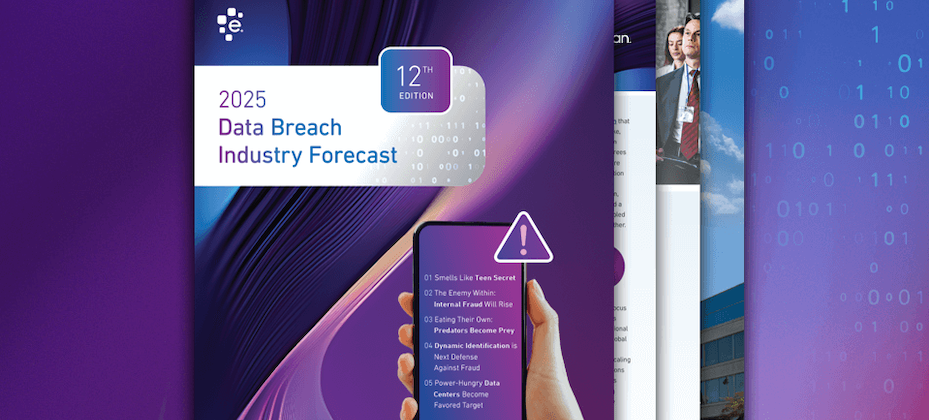
When it comes to cybercriminals and threat vectors, we need to expect the unexpected. Experian’s 12th annual Data Breach Industry Forecast highlights several potential trends for 2025, with AI playing a central role. This year has already seen more data breaches and impacted consumers than 2023, indicating that global data breaches are not slowing down. Some things to watch out for next year includes the potential for more internal fraud. As companies train employees on AI, there is a growing risk that some will misuse their knowledge for internal theft and sourcing sensitive information. Another trend may be cyberattackers targeting large data centers, with the growth of generative AI introducing power as a new attack vector. It’s reported that a single ChatGPT query uses significantly more electricity than a standard Google search, making data centers and cloud infrastructure vulnerable, especially in countries with varying security standards. We expect AI-related attacks to dominate the headlines next year and investments in cybersecurity will increase to tackle this emerging threat, as hackers leverage AI for phishing, password cracking, malware, and deepfakes. Jim Steven, Head of Crisis and Data Response Services at Experian Global Data Breach Resolution in the UK, anticipates that global data breaches will persist at their current rate next year. He notes that ransomware attacks are likely to become even more sophisticated with the integration of AI. Additionally, Steven predicts that threat actors will escalate their tactics to achieve greater rewards, and the misuse of consumer data to damage reputations will increase in 2025. To access the complimentary report, click here.