
A little more than a year removed from the beginning of the pandemic, and we’re still seeing many of the most vulnerable and underserved communities struggling to find a stable financial foothold. These are consumers with little to no credit history and are often underrepresented in the network of bank branches and sometimes less familiar with what’s available to them in the consumer credit system. The pandemic has taken a toll on the fabric of our financial ecosystem, and we need to help these consumers get back on their feet. That’s one of the reasons we’ve partnered with the 100 Black Men of Greater Washington, D.C. Together, we’re launching a broad financial health initiative to assist multiple African American communities suffering COVID-19-related hardship. But the partnership is just one of the ways Experian is assisting marginalized and underserved communities. Addressing Financial Inclusion Experian is deeply committed to helping marginalized and low-income communities access the financial resources they need to live. That’s why we’re working to ensure we find ways to help underserved consumers gain access to fair and affordable credit by assisting them in building their credit profiles. We view ourselves as “The Consumers’ Bureau,” and it’s our commensurate responsibility to do everything we can to drive financial inclusion. We are working side-by-side with lenders, credit scoring companies and consumers to eliminate credit invisibility and improve financial equity. Our teams at Experian, diverse as they are, feel passionate about this very important mission. We understand that a big part of the solution relies on bringing new sources of data into our credit files, so that credit scores reflect all of a consumers’ relevant financial behavior. We strongly believe that these new sources of data will augment and thereby enhance our current credit data as an effective means for lenders’ assessment of a consumer’s financial situation. There’s a percentage of the population—on average, it’s 17% of Americans, measured by FICO—who are excluded from the credit economy because they simply lack a credit history. To that end, we’ve been a pioneer in using rental, utilities and telecom payment data to help broaden credit access for consumers. Boosting 6 Million In fact, more than two years ago, we created Experian Boost, which was a first-of-its-kind service designed to help consumers instantly improve their FICO® Score by giving them credit for on-time utility, telecom and streaming service payments. All of those elements are conceived to be part of people’s credit scores, however utility and cell phone providers have not collaborated to report their data to all credit bureaus. With Experian Boost, we empower consumers to report the data themselves, and more importantly, 70% of consumers benefit from doing so, seeing an uplift in their credit score. And to date, more than 6 million consumers have used Experian Boost with over 50 million cumulative points added to FICO Scores across the US. Our Commitment to Financial Health But our commitment doesn’t end there. Consumer credit education and best practices are key to setting marginalized consumers up for financial success. Through Experian’s United for Financial Health initiative—we’re empowering vulnerable people and communities to improve their financial wellbeing through that very belief. In addition to our partnership with the 100 Black Men of Greater Washington, D.C., we’re working closely with Operation HOPE, Black Girl Ventures, and NAACP Empowerment Programs, to help disenfranchised groups improve their credit standing, provide entrepreneurial education for Black and Brown women entrepreneurs, and offer grants to help homeowners at risk of losing their homes In addition to our consumer credit education initiatives with our partners, we continually push credit education materials and programming through our own social media channels and community outreach efforts. In honor of Financial Literacy Month, we’re hosting a #CreditChat on Wednesday, April 28 at 3 p.m. ET, entitled, Closing the Financial Literacy Gap in Underserved Communities. We believe helping underserved communities better understand the credit ecosystem and equipping them with the tools and knowledge to improve their credit standing, are mission critical to a healthier financial life. And we’re hopeful this #CreditChat discussion is another step forward in that journey. We won’t rest until the job’s done. We’ll continue to innovate and find new ways to use data in the credit scoring process, and work arm-in-arm with consumers and lenders to improve financial access. Through our investments in data and advanced analytics, we’ll continue to help lenders identify consumers who are excluded from the credit ecosystem, but who can fulfill their financial obligations and pay responsibly. We want to empower consumers to take control of their financial lives, and will continue to take strides to do so.

5th Annual Global Identity & Fraud Report Finds That Consumer Preferences for How Businesses Secure Digital Transactions is Changing
Data & AnalyticsAs the demand for digital transactions exploded due to the pandemic, businesses transformed operations and had to forecast how to balance the ever-increasing trend while managing customer expectations. New research from Experian’s 2021 Global Identity and Fraud Report shows that as more consumers go online, expectations for a secure experience are higher than ever and that the types of security consumers expect are shifting towards invisible protection. Our research found that 2 out of 3 businesses have increased concern about the overall level of fraud since the pandemic. Unsurprisingly, security is still a top concern for consumers, with 55% citing security as the most important aspect of their online experience. However, consumers are also looking for methods of data protection that are both convenient and trustworthy. One of the report’s most significant findings was the increasing comfort and preference that consumers have for physical and behavior-based—or invisible—methods of security. 74% of consumers ranked physical biometrics first based on their perceived security physical biometrics, followed by pin codes sent to cell phones at 72%, and behavioral analytics requiring no effort from the consumer third at 66%. Notably, passwords didn’t earn a spot in the top three preferred methods for authenticating customer identity, even though nearly every digital account and device includes some sort of password protection. This indicates a new shift in consumer thinking that moves away from the realm of the password. Businesses have an opportunity for a new approach to security, layering visible and invisible methods. By leveraging data and observations garnered throughout the customer journey, companies can facilitate accurate recognition and authentication at each discrete decision. The same insights that companies use to improve the customer experience power that continuous authentication—and reduce friction across the customer’s journey. In a post-pandemic landscape, businesses that prioritize security in a convenient format will meet and exceed consumer expectations. The 2021 Global Identity and Fraud Report is composed of three waves of survey data collected throughout the pandemic. The business and consumer surveys span from June 2020 to January 2021 across 10 countries including Australia, Brazil, Germany, France, India, Japan, Singapore, Spain, United Kingdom and the United States. Click here to view the full 2021 Global Identity and Fraud Report.

Our Purpose Runs Deep: Experian North America Ranked #31 in Fortune’s “100 Best Companies to Work For”
FeaturedDuring a year of the pivot, Experian North America remained focused on our purpose: Creating a Better Tomorrow. It’s not just a marketing tag line. It’s the lens through which we care for our employees, and how they in turn fuel innovations to serve our communities when they need help the most. That’s why this year’s 31 ranking in the Fortune “100 Best Companies to Work For” is so incredibly meaningful. For this year’s national award, two elements were considered: confidential employee feedback and the programs companies created to support people and communities in response to COVID-19. The employee surveys were distributed last summer, in the thick of pandemic restrictions and lockdowns. All around, we saw improvement: 50 percent of employees responded to the surveys (compared to 43 percent the year before), and 92 percent of employees attest that Experian is a Great Company to Work For (compared to 86 percent the year before). We’ve worked hard to build an employee culture over the past several years that continuously strives for inclusion and equity. This foundation became instrumental to how we navigated the past twelve months. Our employee resource groups took the lead to support our colleagues with the creation of a dynamic mental health and well-being guide, producing programs that brought awareness and support during social unrest and the rise in racism, and arranging annual celebrations to provide a touch of “normalcy.” Through a year that also included natural disasters such as the arctic blast, wildfires, storms and flooding, we have been there for each other. From free credit reports for consumers and small businesses, to products and services that enable governments, healthcare providers and nonprofits to prepare for and serve populations in crisis, Experian North America’s workforce leveraged diversity of perspectives, backgrounds and experiences to help vulnerable populations in crisis from COVID-19. Even through lockdowns and restrictions, employees logged 18,000 volunteer hours to increase financial inclusivity, support frontline healthcare workers, honor the nation’s military and veterans, and fight hunger. The Human Rights Campaign Foundation gave Experian North America a perfect score in its Corporate Equality Index for the third year in a row, and the company earned its recertification as a Great Place to Work. It has been named one of the top 10 Fortune’s Best Workplaces in Financial Services and Insurance, and a Comparably Top 50 company for Best Outlook 2021. Experian Costa Rica, part of our North America region, also earned Great Place to Work honors for the third year in a row. Our purpose runs deep. We put our people at the heart of how we run our business and it guides how we serve our consumers, clients and each other. We will continue this momentum of the 2021 Fortune 100 Best Companies to Work For by helping to drive financial inclusion and equity, growing our business through innovation, and creating opportunities for our coworkers to thrive and build meaningful careers.
Related Posts
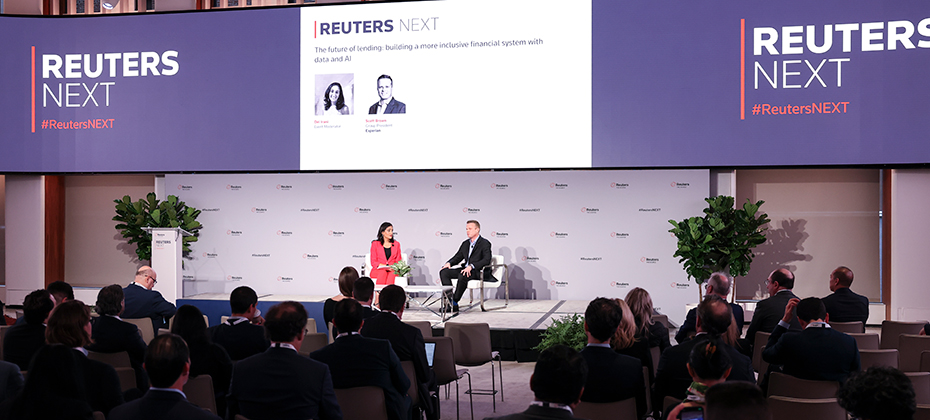
Insights from Reuters Next: Building a More Inclusive Financial System with Data and AI
Data & AnalyticsToday, we stand at the forefront of a digital revolution that is reshaping the financial services industry. And, against this backdrop, financial institutions are at vastly different levels of maturity; the world’s biggest banks are managing large-scale infrastructure migrations and making significant investments in AI while regional banks and credit unions are putting plans in place for modernization strategies, and fintechs are purpose-built and cloud native. To explore this more, I recently had the privilege of attending the annual Reuters NEXT live event in New York City. The event gathers globally recognized leaders across business, finance, technology, and government to tackle some of today’s most pressing issues. On the World Stage, I joined Del Irani, a talented anchor and broadcast journalist, to discuss the future of lending and the pivotal role of data and AI in building a more inclusive financial system. Improving financial access Our discussion highlighted the lack of access to traditional financial systems, and the impact it has on nearly 100 million people in North America alone. Globally, the problem affects over one billion people. These people, who are credit invisible, unscoreable, or have subprime credit scores, are unable to secure everyday financial products that many of us take for granted. What many don’t realize is, this is not a fringe subset of the population. Most of us, myself included, know someone who has faced the challenges of financial exclusion. Everyday Americans, including young people who are just starting out, new immigrants and people from diverse communities, often lack access to mainstream financial products. We discussed how traditional lending has a limited view of a consumer. Like looking through a keyhole, the lender’s understanding of the person in view is often incomplete and obstructed. However, with expanded data, technology, and advanced analytics, there is an opportunity to better understand the whole person, and as a result have a more inclusive financial system. At Experian, we have a unique ability to connect the power of traditional credit with alternative data, bringing a more holistic understanding of consumers and their behaviors. We are dedicated to leveraging our rich history in data and our expertise in technology to create the future of credit and ultimately bring financial power to everyone. The future of lending After spending two days with over 700 industry leaders from around the world, one thing is abundantly clear: much like the early days of the internet, today, we are at the cutting-edge of a technical revolution. Reflecting on my time at Reuters NEXT, I am particularly excited by the collective commitment to drive innovative, and smarter ways of working. We are only beginning to scratch the surface of how data and technology can transform financial services, and Experian is positioned to play a significant role. As we look to the future, I am excited about the ways we will create new opportunities for businesses and consumers alike.
The advertising ecosystem has seen significant transformation over the past few years, with increased privacy regulation, changes in available signals, and the rise of channels like connected TV and retail media. These changes are impacting the way that consumers interact with brands and how brands understand and continue to deliver relevant messages to consumers with precision. Experian has been helping marketers navigate these changes, and as a result, our marketing data and identity solutions underpin much of today’s advertising industry. We’re committed to empowering marketers and agencies to understand and reach their target audiences, across all channels. Today, we are excited to announce our acquisition of Audigent—a leading data and activation platform in the advertising industry. With Audigent’s combination of first-party publisher data, inventory and deep supply-side distribution relationships, publishers, big and small, can empower marketers to better understand their customers, expand the reach of their target audiences and activate those audiences across the most impactful inventory. I am excited to bring together Audigent’s supply-side network as a natural extension to our existing demand-side capabilities. Audigent’s ability to combine inventory with targeted audiences using first-party, third-party and contextual signals provides the best of all worlds, allowing marketers to deliver campaigns centered on consumer choices, preferences, and behaviors. The addition of Audigent further strengthens our strategy to be the premier independent provider of marketing data and identity, ultimately creating more relevant experiences for consumers. To learn more about Experian and Audigent, visit https://www.experian.com/marketing/ and https://audigent.com/.
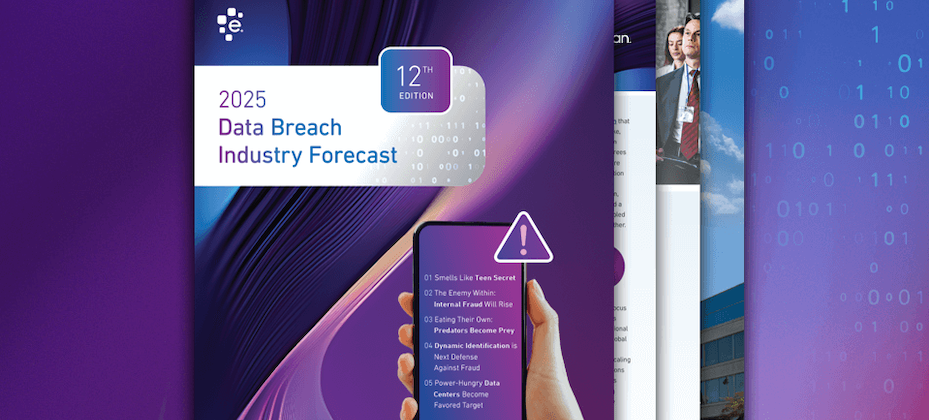
Experian Releases its 12th Annual Data Breach Industry Forecast Highlighting Five Predictions for 2025
Data & AnalyticsWhen it comes to cybercriminals and threat vectors, we need to expect the unexpected. Experian’s 12th annual Data Breach Industry Forecast highlights several potential trends for 2025, with AI playing a central role. This year has already seen more data breaches and impacted consumers than 2023, indicating that global data breaches are not slowing down. Some things to watch out for next year includes the potential for more internal fraud. As companies train employees on AI, there is a growing risk that some will misuse their knowledge for internal theft and sourcing sensitive information. Another trend may be cyberattackers targeting large data centers, with the growth of generative AI introducing power as a new attack vector. It’s reported that a single ChatGPT query uses significantly more electricity than a standard Google search, making data centers and cloud infrastructure vulnerable, especially in countries with varying security standards. We expect AI-related attacks to dominate the headlines next year and investments in cybersecurity will increase to tackle this emerging threat, as hackers leverage AI for phishing, password cracking, malware, and deepfakes. Jim Steven, Head of Crisis and Data Response Services at Experian Global Data Breach Resolution in the UK, anticipates that global data breaches will persist at their current rate next year. He notes that ransomware attacks are likely to become even more sophisticated with the integration of AI. Additionally, Steven predicts that threat actors will escalate their tactics to achieve greater rewards, and the misuse of consumer data to damage reputations will increase in 2025. To access the complimentary report, click here.