Lorem Ipsumis simply dummy text of the printing and typesetting industry. Lorem Ipsum has been the industry’s standard dummy text ever since the 1500s, when an unknown printer took a galley of type and scrambled it to make a type specimen book. It has survived not only five centuries, but also the leap into electronic typesetting, remaining essentially unchanged
Author One

During a year of the pivot, Experian North America remained focused on our purpose: Creating a Better Tomorrow. It’s not just a marketing tag line. It’s the lens through which we care for our employees, and how they in turn fuel innovations to serve our communities when they need help the most. That’s why this year’s 31 ranking in the Fortune “100 Best Companies to Work For” is so incredibly meaningful. For this year’s national award, two elements were considered: confidential employee feedback and the programs companies created to support people and communities in response to COVID-19. The employee surveys were distributed last summer, in the thick of pandemic restrictions and lockdowns. All around, we saw improvement: 50 percent of employees responded to the surveys (compared to 43 percent the year before), and 92 percent of employees attest that Experian is a Great Company to Work For (compared to 86 percent the year before). We’ve worked hard to build an employee culture over the past several years that continuously strives for inclusion and equity. This foundation became instrumental to how we navigated the past twelve months. Our employee resource groups took the lead to support our colleagues with the creation of a dynamic mental health and well-being guide, producing programs that brought awareness and support during social unrest and the rise in racism, and arranging annual celebrations to provide a touch of “normalcy.” Through a year that also included natural disasters such as the arctic blast, wildfires, storms and flooding, we have been there for each other. From free credit reports for consumers and small businesses, to products and services that enable governments, healthcare providers and nonprofits to prepare for and serve populations in crisis, Experian North America’s workforce leveraged diversity of perspectives, backgrounds and experiences to help vulnerable populations in crisis from COVID-19. Even through lockdowns and restrictions, employees logged 18,000 volunteer hours to increase financial inclusivity, support frontline healthcare workers, honor the nation’s military and veterans, and fight hunger. The Human Rights Campaign Foundation gave Experian North America a perfect score in its Corporate Equality Index for the third year in a row, and the company earned its recertification as a Great Place to Work. It has been named one of the top 10 Fortune’s Best Workplaces in Financial Services and Insurance, and a Comparably Top 50 company for Best Outlook 2021. Experian Costa Rica, part of our North America region, also earned Great Place to Work honors for the third year in a row. Our purpose runs deep. We put our people at the heart of how we run our business and it guides how we serve our consumers, clients and each other. We will continue this momentum of the 2021 Fortune 100 Best Companies to Work For by helping to drive financial inclusion and equity, growing our business through innovation, and creating opportunities for our coworkers to thrive and build meaningful careers.

Today is Transgender Day of Visibility. A day to celebrate trans people around the world, highlighting their experiences, perspectives and also unfortunately spotlighting the discrimination and challenges they still face. A recent report from TotalJobs found that the number of trans workers in the UK surveyed who said they hid their gender identity at work has risen in the past 5 years – from 52% in 2016 to 65% in 2021. It also found that 43% of trans employees surveyed said they had left a job because the environment was unwelcoming, up from 36% in 2016. This should make us all sit up and want to take action. At Experian, we want colleagues of all gender identities to feel comfortable and safe bringing their whole selves to work. We’ve been working hard on how we can continue to improve the support we offer our trans and non-binary colleagues. We realise that choosing to be open about one’s gender identity is a very personal decision, but all trans and non-binary employees should feel safe at Experian if they choose to disclose. Last year we re-wrote our Transitioning at Work policy to ensure it is reflective and inclusive of the experiences and identities of employees who may use it. We offer paid leave to attend medical appointments and we also provide help in changing your records on our systems. Where an employee chooses to disclose information about their gender identity or status, we treat this information with the utmost confidentiality. We never share this information without the written consent of the individual. We encourage our employees to self-identify and recognise the issues in the current Gender Recognition Act. In September, we supported Stonewall’s Trans Right are Human Rights campaign, pushing for its reform. We continue to monitor the progress that has been made but also progress that is yet to come. It’s important you know that Experian will never ask for you to show a Gender Recognition Certificate (GRC) and we respect your right to privacy as to whether or not you have one. At Experian, we take an always listening, always learning approach to building awareness and acceptance. Creating safe spaces for meaningful dialogue is something we really strive for. It is the responsibility of all our employees to respect their colleagues and to create an inclusive workplace where everyone feels they can belong. We have zero tolerance for discrimination, bullying or harassment and take any incidents very seriously. Experian continues to work with the Experian Pride Network UK&I alongside LGBTQ+ charities Stonewall and Mermaids in the UK to further the inclusion of our trans and non-binary employees. We want all trans and non-binary employees at Experian to feel safe and be able to be themselves at work and we expect all colleagues to support each other to make that real.
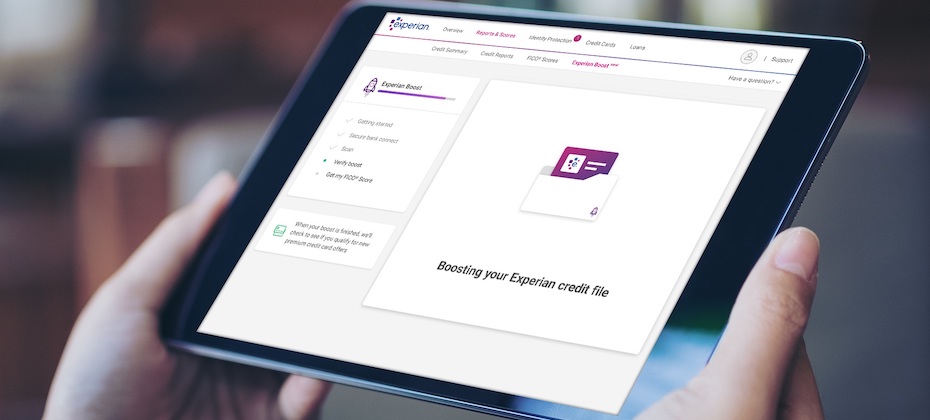
After launching Experian Boost, the first-of-its-kind tool that allows consumers to instantly increase their credit scores, in March 2019 we recently reached a significant milestone. Millions of consumers have boosted their credit scores to the tune of 50 million total points. This means many consumers have improved score bands, saved money with better interest rates, and maybe reached some of their financial goals such as gaining access to credit for a home. In fact, we know our Boost users have gained access to more than 1.7 billion total dollars in credit as a result of improving their credit score. The idea behind Experian Boost is to give consumers control over their credit – to enable them to make real, substantial progress in their financial health journey by getting “credit” for paying bills on time. Our ability to help consumers in a challenging economic climate is what drives us to continue to innovate. For example, we recently expanded Experian Boost to add positive payment history for video streaming services such as Netflix in addition to telecom and utility payments. The benefits to having control and using tools like Experian Boost do not end there. Consumers receive a boosted FICO® Score, which is used by a majority of lenders giving them a great opportunity for credit with better terms. In the first year after launching, we saw one million consumers add a credit card and nearly 250,000 consumers acquired an auto loan. Also, some consumers earned a credit score for the first time. What is also significant about Experian Boost is that this type of financial control and opportunity gives consumers a sense of empowerment, motivation and satisfaction that they can take a positive step in their financial journey. We’ve heard this firsthand from consumers through focus groups, and we even featured some consumers in our commercials who shared their positive experiences in front of the camera. This sentiment of empowerment among consumers is especially important right now as many are struggling financially due to the pandemic. We have many exciting new tools launching in 2021 and will continue to focus on empowering consumers to reach their financial goals. To learn more about Experian Boost, visit www.experian.com/boost.

Does checking my credit report hurt my credit score? How can I improve my credit score? What’s the difference between a credit score and a credit report? These are a few of the questions I most often hear about credit, and the answers to these fundamental questions are essential to financial well-being. Understanding credit scores and the factors that influence overall credit health is important any time, but this is especially true in our current environment. As part of our ongoing commitment to consumer education on the road to recovery, I recently had the pleasure of partnering with Akbar Gbajabiamila, host of American Ninja Warrior, former football pro and financial fitness expert, for an Instagram Live event. Akbar is passionate about helping people develop a financial game plan and he understands having a good credit history is a key component of good financial health. During the Instagram Live event, I answered questions from Akbar’s fans and shared ways to improve your credit score through tools like Experian Boost. In case you missed it, you can watch the video recap on Akbar’s Instagram account (@akbar_gbaja) or at the following link: https://www.instagram.com/tv/CLpbdDJlaQ6/ View this post on Instagram A post shared by 🇳🇬Akbar Gbajabiamila🇺🇸 (@akbar_gbaja) A positive credit history can be the gatekeeper to many of the things we all want in life, and we’re committed to helping facilitate fair and affordable access to credit for all consumers, including those in marginalized communities. This is one of the many reasons I’m passionate about my role at Experian. Educating consumers about credit is an important part of getting the economy as a whole humming again and helping those most in need. If you have additional questions about credit, feel free to check out the free resources below. Additional credit education resources and tools Join Experian’s weekly#CreditChat hosted by @Experian on Twitter with financial experts every Wednesday at 3 p.m. Eastern time. Visit the Ask Experian blog for answers to common questions, advice and education about credit. Add positive telecom, utility and streaming service payments to your Experian credit report for an opportunity to improve your credit scores by visiting experian.com/boost. You can request a free copy of your credit report from each of the three credit bureaus once a week through April 20, 2022 by visiting annualcreditreport.com For additional resources, visit https://www.experian.com/consumereducationor experian.com/coronavirus.

We recognize that COVID-19 has challenged Americans across the country, and nearly a year later, people are still struggling to recover. Among the more pressing issues for people has been navigating the financial landscape and hardships brought on by illness and high unemployment rates. At Experian, we empathize with consumers and are committed to helping them manage their financial lives. As part of this commitment, Experian, along with the other U.S. credit reporting agencies, is continuing to offer free weekly credit reports to all Americans for an additional year via AnnualCreditReport.com. At Experian, we view ourselves as the consumers’ bureau, and aim to help people better position themselves as they recover from COVID-related hardships. We’re proud of our ongoing efforts to assist consumers, particularly during these difficult times. Financial and credit information is constantly updated, and we believe providing consumers with increased access to their credit reports will help them improve their financial health, monitor for lender updates and ensure there is no fraudulent or unfamiliar activity on their credit profiles. We are committed to helping facilitate access to fair and affordable access to credit for all consumers. Our goal is not only to help consumers build credit, but also to effectively manage it. Beyond our continued offering of free credit reports, consumers can access resources and educational materials to help learn about credit and other important personal finance topics. In fact, we recently launched our United for Financial Health project to empower vulnerable populations to improve their financial health through education and action. We’re continually exploring new ways to use our data and resources to empower consumers and to improve their financial health and recover from COVID-19; extending access to free weekly credit reports is just another step in that process.
In this article…
First Heading
Lorem Ipsumis simply dummy text of the printing and typesetting industry. Lorem Ipsum has been the industry’s standard dummy text ever since the 1500s, when an unknown printer took a galley of type and scrambled it to make a type specimen book. It has survived not only five centuries, but also the leap into electronic typesetting, remaining essentially unchanged
It was popularised in the 1960s with the release of Letraset sheets containing Lorem Ipsum passages, and more recently with desktop publishing software like Aldus PageMaker including versions of Lorem Ipsum.
Why do we use it?
It is a long established fact that a reader will be distracted by the readable content of a page when looking at its layout. The point of using Lorem Ipsum is that it has a more-or-less normal distribution of letters, as opposed to using ‘Content here, content here’, making it look like readable English. Many desktop publishing packages and web page editors now use Lorem Ipsum as their default model text, and a search for ‘lorem ipsum’ will uncover many web sites still in their infancy. Various versions have evolved over the years, sometimes by accident, sometimes on purpose (injected humour and the like).
It was popularised in the 1960s with the release of Letraset sheets containing Lorem Ipsum passages, and more recently with desktop publishing software like Aldus PageMaker including versions of Lorem Ipsum.
Why do we use it?
It is a long established fact that a reader will be distracted by the readable content of a page when looking at its layout. The point of using Lorem Ipsum is that it has a more-or-less normal distribution of letters, as opposed to using ‘Content here, content here’, making it look like readable English. Many desktop publishing packages and web page editors now use Lorem Ipsum as their default model text, and a search for ‘lorem ipsum’ will uncover many web sites still in their infancy. Various versions have evolved over the years, sometimes by accident, sometimes on purpose (injected humour and the like).
Second Heading
It was popularised in the 1960s with the release of Letraset sheets containing Lorem Ipsum passages, and more recently with desktop publishing software like Aldus PageMaker including versions of Lorem Ipsum.

Where can I get some?
There are many variations of passages of Lorem Ipsum available, but the majority have suffered alteration in some form, by injected humour, or randomised words which don’t look even slightly believable. If you are going to use a passage of Lorem Ipsum, you need to be sure there isn’t anything embarrassing hidden in the middle of text. All the Lorem Ipsum generators on the Internet tend to repeat predefined chunks as necessary, making this the first true generator on the Internet. It uses a dictionary of over 200 Latin words, combined with a handful of model sentence structures, to generate Lorem Ipsum which looks reasonable.
There are many variations of passages of Lorem Ipsum available, but the majority have suffered alteration in some form, by injected humour, or randomised words which don’t look even slightly believable. If you are going to use a passage of Lorem Ipsum, you need to be sure there isn’t anything embarrassing hidden in the middle of text. All the Lorem Ipsum generators on the Internet tend to repeat predefined chunks as necessary, making this the first true generator on the Internet. It uses a dictionary of over 200 Latin words, combined with a handful of model sentence structures, to generate Lorem Ipsum which looks reasonable. The generated Lorem Ipsum is therefore always free from repetition, injected humour, or non-characteristic words etc.
Author test
Buttons margin test