Many desktop publishing packages and web page editors now use Lorem Ipsum as their default model text, and a search for ‘lorem ipsum’ will uncover many web sites still in their infancy.
Managing Holiday Debt the Smart Way
Many desktop publishing packages and web page editors now use Lorem Ipsum as their default model text, and a search for ‘lorem ipsum’ will uncover many web sites still in their infancy.Many desktop publishing packages and web page editors now use Lorem Ipsum as their default model text, and a search for ‘lorem ipsum’ will uncover many web sites still in their infancy.Many desktop publishing packages and web page editors now use Lorem Ipsum as their default model text, and a search for ‘lorem ipsum’ will uncover many web sites still in their infancy.Many desktop publishing packages and web page editors now use Lorem Ipsum as their default model text, and a search for ‘lorem ipsum’ will uncover many web sites still in their infancy.

Many desktop publishing packages and web page editors now use Lorem Ipsum as their default model text, and a search for ‘lorem ipsum’ will uncover many web sites still in their infancy.Many desktop publishing packages and web page editors now use Lorem Ipsum as their default model text, and a search for ‘lorem ipsum’ will uncover many web sites still in their infancy.Many desktop publishing packages and web page editors now use Lorem Ipsum as their default model text, and a search for ‘lorem ipsum’ will uncover many web sites still in their infancy.Many desktop publishing packages and web page editors now use Lorem Ipsum as their default model text, and a search for ‘lorem ipsum’ will uncover many web sites still in their infancy.Many desktop publishing packages and web page editors now use Lorem Ipsum as their default model text, and a search for ‘lorem ipsum’ will uncover many web sites still in their infancy.

Many desktop publishing packages and web page editors now use Lorem Ipsum as their default model text
The Marketing Guy
The Marketing Guy speaks the truth
Many desktop publishing packages and web page editors now use Lorem Ipsum as their default model text, and a search for ‘lorem ipsum’ will uncover many web sites still in their infancy.Many desktop publishing packages and web page editors now use Lorem Ipsum as their default model text, and a search for ‘lorem ipsum’ will uncover many web sites still in their infancy.Many desktop publishing packages and web page editors now use Lorem Ipsum as their default model text, and a search for ‘lorem ipsum’ will uncover many web sites still in their infancy.

Guess That Credit Score
Many desktop publishing packages and web page editors now use Lorem Ipsum as their default model text, and a search for ‘lorem ipsum’ will uncover many web sites still in their infancy.Many desktop publishing packages and web page editors now use Lorem Ipsum as their default model text, and a search for ‘lorem ipsum’ will uncover many web sites still in their infancy.Many desktop publishing packages and web page editors now use Lorem Ipsum as their default model text, and a search for ‘lorem ipsum’ will uncover many web sites still in their infancy.
Check out the latest post

The following article is a guest post from Laura Levine, president and CEO of the Jump$tart Coalition for Personal Financial Literacy® As we wrap up another Financial Literacy Month, it’s fun to look back at how far we’ve come; important to look forward at how much further we have to go; and compelling to look closely at how we’re making a difference. A decade and a half ago, the National Endowment for Financial Education established “Financial Literacy for Youth Day” in conjunction with its High School Financial Planning Program. Recognizing the groundswell of support beginning to build for financial literacy, NEFE turned the idea over to Jump$tart to promote April among its national partners first as “Financial Literacy for Youth Month” and later as simply “Financial Literacy Month.” Congress recognized it officially with a resolution in 2003 and more recently, the month has also been recognized as “National Financial Capability Month.” By any name, it’s been gratifying to see individuals and organizations across the country, united as we’ve raised awareness on the importance of financial literacy or capability, and the need for more and better financial education. It’s been particularly encouraging to see the renewed focus on financial literacy for young people. President Obama’s current advisory council is officially the President’s Advisory Council on Financial Capability for Young Americans. Other prominent entities, including the 22-agency Financial Literacy and Education Commission and the national Jump$tart Coalition for Personal Financial Literacy; have placed heavy emphasis on financial literacy for youth. Experian was at the table as Jump$tart was forming—two decades ago—on the notion that we should educate young people about money before they start making independent financial decisions as adult consumers and are sometimes required to learn by trial and costly error. And while many experts agree that the best financial education starts at home, there is also widespread recognition that not all families can or will provide their own children with a sufficient introduction to money management and that we must all work together to help provide financial education to students in school, after school, at home and in their communities. In the early days of Jump$tart and the concerted financial literacy movement, much of our energy focused on what students needed to know about money and what skills they needed to develop. Consequently, we saw a rush to develop new programs and materials and assess how much students actually knew. We found it wasn’t much. We had our work cut out for us; but we knew we had started down the right path. At the dawn of the 21st Century, innovators sought ways to utilize technology as a means of delivering financial education to more students and adults alike—to deliver it faster; more efficiently. We watched as technology made financial education more interactive, more engaging, and, presumably, more effective. Financial education was getting better and we were reaching more students; but still, there was much to be done. In recent years, Jump$tart turned a good deal of its attention to the support of classroom educators—the talented and dedicated teachers who bring personal finance to life in their classrooms every day—because isn’t it an effective teacher who does more than impart knowledge and know-how? Isn’t it an effective teacher who has the opportunity and ability to affect young lives? That’s what Jump$tart believes. It’s what I believe, personally. Fortunately for us, it’s what our friend Maxine Sweet believes too, and in 2009, she not only prompted Experian to provide us with a generous grant; but also, helped to inspire the first national conference dedicated to the teaching of personal finance in K-12 classrooms. The Jump$tart National Educator Conference, now in its seventh year, has introduced personal finance teachers from every state in the country to new approaches and information, a variety of resources, and each other—effectively giving every finance teacher, who may be the only one at his or her school, a nationwide network of colleagues. Teachers who attended our most recent conference reported that, collectively, they would teach 38,654 students this year alone. Since most will go on to teach for years to come and since new teachers attend our conference every year; the impact will be exponential. Just this April, we were so pleased to have had the opportunity to recognize Maxine Sweet, recently retired as the vice president of consumer education for Experian, with our William E. Odom Visionary Leadership Award. The award recognized her unique contributions to financial education, as well as to consumer education in her role with Experian. With support from, and working alongside, Experian and many other partners from business, finance, education, academia, government, non-profits, and other sectors, Jump$tart will continue to promote top quality financial education resources, effective programs and techniques, and support for classroom teachers and other educators—including parents and caregivers. Sometimes, when our critics question why we haven’t fixed our nation’s financial literacy problems yet, I’ve heard advocates remind them that financial education, like all education, is much more a marathon than a sprint. But I don’t see it as a race at all, as even a marathon has a finish line. I think financial education deserves a permanent role in the upbringing of young consumers. Even as we work diligently to expand, improve, and evolve the way we conduct this education, we’ll never really be done; because every spring there’s a new class of graduates and every fall, there’s a new class of preschoolers.

In the wake of some of the largest data breaches in history, which were specifically payment card breaches, we thought it would be insightful to take a closer look at how companies are dealing with the aftermath. We are proud to partner with the Ponemon Institute, a premier research think tank, to release the first industry study that closely examines payment technologies and the growing threat of data breaches. The study, “Data Security in the Evolving Payments Ecosystem,” asked professionals to weigh in on several topics including who should be responsible for securing payment systems and how effective their organizations is in preparing for and responding to a payment card breach. New technologies bring consumer convenience and increased security concerns Executives are feeling the challenges of keeping up with the security of emerging systems. While most executives support implementation of EMV chip and PIN technology, for example, with 59 percent of survey respondents indicating it is an important part of their organization’s payment strategy, they do not feel it is the security silver bullet. Barely more than half of respondents (53 percent) believe EMV cards will decrease the risk of a data breach. However, companies are pressured to integrate new systems acknowledging consumer convenience and preferences. More than half accept that risk (53 percent) and noted that, for their company, customer convenience is more important than security. Reality has set in The recent high profile data breaches have had a profound effect on business and they now realize how devastating a breach can be on company reputation and loss of revenue. In fact, a majority of survey respondents (69 percent) are most concerned about loss of customer loyalty after a data breach and fraudulent charges on customers’ payment cards (55 percent). In looking inward, they also do not feel their company is effective in responding to payment card breaches (35 percent). On the right track It seems not a day goes by without the media reporting on a data breach. This has had an effect as 69 percent of survey respondents said media coverage of payment breaches over the past year caused their organizations to re-evaluate and prioritize security. It’s encouraging to see that this is leading to action; companies are seeing increased attention from the c-suite, with 67 percent of survey respondents saying their executives are more supportive of enhanced security measures to protect payment information. Furthermore, 45 percent of survey respondents increased their security budgets, and 41 percent hired more security staff. Industry collaboration is lacking While companies are doing more, they realize there is still even more to be done. Sixty-five percent of survey respondents said they are increasing employee training (65 percent) and improving or putting a data breach response plan in place (56 percent of survey respondents). Payment professionals also recognize that solving current and emerging security concerns can’t be the job of a single entity. There is consensus on the need for cooperation, with 85 percent of survey respondents agreeing that industry collaboration is critical to achieving a high level of security in the emerging payment ecosystem. And there is certainly room to grow, as the current level of industry collaboration is considered minimal (30 percent of respondents) to nonexistent (20 percent) by survey respondents. The security outlook for all those organizations involved in the payment ecosystem is mixed. It will be challenging to constantly keep up the pace with new technologies and ward off cybercriminals 24-7, while satisfying consumers who value the benefits of emerging systems. The best path forward for companies is to face the issue head on and prepare for the inevitable data breach and their incident response to mitigate the fallout. To access the full report, Data Security in the Evolving Payments Ecosystem, visit Experian.com/databreach.

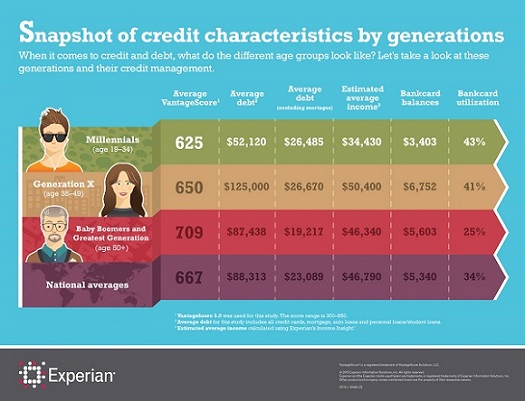
Millennials are considered the “Me Me Me” generation. Why shouldn’t they be? Aged 18–34, millennials have everything going for them in today’s economy. The job market is favorable, and as the creators of advancing technology, they’re poised for growth. According to the U.S. Census Bureau, the “millennial” generation is projected to surpass the outsized baby-boomer generation this year to be the nation’s largest living generation. How are millennials handling credit? This is a generation unique in its behaviors and mindful of its financial position going forward. The choices millennials make as they enter their peak spending years will have a direct impact on the credit market. This is a ballooning opportunity for lenders, and it makes sense for marketers to design their brand experience to target this generation. However, lenders need to understand what appeals to millenials to reach this group. As part of our upcoming Vision 2015 session, we’re giving lenders the analytical insight they need to understand this generation better. This session will explore housing, auto, bankcard and student loan trends in credit establishment, and how millennials compare to Gen X when they were the same age. Our analysis shows that millennials haven’t fully embraced credit. They understand the importance of building credit; however, they’re adopting bankcards at a slower rate than their Gen X counterparts when they were the same age. Forty-six percent of Gen Xers had bankcards when they were 18–34 years old. On the other hand, 27 percent of millennials have bankcards, which is half the rate of the previous generation. Every generation is different and every business is trying to capture the millennials’ attention. How should lenders go about building trust and a lasting relationship with millennials? We took to the streets to speak to millennials firsthand to give you an opportunity to hear their perspective. Come join us to discover “Four great insights about millennials in 40 minutes” and rethink how you can reach millennials at the right time with the right message.
Many desktop publishing packages and web page editors now use Lorem Ipsum as their default model text, and a search for ‘lorem ipsum’ will uncover many web sites still in their infancy.
This is a pull quote
This is test
This is a heading
Many desktop publishing packages and web page editors now use Lorem Ipsum as their default model text, and a search for ‘lorem ipsum’ will uncover many web sites still in their infancy.
- Test 1
- Test 2
- Test 3

It was popularised in the 1960s with the release of Letraset sheets containing Lorem Ipsum passages, and more recently with desktop publishing software like Aldus PageMaker including versions of Lorem Ipsum.
My Company Experian