There’s no escaping the fact that data is universal; enabling our choices, fuelling our economy, informing decisions and shaping our ideas. It’s influence, driven and shaped by the digitalisation of our culture, is only set to expand as we enter the next decade. As the world becomes ever more connected, the sheer volume of available data will continue to grow at a substantial rate. So too will the range and variety of that data. With that comes huge opportunity for organisations to use data-driven solutions to not only deliver better outcomes for their customers, but take on some of the biggest challenges in society. At Experian, we believe data has the power to change the world for the better, and remain committed to creating new ways to drive innovation for the benefit of everyone. That’s why we’re proud to sponsor the very first ‘Data Excellence Award’ at the National Business Awards in November, championing the best examples of those working at the forefront of data and analytics. The ‘Experian Data Excellence Award 2018’ is designed to recognise organisations that are unlocking the power of data to create opportunities for people, businesses and society. If you understand that the value in data goes far beyond regulatory compliance, this is the award for you. It’s hugely exciting to be part of this year’s awards and we are looking forward to seeing some high-quality entries showcasing data excellence. Interested? Then visit the National Business Awards website for more information.

Experian: Positive Financial Results Underscore Our Commitment to Help Clients and Consumers
FeaturedToday we announced our results for the last financial year. The results and the business growth are strong, and a reflection of the actions we have taken to build our success. While we posted some very good results – 8% total revenue growth for the year is great – but it is the people, the strategy and the execution behind those numbers that we are most proud of. In recent years, we intentionally set a course that started with a brand promise to power new opportunities for our clients while creating a better tomorrow for consumers and society. In the last year, towards our quest to achieve that promise, we have made significant progress: We have invested in technologies like API and analytical sandboxes to help us better serve clients worldwide and effectively and safely manage the data and decisioning tools that help our clients succeed; We have made key investments to add new sources of data – including the acquisition of Clarity Services in North America and our continued strategy to look at mobile phone data in EMEA and Asia Pacific to help those who are excluded from the traditional financial system; We have introduced new products for consumers that help them better protect their identities and help them effectively manage their financial profile and credit standings to help ensure financial access in today’s credit economy; and We have created innovations such as our “Text for Credit” offering, which not only makes it easier for consumers to have a seamless credit application process, but it also enables lenders to have a more productive relationship with consumers who are looking for loans. Those are just some of the efforts that underscore our financial results. But more important than the positive results is the fact that we achieved this growth while also staying true to our brand promise. We are doing great things around the world – for businesses, for people and for society. The possibilities and potential of data have never been more exciting or life-enhancing – and our belief remains that data is central to how we all live and has the potential to transform all our lives for the better. The work our nearly 17,000 employees are doing – and have been doing – is indeed transformational. And that is one result for which we couldn’t be prouder.

As the owner of one of those increasingly popular voice-controlled assistants, I get a weekly email from the supplier suggesting new things to ask it to do or help with. Rather conveniently, this week’s update arrived this morning and includes the suggestion: “[Hello], can you do maths?” I use the word ‘conveniently’ because among the various tasks on my to-do list today is ‘write a short blog about numeracy’. So now I have an introduction. Like literacy, numeracy – understanding and being able to apply numbers – is a vital life skill. They are both key foundations of our education from the earliest of ages and go on to support opportunity and achievement throughout our schooling, into the world of work and beyond. Low levels of numeracy in adult life can be a major obstacle to success. Most employers require at least basic maths skills. And if you struggle with numbers, making successful financial decisions about the money that going to work generates will be very challenging. But this is the reality for many adults today. In the UK, almost half of us possess the maths skills expected of an 11 year old. This is according to National Numeracy, a charity that champions the importance of good numeracy and provides tools to help people improve. So when National Numeracy asked Experian to support the UK’s first National Numeracy Day on 16 May we were delighted to say yes. I’m certainly looking forward to working alongside a number of other big brands as well as numeracy ambassadors Rachel Riley and Martin Lewis. It’s a great fit for Experian, a company with a long track record of supporting initiatives designed to help people make successful decisions, particularly around personal finances. Our learning resource Values, Money & Me is already used in primary-school classrooms around the country to help cement good financial habits from an early age. Similarly, millions of adults track the health of their credit with the help of a free Experian account, and use the built-in eligibility features to secure better deals on financial products. Like others, we firmly believe that maths skills and financial success are closely linked, so we’re delighted to be helping support and promote National Numeracy Day. We’ll be encouraging as many people as possible to tackle the National Numeracy challenge and, where necessary, to take follow-up steps to brush up on their maths skills and, as a result we hope, improve their financial futures. Written by: James Jones, Head of Consumer Affairs, UK&I

Experian MicroAnalytics Empowers Emerging Market Consumers with Financial Services to Improve Quality of Life
Data & AnalyticsElio Vitucci, CEO of Experian MicroAnalytics, authored the op-ed Financial Empowerment for the Emerging Market Consumer in U.S. News & World Report. To date, Experian MicroAnalytics has extended over 4.9 billion credit offers to the world’s unbanked people, and nearly half of those offers were in the past year. The new emerging market consumer is becoming empowered with tools and services needed for a better quality of life and economic vitality. Experian MicroAnalytics contributes to global progress by helping those with no credit history gain access to credit and financial products for their businesses and personal needs. In regions where financial history doesn’t exist, understanding creditworthiness is a challenge. While only a small minority of people in emerging markets have access to credit services, the vast majority have access to mobile services — most of them on a prepaid plan. As such, an alternate credit identity can now be established. Financial services in the emerging world are drastically underserving the potential banked population. Long-term economic growth in the emerging world hinges on access to financial services. Unlocking the new consumer’s credit capability is the new financial frontier. Learn more about how Experian is empowering emerging market consumers with financial products and services to improve quality of life and increase prosperity around the world.

Identity fraud is at an all-time high, and it can have devastating consequences on a person’s life. Victims of identity fraud may have to file for bankruptcy or deal with debt, which can sometimes cause personal relationships to suffer. Elderly people in particular are at the greatest risk of fraud out of any age group, as they tend to more trusting of phone calls, house calls and email scams. It’s my job at Experian to arm them with the tools they need to prevent identity fraud. The number one challenge in helping prevent identity fraud is lack of awareness. People simply don’t know all the risks, so education is a paramount priority. At Experian, we conducted research on the best way to educate different age groups, and found that it varied widely. While younger people are best reached online, older people are more responsive to face-to-face activities, which is part of the reason they are more susceptible to doorstep scams. To help educate elderly people, we found we needed to go out into the community and literally put useful information into people’s hands. As part of these efforts, my team at Experian first worked with the Outreach Solutions organization to help older people in Nottinghamshire, England, understand the dangers of fraud. The pilot campaign, “Tackling Fraud,” reached 15,000 U.K. residents over age 55, teaching them how to tackle the threat of fraud. We armed these individuals with expert advice on how to spot suspicious activity and stop it from happening to them or the people they care about. Given the success and great reception we had in Nottinghamshire, it was clear that this movement could continue growing. According to Experian research, Glasgow is one of the areas with the highest number of identity fraud cases in Scotland. We’d been testing a new television advertisement in Glasgow – marking the first time that identity fraud has ever been advertised on TV in the U.K. – so I made the case to run the next iteration of our Tackling Fraud campaign there, too. In partnership with the Glasgow Council for the Voluntary Sector, we worked with a range of individuals and community groups to provide fraud prevention training to more than 30,000 elderly people in the city.\ We’re dedicated to helping the elderly with our Tackling Fraud campaign, putting people in control of their lives by giving them the information they need to help them protect themselves. I hope that one day we can take this project throughout the U.K. Written by: Phil Rance, Director of Product Identity, Experian Consumer Services

I am delighted to be able to share the exciting news of Experian’s intended acquisition of ClearScore. By combining the experience and strength of our global organisation with those of a successful and rapidly scaling business, it’s our aim to create the most compelling destinations for consumer finances in the UK. Today’s announcement is the first step in delivering a pipeline of future products and services that will further improve consumer choice and access to credit in the UK and beyond. Consumer digital behaviour is rapidly changing the way we all access financial services. At Experian, we’re introducing a range of new services that meet the demands of this changing marketplace, helping people to manage their finances in a simpler, faster and more affordable way. Whichever device people prefer, at any given time, they will be able compare offers on credit cards, loans and mortgages to see which product best suits them, helping them to plan and better manage their financial lives. Like us, ClearScore is a leader in digital finances. It’s an incredibly dynamic organisation, with a large, enthusiastic and engaged group of users. Since its launch in 2014 the business has grown rapidly to more than six million users across the UK and South Africa access to a free credit report and scores. It is our intention to maintain the two brands alongside each other – both ClearScore and Experian. We want to offer services that appeal to the widest possible range of people, and each of these successful identities has a role to play in doing that. At the same time, by bringing ClearScore into the Experian family, we’ll be able to combine our skills and expertise to better enhance the consumer experience. Together we’ll accelerate the development of new, innovative products and services for both brands, leading to a better choice for people across the UK and beyond. Justin Basini, co-founder and CEO of ClearScore, has reiterated the importance of the acquisition: ClearScore is excited to join Experian in due course and to begin a new stage in our incredible journey. We will catalyse positive change for consumers as we combine the businesses and build a global business. It allows ClearScore to deliver on our mission – to help people sort their money – even more effectively. We will be better able to scale, more efficiently, with more resources at our disposal and this will allow us to deliver more for the people who matter most to us – our users. Experian is the world’s biggest credit information company, operating in 37 countries around the world, giving us a much bigger stage upon which to build ClearScore. As is common in a deal such as this, the agreement is subject to regulatory approval. Once that’s concluded, we’ll be able to talk in more detail about how and why this combination will help both Experian and ClearScore to achieve our shared goals. Namely, providing more choice and greater convenience to individuals who want to access personal financial products at the best prices, while also making it easier for businesses to connect with the right customers. In the meantime, it’s business as usual for both companies. We are immensely excited by the opportunities the acquisition of ClearScore brings, and look forward to welcoming the ClearScore team to Experian in due course.
Related Posts

Read Moreio55 Button 2- Learn more Primary button Secondary button Related Posts
Insights from Reuters Next: Building a More Inclusive Financial System with Data and AI
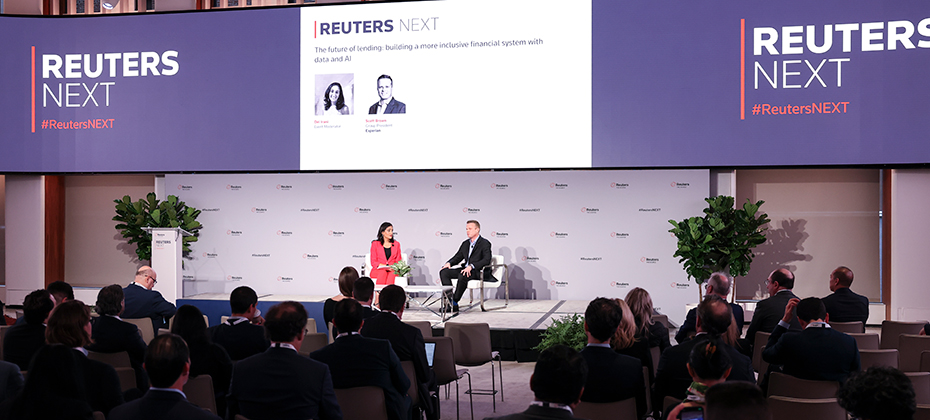
Data & AnalyticsToday, we stand at the forefront of a digital revolution that is reshaping the financial services industry. And, against this backdrop, financial institutions are at vastly different levels of maturity; the world’s biggest banks are managing large-scale infrastructure migrations and making significant investments in AI while regional banks and credit unions are putting plans in place for modernization strategies, and fintechs are purpose-built and cloud native. To explore this more, I recently had the privilege of attending the annual Reuters NEXT live event in New York City. The event gathers globally recognized leaders across business, finance, technology, and government to tackle some of today’s most pressing issues. On the World Stage, I joined Del Irani, a talented anchor and broadcast journalist, to discuss the future of lending and the pivotal role of data and AI in building a more inclusive financial system. Improving financial access Our discussion highlighted the lack of access to traditional financial systems, and the impact it has on nearly 100 million people in North America alone. Globally, the problem affects over one billion people. These people, who are credit invisible, unscoreable, or have subprime credit scores, are unable to secure everyday financial products that many of us take for granted. What many don’t realize is, this is not a fringe subset of the population. Most of us, myself included, know someone who has faced the challenges of financial exclusion. Everyday Americans, including young people who are just starting out, new immigrants and people from diverse communities, often lack access to mainstream financial products. We discussed how traditional lending has a limited view of a consumer. Like looking through a keyhole, the lender’s understanding of the person in view is often incomplete and obstructed. However, with expanded data, technology, and advanced analytics, there is an opportunity to better understand the whole person, and as a result have a more inclusive financial system. At Experian, we have a unique ability to connect the power of traditional credit with alternative data, bringing a more holistic understanding of consumers and their behaviors. We are dedicated to leveraging our rich history in data and our expertise in technology to create the future of credit and ultimately bring financial power to everyone. The future of lending After spending two days with over 700 industry leaders from around the world, one thing is abundantly clear: much like the early days of the internet, today, we are at the cutting-edge of a technical revolution. Reflecting on my time at Reuters NEXT, I am particularly excited by the collective commitment to drive innovative, and smarter ways of working. We are only beginning to scratch the surface of how data and technology can transform financial services, and Experian is positioned to play a significant role. As we look to the future, I am excited about the ways we will create new opportunities for businesses and consumers alike.
The advertising ecosystem has seen significant transformation over the past few years, with increased privacy regulation, changes in available signals, and the rise of channels like connected TV and retail media. These changes are impacting the way that consumers interact with brands and how brands understand and continue to deliver relevant messages to consumers with precision. Experian has been helping marketers navigate these changes, and as a result, our marketing data and identity solutions underpin much of today’s advertising industry. We’re committed to empowering marketers and agencies to understand and reach their target audiences, across all channels. Today, we are excited to announce our acquisition of Audigent—a leading data and activation platform in the advertising industry. With Audigent’s combination of first-party publisher data, inventory and deep supply-side distribution relationships, publishers, big and small, can empower marketers to better understand their customers, expand the reach of their target audiences and activate those audiences across the most impactful inventory. I am excited to bring together Audigent’s supply-side network as a natural extension to our existing demand-side capabilities. Audigent’s ability to combine inventory with targeted audiences using first-party, third-party and contextual signals provides the best of all worlds, allowing marketers to deliver campaigns centered on consumer choices, preferences, and behaviors. The addition of Audigent further strengthens our strategy to be the premier independent provider of marketing data and identity, ultimately creating more relevant experiences for consumers. To learn more about Experian and Audigent, visit https://www.experian.com/marketing/ and https://audigent.com/.