
At Experian, we often say our people are our biggest superpower – and today, I’m thrilled to share that this belief has been recognised once again. Experian has been named one of the 2025 World’s Best Workplaces™ by Fortune and Great Place to Work® for the second year in a row.
This achievement reflects the culture we’ve built together – one that’s welcoming, inclusive, and rooted belonging. It’s a celebration of every colleague who brings their whole self to work, who lifts others up, and who powers opportunities for our clients, consumers, and communities.

We’ve made it our mission to create a workplace where everyone feels included, respected, and empowered. That’s why we’re proud to have earned top scores on the Corporate Equality Index and the Disability Equality Index, and to be recognised with the Outie Award for Workplace Excellence and Belonging.
These recognitions matter. But what matters most is how our people experience life at Experian. Whether it’s collaborating, innovating, or growing through world-class development of products, services and contributing to our communities, our culture is designed to help everyone thrive.
We’ve also made bold commitments to career development. Initiatives like Global Careers Week, the AI-driven performance coach Nadia, and the NextGen Forum – a global leadership development programme for emerging talent from across our regions – give our people the resources to take charge of their growth and build a “One Experian” mindset.
Being named one of the World’s Best Workplaces is a moment to celebrate but also a reminder to keep aiming higher. The world of work is evolving fast, and so are we. From embracing AI to enhancing our digital workplace experience, we’ll continue to push forward and listen to our people every step of the way.
Questions we will discuss:
- What does “retirement readiness” mean to you, and how can someone tell when they are financially ready to retire?
- Is there a magic number for retirement savings, and what factors should someone consider when setting a retirement goal?
- How can someone estimate their retirement expenses realistically?
- What are some common myths or misconceptions about how much money you need to retire?
- How should Gen Z, Millennials, and Gen Xers each approach retirement planning differently based on their stage of life?
- What are the biggest obstacles people face when trying to save for retirement, and how can they overcome them?
- How can you balance saving for retirement with paying off debt or supporting family today?
- What tools, calculators, or strategies can help people figure out if they’re on track for retirement?
- How can people prepare for unexpected costs or life changes that could impact their retirement plans?
- What’s one piece of advice you’d give someone just starting—or restarting—their retirement savings journey?
| Columns 1 | Column 2 | Column 3 | Column 4 |
|---|---|---|---|
| Row 1 Col 1 | |||
| Row 2 Col 1 | |||
| Row 3 Col 1 | |||
| Footer 1 | Footer 2 | Footer 3 | Footer 4 |

Credit Chat
Stretching your Dollars: Practical Tips to Cut Costs and Save More
February 5, 2025 3-4 PM ET
- What does “retirement readiness” mean to you, and how can someone tell when they are financially ready to retire?
- Is there a magic number for retirement savings, and what factors should someone consider when setting a retirement goal?
- How can someone estimate their retirement expenses realistically?

Greater transparency in buy now, pay later activity is key to helping consumers build their credit histories and supporting responsible lending. We have members of the military right now right out of high school and there’s not a lot of experience managing their own money. They’re quickly thrust into a place where they don’t have a support system to do that. We have members of the military right now right out of high school and there’s not a lot of experience managing their own money. They’re quickly thrust into a place where they don’t have a support system to do that. We have members of the military right now right out of high school and there’s not a lot of experience managing their own money. They’re quickly thrust into a place where they don’t have a support system to do that. We have members of the military right now right out of high school and there’s not a lot of experience managing their own money. They’re quickly thrust into a place where they don’t have a support system to do that. We have members of the military right now right out of high school and there’s not a lot of experience managing their own money. They’re quickly thrust into a place where they don’t have a support system to do that.
Experian North AmericaScott Brown, Group President, Financial Services

I recently attended a conference in Alwar, India, hosted by Experian and the International Finance Corporation. During one of the sessions, I met a single mother of two who had recently moved to a rural village in India. Her husband had left her and she was hoping to pick up work as a tailor once she purchased a sewing machine to support her family. As we talked, she confided in me that she was having trouble securing a loan from microfinance institutions because she didn’t have papers to prove her identity. And since she was new to the village, no one knew who she was. Without a proven identity, she couldn’t qualify for a loan and get the money she needed to support herself and feed her children. Indian banks predominantly serve urban customers whose credit reports are extensive. However, most customers from smaller districts and rural towns – like this woman – can fit their credit history on less than a page. Identification may be the only way they can verify their character to secure a loan. As I sat with this woman, I started telling her about our Prove ID tool that I had recently helped to develop. Using an individual’s biometrics, the tool would search her credit history, bank card and any information that can prove she is who she claimed to be. I explained that by using this tool, she could now prove what village she’s from, that she was a permanent resident in her new village and that she was likely to repay her loan. She was stunned and overwhelmed. In that moment, I realized that rural clients often need human connection to clearly understand what a bank or microfinance institution requires in order to obtain a loan. Many rural customers can’t read the brochures or pamphlets sitting in a bank, but by engaging them in conversation, you can effectively educate them about how to prove their identities and build their credit profiles to successfully access the finances they need. As a Product Developer for banks, I sometimes get so caught up on how to make products run that I lose sight of how the work I do impacts the community. Helping one woman discover Prove-ID to secure a loan and provide for her family inspired me. I want to continue being more involved in my community to help others who may not be literate learn how to prove their identities so they can better support their families.
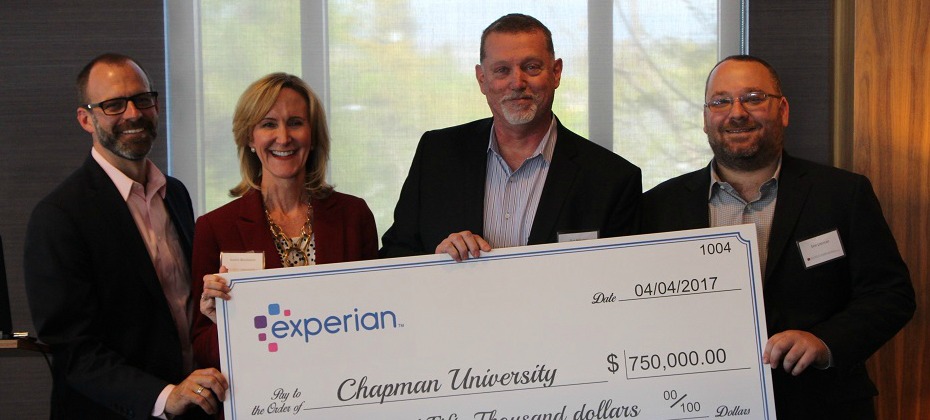
The field of data science is still in its infancy. Every day, new advancements are helping to yield more exciting results. We’re learning how data can allow cities to provide more effective services for residents, how it can help to solve vexing health riddles, and how companies can leverage data to better serve consumers. But for advancements to be achieved, collaboration between research institutions and the private sector is essential. Even more essential is ensuring that the next generation of data scientists are equipped with the latest knowledge and resources to continue to advance the field. That’s why we are excited to announce Experian’s $750,000 gift to create the Experian Assistant Professorship in Machine Learning at Chapman University, which will be used to expand machine learning opportunities at Chapman University’s Machine Learning and Assistive Technology Lab (MLAT), where Chapman researchers use big data and technology to address challenges of social significance like autism. We believe this investment is a necessary step in an ongoing commitment to ensure our Southern California community continues to fuel economic growth by ensuring that businesses like Experian have the talent to advance field of information services. The assistant professorship will be held by Erik Linstead, Ph.D., the director of the undergraduate computing programs in computer science, software engineering, and data analytics. Dr. Linstead, one of the nation’s leading authorities on big data, is also the principal investigator MLAT. Experian has learned the value of attracting data scientists with a wide degree of interests, backgrounds, and professional experiences to help assist our clients best serve consumers. Similarly, MLAT seeks to do the same. Projects that they take on range from bioinformatics and molecular biology to machine learning and artificial intelligence. Experian’s gift will help MLAT to expand their data science-focused efforts into new fields. This gift is the latest of a long series of collaborations between Chapman and Experian. Several years ago, Experian and Chapman began a partnership that involved placing graduate students training to become data scientists in internships within Experian to provide them real-world, hands on training. Since then, the partnership has blossomed to include embedding a Chapman faculty member within Experian to better ground the academic community on how data scientists work within the private sector to better shape their curriculum. We’ve also supported scholarships and programs at Chapman to ensure that the field of data science remains inclusive, diverse, and talented. Data science will inevitably continue to have a growing impact on our lives. This gift is a commitment to the future of data science and the promise of a better tomorrow that it holds. We wish a congratulations to Dr. Linstead, and look forward to a continued stream of talent emerging from Chapman to continue to advance the field and produce better outcomes for everyone. Photo of the check presentation courtesy of Christopher Simonson. Pictured (L-R): Dean of Schmid College of Science and Technology Andrew Lyon, EVP of University Advancement Sheryl Bourgeois, President of Experian Consumer Services Guy Abramo and Principal Investigator of the MLAT Lab Erik Linstead.

Spanish Translation I’m a Senior Product Manager in Experian’s Fraud and Identity Solutions department, which means I partner with data scientists to protect banks and their customers from fraud. When most people think of fraud, they envision someone trying to open a bank account in someone else’s name. However, it wasn’t until I did a series of customer visits with big banks to understand their struggles and discovered a pervasive form of fraud in the finance industry called “bust-out” fraud. In a "bust-out" fraud, an individual applies for a credit card in their own name, establishes a normal usage pattern and builds a solid repayment history. Then, when they’re ready to execute their scam, they max out all their available lines of credit from various lenders, disappear and leave the banks with the losses. Meanwhile, the money could be funneled into funding many types of organized crime, from human trafficking to drug trading and other illicit activities. What makes this type of crime all the harder to identify and catch before it occurs is that the person applying for a credit card is who they say they are. So it’s not about identity theft. To address this issue, my team and I created a solution called BustOut ScoreSM. We began by reviewing data from different banks to identify patterns where bust-outs occurred. From there, we built a score that predicts the likelihood that an individual will execute the scam — months before the scam occurs. Our clients now use this tool both when opening new accounts and as part of account management. The tool flags suspicious-looking accounts, which our team then manually reviews to evaluate if the account is truly at risk for a bust-out. If it is, we work with our clients to freeze or close out those suspicious accounts. Finding solutions to a fraud problem that hasn’t been solved is probably my favorite part of the job. I love seeing products that solve real issues affecting real people come to life — from inception to launch. Helping protect people from identity theft and fraud is what gives me purpose and meaning in my work. I am proud to use the power of data as a force for good.

2024 Best Place to Work for Disability Inclusion

Web Developer
With a passion for crafting seamless digital experiences and a keen eye for front-end development, Krishna brings practical insights and hands-on expertise to every post. Whether exploring new frameworks or optimizing performance, his writing reflects a commitment to clean code and user-centric design.
With a passion for crafting seamless digital experiences and a keen eye for front-end development, Krishna brings practical insights and hands-on expertise to every post. Whether exploring new frameworks or optimizing performance, his writing reflects a commitment to clean code and user-centric design.
With a passion for crafting seamless digital experiences and a keen eye for front-end development, Krishna brings practical insights and hands-on expertise to every post. Whether exploring new frameworks or optimizing performance, his writing reflects a commitment to clean code and user-centric design.