At Experian, we often say our people are our biggest superpower – and today, I’m thrilled to share that this belief has been recognised once again. Experian has been named one of the 2025 World’s Best Workplaces™ by Fortune and Great Place to Work® for the second year in a row.
This achievement reflects the culture we’ve built together – one that’s welcoming, inclusive, and rooted belonging. It’s a celebration of every colleague who brings their whole self to work, who lifts others up, and who powers opportunities for our clients, consumers, and communities.

We’ve made it our mission to create a workplace where everyone feels included, respected, and empowered. That’s why we’re proud to have earned top scores on the Corporate Equality Index and the Disability Equality Index, and to be recognised with the Outie Award for Workplace Excellence and Belonging.
These recognitions matter. But what matters most is how our people experience life at Experian. Whether it’s collaborating, innovating, or growing through world-class development of products, services and contributing to our communities, our culture is designed to help everyone thrive.
We’ve also made bold commitments to career development. Initiatives like Global Careers Week, the AI-driven performance coach Nadia, and the NextGen Forum – a global leadership development programme for emerging talent from across our regions – give our people the resources to take charge of their growth and build a “One Experian” mindset.
Being named one of the World’s Best Workplaces is a moment to celebrate but also a reminder to keep aiming higher. The world of work is evolving fast, and so are we. From embracing AI to enhancing our digital workplace experience, we’ll continue to push forward and listen to our people every step of the way.
Questions we will discuss:
- What does “retirement readiness” mean to you, and how can someone tell when they are financially ready to retire?
- Is there a magic number for retirement savings, and what factors should someone consider when setting a retirement goal?
- How can someone estimate their retirement expenses realistically?
- What are some common myths or misconceptions about how much money you need to retire?
- How should Gen Z, Millennials, and Gen Xers each approach retirement planning differently based on their stage of life?
- What are the biggest obstacles people face when trying to save for retirement, and how can they overcome them?
- How can you balance saving for retirement with paying off debt or supporting family today?
- What tools, calculators, or strategies can help people figure out if they’re on track for retirement?
- How can people prepare for unexpected costs or life changes that could impact their retirement plans?
- What’s one piece of advice you’d give someone just starting—or restarting—their retirement savings journey?
| Columns 1 | Column 2 | Column 3 | Column 4 |
|---|---|---|---|
| Row 1 Col 1 | |||
| Row 2 Col 1 | |||
| Row 3 Col 1 | |||
| Footer 1 | Footer 2 | Footer 3 | Footer 4 |
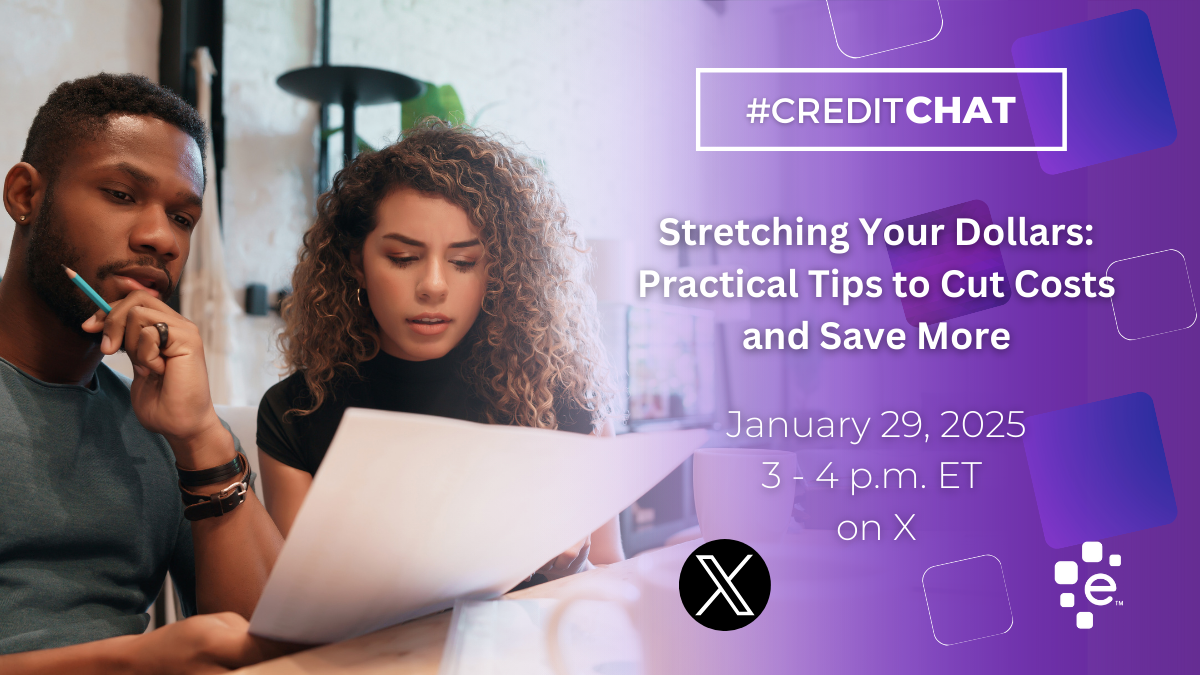
Credit Chat
Stretching your Dollars: Practical Tips to Cut Costs and Save More
February 5, 2025 3-4 PM ET
- What does “retirement readiness” mean to you, and how can someone tell when they are financially ready to retire?
- Is there a magic number for retirement savings, and what factors should someone consider when setting a retirement goal?
- How can someone estimate their retirement expenses realistically?
Greater transparency in buy now, pay later activity is key to helping consumers build their credit histories and supporting responsible lending. We have members of the military right now right out of high school and there’s not a lot of experience managing their own money. They’re quickly thrust into a place where they don’t have a support system to do that. We have members of the military right now right out of high school and there’s not a lot of experience managing their own money. They’re quickly thrust into a place where they don’t have a support system to do that. We have members of the military right now right out of high school and there’s not a lot of experience managing their own money. They’re quickly thrust into a place where they don’t have a support system to do that. We have members of the military right now right out of high school and there’s not a lot of experience managing their own money. They’re quickly thrust into a place where they don’t have a support system to do that. We have members of the military right now right out of high school and there’s not a lot of experience managing their own money. They’re quickly thrust into a place where they don’t have a support system to do that.
Experian North AmericaScott Brown, Group President, Financial Services


The following article is a guest post from, John C. Linfield, Executive Director at the Institute for Financial Literacy. At the end of “Financial Literacy Month” here in the United States, it seems appropriate to take a moment and think about why we should become financially literate, and how we can use that to stay on track for the long term. As educators, we talk a lot about what financially literacy is. But when all is said and done, are we becoming financially literate just because we should? Is financial literacy only about acquiring a specific set of skills and knowledge, for the sake of being able to say we learned it? Many financial educators, myself included, focus on the technical skills and knowledge that the average consumer needs to manage their personal finances on a day to day basis. Money management, credit and debt management, insurance, and the basics of investing and retirement planning form the pillars of financial literacy, the required knowledge that forms the core of a financially literate consumer. As financial literacy evolves however, we are finding that knowledge, while absolutely critical, is not enough. For example, when people learn about debt management, some go home and immediately begin a successful debt reduction plan. Others just feel good about themselves for a little while and never apply what they’ve learned. Why? Is there something that transforms someone from a merely knowledgeable consumer to one that is engaged and in control of their finances? Is there is a catalyst, a secret, which moves a consumer from knowing to doing? The truth is that there is a secret in financial literacy, and many financial educators (including yours truly) often fail to share that secret with our students through oversight. So, here’s your big chance. I’m coming clean. I’m revealing how the financial magic works. I’m going rogue, throwing caution to the wind and sharing arcane and mysterious knowledge that will transform your world. To start, picture this scenario, all too common in homes throughout the United States: You sit down to pay your bills. You struggle as you decide which bills you’ll pay this month, and which ones will have to wait, or worse be ignored entirely. You check your credit card statements, and once again the balances due are even higher than the month before. You have little to no savings and no retirement plan. Your mortgage, which you’re already behind on, has a balance that’s growing due to late fees and the fact you aren’t paying each month, just often enough to hold off the foreclosure on the house you couldn’t afford to buy in the first place. The phone rings 3 or 4 times, but you don’t bother answering it because it’s just the nightly calls from the debt collectors. By the time you’re finished struggling through the mess, you head into bed exhausted, knowing you don’t have enough money to do anything enjoyable anyway. Now picture this scenario: You sit down to pay your bills. You pay all of your bills on time, and you pay off your credit cards in full, as you do every month. You check your bank statements and see that your savings and investments are continuing to grow slowly but steadily. Finally, you check your mortgage statement and see that those extra payments you’ve been making are shrinking your mortgage balance much faster than you ever thought possible. You get a call from your good friend, and you make plans for the weekend. Having finished managing your finances for today, you get up and head out to enjoy the rest of the evening. Most likely, your reality falls somewhere between these two extremes. Which scenario would you rather be in? More importantly, if the first scenario is closer to your reality than you would like, what can you do to turn things around? Here’s an exercise that will help you find your secret, and help you stay on the right track financially. Many of us avoid thinking about our finances because of the stress and negative feelings that it dredges up. But those feelings are OK. I want you to feel that stress and those negative feelings. Why am I such a jerk? Why do I want you to feel that pain? Because it’s only by doing so that you can take the first step to finding your secret. I want you to sit and close your eyes for at least 10 minutes (really, I’m serious). I want you to think about your financial situation. Think about the bills, the debt, and the worries for the future. Don’t shy away from it; face it in the full, cold light of day. Allow yourself to feel the worry and the fear and the stress to the fullest extent possible. The worse your financial situation, the closer to tears you should get. Embrace it, wallow in it, but above all feel it. Now focus on the One Thing about your finances that causes you the most pain, whatever it is. Feel that one worry as deeply as you can. Hold that feeling. When you’ve gotten as low as you can go, picture yourself in the second scenario above. Picture yourself paying all of your bills on time, every time. Picture your debt decreasing while your assets are growing. Picture yourself dealing with the most terrifying/depressing aspect of your finances and solving it. Imagine what that would feel like, how light you would feel, how calm and peaceful and relieved. Do you feel that smile? That warm glow? That sense of well-being that makes you want to do anything you can to achieve it? That’s it, right there. It’s the One Thing that will keep you focused, engaged and committed with your finances. It will keep you on track, it will give you the willpower to do the things you need to do to achieve the One Thing. Even better, that focus and commitment will spread to the other aspects of your personal finances like a virus over time. That’s your motivation. That’s your secret. As with many things in life, each of us has our own motivations, our own secrets. For some, it is paying off a mortgage, getting out of debt or retiring. All of these are practical, achievable, logical goals, and many of us share these goals or have multiple goals we want to achieve. But in order to transform your finances, in order to take control over the long-term, you have to identify the One Thing and focus on it like a laser. In short, you need to make an emotional connection with your finances, one that can balance the emotional connection you have to the behaviors and choices that led you into financial trouble in the first place. You need to find your motivation. Why? As human beings, we need to feel an emotional connection to something in order to embrace it fully. We don’t pay bills for the sheer joy of paying bills. Building a rainy day fund doesn’t make us better people. If we’re doing these things because we think we have to, we won’t last. We have to dig deeper, get past the technical aspects of managing our finances, and find the One Thing. That emotional connection between our finances and our lives that will give us the strength we need to do what has to be done because a stable financial situation is the gateway to enjoying our lives fully. That’s why financial literacy is important. Through the financial resources it helps us develop, it provides us with the one thing we all have in limited supply: time to enjoy our lives, however we define that. And that’s the secret.

People are making a big deal about big data—and it is a big deal. It has the power to guide us in addressing some of our nation’s most pressing needs, from protecting against fraud at the checkout counter to helping families secure affordable loans that help them accomplish their dreams. And like any powerful tool, it must be deployed wisely; in the wrong hands, as Hollywood saw recently, data can be hacked. But that doesn’t mean abandoning big data is the solution, especially with so many weighty challenges burdening our nation. There’s a smart way to use data right, and we can “unleash untold opportunities” if we use technology to do it well, as President Obama alluded to in this year’s State of the Union address. With big data, technology is now able to process unfathomable, and until recently largely unmanageable, volumes of information. And from that processing, we can identify actionable insights that can illuminate new solutions to old problems. Read the full article on TheHill.com

On Monday, Experian’s former North American CEO Craig Boundy welcomed conference attendees, asking everyone to Think BIG during the week. Later in the day, we heard an inspirational forward thinking keynote address by former US secretary of state Dr. Madeleine Albright on the geopolitical environment touching on information security. On Tuesday, it was all about BIG insights on the US economy as Adam Fingersh introduced Dr. James Paulsen from Wells Capital Management, who delivered an in-depth economic and financial market update. Paulsen, deemed the recovery the longest in U. S. history, saying “The great recession is often compared to the great depression, but this is really a great exaggeration.” After Dr. Paulsen’s remarks, Experian began its second day of breakout sessions with insights from our team of experts in big data, decision analytics, consumer credit, compliance and fraud before heading off for a day of networking activities. Later in the evening we all celebrated over dinner together while being entertained by the legendary Kool and the Gang. On The final day of the conference, Lloyd Parker, Group President of Credit Services closed Vision by introducing NBA Legend and Hall of Famer, Earvin “Magic” Johnson, who delivered an inspiring talk. Magic got up close and personal with the audience, sharing his insights on being a champion athlete, overcoming obstacles, and the many life lessons on becoming a successful entrepreneur, job creator and community advocate. We are all looking forward to seeing you in Scottsdale, Arizona next year for Vision 2016. Twitter Highlights "Big data is a force for good and makes a difference in the economy, consumers and society," Craig Boundy #vision2015 — Vision Conference (@ExperianVision) May 4, 2015 One day we hope to have a client user event like @ExperianVision as its the best for content, networking and fun! #V…https://t.co/LGiyxKAh5i — masterQueue (@intellaegis) May 8, 2015 I shared my business expertise and how I transitioned from basketball court to the boardroom! @Experian_B2B #vision2015 — Earvin Magic Johnson (@MagicJohnson) May 6, 2015 "Whether you are a foreign minister or a CEO you have to be able to manage risk," Madeleine K. Albright #vision2015 — Vision Conference (@ExperianVision) May 4, 2015 For more Twitter highlights, click here.
2024 Best Place to Work for Disability Inclusion