Loading...

Icon block

Published: November 26, 2025 by Rathnathilaga.MelapavoorSankaran@experian.com

Lorem Ipsumis simply dummy text of the printing and typesetting industry. Lorem Ipsum has been the industry’s standard dummy text ever since the 1500s, when an unknown printer took a galley of type and scrambled it to make a type specimen book. It has survived not only five centuries, but also the leap into electronic typesetting, remaining essentially unchanged.


Loading…
Harnessing Big Data and Big Data analytics to improve financial inclusion

As the increased buzz about Big Data has filtered into Washington, D.C., policymakers have sought to learn more about Big Data, the technology that drives it, and the benefits and potential impacts for consumers. To that end, there have been three government reports released over the past year — two issued (1) by the Obama administration that focused explicitly on Big Data and one by the Federal Trade Commission (2) that centered on “data brokers.” The upside of Big Data: The reports found that in most instances Big Data promises important societal, public safety and economic benefits, including: • Aiding in the detection of health-related outbreaks • Reducing traffic • Fostering the development of innovative products The perceived challenges of Big Data: All three reports also focused on some of the challenges of Big Data, such as the need for greater transparency and accountability regarding data collection and use practices. They also found that Big Data presents the potential for discrimination against underserved communities. However, the reports failed to address the fact that there are fair lending, fair housing and equal employment laws already on the books (3) that regulators can use to address discriminatory practices. More important, however, is that all three reports failed to recognize that Big Data can bring immense opportunity for improving financial inclusion among our nation’s underserved communities. An estimated 60 million Americans are considered “credit invisible” Many reading this blog may take it for granted that credit can be accessed easily through a credit card or an auto, a mortgage or a student loan. However, for an estimated 60 million Americans who are considered to be “credit invisible,” this isn’t the reality. Today’s automated underwriting systems rely on a credit score. Thus, consumers without a proven track record of meeting financial obligations often are unable to access affordable credit simply because they don’t have a score or they have a credit history so thin that it cannot be scored. Without access to mainstream financial products, these consumers often are forced to rely on high-priced, short-term loans, some of which are from lenders that are predatory in nature. Big Data’s role in helping “credit invisibles” So how can Big Data help these people build a financial history and identity? While credit invisible consumers may not have traditional credit history, most make their cable, utility or mobile payments on time. This data, however, is not generally included in their credit file, as telecommunications companies and utilities typically report only late payments or when an account has been sent to collections. Of course this could be remedied if these entities started to report on-time positive payments to the credit reporting agencies, just as financial institutions do today. A recent study by PERC and the Brookings Institution found that including on-time payments from energy, utility and telephone firms would shrink the population of credit invisibles to around 5 million (4). Research (5) also has shown that it would be a net positive for underserved communities: • Twenty-two percent of Hispanics, 21 percent of African Americans and 21 percent of those earning $20,000 or less annually could be accepted for mainstream offers of credit • Fourteen percent of those aged 25 or younger could move into the traditional banking system Policymakers can help by clarifying that federal law allows for telecommunications companies and utilities to report on-time payment data and give consumers credit for paying their bills on time. Including this as part of the larger Big Data debate is critical in demonstrating that more predictive data in the credit system can help consumers. It’s not just telecommunications and utility data that can be included in credit reports. A recent analysis by Experian RentBureau uncovered how the addition of rent payment data to credit files can help financially excluded consumers gain access to traditional financial services. Specifically, 100 percent of the previously unscoreable study participants now are credit-scoreable, with the majority falling into the least risky prime category. Additional findings from the report are available here. Financial inclusion through improved scoring models and analytics Big Data’s financial empowerment potential can be unleashed through wider adoption of more inclusive credit scores. VantageScore® (6), for example, utilizes advanced analytics and reaches deeper into the credit file by integrating new data points, like rental payments, to help score consumers who previously were unscoreable. The impact of these analytics equates to bringing into the financial mainstream between 30 million and 35 million creditworthy consumers who previously would have been unscoreable using legacy credit scoring models. This is just one example of how advanced analytics using Big Data sets derived from credit databases can help achieve the goal of greater financial inclusion. In conclusion, as illustrated by the many examples provided throughout this blog post, Big Data can bring immense opportunity for improving financial inclusion among our nation’s underserved communities. At Experian, we remain committed to helping expand the creditworthiness of individuals and furthering financial inclusion through Big Data analytics — a clear positive for consumers, industry and our nation. Written By: Tony Hadley, Senior Vice President, Government & Regulatory Affairs at Experian     (1) http://www.whitehouse.gov/sites/default/files/docs/big_data_privacy_report_5.1.14_final_print.pdf http://www.whitehouse.gov/blog/2014/05/01/pcast-releases-report-big-data-and-privacy  (2) http://www.ftc.gov/system/files/documents/reports/data-brokers-call-transparency-accountability-report-federal-trade-commission-may-2014/140527databrokerreport.pdf (3) Fair Credit Reporting Act, Equal Credit Opportunity Act, Truth in Lending Act, among others (4) http://financialservices.house.gov/uploadedfiles/hhrg-112-ba15-wstate-mturner-20120913.pdf (5) http://www.perc.net/subsidiaries-affiliates/alternative-data-institute-adi/alternative-data-initiative-sign-letter/ (6) VantageScore® is a registered trademark of VantageScore Solutions, LLC.

Sep 13,2014 by Editor

Perspectives on Debt and Education

The following article is a guest post from Paul Combe, President and CEO of Boston-based American Student Assistance. According to recent Experian research, student loans were the only type of consumer debt to increase during the recession, growing 84 percent from 2008 to 2014. Today, 40 million Americans carry college loans. The average borrower has nearly four different student loans for a total of $29,000. Keeping track of multiple loan payments and high debt can mean a rough financial start for newly minted college graduates. Evidence is mounting that student debt could be getting in the way of our economic recovery, as growing numbers of millennials delay forming their own households under the weight of their student debt burden. But amid all the student loan doom and gloom is this stark reality: higher education remains the key to unlocking the American Dream. It remains the surest path to individual prosperity and economic mobility. College graduates still enjoy far greater earnings and far less unemployment than those with no college degree. In fact, Experian’s data show 18- to 34-year-olds with student loans make an average annual income of $42,000, vs. $34,000 for all credit active consumers in the same age group. A college-educated workforce also contributes more in income tax, relies less on government-provided services, and overall helps the United States retain global competitiveness. In short, how do we reconcile these two things – the national need for a qualified, educated workforce on one hand, and on the other the need of the workforce to take on substantial amounts of debt to achieve that education? One answer is to teach students how to make the debt manageable. Sensational media coverage aside, student debt actually is controllable when students and graduates have the financial know-how, tools, and advice to cope with it. According to Experian, consumers aged 18-34 with at least one open student loan have credit scores 20 points higher than those without student loans, indicating that student loans can help build and establish credit for young adults. High scores also suggest that responsible student loan borrowing will potentially increase their scores and the ability to get credit in the future. At the nonprofit American Student Assistance®, we run a free-to-the-user educational resource called “SALT™” that provides students the money knowledge for college and beyond that they need to pay for and pay back college costs. SALT teaches three principles that all student loan borrowers, past and present, should live by: Borrow less. What’s the best way to manage debt? Not have it in the first place. That doesn’t mean you have to downsize your college plans or always go for the cheapest education possible. What it does mean is that you should exhaust all “free” financial aid, like grants and scholarships, before you turn to loans. Always fill out the Free Application for Federal Student Aid (FAFSA), even if you don’t think you’re eligible for any federal aid. And if you’re borrowing to cover costs of living in addition to tuition, fees and books, remember the old adage to live like a student now so you don’t have to after graduation. Borrow smarter. Not all student loans are created equal. Federal student loans offer very flexible repayment terms that allow you to suspend or lower your monthly payment in times of unemployment or economic strain. Private student loans generally don’t offer the same repayment rights. Be mindful of the type of loan you’re borrowing and ask upfront about the repayment arrangements. A general rule of thumb is to always take out federal loans first and turn to private loans as a last resort. Repay well. Your student loan choices don’t end at the application process. Federal student loans come with a plethora of repayment plans that you need to thoroughly research and investigate, from spreading out payments over the standard 10 years, to extending the payment term, to paying interest-only for the first few years, to basing payment on your income. Evaluate all your options before you begin repayment, and then be sure to evolve your payment strategy as your economic circumstances change over the years. Bottom line: Policy debates about college costs and the value of education will rage on for years, but we can improve our nation’s student loan situation right now by teaching student borrowers how to make smarter decisions along every step of the student loan process. Paul Combe is President and CEO of Boston-based American Student Assistance, the nonprofit creator of the free educational resource SALT™ that provides students with money knowledge for college and beyond.

Sep 09,2014 by

Experian’s Instant Prescreen service selected by American 1 Credit Union and Credit Union of Southern California

Experian® chosen for its integration with Symitar, along with streamlined delivery and advanced real-time decisioning  Costa Mesa, Calif., September 8, 2014 — Experian®, the leading global information services company, today announced that American 1 Credit Union and Credit Union of Southern California selected Experian’s Decisioning as a ServiceSM for its Instant Prescreen service that identifies quality prospects for additional product offerings. The real-time instant prescreen (also known as prescreen of one) capability of Decisioning as a Service integrated with the credit unions’ Episys® system from Symitar provides an opportunity for the organizations to cross-sell to creditworthy members and improve business performance. The credit unions were looking for a service that was cost-effective, quick to deploy and easy to integrate and provides accurate decisions based on Experian’s vast data and analytical assets. “American 1 chose Experian’s Decisioning as a Service for instant prescreen because we were looking for an additional tool to help us increase our auto loan and credit card portfolios,” said Martha Fuerstenau, executive vice president at American 1 Credit Union. “We recognize that the key to achieve our goal was to empower the frontline and give them confidence to make that cross-sell while they are serving the members. Because of this new feature, American 1 has increased the number of loan applications that are generated from the account specialist team.” “It was important to have a seamless process in place at the teller line so that the member did not have additional wait time while the instant prescreen was being completed,” stated Dennis Wendorf, director of research and development at American 1 Credit Union. “By using Decisioning as a Service, our frontline is able to view whether or not a member is preapproved for an auto loan or a credit card with just a few clicks on the Symitar system.” “Experian continually invests in developing services that make a positive shift in the way our industry operates and give more options to consumers that enhance their credit profiles,” said David Proctor, vice president, Consumer Information Services, Experian. “The instant prescreen aspect is just one extension of our Decisioning as a Service product. The foundation of our service is the integrity of our data assets, deep analytics capabilities and the predictability of the scoring models, which, when they are combined, provide a powerful holistic decisioning tool that assists businesses in attaining growth and increasing profitability.” Experian’s Decisioning as a Service is an instant decisioning service engineered to help clients gain greater value from data and decisioning products. It does so by providing flexible, real-time access to more data sources, attributes, scores and analytics for key decision areas such as instant prescreen and credit underwriting. Visit our Decisioning as a Service and Instant Prescreen sites to learn more.

Sep 08,2014 by Editor

Insights from Reuters Next: Building a More Inclusive Financial System with Data and AI

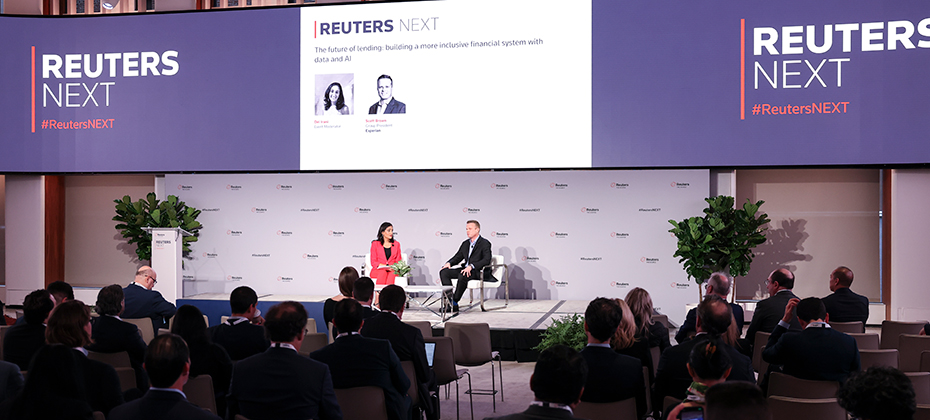
Today, we stand at the forefront of a digital revolution that is reshaping the financial services industry. And, against this backdrop, financial institutions are at vastly different levels of maturity; the world’s biggest banks are managing large-scale infrastructure migrations and making significant investments in AI while regional banks and credit unions are putting plans in place for modernization strategies, and fintechs are purpose-built and cloud native.  To explore this more, I recently had the privilege of attending the annual Reuters NEXT live event in New York City. The event gathers globally recognized leaders across business, finance, technology, and government to tackle some of today’s most pressing issues.  On the World Stage, I joined Del Irani, a talented anchor and broadcast journalist, to discuss the future of lending and the pivotal role of data and AI in building a more inclusive financial system. Improving financial access Our discussion highlighted the lack of access to traditional financial systems, and the impact it has on nearly 100 million people in North America alone. Globally, the problem affects over one billion people. These people, who are credit invisible, unscoreable, or have subprime credit scores, are unable to secure everyday financial products that many of us take for granted.  What many don’t realize is, this is not a fringe subset of the population. Most of us, myself included, know someone who has faced the challenges of financial exclusion. Everyday Americans, including young people who are just starting out, new immigrants and people from diverse communities, often lack access to mainstream financial products.  We discussed how traditional lending has a limited view of a consumer. Like looking through a keyhole, the lender’s understanding of the person in view is often incomplete and obstructed. However, with expanded data, technology, and advanced analytics, there is an opportunity to better understand the whole person, and as a result have a more inclusive financial system.  At Experian, we have a unique ability to connect the power of traditional credit with alternative data, bringing a more holistic understanding of consumers and their behaviors. We are dedicated to leveraging our rich history in data and our expertise in technology to create the future of credit and ultimately bring financial power to everyone. The future of lending After spending two days with over 700 industry leaders from around the world, one thing is abundantly clear: much like the early days of the internet, today, we are at the cutting-edge of a technical revolution. Reflecting on my time at Reuters NEXT, I am particularly excited by the collective commitment to drive innovative, and smarter ways of working.  We are only beginning to scratch the surface of how data and technology can transform financial services, and Experian is positioned to play a significant role. As we look to the future, I am excited about the ways we will create new opportunities for businesses and consumers alike.    

Dec 13,2024 by Scott Brown

New Initiative Aims to Empower Opportunities in the Hispanic Community

We believe that financial literacy leads to empowerment. That is why Experian supports initiatives and partners with community organizations to deliver financial education. We also develop products and services that give more control to consumers over their credit profile and financial health. As part of advancing our mission of Financial Power to All®, we are proud to announce we are helping more than 5,000 Hispanic individuals nationwide by relieving $10 million dollars of consumer debt. To provide families with this boost, we joined forces with ForgiveCo, a Public Benefit Corporation (PBC), to administer the acquisition and cancellation of qualifying consumer debt for the selected recipients. Beneficiaries will also receive a one-year premium Experian membership for free that offers access to their Experian credit report in English and Spanish[i], FICO® Score[ii], bilingual educational content, and other financial resources. We hope this effort helps raise awareness of the importance of financial literacy for everyone, and that Experian has resources to help individuals reach their financial dreams.  To amplify the message, we collaborated with multi-platinum, award-winning singer and songwriter Prince Royce and you can see his video here. In fact, we have been making a concerted effort the last several years to evolve our educational resources and products to better support all underserved communities. Some of our other activities include the creation of the B.A.L.L. for Life initiative that connects African American and Hispanic youth with financial education, supporting scholarships for Asian Americans through the Ascend organization, providing custom resources for Out & Equal and Born This Way Foundation for the LGBTQ+ community, supporting the NextGen Innovation Lab for Disability:IN, and sponsoring credit counseling for the military community with Operation HOPE. For resources in Spanish, Experian offers a credit e-book and consumers can access a full suite of articles at the Ask Experian blog here. [i] Only Experian credit reports are available in Spanish. All other services associated with an Experian membership are available in English only. English fluency is required for full access to Experian’s products.  [ii] Credit score calculated based on FICO® Score 8 model. Your lender or insurer may use a different FICO® Score than FICO® Score 8, or another type of credit score altogether. Learn more.

Oct 22,2024 by Jeff Softley

Three Myths Blocking the Way to Greater Financial Inclusion

Amid some of the financial challenges that underserved communities experience, members across the financial services community remain committed to championing initiatives and programs that drive greater financial inclusion. In fact, collaboration has led to the inclusion of non-debt related payment information on consumers’ credit profiles, as well as digital services that make it easier to manage money. These efforts have helped to broaden access to fair and affordable financial resources for more individuals. While significant progress has been made, there is still more work to do. However, some of the misconceptions and myths about the financial services community are hindering further advancement. Debunking these myths will accelerate progress by building trust between the financial services community and consumers. Person withdrawing money from ATM contactless Myth #1: “Financial institutions have no interest in underserved consumers or credit invisibles.” The truth is, banks and credit unions want to say “yes” to more prospective borrowers, including individuals and families from underserved communities. Beyond being the right thing to do, it’s an opportunity to potentially build lifelong relationships with a relatively untapped market. A show of good faith to communities who have largely been ignored by the financial system could lead to customer loyalty that may extend to their family and friends. That’s why participants across the financial ecosystem have been proponents of including expanded data sources—such as on-time telecom, utility and video streaming service payments—on to consumer credit reports, as well as exploring other Fair Credit Reporting Act (FCRA)-regulated data sources, including payment data on short-term small dollar loans and expanded public records data. Making this data more accessible to lenders provides a more comprehensive view of a consumer’s ability and willingness to repay outstanding debt—an actionable solution to extending credit to consumers without lenders taking on additional risk. Myth #2: “There is a lack of trustworthy financial education resources.” The financial services community and affiliated organizations recognize that empowering people with financial knowledge and skillset are critical to consumers’ financial success. In fact, banks and credit unions are partnering with nonprofits and non-governmental organizations to better understand the unique challenges and opportunities within specific communities and provide relevant tools and resources. For example, Experian’s B.A.L.L. for Life (Be A Legacy Leader) program, launched in partnership with the National Urban League, serves as a catalyst for engaging with Black communities and low-income youth through live events and digital financial education. Subject matter experts, professional athletes, celebrities, and other influencers share their experiences and expertise, covering topics such as banking, credit, financial management and investing. In addition, to help people improve their financial management, Experian partners with the National Foundation for Credit Counseling (NFCC). The NFCC connects consumers with certified financial counselors to help them address various pain points, including debt management, homeownership, student loans or small business cash flow issues. Myth #3: “Underserved communities have few opportunities to build credit and enter the mainstream financial system.” People from underserved communities, as well as younger consumers and recent immigrants are often excluded from the mainstream financial system because they lack an extensive credit history. Historically, it’s created a vicious cycle; in order to get credit, you have to have credit. Fortunately, there has been a sea change in innovative solutions to address the specific needs of these populations. These include new credit scoring models and microfinancing which provide financial services to individuals who may have been excluded from traditional banking systems. In addition, by incorporating expanded data sources, such as telecom, utility and residential rental payments onto credit reports, lenders have more visibility into consumers who may have been excluded by traditional credit scoring methods.These programs help individuals and families from underserved communities establish and build a credit history that could enable loans, or the ability to rent an apartment or open their dream business. An example is Experian Boost®, a free feature that allows Experian members to contribute their history of making utility, cellphone, insurance, residential rent and video streaming service payments directly into their Experian credit profile. By incorporating nontraditional credit data like paying utility bills on time, online banking transactions, rental payments and verified income data, more people can establish a credit profile that can potentially qualify them for a loan. More Inclusion, Fewer Myths It’s encouraging that community organizations and banks are beginning to see the economic and social benefits of aligning on financial literacy and inclusion. As more initiatives come online, underserved populations will be able to establish a better financial foundation. Then, we can declare the myths to be history.

Jul 23,2024 by Sandy Anderson