
 In today’s world, it seems as though there is a statistic that we can apply to just about anything. Whether it’s viewership of the Super Bowl, popularity of breakfast cereal or the number of red M&Ms that come in a pack, I bet the data is out there. In fact, there is so much data in the world that Emery Simon of the Business Software Alliance once said that if data were placed on DVDs, it would create a stack tall enough to reach the moon.
 Experian is all about turning insights into action… using data for good.
Our commitment is to work with our clients, consumers, non-profits and other parties to help ensure that we, as a company and within society, continue to properly leverage big data for good.
As part of that effort, each week we bring you Experian Insights – a round-up of news and resources highlighting how data is used for positive business, consumer and societal actions in many ways and across multiple sectors.
Experian is all about turning insights into action… using data for good.
Our commitment is to work with our clients, consumers, non-profits and other parties to help ensure that we, as a company and within society, continue to properly leverage big data for good.
As part of that effort, each week we bring you Experian Insights – a round-up of news and resources highlighting how data is used for positive business, consumer and societal actions in many ways and across multiple sectors.
Experian is all about turning insights into action… using data for good. Our commitment is to work with our clients, consumers, non-profits and other parties to help ensure that we, as a company and within society, continue to properly leverage big data for good. As part of that effort, each week we bring you Experian Insights – a round-up of news and resources highlighting how data is used for positive business, consumer and societal actions in many ways and across multiple sectors. Experian Insights in the News The One Thing That Could Instantly Make Your Credit Score Better – Time If both rent and utilities were part of credit scores as many as 54 million people (who are essentially invisible today) would be able to participate in mainstream finance. [Tweet] Five Minutes with Matt Seeley, EMS Group President – The Hub We're working with numerous clients to help guide their organization's data management strategy, putting insights into action to create improved and more meaningful customer interactions. [Tweet] Small Business Insights Drive Action for the Good of the Economy – Experian Blog Small businesses rounded out 2014 performing at a very high level, especially in terms of credit health. [Tweet] Agencies Navigate the Identity-Based Security Ecosystem – GCN Identity systems have become the top priority for organizations looking to safeguard government data from attackers. [Tweet] Experian's Newest CMO Aims to Focus on Consumers – AdAge.com Kristen Simmons will lead strategic direction, development and execution of marketing for Experian consumer services in North America. [Tweet] How Millions of Consumers Could Get Credit for Paying Their Utilities on Time – Experian Blog Study analyzed the financial benefits for consumers by adding positive, monthly utility or rental payments to credit reports. [Tweet] Jump-Starting Car Sales from the Service Lane – Automotive News Automotive News reports how VehicleXchange works with Experian to help car dealers find credit-worthy customers. [Tweet] 5 Tools for Improved Identity Management – GCN Government agencies will have to rely on improving existing technology solutions to help manage their ongoing security threats. [Tweet] Acting on Insights to Create Value for Marketers and Their Customers – Experian Blog Learn how successful businesses are drawing meaningful insights from data to impact almost every aspect of business operations. [Tweet]

Experian’s groundbreaking generative AI-powered tool, Experian Assistant, has earned the prestigious 2025 BIG Innovation Award in the Products for Financial Services category. This recognition underscores Experian’s commitment to pushing the boundaries of innovation by helping businesses achieve success and enhancing consumer experiences. The BIG Innovation Awards, celebrated since 2011, honor organizations and solutions that redefine excellence through creativity and measurable impact. Experian Assistant was recognized for transforming how financial institutions approach data and analytics, enabling faster, smarter decision-making that enhances customer experiences and operational efficiency. Redefining Financial Services Integrated with the Experian Ascend Platform™, Experian Assistant functions as a 24/7 data expert, enabling financial institutions to optimize their credit and fraud models with ease. Using natural language processing (NLP), the virtual assistant guides users providing insights, recommendations and coding assistance. The impact is transformative: Experian Assistant cuts model-development timelines from months to just days— and even hours in some cases. By helping users analyze credit and fraud data, adjust model attributes and streamline workflows, it empowers organizations to innovate faster and make data-driven decisions with confidence. Powered by agentic AI technology, Experian Assistant reimagines how data scientists and analysts approach their work. It accelerates insights, fosters collaboration and empowers businesses to deliver exceptional customer experiences while reducing the time and resources needed to bring new initiatives to market. Driving Results Across Industries While tailored for financial services, Experian Assistant’s capabilities extend across industries. Businesses can leverage its tools for data exploration, model deployment, performance monitoring and faster time-to-market for new offerings. With Experian Assistant, users gain a powerful edge in scoring more consumers, optimizing processes and enhancing overall customer satisfaction. Recognized Excellence The 2025 BIG Innovation Awards spotlight trailblazers evaluated on creativity, impact and results by seasoned business leaders. This accolade solidifies Experian Assistant’s position as a game-changing solution in financial services and beyond.

We are thrilled that for the sixth consecutive year, Experian has earned a score of 100 on the Human Rights Campaign Foundation’s (HRCF) 2025 Corporate Equality Index (CEI). This recognition underscores our commitment to LGBTQ+ workplace equality. We are honored to join the ranks of 765 U.S. businesses that have been awarded the HRCF’s Equality 100 Award, celebrating our leadership in fostering an inclusive workplace. Experian’s dedication to supporting the LGBTQ+ community is reflected in several key initiatives: Name Change Process: We have a process for transgender and non-binary consumers to update their names on credit reports, ensuring their identities are accurately represented. LGBTQ+ Allyship 101 Training: This new training program is available to all Experian employees, promoting allyship and understanding within our workforce. Pride ERG Parenting Committee: Launched to support parents, grandparents and guardians of LGBTQ+ individuals, this committee provides valuable resources and community. Transgender Resource Guide: This guide supports employees who are transitioning at work, offering education and resources for colleagues and managers. Partnerships: We collaborate with organizations such as Out & Equal, GenderCool, The Trevor Project and Born This Way Foundation’s Channel Kindness to provide financial health, mental health and other resources to empower both our internal and external communities. At Experian, we are proud to be part of this movement towards greater equality and inclusion. We remain dedicated to fostering a workplace where every employee feels respected, valued and empowered to bring their authentic selves to work. Learn more about how we drive social impact in English, Portuguese and Spanish.
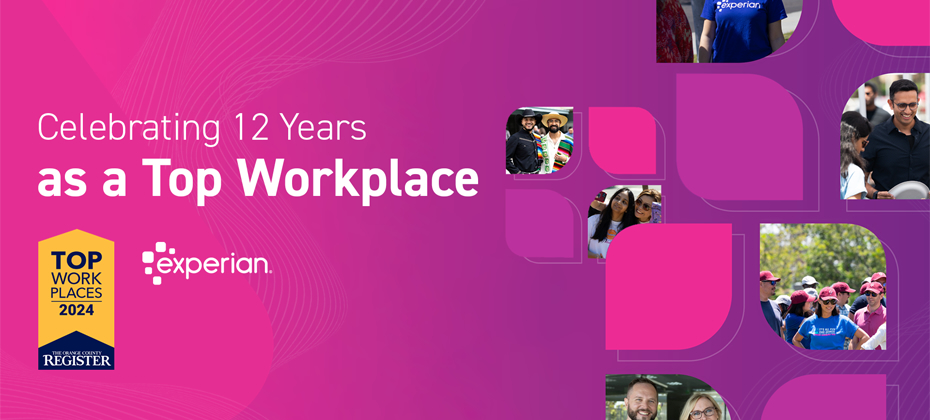
Achieving Top Workplace recognition for 12 consecutive years is no small feat, yet Experian North America has done just that. Named a Top Workplace by the Orange County Register once again, this milestone reflects not just policies or benefits but what truly makes Experian exceptional: our people. As Hiq Lee, Chief People Officer at Experian North America, notes, this honor is a testament to the remarkable contributions of our team. Experian’s employees shape an environment where innovation, inclusivity, and purpose thrive. More Than Work What sets Experian apart is our engagement with the world and community. Through initiatives like the Experian Volunteer Leadership Network and partnerships with organizations such as the Octane Foundation for Innovation and the Hispanic Chamber of Commerce of Orange County Education Foundation, our impact extends beyond the workplace. In 2024, we earned additional recognitions, including being named one of the World’s Best Workplaces™ by Fortune and Great Place to Work®. We were also recognized as one of the Best Workplaces for Parents, Millennials, and in Technology. The Secret to Success Our success lies in focusing on people. Experian is a place where careers are built, ideas are encouraged, and employees feel valued. Initiatives such as, Employee Resource Groups foster belonging, Mental Health First Aiders provide support, and technology hackathons inspire creativity. Innovation at the Core Innovation continues to drive our success. By leveraging technologies like artificial intelligence and machine learning, we are redefining decision-making and fraud prevention. This commitment to innovation empowers businesses and consumers worldwide, aligning with our mission to promote financial inclusivity. Looking Ahead For Experian, being a Top Workplace for more than a decade isn’t a finish line—it’s a springboard. With an ongoing commitment to our employees and communities, we continue to evolve, creating better experiences for our team, clients, and the world.
Lorem Ipsum is simply dummy text of the printing and typesetting industry. Lorem Ipsum has been the industry’s standard dummy text ever since the 1500s, when an unknown printer took a galley of type and scrambled it to make a type specimen book. It has survived not only five centuries, but also the leap into electronic typesetting, remaining essentially unchanged. It was popularised in the 1960s with the release of Letraset sheets containing Lorem Ipsum passages, and more recently with desktop publishing software like Aldus PageMaker including versions of Lorem Ipsum.
Lorem Ipsum is simply dummy text of the printing and typesetting industry. Lorem Ipsum has been the industry’s standard dummy text ever since the 1500s, when an unknown printer took a galley of type and scrambled it to make a type specimen book. It has survived not only five centuries, but also the leap into electronic typesetting, remaining essentially unchanged. It was popularised in the 1960s with the release of Letraset sheets containing Lorem Ipsum passages, and more recently with desktop publishing software like Aldus PageMaker including versions of Lorem Ipsum.

Web Developer
With a passion for crafting seamless digital experiences and a keen eye for front-end development, Krishna brings practical insights and hands-on expertise to every post. Whether exploring new frameworks or optimizing performance, his writing reflects a commitment to clean code and user-centric design.
With a passion for crafting seamless digital experiences and a keen eye for front-end development, Krishna brings practical insights and hands-on expertise to every post. Whether exploring new frameworks or optimizing performance, his writing reflects a commitment to clean code and user-centric design.
With a passion for crafting seamless digital experiences and a keen eye for front-end development, Krishna brings practical insights and hands-on expertise to every post. Whether exploring new frameworks or optimizing performance, his writing reflects a commitment to clean code and user-centric design.