
While there is no question the pandemic continues to create a challenging financial situation for millions of consumers, this is not the case for everyone. Because Americans are finding themselves in unique financial situations, there is not a one size fits all solution for maintaining access to the credit economy. As 2020 comes to a close and U.S. consumers and businesses grapple with another surge in COVID-19 cases, it is critical for the credit services industry to continually recognize and assess the impact the pandemic is having on consumer’s financial health. At Experian, our role is to help lenders understand consumer’s unique circumstances, so they know who they are talking to and what risk an applicant represents at any given time. We use the power of data, including traditional credit data, alternative data and consumer permissioned data, to accomplish this objective. I was recently invited to speak with Cheddar’s Nora Ali to share my views on the Road to Recovery from the pandemic, how we can maintain access to the credit economy and ways consumers can protect their credit standing and financial health during this time. You can watch the full interview here. I believe data is key to maintaining access to the credit economy and protecting consumer financial health, especially in environments like the one we currently find ourselves in.

For the eighth consecutive year, the Orange County Register has named Experian as one of the Top Workplaces, with the company securing the #1 ranking for the second time in three years. The award, which is based on employee feedback in a survey of hundreds of leading companies in Orange County, recognizes our company’s culture of innovation and inclusion, and our commitment to employees and communities during the pandemic. For more than 40 years, Orange County has been at the heart of our North America operations, and as we persevere through these challenging times, we are especially honored to be recognized for our dedication to maintaining a healthy, collaborative work environment and achieving higher performance while giving back. This award demonstrates the resilience, talent and compassion of all the people who work here at Experian. Since the start of the pandemic, we have further expanded our dedication to social good by creating new opportunities to support employees and the broader community. Because we are founded on a culture of innovating through bringing together technology and data, we were able to quickly respond to COVID-19 and honor our commitment to using data for good. Maintaining company culture All our decisions are driven by our desire to lead with empathy, and ensuring our employees feel valued and protected, while simultaneously mobilizing our resources to positively impact society, creating greater levels of financial and social inclusion. Although we had technology in place to easily initiate working remotely, we supported the transition to remote working by launching initiatives dedicated to mental and physical well-being, including a COVID-19 Resource Center, enhanced sick-leave policies, increased opportunities to ensure continuity of professional development, as well as an ASPIRE to be Well guide, in partnership with our Employee Resource Groups (ERGs). Giving back Throughout the pandemic, our employees have felt compelled to help clients who were facing unprecedented and unforeseen challenges. Different groups and employees of all levels began working together to develop new products and services to help clients, customers and communities persevere. This included free credit reports for small business, adding video streaming service payments to Experian Boost, hosting #CreditChat on social media, the Experian CORE heatmap, COVID-19 U.S. Business Risk Index , Experian® Health Payer Policy Alerts and updated fraud protections through the Business Resources Website. As part of our United for Financial Health initiative, we also launched two new partnerships with non-profit organizations to empower vulnerable consumers and those marginalized by the pandemic. In collaboration with Operation HOPE, we are helping vulnerable communities improve financial health with its data, analytics, products and services. Most recently, we partnered with NAACP Empowerment Programs to offer Home Preservation Grants to African Americans at risk of losing their homes. Although COVID-19 has been a source of stress and anxiety for businesses and individuals alike, we remain committed to helping employees reach their full potential and demonstrating that values and purpose do not change in a crisis. We are honored that the Orange County Register is recognizing our tireless efforts to make a difference in the communities in which we live and work.

Time to Move Past the Uncertainty With Digital Decisioning Platforms That Ensure Preparedness for Today and Readiness for Future Growth
Data & AnalyticsAlmost a year worth of a global pandemic has galvanized a past of relative stability and predictability, bringing chaos and disruption and signaling a different, certainly unexpected, future. As this future unfolds, it will be the actions that business leaders and their teams take now, amidst the crisis, that will determine the fate of their organization. Navigating the current complexity and change requires the ability to effectively address the urgent needs of the present, make immediate choices, and allocate resources. The pace is fast, and actions are decisive – in fact, companies have acted 20 to 25 times faster than expected since the coronavirus pandemic started, according to McKinsey[1]. Modern decision automation facilitates technology and business strategic alignment This search for increased nimbleness and improved strategic alignment has been a recurrent topic in our conversations with clients from around the globe. What we hear is that the pandemic has boosted their search for solutions that create synergies across technology and business groups and allow for an optimal use of their IT investments. As organizations are accelerating and driving their digital transformation, they are pursuing simpler fit-for-purpose solutions to lower their costs, drive internal alignment and operational efficiencies, and help them meet and exceed all-time high customer expectations in less time. Decision automation platforms such as Experian PowerCurve bring all those elements together, taking the complexity out of the customer decision making process. This crisis has accelerated the need for automated decision management solutions that are secure, can easily scale to meet emerging needs and changes in demand, and be upgraded seamlessly to avoid getting stuck on outdated software and unnecessary long and complex IT infrastructure overhauls. That sheer need for readiness has led to more, accelerated digital transformation. McKinsey Global Survey of Executives[2] shows that companies have accelerated the digitization of their customer and supply-chain interactions and of their internal operations by three to four years. Additionally, the share of digital or digitally enabled products in their portfolios has accelerated by seven years. These findings suggest that during the crisis, companies have prioritized refocusing their offerings to solve for the needs at hand rather than made huge leaps in product development in the span of a few months. With 60% of consumers having higher expectations[3] for their digital experience than before Covid-19, businesses big and small are acutely aware they must reshape their customer journeys to come out of this crisis reinforced. That requires the ability to access and manage more data sources, more attributes, more advanced analytics faster, more easily, and through a more consistent customer experience. It ultimately requires a platform that enables decision management in a digital world. In this regard, Forrester Research states in its new report; The Forrester Wave™: Digital Decisioning Platforms, Q4 2020[4], that “Experian’s PowerCurve really shines at keeping the leaders who are accountable for business results in control of decisioning by providing transparency into the decision logic and insight into actual results.” The capability to ingest and analyze high volumes of owned, third-party, and alternative data combined with seamless and flexible customer consent and protection enables faster, more effective and accurate credit decisioning, resulting in better risk management for the organization and better outcomes from clients. Technology has been fundamental in helping weather past crises and emerge stronger each time Of the hundreds of organizations currently using our decisioning software and platforms, some are prioritizing speed, like many community banks stepping up to support consumers going through hardship in a matter of weeks. Others such as Standard Chartered leverage Experian’s credit decisioning technology and machine learning capabilities to drive financial access in underbanked communities. For global financial institutions and leading retail brands, it’s all about regaining control over how and when they deploy the most relevant credit decisions and strategies while leveraging their existing data. They especially appreciate PowerCurve’s business-user-focused tools, which have received industry recognition[5] for the way they enable organizations to design strategies, including decision logic that can leverage machine learning models pretrained on prior customer behaviors. Many found in our cloud-based pre-configured data and decisioning capabilities the best way to solve for their customers’ immediate needs. It’s the case of AU Bank in India, where they leverage our standard, ‘out-of-the-box’ applications to accelerate their own transformation and continue to redefine the banking experience for consumers in the markets they serve. Other clients with sophisticated, decision-driven business processes prefer highly configurable solutions for their business-users to help them address specific needs. Personally, I feel energized by this challenge and excited about our commitment to helping more businesses find new ways to meet and exceed today’s consumer demands. Through our decisioning platform, organizations can listen to their customers, adapt their business models, adjust their offerings and innovate to drive a strong top line so they are better positioned down the road to recovery. Our decisioning solutions span the entire customer lifecycle and are used by credit and risk managers as well as developers to increase the knowledge about customer and market needs and be ready to solve today’s challenges and take on tomorrow’s opportunities. 1 McKinsey Global Survey of Executives, October 2020. 2 How COVID-19 has pushed companies over the technology tipping point—and transformed business forever. https://www.mckinsey.com/business-functions/strategy-and-corporate-finance/our-insights/how-covid-19-has-pushed-companies-over-the-technology-tipping-point-and-transformed-business-forever 3 Experian Global Insights Report September / October 2020 https://bit.ly/GIR_sep-otc 4 The Forrester Wave™: Digital Decisioning Platforms, Q4 2020 5 Experian’s profile, The Forrester Wave™: Digital Decisioning Platforms Q4 2020” Report.
Related Posts

Experian’s groundbreaking generative AI-powered tool, Experian Assistant, has earned the prestigious 2025 BIG Innovation Award in the Products for Financial Services category. This recognition underscores Experian’s commitment to pushing the boundaries of innovation by helping businesses achieve success and enhancing consumer experiences. The BIG Innovation Awards, celebrated since 2011, honor organizations and solutions that redefine excellence through creativity and measurable impact. Experian Assistant was recognized for transforming how financial institutions approach data and analytics, enabling faster, smarter decision-making that enhances customer experiences and operational efficiency. Redefining Financial Services Integrated with the Experian Ascend Platform™, Experian Assistant functions as a 24/7 data expert, enabling financial institutions to optimize their credit and fraud models with ease. Using natural language processing (NLP), the virtual assistant guides users providing insights, recommendations and coding assistance. The impact is transformative: Experian Assistant cuts model-development timelines from months to just days— and even hours in some cases. By helping users analyze credit and fraud data, adjust model attributes and streamline workflows, it empowers organizations to innovate faster and make data-driven decisions with confidence. Powered by agentic AI technology, Experian Assistant reimagines how data scientists and analysts approach their work. It accelerates insights, fosters collaboration and empowers businesses to deliver exceptional customer experiences while reducing the time and resources needed to bring new initiatives to market. Driving Results Across Industries While tailored for financial services, Experian Assistant’s capabilities extend across industries. Businesses can leverage its tools for data exploration, model deployment, performance monitoring and faster time-to-market for new offerings. With Experian Assistant, users gain a powerful edge in scoring more consumers, optimizing processes and enhancing overall customer satisfaction. Recognized Excellence The 2025 BIG Innovation Awards spotlight trailblazers evaluated on creativity, impact and results by seasoned business leaders. This accolade solidifies Experian Assistant’s position as a game-changing solution in financial services and beyond.

Experian Earns Top Score in Human Rights Campaign Foundation’s 2025 Corporate Equality Index
Diversity & InclusionWe are thrilled that for the sixth consecutive year, Experian has earned a score of 100 on the Human Rights Campaign Foundation’s (HRCF) 2025 Corporate Equality Index (CEI). This recognition underscores our commitment to LGBTQ+ workplace equality. We are honored to join the ranks of 765 U.S. businesses that have been awarded the HRCF’s Equality 100 Award, celebrating our leadership in fostering an inclusive workplace. Experian’s dedication to supporting the LGBTQ+ community is reflected in several key initiatives: Name Change Process: We have a process for transgender and non-binary consumers to update their names on credit reports, ensuring their identities are accurately represented. LGBTQ+ Allyship 101 Training: This new training program is available to all Experian employees, promoting allyship and understanding within our workforce. Pride ERG Parenting Committee: Launched to support parents, grandparents and guardians of LGBTQ+ individuals, this committee provides valuable resources and community. Transgender Resource Guide: This guide supports employees who are transitioning at work, offering education and resources for colleagues and managers. Partnerships: We collaborate with organizations such as Out & Equal, GenderCool, The Trevor Project and Born This Way Foundation’s Channel Kindness to provide financial health, mental health and other resources to empower both our internal and external communities. At Experian, we are proud to be part of this movement towards greater equality and inclusion. We remain dedicated to fostering a workplace where every employee feels respected, valued and empowered to bring their authentic selves to work. Learn more about how we drive social impact in English, Portuguese and Spanish.
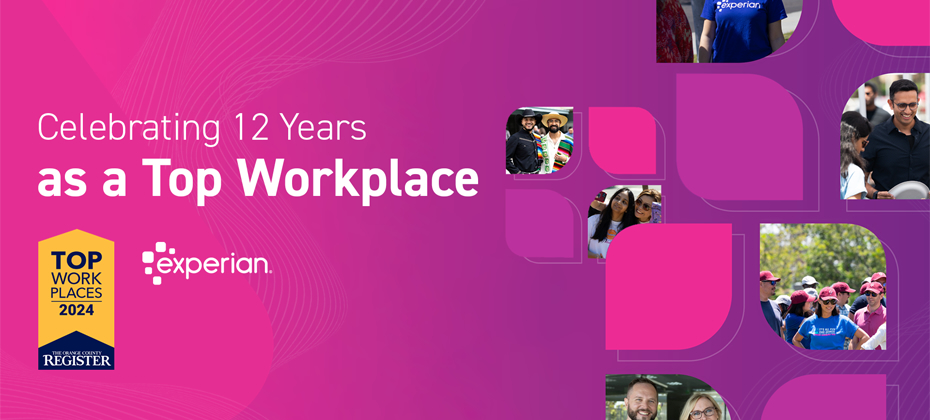
Achieving Top Workplace recognition for 12 consecutive years is no small feat, yet Experian North America has done just that. Named a Top Workplace by the Orange County Register once again, this milestone reflects not just policies or benefits but what truly makes Experian exceptional: our people. As Hiq Lee, Chief People Officer at Experian North America, notes, this honor is a testament to the remarkable contributions of our team. Experian’s employees shape an environment where innovation, inclusivity, and purpose thrive. More Than Work What sets Experian apart is our engagement with the world and community. Through initiatives like the Experian Volunteer Leadership Network and partnerships with organizations such as the Octane Foundation for Innovation and the Hispanic Chamber of Commerce of Orange County Education Foundation, our impact extends beyond the workplace. In 2024, we earned additional recognitions, including being named one of the World’s Best Workplaces™ by Fortune and Great Place to Work®. We were also recognized as one of the Best Workplaces for Parents, Millennials, and in Technology. The Secret to Success Our success lies in focusing on people. Experian is a place where careers are built, ideas are encouraged, and employees feel valued. Initiatives such as, Employee Resource Groups foster belonging, Mental Health First Aiders provide support, and technology hackathons inspire creativity. Innovation at the Core Innovation continues to drive our success. By leveraging technologies like artificial intelligence and machine learning, we are redefining decision-making and fraud prevention. This commitment to innovation empowers businesses and consumers worldwide, aligning with our mission to promote financial inclusivity. Looking Ahead For Experian, being a Top Workplace for more than a decade isn’t a finish line—it’s a springboard. With an ongoing commitment to our employees and communities, we continue to evolve, creating better experiences for our team, clients, and the world.
Lorem Ipsum is simply dummy text of the printing and typesetting industry. Lorem Ipsum has been the industry’s standard dummy text ever since the 1500s, when an unknown printer took a galley of type and scrambled it to make a type specimen book. It has survived not only five centuries, but also the leap into electronic typesetting, remaining essentially unchanged. It was popularised in the 1960s with the release of Letraset sheets containing Lorem Ipsum passages, and more recently with desktop publishing software like Aldus PageMaker including versions of Lorem Ipsum.
Lorem Ipsum is simply dummy text of the printing and typesetting industry. Lorem Ipsum has been the industry’s standard dummy text ever since the 1500s, when an unknown printer took a galley of type and scrambled it to make a type specimen book. It has survived not only five centuries, but also the leap into electronic typesetting, remaining essentially unchanged. It was popularised in the 1960s with the release of Letraset sheets containing Lorem Ipsum passages, and more recently with desktop publishing software like Aldus PageMaker including versions of Lorem Ipsum.

Web Developer
With a passion for crafting seamless digital experiences and a keen eye for front-end development, Krishna brings practical insights and hands-on expertise to every post. Whether exploring new frameworks or optimizing performance, his writing reflects a commitment to clean code and user-centric design.
With a passion for crafting seamless digital experiences and a keen eye for front-end development, Krishna brings practical insights and hands-on expertise to every post. Whether exploring new frameworks or optimizing performance, his writing reflects a commitment to clean code and user-centric design.
With a passion for crafting seamless digital experiences and a keen eye for front-end development, Krishna brings practical insights and hands-on expertise to every post. Whether exploring new frameworks or optimizing performance, his writing reflects a commitment to clean code and user-centric design.