
If you’re anything like me, you’re likely spending much more time online these days. From online shopping to grocery and food delivery and thumbing through our social media feeds – the COVID-19 pandemic has many of us spending more time in our homes and “plugged in” than ever before. The COVID-19 pandemic has also contributed to an increase in fraud activity. According to the FTC from January to early October 2020, consumers have reported losing a total of more than $156 million to COVID-19-related fraud. At Experian, we are committed to protecting consumer financial health during the pandemic and beyond. Educating consumers about how to protect their personal information online is key to supporting this effort. As we prepare to enter the holiday season in our virtual world and in honor of National Cybersecurity Awareness Month, I’d like to share a few ways you can protect your financial health online: Shop Safely Online As I mentioned, the amount of shopping you do online has likely increased significantly since the start of the COVID-19 pandemic. This is a trend that’s expected to continue. In fact, according to a recent report from Experian, as many as half of consumers globally expect their spending online to increase in the next 12 months. Practicing safe online shopping habits is always important. This is especially true now. While you may not be spending as much time in airports or your local coffee shops, it is a good practice to avoiding using your financial information to make purchases online if you are on a public WiFi network. Without a password protected network, you have a higher risk of fraudsters gaining access to your banking information which could significantly damage your financial health. Using a virtual private network or a VPN can be an added layer of protection when you are entering your financial information online. Using a credit card to make your online purchases is also a useful way to protect yourself against losses tied to fraudulent charges. According to the federal Fair Credit Billing Act if your credit card — the physical card — is stolen and used to make fraudulent purchases, your issuer can hold you responsible for up to $50 in fraudulent charges. However, if you report the card stolen before any fraudulent charges are made, you have no liability. If your card number is stolen but you’re still in possession of the card, you’re not responsible for any fraudulent charges. Avoid Falling for Phishing Emails Phishing is an attempt to obtain sensitive information for criminal and fraudulent purposes through email. Against the backdrop of the pandemic, there have been increased reports of phishing attempts around COVID-19 testing, vaccines, treatments and cures. Keep in mind that generally if something sounds too good to be true, it likely is. To prevent damage to your identity or your financial health avoid opening any suspected phishing emails and never click on included links. While phishing emails are getting more sophisticated, there are a few clues that can help you identify one in your inbox. If you receive a suspicious looking email, look at the sender name or email address. Phishing emails tend to have suspicious email addresses that are often different than the name of the sender (it could be anything from a slight misspelling of the senders name to an email address that is completely different). It’s also common for phishing emails to use urgent language and include unusual attachments or links. While reputable organizations may sometimes ask for personal information over email, pay close attention to the details of the email before sharing any of your information. It may be a better idea to call the requesting organization and find out if there is a more secure way to do whatever it is they may be requesting. Always think twice before clicking any links. When in doubt, type the organization’s name into an internet search and visit the site directly. Protect Your Passwords This is a basic point, but one that is commonly overlooked. Using complex passwords can be your first line of defense against potential cyber threats. I know it can be challenging but avoid using the same password for multiple online accounts. When you’re creating unique passwords, it’s best to include a minimum of eight characters with a variety of letters, numbers and symbols. Keeping track of your passwords for your online bank accounts, email, social media, shopping apps and online medical portals can be a lot to manage. A password manager subscription can be a convenient and secure way to manage your passwords. They are affordable and more secure than writing down all your passwords or using the same password for multiple accounts. Avoid Over Sharing on Social Media Oversharing on social can lead to unwanted implications. For example, fraudsters and criminals can learn a lot about you from the data included in the photos you share online, including where you are and when you are there. Avoid photos of items that can be used to determine more information about you such as your license plate or the front of your home. Keep in mind, that while it may be tempting to share photos of your family vacations on your social networks, this may also tell unwanted visitors that you are not home. Use tools to Combat Fraudsters Checking your credit report regularly can help you stay informed about potentially fraudulent activity. In an effort to encourage consumers to monitor and understand the information in their credit reports, Experian joined forces with the other U.S. credit reporting agencies, to offer free weekly credit reports to all Americans through April 2021 via www.annualcredreport.com. Credit monitoring services can help you spot potential fraud early. Experian offers free and paid services that provide daily credit monitoring alerts for things like new inquiries and accounts opened in your name, changes to your personal information and suspicious activity detected on your Experian credit report. You can find more National Cybersecurity Awareness Month resources to protect yourself online here.

As the nation’s leading Credit Bureau, we have two primary goals. On one hand, we want to provide lenders the data necessary to assess the risk that a loan applicant represents. On the other hand, we want to help consumers build credit and improve access to credit. This bifurcated set of objectives is the inspiration behind our annual State of Credit report. Each year, this report provides a view into how consumers are managing credit, including their debt levels, on-time payments and utilizations rates. Now in its 11th year, our latest report shows promising signs in terms of how consumers are managing their debts against the backdrop of the COVID-19 pandemic. While there is no question the global pandemic has created many financial challenges for consumers, this report shows something I’ve always believed: many American consumers are resilient, they make smart decisions in light of a difficult environment and they adjust their financial habits. Specific evidence for that assertion can be found as we compare 2019, the year prior to the pandemic and 2020, the year marked by the impacts of the pandemic. Year-over-year, consumers lowered their credit card balances, decreased their utilization rates and reduced delinquency rates on the recurring monthly payments they need to make to service their debt. These factors attributed to an average credit score of 688 — a six-point increase from the same period in 2019. You can view additional findings from this year’s report here. The Value Credit Data in America When determining whether to extend an offer of credit to a consumer, lenders can gain excellent insight into a consumer’s risk profile from the information included in a consumer’s credit profile. It details a consumer’s financial track record and delivers a historical view of how a consumer is managing and repaying debt over time. This information helps lenders determine who can fulfill their financial obligations and ensures consumers continue to have access to credit. Recently, there are reports of using alternative means to assess consumer creditworthiness such as cash-flow data. While Experian is a recognized leader and advocate for the use of alternative data, the use of cash flow data alone can be risky. For example, consumer’s savings have also increased since the start of the pandemic. If a consumer is responsibly and regularly investing in some form of savings, this would narrow their cash flow, which may be misleading and constrain financial access. Looking at a consumer’s credit utilization rate, payment histories and credit balances through traditional credit data remains the primary means to effectively assess lending risk for most American consumers. When necessary, layering traditional credit data with alternative credit data can provide lenders with a more detailed view of a borrower’s stability, ability and willingness to repay. For example, innovations like Experian Boost empower consumers to contribute on time payment histories for additional monthly recurring financial obligations, such as their cable, utilities, mobile phone or Netflix service, directly to their Experian credit report. These payment histories can demonstrate to lenders how reliably consumers are servicing these payments. Incorporating this information has been proven to increase the predictiveness of a consumer’s credit reputation and can complement the data derived from their lending history. Of course, not every American consumer is in a position to adjust their financial habits and make the commensurate smart decisions. Some have had the rug pulled out from underneath them. The CARES Act stimulus was effective in increasing the number of consumers who could maintain their financial health, but still some need more help as we embark on the road to economic recovery from the COVID-19 pandemic. At Experian, we feel that educating consumers about the information included in their credit report and ways they can improve their credit histories will be another factor in getting the economy as a whole humming again and helping those most in need. We pride ourselves to be “The Consumers’ Bureau” and, as such, education will continue to be a primary focus for us. In an effort to encourage consumers to regularly monitor and understand the information in their credit reports, Experian joined forces with the other U.S. credit reporting agencies to offer free weekly credit reports to all Americans through April 2021 via www.annualcreditreport.com. Experian also offers consumers free access to their credit report and ongoing credit monitoring at Experian.com. For additional ways to maintain a healthy credit profile, I encourage you to: Join Experian’s #creditchat hosted by @Experian on Twitter with financial experts every Wednesday at 3 p.m. Eastern time. Visit the Ask Experian blog for answers to common questions, advice and education about credit. Add positive telecom and utility payments to your Experian credit report for an opportunity to improve your credit scores by visiting experian.com/boost[1] For additional resources, visit https://www.experian.com/consumereducation or experian.com/coronavirus. [1] Results may vary. See Experian.com for details

There are many responsibilities I carry as CEO of Experian North America. All of them critical in terms of client relationships, product offerings, innovation, culture, our people and our purpose. A part of my work that I’m extremely passionate about is how we make a difference to consumers and their financial health. As leading data and technology company – and the world’s largest credit bureau – we have the opportunity to work with organizations and individuals every day to help them achieve their financial goals. And while that is good for business, it is also good for society and consumers. That is why I am pleased to join the HOPE Global Forum and John Hope Bryant to announce our new partnership. Operation HOPE is a national nonprofit with goals that align with our own at Experian: to uplift disenfranchised youth and adults from poverty to thriving in a credit ecosystem. We are committed to helping vulnerable communities with our data, analytics, products and services and working with Operation HOPE will help us further that mission. One way we have already been doing that is through products like Experian Boost, designed to drive financial inclusion and help people get fair and affordable access to credit. I have seen firsthand how these actions can change people’s lives. Let me tell you about an Experian Boost customer named Lawrence. Last spring, in March of 2019, his credit score was 640. He was already enrolled in our credit monitoring services, but was not proactive in trying to improve his credit score. Then, he tried Experian Boost. He was able to show positive payment history for utilities, cable, and his cell phone bills. Instantly, his score jumped 30 points. Following the advice of our credit education resources, he paid down his credit cards, which propelled his score even higher. He now has a credit score of 770. What does this mean for Lawrence and his family? Previously, they owned one car and paid 18% interest on that loan. Now, the family has two cars, and they pay 5% and 8.2% on two car loans. This represents incredible savings the family can now use for other needs, and increased access to financial services that can help them achieve other goals. This is what we mean when we talk about empowering consumers so they can have financial freedom. For some, this means the ability to purchase a car, have a credit card, own a home, or simply just save money. The financial health journey can start at any time and have a lifetime impact. I am really excited about this partnership. Together we have the potential to make a tangible difference in financial inclusion in the United States, combining Operation HOPE’s education and counseling programs with our credit education knowledge, capability and services like Experian Boost.
Related Posts

Experian’s groundbreaking generative AI-powered tool, Experian Assistant, has earned the prestigious 2025 BIG Innovation Award in the Products for Financial Services category. This recognition underscores Experian’s commitment to pushing the boundaries of innovation by helping businesses achieve success and enhancing consumer experiences. The BIG Innovation Awards, celebrated since 2011, honor organizations and solutions that redefine excellence through creativity and measurable impact. Experian Assistant was recognized for transforming how financial institutions approach data and analytics, enabling faster, smarter decision-making that enhances customer experiences and operational efficiency. Redefining Financial Services Integrated with the Experian Ascend Platform™, Experian Assistant functions as a 24/7 data expert, enabling financial institutions to optimize their credit and fraud models with ease. Using natural language processing (NLP), the virtual assistant guides users providing insights, recommendations and coding assistance. The impact is transformative: Experian Assistant cuts model-development timelines from months to just days— and even hours in some cases. By helping users analyze credit and fraud data, adjust model attributes and streamline workflows, it empowers organizations to innovate faster and make data-driven decisions with confidence. Powered by agentic AI technology, Experian Assistant reimagines how data scientists and analysts approach their work. It accelerates insights, fosters collaboration and empowers businesses to deliver exceptional customer experiences while reducing the time and resources needed to bring new initiatives to market. Driving Results Across Industries While tailored for financial services, Experian Assistant’s capabilities extend across industries. Businesses can leverage its tools for data exploration, model deployment, performance monitoring and faster time-to-market for new offerings. With Experian Assistant, users gain a powerful edge in scoring more consumers, optimizing processes and enhancing overall customer satisfaction. Recognized Excellence The 2025 BIG Innovation Awards spotlight trailblazers evaluated on creativity, impact and results by seasoned business leaders. This accolade solidifies Experian Assistant’s position as a game-changing solution in financial services and beyond.

Experian Earns Top Score in Human Rights Campaign Foundation’s 2025 Corporate Equality Index
Diversity & InclusionWe are thrilled that for the sixth consecutive year, Experian has earned a score of 100 on the Human Rights Campaign Foundation’s (HRCF) 2025 Corporate Equality Index (CEI). This recognition underscores our commitment to LGBTQ+ workplace equality. We are honored to join the ranks of 765 U.S. businesses that have been awarded the HRCF’s Equality 100 Award, celebrating our leadership in fostering an inclusive workplace. Experian’s dedication to supporting the LGBTQ+ community is reflected in several key initiatives: Name Change Process: We have a process for transgender and non-binary consumers to update their names on credit reports, ensuring their identities are accurately represented. LGBTQ+ Allyship 101 Training: This new training program is available to all Experian employees, promoting allyship and understanding within our workforce. Pride ERG Parenting Committee: Launched to support parents, grandparents and guardians of LGBTQ+ individuals, this committee provides valuable resources and community. Transgender Resource Guide: This guide supports employees who are transitioning at work, offering education and resources for colleagues and managers. Partnerships: We collaborate with organizations such as Out & Equal, GenderCool, The Trevor Project and Born This Way Foundation’s Channel Kindness to provide financial health, mental health and other resources to empower both our internal and external communities. At Experian, we are proud to be part of this movement towards greater equality and inclusion. We remain dedicated to fostering a workplace where every employee feels respected, valued and empowered to bring their authentic selves to work. Learn more about how we drive social impact in English, Portuguese and Spanish.
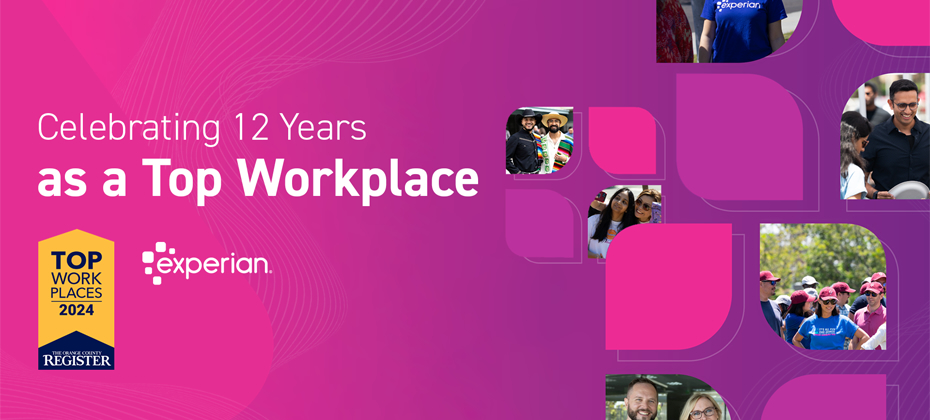
Achieving Top Workplace recognition for 12 consecutive years is no small feat, yet Experian North America has done just that. Named a Top Workplace by the Orange County Register once again, this milestone reflects not just policies or benefits but what truly makes Experian exceptional: our people. As Hiq Lee, Chief People Officer at Experian North America, notes, this honor is a testament to the remarkable contributions of our team. Experian’s employees shape an environment where innovation, inclusivity, and purpose thrive. More Than Work What sets Experian apart is our engagement with the world and community. Through initiatives like the Experian Volunteer Leadership Network and partnerships with organizations such as the Octane Foundation for Innovation and the Hispanic Chamber of Commerce of Orange County Education Foundation, our impact extends beyond the workplace. In 2024, we earned additional recognitions, including being named one of the World’s Best Workplaces™ by Fortune and Great Place to Work®. We were also recognized as one of the Best Workplaces for Parents, Millennials, and in Technology. The Secret to Success Our success lies in focusing on people. Experian is a place where careers are built, ideas are encouraged, and employees feel valued. Initiatives such as, Employee Resource Groups foster belonging, Mental Health First Aiders provide support, and technology hackathons inspire creativity. Innovation at the Core Innovation continues to drive our success. By leveraging technologies like artificial intelligence and machine learning, we are redefining decision-making and fraud prevention. This commitment to innovation empowers businesses and consumers worldwide, aligning with our mission to promote financial inclusivity. Looking Ahead For Experian, being a Top Workplace for more than a decade isn’t a finish line—it’s a springboard. With an ongoing commitment to our employees and communities, we continue to evolve, creating better experiences for our team, clients, and the world.
Lorem Ipsum is simply dummy text of the printing and typesetting industry. Lorem Ipsum has been the industry’s standard dummy text ever since the 1500s, when an unknown printer took a galley of type and scrambled it to make a type specimen book. It has survived not only five centuries, but also the leap into electronic typesetting, remaining essentially unchanged. It was popularised in the 1960s with the release of Letraset sheets containing Lorem Ipsum passages, and more recently with desktop publishing software like Aldus PageMaker including versions of Lorem Ipsum.
Lorem Ipsum is simply dummy text of the printing and typesetting industry. Lorem Ipsum has been the industry’s standard dummy text ever since the 1500s, when an unknown printer took a galley of type and scrambled it to make a type specimen book. It has survived not only five centuries, but also the leap into electronic typesetting, remaining essentially unchanged. It was popularised in the 1960s with the release of Letraset sheets containing Lorem Ipsum passages, and more recently with desktop publishing software like Aldus PageMaker including versions of Lorem Ipsum.

Web Developer
With a passion for crafting seamless digital experiences and a keen eye for front-end development, Krishna brings practical insights and hands-on expertise to every post. Whether exploring new frameworks or optimizing performance, his writing reflects a commitment to clean code and user-centric design.
With a passion for crafting seamless digital experiences and a keen eye for front-end development, Krishna brings practical insights and hands-on expertise to every post. Whether exploring new frameworks or optimizing performance, his writing reflects a commitment to clean code and user-centric design.
With a passion for crafting seamless digital experiences and a keen eye for front-end development, Krishna brings practical insights and hands-on expertise to every post. Whether exploring new frameworks or optimizing performance, his writing reflects a commitment to clean code and user-centric design.