
At Experian, we are committed to educating consumers about how to manage their credit histories and protect their financial health. At the same time, we know the COVID-19 pandemic has created a difficult economic reality for millions of Americans. In response, many people have questions about how to protect themselves financially, including their credit histories and scores. To address these questions, we partnered with pro football legend and American Ninja Warrior host Akbar Gbajabiamila to educate consumers across the country about steps they can take to protect their financial health and their credit standing. Gbajabiamila, author of “Everyone Can be a Ninja,” is passionate about helping people develop a financial game plan and he understands having a good credit history is a key component of good financial health. These interviews provided a platform for Gbajabiamila to share the four-point financial fitness game plan consumers can use protect and improve their financial health during the pandemic, including: Contacting your lenders as soon as possible if you think you may miss a payment. Many lenders provide emergency support, which can help protect your credit standing. Getting credit for paying cable, satellite, internet, Netflix and utility bills on time with Experian Boost Exploring balance transfer options or other introductory credit offers through Experian Credit Match Checking your credit report regularly. It’s free once a week at AnnualCreditReport.com. Tune in to Gbajabiamila’s interview with NBC Washington and hear his message to consumers in the videos below. For more credit education resources and tools: Join Experian’s #CreditChat hosted by @Experian on Twitter with financial experts every Wednesday at 3 p.m. Eastern time Visit the Ask Experian blog for answers to common questions, advice and education about credit For additional resources visit www.experian.com/coronavirus

In 2013, I came out to my brother. Sitting down at dinner, knowing whole-heartedly that he would fully accept me and nothing with our relationship would change, I was still scared. Each year on October 11, National Coming Out Day, I reflect on that first coming out experience and what I truly feared. Even though I knew I was safe, I also knew that coming out to him was just the start of coming out every single day for the rest of my life. It was the start of facing discrimination and judgment both in day-to-day life and professionally. It wasn’t a decision I made lightly. Coincidently, my brother came out to me at that very same dinner which certainly took some weight and anxiety off my shoulders. We came out to our family, together later that week and we were welcomed with love, acceptance, and support. The unconditional support I received is not normal, but my anxiety around the process was. I am grateful and quite lucky that my initial coming out process to my family was, for lack of a better term, easy. Like many others I don’t experience that same ease everywhere I go. I have been asked to leave restaurants, turned away from stores, spat on multiple times, and even asked to leave mass during service. I am regularly questioned when entering or leaving a women’s public restroom. Michele Bodda, our executive co-sponsor of Experian’s Pride employee resource group, said it perfectly in her message two years ago, “The difficulty some of our LGBT+ colleagues face making daily decisions about where they can be fully present aren’t merely insecurities. They are the realities of being LGBT+.” Let that sink in. Coming out is not a one and done experience, it is something we do over and over throughout our lives. That reality impacts people in different ways, and it’s why acknowledging National Coming Out Day means so much to me – why it means so much to many others. I feel particularly fortunate to work for a company that celebrates and recognizes our uniqueness. I know many people at Experian, like myself, who feel empowered and supported to bring their whole self to work and that reality is assuring, professionally and personally. I have been told I am brave for bringing forth my full authentic self each day. During a time of such global anxiety, uncertainty, and open expressions of intolerance and hatred, being a voice of empowerment, representation, and visibility for folks who do not feel comfortable being out is more important than ever. I’m willing to be a voice so others know they are not alone. Be brave with me. And if you’re not ready, I understand. I’m here for you when you are.

In a world that was already becoming increasingly digital, COVID-19 expedited timelines and turned forecasted projects into immediate needs nearly overnight. I’ve seen this play out in my role at Experian as well as across the financial services industry. Experian was recognized as an innovative company prior to the pandemic and the current environment has only accelerated our ability to innovate. As we surpassed the six month mark adjusting to our new normal, I was invited to join Bloomberg’s Future of Finance: Leveraging Digital Transformation for a Virtual World roundtable discussion with Senior Analyst of Bloomberg Intelligence Julia Chariell and leaders from IBM, Ally Financial, Deutsche Bank and others, to share how we are rising to meet the needs of consumers and lenders during the COVID-19 pandemic. You can find a recap of our conversation here and view the full video discussion here. We know each American is facing unique COVID-19-related circumstances, so there is not a one-size-fits-all solution. This notion has carried us as we are rising to meet the needs of our clients and consumers during the pandemic. We must allow individuals who can still meet their financial obligations to have access to credit and ensure lenders can identify them. Maintaining and improving financial access for these consumers will play an important role in our road to economic recovery. To continue to lend responsibly, the financial services industry must carefully examine all aspects of consumer financial capability in near real-time – consumer control and consumer-permissioned data play a key role in achieving this. By leveraging accurate data, I believe we have a chance to lessen the impact of the current U.S. economic crisis, extend credit responsibly, and support the hardest-hit consumers as we adjust to a new world post COVID-19.
Related Posts

Experian’s groundbreaking generative AI-powered tool, Experian Assistant, has earned the prestigious 2025 BIG Innovation Award in the Products for Financial Services category. This recognition underscores Experian’s commitment to pushing the boundaries of innovation by helping businesses achieve success and enhancing consumer experiences. The BIG Innovation Awards, celebrated since 2011, honor organizations and solutions that redefine excellence through creativity and measurable impact. Experian Assistant was recognized for transforming how financial institutions approach data and analytics, enabling faster, smarter decision-making that enhances customer experiences and operational efficiency. Redefining Financial Services Integrated with the Experian Ascend Platform™, Experian Assistant functions as a 24/7 data expert, enabling financial institutions to optimize their credit and fraud models with ease. Using natural language processing (NLP), the virtual assistant guides users providing insights, recommendations and coding assistance. The impact is transformative: Experian Assistant cuts model-development timelines from months to just days— and even hours in some cases. By helping users analyze credit and fraud data, adjust model attributes and streamline workflows, it empowers organizations to innovate faster and make data-driven decisions with confidence. Powered by agentic AI technology, Experian Assistant reimagines how data scientists and analysts approach their work. It accelerates insights, fosters collaboration and empowers businesses to deliver exceptional customer experiences while reducing the time and resources needed to bring new initiatives to market. Driving Results Across Industries While tailored for financial services, Experian Assistant’s capabilities extend across industries. Businesses can leverage its tools for data exploration, model deployment, performance monitoring and faster time-to-market for new offerings. With Experian Assistant, users gain a powerful edge in scoring more consumers, optimizing processes and enhancing overall customer satisfaction. Recognized Excellence The 2025 BIG Innovation Awards spotlight trailblazers evaluated on creativity, impact and results by seasoned business leaders. This accolade solidifies Experian Assistant’s position as a game-changing solution in financial services and beyond.

Experian Earns Top Score in Human Rights Campaign Foundation’s 2025 Corporate Equality Index
Diversity & InclusionWe are thrilled that for the sixth consecutive year, Experian has earned a score of 100 on the Human Rights Campaign Foundation’s (HRCF) 2025 Corporate Equality Index (CEI). This recognition underscores our commitment to LGBTQ+ workplace equality. We are honored to join the ranks of 765 U.S. businesses that have been awarded the HRCF’s Equality 100 Award, celebrating our leadership in fostering an inclusive workplace. Experian’s dedication to supporting the LGBTQ+ community is reflected in several key initiatives: Name Change Process: We have a process for transgender and non-binary consumers to update their names on credit reports, ensuring their identities are accurately represented. LGBTQ+ Allyship 101 Training: This new training program is available to all Experian employees, promoting allyship and understanding within our workforce. Pride ERG Parenting Committee: Launched to support parents, grandparents and guardians of LGBTQ+ individuals, this committee provides valuable resources and community. Transgender Resource Guide: This guide supports employees who are transitioning at work, offering education and resources for colleagues and managers. Partnerships: We collaborate with organizations such as Out & Equal, GenderCool, The Trevor Project and Born This Way Foundation’s Channel Kindness to provide financial health, mental health and other resources to empower both our internal and external communities. At Experian, we are proud to be part of this movement towards greater equality and inclusion. We remain dedicated to fostering a workplace where every employee feels respected, valued and empowered to bring their authentic selves to work. Learn more about how we drive social impact in English, Portuguese and Spanish.
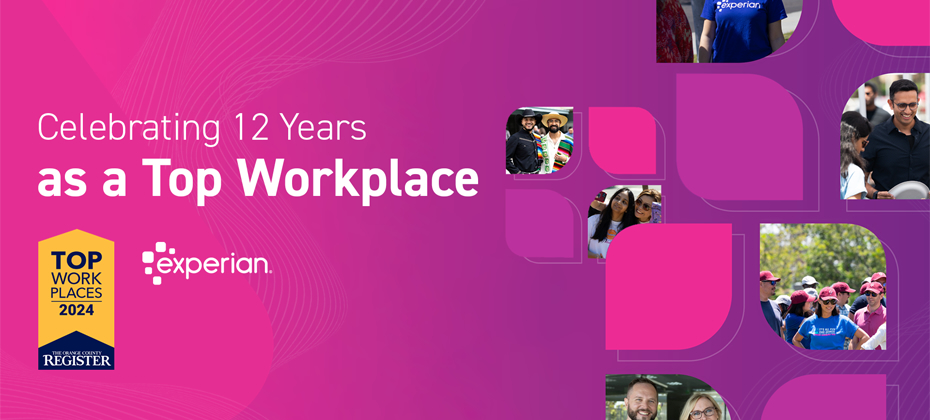
Achieving Top Workplace recognition for 12 consecutive years is no small feat, yet Experian North America has done just that. Named a Top Workplace by the Orange County Register once again, this milestone reflects not just policies or benefits but what truly makes Experian exceptional: our people. As Hiq Lee, Chief People Officer at Experian North America, notes, this honor is a testament to the remarkable contributions of our team. Experian’s employees shape an environment where innovation, inclusivity, and purpose thrive. More Than Work What sets Experian apart is our engagement with the world and community. Through initiatives like the Experian Volunteer Leadership Network and partnerships with organizations such as the Octane Foundation for Innovation and the Hispanic Chamber of Commerce of Orange County Education Foundation, our impact extends beyond the workplace. In 2024, we earned additional recognitions, including being named one of the World’s Best Workplaces™ by Fortune and Great Place to Work®. We were also recognized as one of the Best Workplaces for Parents, Millennials, and in Technology. The Secret to Success Our success lies in focusing on people. Experian is a place where careers are built, ideas are encouraged, and employees feel valued. Initiatives such as, Employee Resource Groups foster belonging, Mental Health First Aiders provide support, and technology hackathons inspire creativity. Innovation at the Core Innovation continues to drive our success. By leveraging technologies like artificial intelligence and machine learning, we are redefining decision-making and fraud prevention. This commitment to innovation empowers businesses and consumers worldwide, aligning with our mission to promote financial inclusivity. Looking Ahead For Experian, being a Top Workplace for more than a decade isn’t a finish line—it’s a springboard. With an ongoing commitment to our employees and communities, we continue to evolve, creating better experiences for our team, clients, and the world.
Lorem Ipsum is simply dummy text of the printing and typesetting industry. Lorem Ipsum has been the industry’s standard dummy text ever since the 1500s, when an unknown printer took a galley of type and scrambled it to make a type specimen book. It has survived not only five centuries, but also the leap into electronic typesetting, remaining essentially unchanged. It was popularised in the 1960s with the release of Letraset sheets containing Lorem Ipsum passages, and more recently with desktop publishing software like Aldus PageMaker including versions of Lorem Ipsum.
Lorem Ipsum is simply dummy text of the printing and typesetting industry. Lorem Ipsum has been the industry’s standard dummy text ever since the 1500s, when an unknown printer took a galley of type and scrambled it to make a type specimen book. It has survived not only five centuries, but also the leap into electronic typesetting, remaining essentially unchanged. It was popularised in the 1960s with the release of Letraset sheets containing Lorem Ipsum passages, and more recently with desktop publishing software like Aldus PageMaker including versions of Lorem Ipsum.

Web Developer
With a passion for crafting seamless digital experiences and a keen eye for front-end development, Krishna brings practical insights and hands-on expertise to every post. Whether exploring new frameworks or optimizing performance, his writing reflects a commitment to clean code and user-centric design.
With a passion for crafting seamless digital experiences and a keen eye for front-end development, Krishna brings practical insights and hands-on expertise to every post. Whether exploring new frameworks or optimizing performance, his writing reflects a commitment to clean code and user-centric design.
With a passion for crafting seamless digital experiences and a keen eye for front-end development, Krishna brings practical insights and hands-on expertise to every post. Whether exploring new frameworks or optimizing performance, his writing reflects a commitment to clean code and user-centric design.