
Greater transparency in buy now, pay later activity is key to helping consumers build their credit histories and supporting responsible lending.
Experian North AmericaScott Brown, Group President, Financial Services

Affirm plans to report all pay-over-time loan products issued from April 1, 2025, and beyond, including Pay-in-4. The move will help drive greater transparency into the buy now, pay later market while helping consumers build their credit histories over time.

Read Moreio55 Button 2- Learn more Primary button Secondary button Related Posts
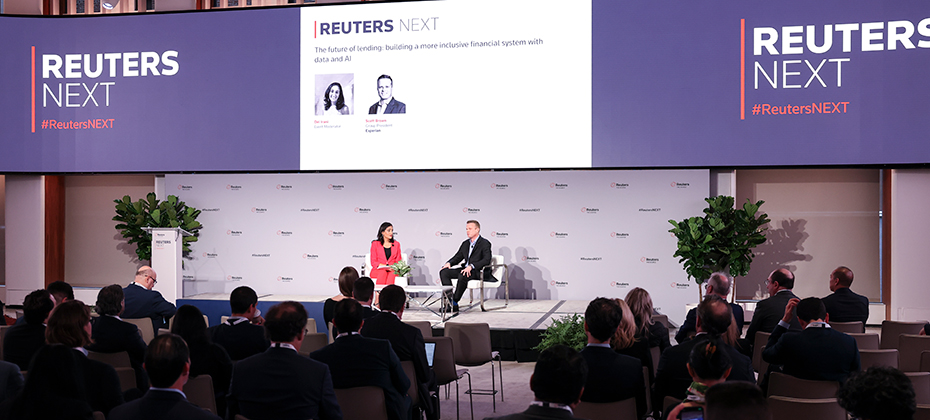
Today, we stand at the forefront of a digital revolution that is reshaping the financial services industry. And, against this backdrop, financial institutions are at vastly different levels of maturity; the world’s biggest banks are managing large-scale infrastructure migrations and making significant investments in AI while regional banks and credit unions are putting plans in place for modernization strategies, and fintechs are purpose-built and cloud native. To explore this more, I recently had the privilege of attending the annual Reuters NEXT live event in New York City. The event gathers globally recognized leaders across business, finance, technology, and government to tackle some of today’s most pressing issues. On the World Stage, I joined Del Irani, a talented anchor and broadcast journalist, to discuss the future of lending and the pivotal role of data and AI in building a more inclusive financial system. Improving financial access Our discussion highlighted the lack of access to traditional financial systems, and the impact it has on nearly 100 million people in North America alone. Globally, the problem affects over one billion people. These people, who are credit invisible, unscoreable, or have subprime credit scores, are unable to secure everyday financial products that many of us take for granted. What many don’t realize is, this is not a fringe subset of the population. Most of us, myself included, know someone who has faced the challenges of financial exclusion. Everyday Americans, including young people who are just starting out, new immigrants and people from diverse communities, often lack access to mainstream financial products. We discussed how traditional lending has a limited view of a consumer. Like looking through a keyhole, the lender’s understanding of the person in view is often incomplete and obstructed. However, with expanded data, technology, and advanced analytics, there is an opportunity to better understand the whole person, and as a result have a more inclusive financial system. At Experian, we have a unique ability to connect the power of traditional credit with alternative data, bringing a more holistic understanding of consumers and their behaviors. We are dedicated to leveraging our rich history in data and our expertise in technology to create the future of credit and ultimately bring financial power to everyone. The future of lending After spending two days with over 700 industry leaders from around the world, one thing is abundantly clear: much like the early days of the internet, today, we are at the cutting-edge of a technical revolution. Reflecting on my time at Reuters NEXT, I am particularly excited by the collective commitment to drive innovative, and smarter ways of working. We are only beginning to scratch the surface of how data and technology can transform financial services, and Experian is positioned to play a significant role. As we look to the future, I am excited about the ways we will create new opportunities for businesses and consumers alike.
The advertising ecosystem has seen significant transformation over the past few years, with increased privacy regulation, changes in available signals, and the rise of channels like connected TV and retail media. These changes are impacting the way that consumers interact with brands and how brands understand and continue to deliver relevant messages to consumers with precision. Experian has been helping marketers navigate these changes, and as a result, our marketing data and identity solutions underpin much of today’s advertising industry. We’re committed to empowering marketers and agencies to understand and reach their target audiences, across all channels. Today, we are excited to announce our acquisition of Audigent—a leading data and activation platform in the advertising industry. With Audigent’s combination of first-party publisher data, inventory and deep supply-side distribution relationships, publishers, big and small, can empower marketers to better understand their customers, expand the reach of their target audiences and activate those audiences across the most impactful inventory. I am excited to bring together Audigent’s supply-side network as a natural extension to our existing demand-side capabilities. Audigent’s ability to combine inventory with targeted audiences using first-party, third-party and contextual signals provides the best of all worlds, allowing marketers to deliver campaigns centered on consumer choices, preferences, and behaviors. The addition of Audigent further strengthens our strategy to be the premier independent provider of marketing data and identity, ultimately creating more relevant experiences for consumers. To learn more about Experian and Audigent, visit https://www.experian.com/marketing/ and https://audigent.com/.

As part of Credit Awareness Week, Experian and Credit Strategy are launching a new credit refusal pathfinder to help people understand the lending process and how they can tackle a credit refusal. It can be a real pain when you make an unsuccessful credit application, especially when you can’t see why you were refused. “But I’ve got a good credit score!”, “But I pay all my bills on time!”, “But I don’t even have a credit card!” people may say. When you apply for a credit card, loan or even a mobile phone contract, it’s up to the lender to decide whether or not to offer you credit – and they have varying methods to work out if you’re eligible. New research from Credit Strategy, Experian and the CFA* has found a whopping 86% say that they should be offered a clearer explanation about why they have been declined credit. Many people completely misunderstand the credit-decision-making process; 26% of UK adults wrongly think the credit reference agency makes the decision to turn down applications for a loan, while 32% think credit reference agencies decide to approve credit cards. The reality is that lenders decide which customers to accept and refuse, with one or more credit reference agency simply providing information to help the decision. In fact, industry guidelines require lenders to tell people the main reason for refusing credit, but only if they ask. Does being refused credit affect your credit score? The research also found that 75% of the population think that being refused credit affects your credit score. Being refused for credit is not, in itself, hazardous for your credit score. While your credit report will show that you applied for a credit card – it stays on for a year – it won’t actually show whether or not you were accepted. However, credit refusal can often lead to more attempts to get credit – and making a lot of applications in a short space of time could have a serious impact on your credit score, and your ability to get credit in the future. Some common reasons to be refused credit: You’ve missed or made late credit payments recently, which show up on your credit report You’ve had a default or a CCJ in the past six years, which will show up on your credit report You’ve made too many credit applications in a short space of time in the past six months There are mistakes such as incorrect addresses or other errors on your application form You may not fall into the target bracket for the type of credit you’ve applied for Your Experian UK Credit Score tells you how lenders may view you, which is useful when you apply for credit – and is FREE FOREVER. The higher your credit score, the more chance of being accepted for credit, at the best rates. * Conducted by YouGov on behalf of Credit Strategy, Experian and the Consumer Finance Association (CFA), 10th – 13th March 2017

Experian and Finicity are announcing a partnership that promises to transform the consumer and lender experience and bring it into the 21st century. By partnering with Finicity, we are leveraging our combined capabilities – their industry-leading 16,000 connections throughout the financial services field and Experian’s Decisioning as a Service platform, to be the first credit bureau that can digitize the loan asset and income verification steps of the underwriting process for consumers and lenders.

I’m a Senior Vice President of Sales, responsible for leading Experian Health’s teams as they assist hospitals, physicians, labs and pharmacies across the U.S. We provide technology for providers and patients to help keep the costs and payment processing component of healthcare easy and transparent. The part of my work I am most passionate about, however, is our efforts to decrease identity theft in healthcare. Medical identity theft is one of the fastest growing areas of identity fraud in the world. With everything moving online at a fast pace, health care providers may not always keep up with the protections needed with new technologies. Unfortunately, that means hackers can sometimes acquire a patient’s personal information – name, Social Security number, health insurance number – to illegally obtain medical services or devices, insurance reimbursements or prescription drugs. One of the biggest issues with this type of fraud is that it leaves its victims with little to no recourse for recovery. They often experience financial repercussions and discover that faulty information has been added to their personal medical files as a result. To address this issue, my team and I partnered with Experian’s Decision Analytics team to create a new tool that protects patients’ online portals in much the same way that banks have protected their online clients for years. Additionally, our team is the in process of launching a Universal Identity Matching solution – a unique PIN which acts like the Social Security Number for your health care information. As more health care companies begin to adopt it, this PIN will be the one thing you will need to carry with you, as it will be your unique identifier for all your health care experiences. A lot of processes in hospitals today are still manual, but I want to change that. I want to automate systems so hospital staff can focus on where they are most needed. I am proud to work at a company that’s at the forefront of solving the major problems in healthcare IT. Being able to provide technological solutions in an industry where you can directly see the benefit is both personally and professionally rewarding. Read more #ExperianStories from our colleagues around the world.
In this article…