
Greater transparency in buy now, pay later activity is key to helping consumers build their credit histories and supporting responsible lending.
Experian North AmericaScott Brown, Group President, Financial Services

Affirm plans to report all pay-over-time loan products issued from April 1, 2025, and beyond, including Pay-in-4. The move will help drive greater transparency into the buy now, pay later market while helping consumers build their credit histories over time.
Related Posts

Read Moreio55 Button 2- Learn more Primary button Secondary button Related Posts
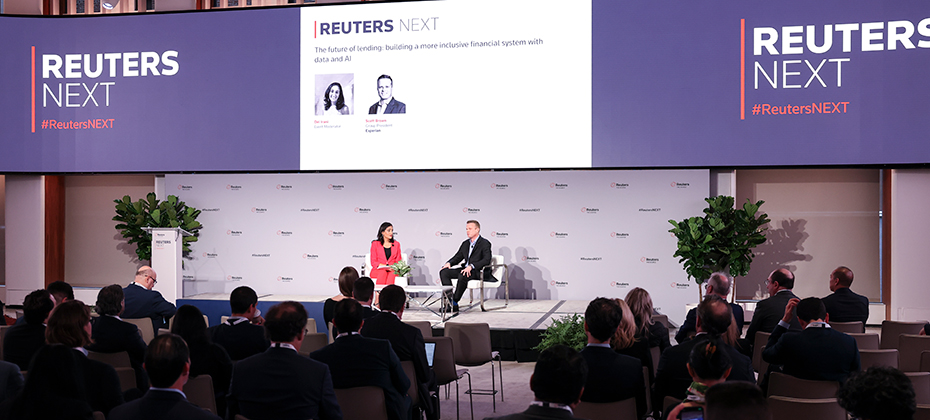
Insights from Reuters Next: Building a More Inclusive Financial System with Data and AI
Data & AnalyticsToday, we stand at the forefront of a digital revolution that is reshaping the financial services industry. And, against this backdrop, financial institutions are at vastly different levels of maturity; the world’s biggest banks are managing large-scale infrastructure migrations and making significant investments in AI while regional banks and credit unions are putting plans in place for modernization strategies, and fintechs are purpose-built and cloud native. To explore this more, I recently had the privilege of attending the annual Reuters NEXT live event in New York City. The event gathers globally recognized leaders across business, finance, technology, and government to tackle some of today’s most pressing issues. On the World Stage, I joined Del Irani, a talented anchor and broadcast journalist, to discuss the future of lending and the pivotal role of data and AI in building a more inclusive financial system. Improving financial access Our discussion highlighted the lack of access to traditional financial systems, and the impact it has on nearly 100 million people in North America alone. Globally, the problem affects over one billion people. These people, who are credit invisible, unscoreable, or have subprime credit scores, are unable to secure everyday financial products that many of us take for granted. What many don’t realize is, this is not a fringe subset of the population. Most of us, myself included, know someone who has faced the challenges of financial exclusion. Everyday Americans, including young people who are just starting out, new immigrants and people from diverse communities, often lack access to mainstream financial products. We discussed how traditional lending has a limited view of a consumer. Like looking through a keyhole, the lender’s understanding of the person in view is often incomplete and obstructed. However, with expanded data, technology, and advanced analytics, there is an opportunity to better understand the whole person, and as a result have a more inclusive financial system. At Experian, we have a unique ability to connect the power of traditional credit with alternative data, bringing a more holistic understanding of consumers and their behaviors. We are dedicated to leveraging our rich history in data and our expertise in technology to create the future of credit and ultimately bring financial power to everyone. The future of lending After spending two days with over 700 industry leaders from around the world, one thing is abundantly clear: much like the early days of the internet, today, we are at the cutting-edge of a technical revolution. Reflecting on my time at Reuters NEXT, I am particularly excited by the collective commitment to drive innovative, and smarter ways of working. We are only beginning to scratch the surface of how data and technology can transform financial services, and Experian is positioned to play a significant role. As we look to the future, I am excited about the ways we will create new opportunities for businesses and consumers alike.
The advertising ecosystem has seen significant transformation over the past few years, with increased privacy regulation, changes in available signals, and the rise of channels like connected TV and retail media. These changes are impacting the way that consumers interact with brands and how brands understand and continue to deliver relevant messages to consumers with precision. Experian has been helping marketers navigate these changes, and as a result, our marketing data and identity solutions underpin much of today’s advertising industry. We’re committed to empowering marketers and agencies to understand and reach their target audiences, across all channels. Today, we are excited to announce our acquisition of Audigent—a leading data and activation platform in the advertising industry. With Audigent’s combination of first-party publisher data, inventory and deep supply-side distribution relationships, publishers, big and small, can empower marketers to better understand their customers, expand the reach of their target audiences and activate those audiences across the most impactful inventory. I am excited to bring together Audigent’s supply-side network as a natural extension to our existing demand-side capabilities. Audigent’s ability to combine inventory with targeted audiences using first-party, third-party and contextual signals provides the best of all worlds, allowing marketers to deliver campaigns centered on consumer choices, preferences, and behaviors. The addition of Audigent further strengthens our strategy to be the premier independent provider of marketing data and identity, ultimately creating more relevant experiences for consumers. To learn more about Experian and Audigent, visit https://www.experian.com/marketing/ and https://audigent.com/.
Tim Howard discusses building his brand and the value of trusted business relationships at the Experian Marketing Services 2014 Client Summit
NewsExperian Marketing Services, a global provider of integrated consumer insights, targeting, data quality and cross-channel marketing, hosted a fireside chat with U.S. Men’s National Soccer Team goalkeeper Tim Howard at its 2014 Client Summit. In the following video clip from that fireside chat, Howard discusses how he decides to align with brands that match his personal and professional image. Specifically, Howard describes the formula he uses to make business partnership decisions. “We try and look for a good fit,” said Howard. “There’s not always a blueprint for that, but it’s a feeling.” He continues, “I don’t want to lend my name to just any old company. I have put in a lot of hard work into my own brand, which is basically on the field, trying to be a decent guy and a good player.” A video of the entire fireside chat featuring Howard and moderator Rick Erwin, president of consumer insights and targeting at Experian Marketing Services, can be viewed on the company’s YouTube channel with this link: https://www.youtube.com/watch?v=T19JM3i-brY Insights and stories shared by Howard connected directly to the theme of the 2014 Client Summit, reinforcing the importance of storytelling for marketers and how brands need to deliver exceptional and authentic customer experiences. During the Client Summit, Experian Marketing Services also unveiled several new capabilities that will help marketers drive customer acquisition, increase brand loyalty and improve marketing return on investment. The biggest highlight was the announcement of the Experian Marketing Suite, a cohesive, end-to-end marketing capability that enables brands to deliver authentic customer experiences every time, in any channel and via any device. To watch additional Client Summit videos, including event keynote sessions, visit http://ex.pn/W8ktEQ.
Experian’s partnership with Ubuntu Education highlights commitment to social responsibility
Corporate ResponsibilityAt Experian, we have a firm commitment to social responsibility. We show that commitment through a broad range of efforts that help communities realize their social and economic potential by investing in community and education programs that foster the financial health of individuals and small businesses across the globe. As part of this commitment, Experian has more than 100 employees who are certified as Experian Education Ambassadors. These ambassadors educate consumers throughout the United States about credit reporting, credit scoring, fraud and identity theft and other issues in which Experian has expertise. Presentations take place at youth organizations, schools, colleges and universities, faith-based organizations – anywhere people gather and request information about these important subjects.
Experian Marketing Services, a global provider of integrated consumer insights, targeting, data quality and cross-channel marketing, gathered more than 1,000 top marketing executives from the world’s leading brands for the 2014 Client Summit. The event reinforced the importance of storytelling for marketers and how brands need to deliver exceptional and authentic customer experiences.
In this article…