

Greater transparency in buy now, pay later activity is key to helping consumers build their credit histories and supporting responsible lending.
Experian North AmericaScott Brown, Group President, Financial Services
Affirm plans to report all pay-over-time loan products issued from April 1, 2025, and beyond, including Pay-in-4. The move will help drive greater transparency into the buy now, pay later market while helping consumers build their credit histories over time.
Related Posts

Read Moreio55 Button 2- Learn more Primary button Secondary button Related Posts
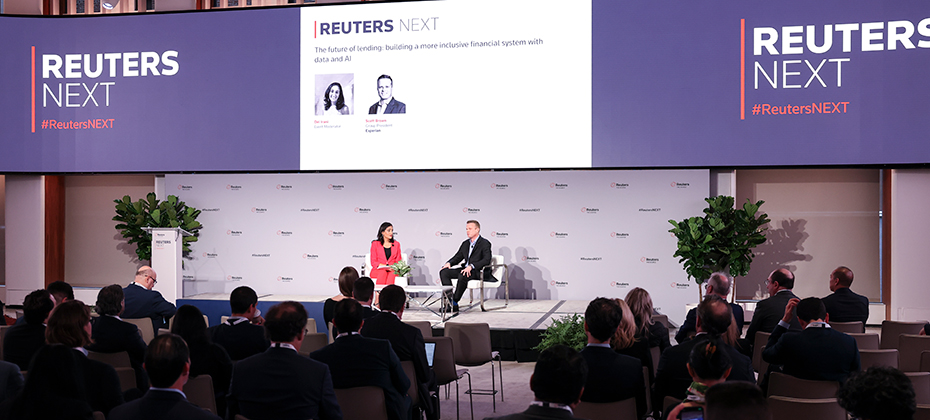
Insights from Reuters Next: Building a More Inclusive Financial System with Data and AI
Data & AnalyticsToday, we stand at the forefront of a digital revolution that is reshaping the financial services industry. And, against this backdrop, financial institutions are at vastly different levels of maturity; the world’s biggest banks are managing large-scale infrastructure migrations and making significant investments in AI while regional banks and credit unions are putting plans in place for modernization strategies, and fintechs are purpose-built and cloud native. To explore this more, I recently had the privilege of attending the annual Reuters NEXT live event in New York City. The event gathers globally recognized leaders across business, finance, technology, and government to tackle some of today’s most pressing issues. On the World Stage, I joined Del Irani, a talented anchor and broadcast journalist, to discuss the future of lending and the pivotal role of data and AI in building a more inclusive financial system. Improving financial access Our discussion highlighted the lack of access to traditional financial systems, and the impact it has on nearly 100 million people in North America alone. Globally, the problem affects over one billion people. These people, who are credit invisible, unscoreable, or have subprime credit scores, are unable to secure everyday financial products that many of us take for granted. What many don’t realize is, this is not a fringe subset of the population. Most of us, myself included, know someone who has faced the challenges of financial exclusion. Everyday Americans, including young people who are just starting out, new immigrants and people from diverse communities, often lack access to mainstream financial products. We discussed how traditional lending has a limited view of a consumer. Like looking through a keyhole, the lender’s understanding of the person in view is often incomplete and obstructed. However, with expanded data, technology, and advanced analytics, there is an opportunity to better understand the whole person, and as a result have a more inclusive financial system. At Experian, we have a unique ability to connect the power of traditional credit with alternative data, bringing a more holistic understanding of consumers and their behaviors. We are dedicated to leveraging our rich history in data and our expertise in technology to create the future of credit and ultimately bring financial power to everyone. The future of lending After spending two days with over 700 industry leaders from around the world, one thing is abundantly clear: much like the early days of the internet, today, we are at the cutting-edge of a technical revolution. Reflecting on my time at Reuters NEXT, I am particularly excited by the collective commitment to drive innovative, and smarter ways of working. We are only beginning to scratch the surface of how data and technology can transform financial services, and Experian is positioned to play a significant role. As we look to the future, I am excited about the ways we will create new opportunities for businesses and consumers alike.
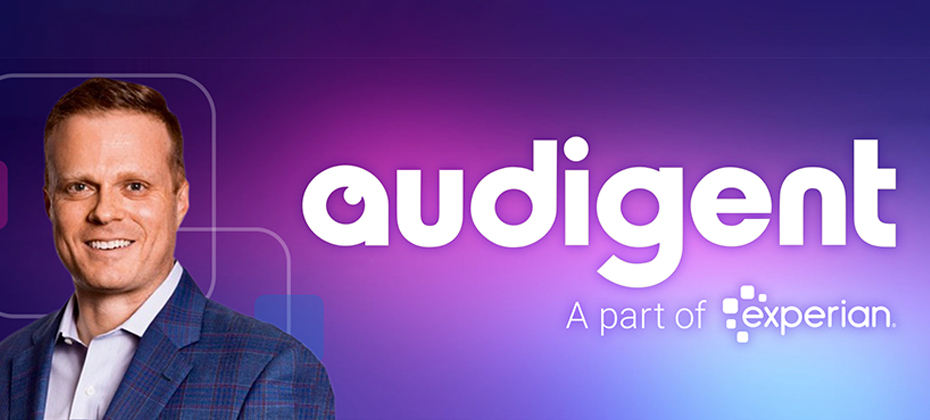
The advertising ecosystem has seen significant transformation over the past few years, with increased privacy regulation, changes in available signals, and the rise of channels like connected TV and retail media. These changes are impacting the way that consumers interact with brands and how brands understand and continue to deliver relevant messages to consumers with precision. Experian has been helping marketers navigate these changes, and as a result, our marketing data and identity solutions underpin much of today’s advertising industry. We’re committed to empowering marketers and agencies to understand and reach their target audiences, across all channels. Today, we are excited to announce our acquisition of Audigent—a leading data and activation platform in the advertising industry. With Audigent’s combination of first-party publisher data, inventory and deep supply-side distribution relationships, publishers, big and small, can empower marketers to better understand their customers, expand the reach of their target audiences and activate those audiences across the most impactful inventory. I am excited to bring together Audigent’s supply-side network as a natural extension to our existing demand-side capabilities. Audigent’s ability to combine inventory with targeted audiences using first-party, third-party and contextual signals provides the best of all worlds, allowing marketers to deliver campaigns centered on consumer choices, preferences, and behaviors. The addition of Audigent further strengthens our strategy to be the premier independent provider of marketing data and identity, ultimately creating more relevant experiences for consumers. To learn more about Experian and Audigent, visit https://www.experian.com/marketing/ and https://audigent.com/.
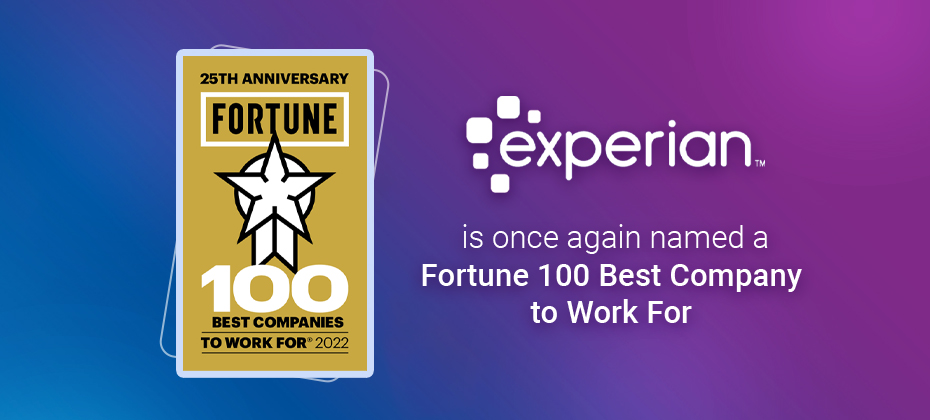
For 3rd Consecutive Year, Experian Named to Fortune’s “100 Best Companies to Work For”
Diversity & InclusionLast year, while still in the grip of the effects of the pandemic, Experian North America continued to reinforce our core purpose and People First approach through creating a workplace culture of belonging, employee wellness and personal and professional growth. It’s especially rewarding that this commitment, along with our financial planning and consumer education resources, were highlighted in this year’s Fortune 100 Best Companies to Work For award recognition. For the third year in a row, Experian North America was named to the prestigious national list that honors the “100 Best companies that adapted to massive changes in the workplace by prioritizing employee well-being, inclusion, purpose, listening and care wherever their employees are.” To determine this year’s 100 Best list, Great Place to Work®, America’s largest ongoing annual workforce study, surveyed more than 870,000 employees and gathered data from companies representing more than 6.1 million employees. The survey enables employees to share confidential feedback about their organization’s culture and the employee experience. Great Place to Work cited that “Experian has expanded benefits to include fertility, surrogacy, and adoption coverage and enhanced its higher education financial planning resources. It’s also tackling workplace equity from the very start of the hiring process with an in-house tool called Lingo that identifies gender-biased language in job descriptions.” In addition, “Experian began to hold conferences for employees to discuss their personal struggles during the pandemic. Since then, the company has continued to improve wellness initiatives, while staying committed to flexibility around employee schedules.” “At Experian we’re especially proud of our purpose-driven culture, where all our people play a role in making a positive impact in the day-to-day lives of the consumers, clients and communities we serve. This includes taking care of each other, celebrating our individual differences, and delivering on our purpose to create a better tomorrow for people everywhere,” said Jennifer Schulz, Chief Executive Officer of Experian North America. “This recognition from Fortune reflects the very best Experian offers to all those we help, and I couldn’t be prouder of our people and the work we’re doing.” At Experian, we believe bringing together unique experiences, diverse backgrounds and individual differences creates a dynamic, innovative and inspiring workplace — one reflective of the clients and communities we serve around the globe. This is why it’s such an honor to be recognized alongside other outstanding brands on the Best 100 list that prioritize their employees. This recognition continues the momentum we’ve built in recent months with other industry accolades and awards. In February, Experian North America was named a “Best Place to Work for LGBTQ Equality” for the fourth year in a row in the Human Rights Campaign Foundation’s Corporate Equality Index 2022, receiving a perfect score in the foundation’s evaluation. Last year, Experian North America was named to the Fortune Best Workplaces for Women™ 2021 among large organizations and 100 Best Large Workplaces for Millennials. In addition, we were ranked the #1 Top Workplace in 2021 by the Orange County Register for the second consecutive year.

Experian: Embracing Changes Due to the Pandemic Will Advance the Healthcare Industry Forward
InnovationSimplifying healthcare for all – that seems like a tall task to accomplish considering the last two years. What we once considered simple activities in our daily lives, such as going to the store to buy groceries or getting children to school, was upended by a global pandemic. Factor in the massive changes in healthcare operations, and it is clear the system needs to continue to evolve. It also cements my belief that Experian Health’s mission is even more relevant and achievable today than it was pre-COVID 19. In fact, this aspiration of simplifying healthcare for all is top of mind for me and Experian as we go into HIMSS22, the premier healthcare conference being held in Orlando this week. The healthcare industry has undergone massive changes since the fateful announcements in early 2020. While adapting to the pandemic was a huge undertaking for many organizations at the onset, those who opted to embrace change saw the payoff as they simplified administrative tasks and created efficiencies for both providers and patients. We saw organizations eagerly adopt technology and tools to take paperwork digital, streamlining the patient intake process and improving the accuracy of the data received. Instead of phone calls, patients and providers scheduled appointments and communicated online through secure portals saving time and manpower. The use of telehealth appointments allowed providers to see more patients and do so safely. Who would not want the simplicity of carving out just a few minutes from the comfort of one’s home for a non-urgent appointment? We are proud to have been a part of this evolution helping healthcare organizations pivot in the face of such a daunting predicament. For example, through our digital front door solutions, patients were able to schedule and pre-register for appointments online avoiding extra time spent in waiting rooms. We verified hundreds of thousands of identities quickly as Americans lined up for COVID-19 testing and vaccines. Our mobile payments system served to make the financial aspects of care easier to fulfill. Providers turned to us to help recoup costs from the government and insurers for COVID-19 care with our insurance discovery solution. Experian will not stop here, and we will continue to innovate high-tech, data-driven approaches to simplify healthcare for all; I hope the industry doesn’t stop either in tackling tough operational challenges using the power of technology and data. With this in mind, I look forward to hearing about the lessons learned by the industry as well as future innovations from the participants at HIMSS22. It’s the “can’t-miss healthcare conference of the year,” and we are pleased to be a sponsor and exhibitor once again. For those attending, visit us at Booth #3059. Taking the conference playbook of a hybrid approach with both digital and in-person participation, the healthcare industry should follow suit. Let’s certainly keep valuable in-person mechanisms in place, but not forget about the last two years and the incredible progress made that moved the industry forward. At Experian, we strive to help clients operate more quickly, smoothly and efficiently across the healthcare journey. With a new mindset in the industry and the tools available to act on change from providers like Experian, simplifying healthcare for all is not just a mission but an outcome we must achieve. Tom Cox is President of Experian Health.

At Experian we pride ourselves on having a great People First culture, it’s something we are all proud of and want to protect. We do this through a dynamic, positive and inclusive working environment for all employees, with the tools and support they need to grow and develop. With that in mind, we are hosting our first ever Careers week for our employees around the world. During Careers week, 70 sessions are taking place across different time zones, with a mix of inspiring speakers, bitesize learning events and insights into new career resources and tools coming in 2022 supporting the ongoing development and learning of our people The theme for this year’s Careers week is ‘Be World Ready’. Put simply this means: Being Aware – having a good understanding about what is happening to jobs and careers in the marketplace Being Relevant – keeping your skills and experiences fresh and meaningful Being Marketable – making sure you stand out from the crowd Our employees will get the chance to hear from internal and external speakers, including experts in their fields sharing the latest thinking on career development and learning. Leaders from Experian, Google, AWS, Microsoft and many others are part of this exciting event. The whole week has been designed to give people the space to learn and reach their highest potential. To find out more about careers at Experian, visit our global careers page.
In this article…