
The recent wildfires in Los Angeles are now among the most destructive recorded in California’s history. Thousands of structures have been damaged or destroyed, and many families are facing the heartbreaking loss of their homes, businesses and personal belongings. The fires have also tragically claimed lives and caused significant injuries. In the wake of such devastation, the immediate priority for everyone is, of course, ensuring the safety and well-being of themselves and their loved ones. As communities come together to navigate this challenging time, we are committed to being a resource to consumers. Our hope is to help those impacted by the fires preempt or prevent potential impacts to their financial health and identity where possible. If you or someone you know has been impacted by the Los Angeles fires, here are some key points to keep in mind. 1. Safeguard Your Identity Natural disasters can unfortunately create opportunities for identity theft. Important documents containing personal information may be lost or scattered. According to the Federal Trade Commission, instances of identity theft have nearly tripled over the last decade and scammers often exploit chaotic situations and vulnerable consumers. Be Wary of Scammers: Sadly, following natural disasters, opportunistic fraudsters often deploy schemes tied to charity and donations, insurance, new financing, construction or clean up, and more. These perpetrators may lift and deploy tactics that were successful following natural disasters in other areas and deploy them to target those impacted by the LA wildfires. Stay vigilant against fraudsters who may try to steal your personal information or money through disaster-related schemes or offers that sound too good to be true. Use Free Credit Monitoring and Fraud Alerts: Take advantage of these services to keep an eye on your credit activity. If you notice anything suspicious, report it immediately to your bank or financial institution. Consider Freezing Your Credit: If your personal information has been compromised, freezing your credit with the three major credit reporting agencies can prevent new fraudulent credit applications. You can freeze your credit for free with Experian by clicking here or enrolling in its free app on your mobile device. 2. Contact Your Lenders In times of crisis, many financial institutions are willing to work with affected consumers. If you’re worried about paying your bills on time due to the fires, reach out to your mortgage, auto loan, and credit card companies as soon as possible. Your lenders can report accounts as deferred or in forbearance if you live in an area impacted by the fires. This means no late payments will be reported, allowing you to focus on immediate concerns. However, interest might continue to accrue on the balance, so be sure to understand the terms of any agreement. 3. Use Your Credit Report as a Financial Tool Tracking down contact information for each of your lenders can be overwhelming. Your credit report, which you can access for free at annualcreditreport.com or via the Experian website or its free app on your mobile device, can be a helpful starting point. While, understandably, protecting your credit history or identity may not be your immediate concern, taking a proactive approach could help prevent any or further damage to your financial health at a time when you need access to credit the most. For more tools and resources to protect your credit standing and financial health, please visit Ask Experian.

Experian is celebrating the one-year anniversary of The Legacy League Game Show™, a dynamic and interactive event that has revolutionized financial literacy education for students at Historically Black Colleges and Universities (HBCUs) and Hispanic Serving Institutions (HSIs). This innovative program, part of the B.A.L.L. for Life™ initiative, combines the excitement of a game show with essential lessons on credit and financial management. We marked the occasion where it debuted in 2023: at EntreprenUTSA at the University of Texas San Antonio. The Legacy League Game Show™ has traveled to ten universities such as Morgan State and Shaw Universities and major events across the United States. The National Urban League describes the event as transformational; HomeFree-USA calls it a “model for how to teach anything to Gen Z and other generations.” Thousands of students have participated across the country, and more than 99% report an increase in their financial literacy after the experience. As someone whose family didn’t discuss money matters growing up, this impact is especially gratifying. In addition to making learning fun, The Legacy League Game Show™ addresses a critical issue: financial invisibility among young consumers, particularly within communities of color. Forty percent of consumers under 25 are credit invisible, with 26% of Hispanic and 28% of Black consumers affected, compared to 16% of their white and Asian peers. Special guests, including rapper and college basketball standout Flau’jae, comedian and actor Mike Merrill, Louisiana State University wide receiver Chris Hilton, Jr. and Grammy-nominated D Smoke have joined the game show, adding star power and excitement. Next year, The Legacy League Game Show™ will hit the road again, visiting more schools and events. We already have stops planned at the #IYKYK Pitch Competition in partnership with HomeFree-USA, the University of Illinois in collaboration with the Hispanic Alliance for Career Enhancement (HACE), and the UnidosUS National Conference. Check out the action from our 2024 stops by clicking here.Learn more about Experian’s commitment to underserved communities in The Power of YOU 2024: Diversity, equity, inclusion and social impact report.

Modernizing the conversation around credit and financial literacy is a key commitment for Experian, especially for young adults. That’s why we partner with organizations like the Singleton Foundation to produce “Your World on Money,” to meet young people where they are, with engaging, easy-to-understand video shorts about credit, budgeting, and saving and more. We’re thrilled this commitment and creativity has earned both Gold and Bronze Anthem Awards, which recognize excellence in social good, celebrate the impactful work of organizations and initiatives that are driving positive change. Financial literacy is often not taught in schools, and the language around credit and personal finance can be intimidating. By normalizing these conversations, we hope to inspire confidence and action, helping young adults make informed financial decisions as they navigate life’s milestones. Our United for Financial Health partnership with the Singleton Foundation continues with our new series, the Finance Couch, where college students join our experts on a coach in the middle of a Los Angeles campus to answer their money questions. And our Anthem Award-winning series, HeartBroke, helps couples whose relationships are tested with financial issues to determine if they can work through it or end up HeartBroke(n).

Harnessing Generative AI for Financial Success: Transforming Financial Literacy and Health in the Digital Age
Financial EducationThroughout time, we’ve seen examples of how new technologies can reshape the way we live our lives and manage our finances. As a millennial, the standouts to me are the start of the internet and the rise of the smart phone and mobile banking. Each innovation has opened new ways of learning and simplifying the way we do things. Now, we find ourselves on the brink of another intriguing shift with the rise of generative AI. This development is especially timely, as we know consumers are hungry for information and resources to improve their credit scores and overall financial health. To get a better sense of how consumers are tapping into this technology, we deployed a survey which showed a significant number of Americans are already embracing generative AI. In fact, 63% of consumers are familiar with generative AI, including 84% of Gen Zers and 79% of millennials. Having learned about finances through trial and error (an approach I wouldn’t recommend), and now dedicating myself to consumer education advocacy, I find this incredibly exciting. Especially considering many consumers, nearly half, are also beginning to tap technology to help manage their personal finances. It’s perhaps no surprise this resonates most for America’s youngest consumers, with 67% of Gen Zers and 62% of millennials stating they use or are considering to use the technology to manage their personal finances. The good news is consumers who are using the technology for personal financial management are reporting an overwhelmingly positive experience – an impressive 96% reported positive experiences and 77% stated they use generative AI for personal financial tasks at least once a week. Key findings include: FINDINGSTOTALGEN Z (18-27)MILLENNIAL (28-43)GEN X (44-59)BOOMER (60-78)SILENT (79+)Indicate they are somewhat or very familiar with GenAI technology63%84%79%58%40%29%Indicate using GenAI to learn about a new topic or personal finances33%46%43%28%19%18%Indicate they are using or considering using GenAI powered tools or apps to help with managing personal finances47%67%62%41%28%23% As we continue to explore the benefits of generative AI, it’s clear this technology can be a valuable resource for improving financial literacy as we look ahead. We believe that the responsible use of AI can open new opportunities for consumers seeking to enhance their financial health. However, as with anything new, there are a few things consumers should keep in mind if they are currently leverage, or considering leveraging generative AI to learn about or manage their finances or credit scores, including: Don’t forget the basics: While there’s no question generative AI can be a helpful tool for managing your finances, consumers shouldn’t lose sight of the “old school” ways to protect their financial health and credit standing. This includes checking your credit report and scores regularly. You can get a free copy of your Experian credit report and FICO® Score[1] updated daily at www.experian.com or via Experian’s free mobile app. Consumers can also get a free credit report from each of the three credit reporting agencies once a week at www.annualcreditreport.com. Verify your findings: Generative AI tools are only as good as the information they consume and there’s no shortage of misinformation about managing your credit scores and finances that exists online. Always cross-check AI-generated financial advice with reputable sources. You can find answers to many personal finance and credit-building questions on Ask Experian—Experian’s free credit advice blog. Be safe and use generative AI responsibly. Many of the generative AI tools that exist today collect and store user data. Be mindful of the personal information you share with generative AI tools to ensure your information is protected. In short, the rise of generative AI marks a pivotal moment in personal finance education, and an exciting one for me. As we embrace this technology, I believe we can create a more informed and financially empowered consumer base. [1] Credit score calculated based on FICO® Score 8 model. Your lender or insurer may use a different FICO® Score than FICO® Score 8, or another type of credit score altogether. Learn more.

We believe that financial literacy leads to empowerment. That is why Experian supports initiatives and partners with community organizations to deliver financial education. We also develop products and services that give more control to consumers over their credit profile and financial health. As part of advancing our mission of Financial Power to All®, we are proud to announce we are helping more than 5,000 Hispanic individuals nationwide by relieving $10 million dollars of consumer debt. To provide families with this boost, we joined forces with ForgiveCo, a Public Benefit Corporation (PBC), to administer the acquisition and cancellation of qualifying consumer debt for the selected recipients. Beneficiaries will also receive a one-year premium Experian membership for free that offers access to their Experian credit report in English and Spanish[i], FICO® Score[ii], bilingual educational content, and other financial resources. We hope this effort helps raise awareness of the importance of financial literacy for everyone, and that Experian has resources to help individuals reach their financial dreams. To amplify the message, we collaborated with multi-platinum, award-winning singer and songwriter Prince Royce and you can see his video here. In fact, we have been making a concerted effort the last several years to evolve our educational resources and products to better support all underserved communities. Some of our other activities include the creation of the B.A.L.L. for Life initiative that connects African American and Hispanic youth with financial education, supporting scholarships for Asian Americans through the Ascend organization, providing custom resources for Out & Equal and Born This Way Foundation for the LGBTQ+ community, supporting the NextGen Innovation Lab for Disability:IN, and sponsoring credit counseling for the military community with Operation HOPE. For resources in Spanish, Experian offers a credit e-book and consumers can access a full suite of articles at the Ask Experian blog here. [i] Only Experian credit reports are available in Spanish. All other services associated with an Experian membership are available in English only. English fluency is required for full access to Experian’s products. [ii] Credit score calculated based on FICO® Score 8 model. Your lender or insurer may use a different FICO® Score than FICO® Score 8, or another type of credit score altogether. Learn more.

Juniper Research released their Online Payment Fraud 2020-2024 report in May highlighting key trends in digital fraud, it’s implications on businesses and consumers as well as a competitive analysis for advanced solutions available to secure digital payments. Experian is proud to have contributed to the research and its CrossCore solution considered on their Fraud Detection & Prevention Leaderboard. Key takeaways: We’re in the middle of a payment revolution with mobile payments on the rise. Nearly half the world will be using digital wallets by 2024, with transaction values to increase by almost 60% to over $9 trillion in 2024. Omnichannel expectations are creating new challenges for online payments as new technologies for creating convenience are being exploited by cybercriminals, but it’s preventable. Juniper Research forecasts a $25.5 billion eCommerce transaction fraud loss in 2019, a 17% increase in 2018. By 2024, this will double to almost $50.5 billion. The Fraud Detection & Prevention Leaderboard is an assessment based on a combination of quantitative and qualitative measures but not considered a ranking or exhaustive list of solutions on the market. Experian’s flagship solution, CrossCore, just released its latest advanced features and offers unique functionality that lives up to its layered approach for mitigating fraud and authenticating customers. CrossCore is an integrated digital identity and fraud risk platform that combines rich data assets from Experian with identity insights and capabilities from its curated partner ecosystem. Through sophisticated orchestration, it applies advanced analytics to give businesses confidence in every transaction. CrossCore combines risk-based authentication, identity proofing, and fraud detection into a single cloud platform to make real-time risk decisions throughout the customer lifecycle. The platform is designed to help clients differentiate between their good and bad customers, without disrupting good customers, or increasing customer friction in their attempts to stop fraud. Key profile features: Our partner network, some of which we don’t publicly disclose, cover a variety of categories including, behavioural biometrics (Biocatch), traditional biometrics (Daon), document verification (Mitek, Acuant, Onfido), call centre risk assessments (TrustID, NextCaller), email verification (Emailage), Alternative Data (Ekata, Global Data Consortium, HelloSoda, Pipl), Mobile Phone Verification (Boku/Danal) and Chargeback Management (Chargebacks911). Customers include banks, eCommerce merchants and retail companies, telecommunications providers, travel providers, health providers, insurance companies, and public sector organizations. Advanced Decisioning: CrossCore is designed to leverage the complete raw output in our partner network to perform advanced analytics via Experian’s native machine learning infrastructure. This approach includes a hybrid of Unsupervised models (to generate features), Supervised generic or custom models per use case, and a business rules infrastructure. This provides high levels of accuracy to the client, leading to significantly reduced friction and operational costs. Find out how Experian’s capabilities compare and hear from our experts on how to balance security with convenient customer experiences.

Experian, the global information services company, has agreed to join FDATA in support of its Open Banking initiatives around the world. The commitment includes membership in the UK, US, and EMEA. It reflects Experian’s strategy for rolling out Open Banking services across its global footprint that includes South America, South East Asia including Australia and South Africa. Access to Open Banking will complement the organisation’s network of credit bureaux, identity verification, and automated decision services that it already provides to consumers and businesses. Open Banking enables Experian to provide additional insight into consumers’ and businesses’ financial wellbeing. Lisa Fretwell, Managing Director of Data Services at Experian, said: “Joining FDATA helps us to exchange knowledge, thought leadership, and drive innovation at a time when we are increasing our strategic commitment and investment plans for Open Banking. This will also include the UK’s Open Finance initiative.” Experian helps consumers and businesses to engage with and understand their finance through combining its bureau data with insights generated from Open Banking. Its consumer services business engages with more than 7 million consumers in the UK and more than 30 million in the U.S, empowering people to manage their money and access services at the best available rates. Meanwhile, Experian also works with a range of businesses – from financial services to utilities, and insurance to the public sector – so is well placed to drive successful Open Banking initiatives. Working with FDATA and its members will further improve Experian’s prospects of encouraging governments and regulators to commit to delivering the highest possible standards in Open Banking. “Our membership will help us gain insights into policy issues that affect Open Banking and drive initiatives so consumers and businesses can gain greater access to fair and affordable credit,” said Paul Haddon, Vice President of Governance & Strategic Initiatives. ”Our launch of adding consumer-permissioned data to Experian credit reports called Experian Boost is a great example of how we are innovating and improving financial access for millions of people.” Launched in 2019, Experian Boost allows consumers to add positive payment history for telecommunications and utility bills to their Experian credit reports, which can possibly increase their credit scores instantly. Gavin Littlejohn, FDATA Global Chair, added, “FDATA is delighted at Experian’s decision to broaden the scope of their membership, a strategy that aligns a significant global footprint with FDATA’s ongoing expansion and engagement in multiple markets. A first step in the journey towards Open Finance, Open Banking is undergoing international proliferation. FDATA shapes and influences this dialogue at the earliest possible stages for the good of the consumer and the health of the ecosystem, providing invaluable insights from across market landscapes with regard to delivery and holding markets accountable for ongoing performance. These efforts rest on the pillars of rich, living repositories of comprehensive research, white papers and opinion pieces and, a proven history of successful lobbying and intervention on behalf of the membership. The addition of Experian’s voice to the FDATA membership extends the collaborative capability of the combined membership, enhancing the synergy between the members themselves. The unprecedented economic crisis brought about by the COVID-19 pandemic has seen a surge of innovative responses from the Fintech community throughout the global ecosystem. FDATA is uniquely placed to facilitate these conversations between industry, governments, and regulators, encouraging the potential of products and services to yield the best possible outcomes for SMEs and populations as a whole.”

Experian Continues Innovation During COVID-19 Pandemic with Global Hackathon to Further Aid in Recovery
InnovationAt Experian, we’re dedicated to innovation and the COVID-19 pandemic has been an impetus for further innovation. Our driving force of successful innovation is our employees. We foster a culture of continuous innovation, from the way we work to the solutions we create. Global Hackathon As part of our effort to mitigate the impact of the pandemic, we’re launching Experian’s first-ever Global Hackathon. Taking place between June 1 and 5, we’ve invited all our employees to get involved and connect, share knowledge and find new ways to help our clients and consumers on the road to recovery from the COVID-19 pandemic. Mitigating COVID-19 Crisis Through Our Innovations In addition to the Global Hackathon, we’ve committed vast resources to develop innovative technologies and new sources of data and analytics to drive solutions that help people, businesses and society at large. For example, to aid in the United States re-opening efforts, Experian has made available a free interactive U.S. map showing populations at-risk of being most susceptible to developing severe cases of COVID-19. The Experian COVID-19 Outlook and Response Evaluator (CORE) tool is intended to help guide healthcare organizations and government agencies as they plan for COVID-19 recovery in the months ahead. The map leverages de-identified data such as pre-existing conditions and social determinants of health to form a comprehensive picture that predicts possible pandemic impact on communities. To help essential organizations during the pandemic, Experian also created At-Risk Audiences, which leverage our data assets to identify groups of individuals that are most likely to be impacted. These new privacy-compliant segments, offered free of charge, are designed to help these organizations find and communicate with at-risk populations, enabling them to deliver essential services as quickly as possible. In the UK, we’re working side-by-side with the government. As part of this, we’re building models to help predict how this disease will spread in local populations and predict the effectiveness of various treatment therapies. In Brazil, we’ve organized a coalition of universities, data companies and technology leaders to launch Covid Radar with the purpose of working together to minimize the impacts generated by the COVID-19 pandemic and contribute to the recovery of Brazil’s economy. The Covid Radar integrates companies to the hospitals and communities that need donations of ventilators, personal protection equipment, or other supplies. In addition to providing case monitoring and disease forecasting. The COVID-19 crisis has forced innovation and change on a scale and pace we wouldn’t normally see. We remain relentlessly focused on helping vulnerable communities, strengthening the resilience of businesses, and playing an important role in helping consumers and the world economy get back to strength. As part of our global innovation program, we’re hosting a global hackathon to help our employees create new ways to help our clients and consumers on the road to recovery from the COVID-19 pandemic. As one of the world’s most innovative companies, we’re doing everything at Experian we can to provide our unique insights back to key stakeholders so they can prioritize help those who need it most urgently.
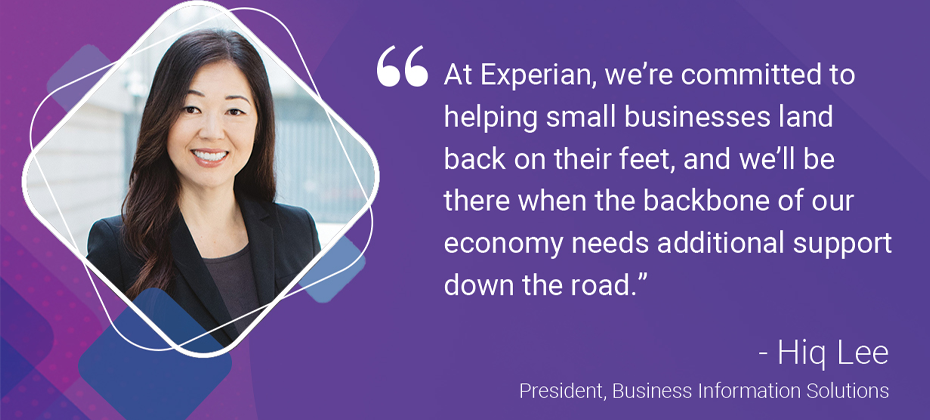
Small businesses are the backbone of our nation’s economy, generating 44% of the nation’s overall revenue. When they take a hit, we all feel it. But as good neighbors – and frequent patrons – we can find a path toward keeping these small businesses on their feet and reopening their doors as soon as possible. At Experian, our obligation is to fight for small businesses that have been impacted by COVID-19. Main Street America reported in April that “COVID-19 has had a devastating impact on small businesses’ revenue…Approximately 35.7 million Americans employed by small businesses are at risk of unemployment as result of the COVID-19 crisis.” That is why we moved quickly to support the signing of the Coronavirus Aid, Relief, and Economic Security Act (CARES Act), providing relief to Americans through expanded unemployment coverage and by distributing grants and loans to small businesses. Acknowledging the unprecedented financial difficulties many are facing, lenders have established relief options for customers unable to make scheduled payments. In an effort to safeguard consumers against potential delinquency and protect credit, the CARES Act calls for creditors to adjust reporting systems for those taking advantage of these relief options. Simply put, your small business’s credit score shouldn’t be your biggest concern these days, and the CARES Act works to ensure that. We know there’s more work to be done to help small businesses navigate these challenging times. We’ve outlined the following steps to keep your business’s credit on track during the pandemic, taking advantage of resources and services we recently launched: Call Your Lender: If a customer or small business is unable to pay a bill, the most critical action they can take is to call their lender and inquire about available assistance programs. If consumers are able to get an accommodation, they can stop a missed payment from negatively impacting their credit. Business Resources Website: Experian has launched a website to help businesses prepare to manage increased attacks, push toward digital banking and understand regulatory changes as businesses find their footing in this evolving financial services landscape. Credit Report Access for All: Experian is offering all consumers access to a free credit report, FICO score and credit monitoring through our CreditWorks product, which also provides access to Experian Boost, a financial tool that has helped more than 2 million consumers increase their credit score to date. This is in addition to the free weekly credit score we are offering in coordination with our peers through annualcrediteport.com. COVID-19 U.S. Business Risk Index: Experian has launched a new service to help lenders and government organizations understand how to make lending options available to the business segments that need it most. This, in turn, directly helps small businesses gain access to capital they need. The public tool includes a risk simulator broken down by state to keep business owners updated on how COVID-19 is affecting specific industries in a particular region. As a nation, we have learned many lessons from the 2008 financial crisis. One vital lesson that sticks with us at Experian is that we’re better at tackling challenges as a collective financial industry, with transparency and a lending hand. At Experian, we’re committed to helping small businesses land back on their feet, and we’ll be there when the backbone of our economy needs additional support down the road.
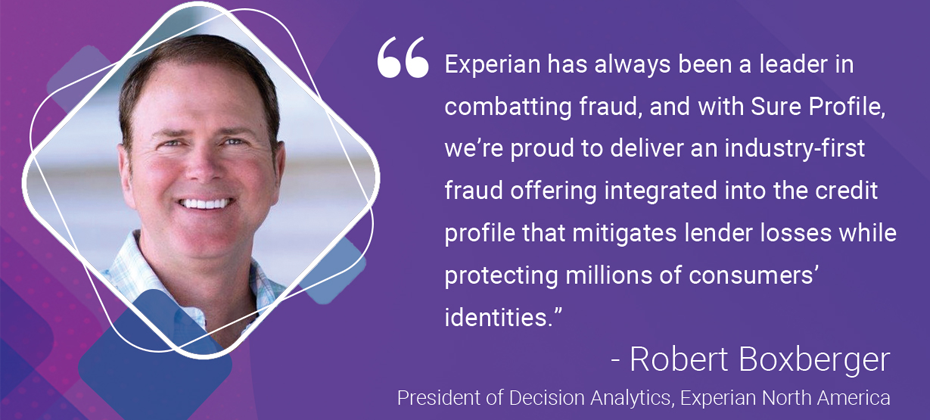
To combat a growing threat that’s expected to drive $48 billion in annual online payment fraud losses by 20231, Experian® has announced the launch of Sure Profile™. Experian is the first company with an offering to combat synthetic identity fraud that is integrated into the credit profile with market-leading assurance. We are proud to be the first in our industry to actually put “skin-in-the-game” by sharing in fraud losses with our clients if the losses occur on assured profiles. Experian’s new offering validates consumer identities, detects profiles that have an increased risk for synthetic identity fraud and helps cover losses resulting from synthetic identity fraud for assured profiles. Leveraging the capabilities of the Experian Ascend Identity Platform™, Sure Profile utilizes Experian’s industry-leading data assets and data quality to drive advanced analytics that set a higher level of protection for lenders. Powered by newly developed machine learning and AI models, Sure Profile offers lenders a streamlined approach to define and detect synthetic identities early in the originations process. Experian’s Sure Profile differentiates between real people and potentially risky applicants, so lenders can confidently increase application approvals with less risk. We expect to authenticate most credit applications through Sure Profile. In the cases where the identity can’t be assured, the company will deliver additional fraud risk indicators, so that lenders can take the right next steps to verify the potential borrower’s identity and prevent fraud. To date, detecting synthetic identities has been a significant challenge for lenders because there’s not an industry standard or a single definition that can be used to establish the legitimacy of an identity. In addition, understanding the financial impact of synthetics has been difficult for lenders as losses tied to synthetic identity fraud are typically categorized as defaults or “bad debt.” With Sure Profile, we are reinforcing our position as a leader by creating a standard set of criteria to define a synthetic identity. Experian has always been a leader in combatting fraud, and with Sure Profile, we’re proud to deliver an industry-first fraud offering integrated into the credit profile that mitigates lender losses while protecting millions of consumers’ identities. Our investments in innovation, AI and machine learning and our data quality are enabling us to lead the way in identity protection and help protect consumers and lenders alike.