- This mission is deeply personal to me. I was born in the United States but spent my formative years in Taiwan, where credit was not part of everyday life. When I returned to the United States for college, I realized that being financially responsible did not automatically translate into having a strong credit profile. I was fortunate that credit did not stand in my way, but that uncertainty stayed with me and shaped my perspective.
- That experience fuels my passion for building tools like EVA. Financial health shapes where we live, what we can plan for, and how secure we feel. Yet managing money and credit can still feel complex or intimidating. EVA helps cut through that complexity by meeting people where they are and adapting in real time to their needs with guidance that feels clear and relevant.
- Improved targeting and personalization: Demographic segmentation powers highly customized campaigns so you can cater to different income levels, family structures, job types, and so forth. B2C brands can provide offers based on factors like age, income, and gender, while B2B brands can target by occupation to reach decision-makers.
- Better product and service development: Understanding which demographics use your product or service is a great way to inform future improvements.
- Higher engagement: With highly customized content, you can speak directly to specific demographic groups and increase engagement.
- Cost efficiency: As you target the most relevant segments, you optimize your spending around the most likely buyers and will see better returns.
- Increased conversion and retention: Relevant, targeted messaging leads to higher conversion rates, and when people feel understood, they’ll want to keep coming back.
- Clearer customer insights: Demographic data provides precise, actionable insights for refining your marketing strategy.
- Simplicity and effectiveness: Demographic insights are immediately actionable and easy to implement, which gives you a great starting point for focused campaigns
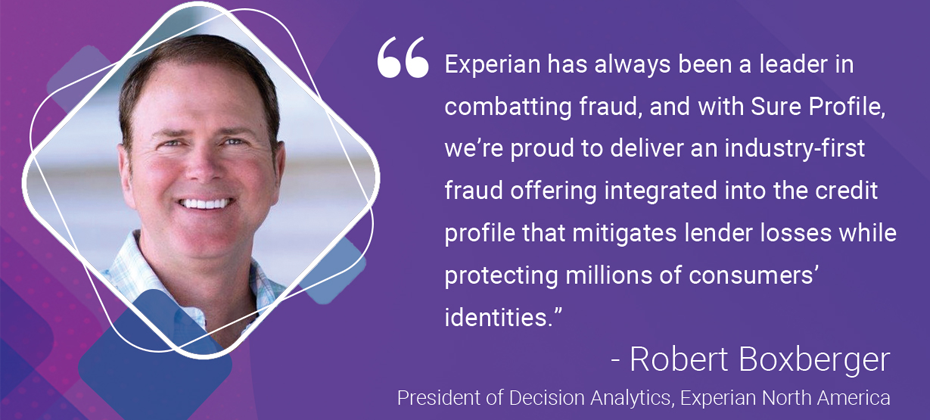
To combat a growing threat that’s expected to drive $48 billion in annual online payment fraud losses by 20231, Experian® has announced the launch of Sure Profile™. Experian is the first company with an offering to combat synthetic identity fraud that is integrated into the credit profile with market-leading assurance. We are proud to be the first in our industry to actually put “skin-in-the-game” by sharing in fraud losses with our clients if the losses occur on assured profiles. Experian’s new offering validates consumer identities, detects profiles that have an increased risk for synthetic identity fraud and helps cover losses resulting from synthetic identity fraud for assured profiles. Leveraging the capabilities of the Experian Ascend Identity Platform™, Sure Profile utilizes Experian’s industry-leading data assets and data quality to drive advanced analytics that set a higher level of protection for lenders. Powered by newly developed machine learning and AI models, Sure Profile offers lenders a streamlined approach to define and detect synthetic identities early in the originations process. Experian’s Sure Profile differentiates between real people and potentially risky applicants, so lenders can confidently increase application approvals with less risk. We expect to authenticate most credit applications through Sure Profile. In the cases where the identity can’t be assured, the company will deliver additional fraud risk indicators, so that lenders can take the right next steps to verify the potential borrower’s identity and prevent fraud. To date, detecting synthetic identities has been a significant challenge for lenders because there’s not an industry standard or a single definition that can be used to establish the legitimacy of an identity. In addition, understanding the financial impact of synthetics has been difficult for lenders as losses tied to synthetic identity fraud are typically categorized as defaults or “bad debt.” With Sure Profile, we are reinforcing our position as a leader by creating a standard set of criteria to define a synthetic identity. Experian has always been a leader in combatting fraud, and with Sure Profile, we’re proud to deliver an industry-first fraud offering integrated into the credit profile that mitigates lender losses while protecting millions of consumers’ identities. Our investments in innovation, AI and machine learning and our data quality are enabling us to lead the way in identity protection and help protect consumers and lenders alike.

We are delighted to have announced our proposed acquisition of a 60% stake in Arvato Financial Solutions Risk Management division. Bringing together Experian’s global data expertise with AFS Risk Management’s market and sector experience will create a uniquely innovative organisation that can offer the best of both companies to the Germany, Austria & Switzerland (DACH) region. For us in Experian EMEA this is an incredibly exciting moment. Germany is Europe’s economic powerhouse and there is a huge opportunity to bring our Decisioning and Analytics expertise and products like Ascend Analytics on Demand to benefit existing and new clients of both organisations. Not only that, we have the privilege to work with a well-respected, established organisation like AFS Risk Management, with its deep focus on customer service, high-quality products, and solutions tailored for key industries like e-commerce, telecoms and insurance; and with the Bertelsman Group, one of Europe’s leading media groups. Following completion, our intention is to make a new, joint entity, made up of the best of Experian and AFS Risk Management, delivering broad coverage and a strong product and innovation roadmap across the DACH region. Clients of both organisations will quickly be able to benefit from the strengths each partner brings – as we deliver the best new technologies into the region, enabling them to make better, faster decisions, and ultimately delivering greater access to finance for people across the region. The acquisition now enters the EU’s standard competition review process.

As the COVID-19 pandemic continues to disrupt lives across the globe, fraudsters continue to take advantage of the vulnerable situation. The opportunistic nature of fraudsters means that times of crisis and pandemics open up additional breeding grounds for fraud and identity theft. Our latest CrossCore® release has never been more relevant for businesses than right now. Confidently recognizing consumers and safeguarding digital transactions is always a difficult balance – but now more critical than ever. With CrossCore, businesses can limit fraud losses and reduce unnecessary customer friction, at a time when safe and convenient access to financial services is essential. This new version of CrossCore, our integrated digital identity and fraud risk platform, combines risk-based authentication, identity proofing, and fraud detection into a single, cloud-based platform. This means that businesses have the capabilities and technology they need to rapidly respond to an ever-changing environment. With flexible decisioning orchestration, advanced analytics, and pre-integrated identity and fraud services, businesses can make real-time risk decisions throughout the customer lifecycle. And they can do all of this through simple self-service. We know there’s no silver bullet when it comes to fighting fraud, which is why we continue to develop our curated partner ecosystem. This gives companies access to all the technology and capabilities they need, in one place – whether it be Experian’s, our partners’, or their own. We combine this with advanced analytics and our own rich data assets plus a built-in strategy design and enhanced workflow giving fraud and compliance teams more control to adjust strategies based on evolving threats. This helps improve efficiency and reduce operational costs. Updates to the new version include the ability for clients to submit dynamic API request payloads, apply progressive risk assessments, apply parallel logic, enable self-service workflow configurations, and provide an online business intelligence (BI) module to view transactional volume reports. These updates will give CrossCore users a simpler way to manage complex orchestration; faster more scalable performance; and key performance indicators in near real-time, all while enabling a personalized and seamless experience for their true customers. More than 250 clients worldwide use CrossCore today, including capabilities from our third-party partners. To start leveraging best-in-class, pre-integrated identity and fraud services through simple self-service learn more about the Experian CrossCore platform.
Related Posts

Having a diverse workforce is vital to help us innovate and deliver on the needs of our increasingly diverse clients and consumers. Over the years, we’ve made some great progress, but there’s so much more we can do and it’s going to take the collective effort of all of us to continue to move the needle. That’s why we’re gearing up to celebrate International Women’s Day (IWD). It’s a day celebrated in many countries around the world to recognize the achievements of women and drive equality among men and women. At Experian, IWD activities are extending throughout the month of March. Have a look at what’s going on around the world as Experian celebrates this important day: Asia Pacific The Asia Pacific region is hosting a range of activities across our offices in March, which will include round-table and speaker events as well as an opportunity to network and pledge their support for IWD. EMEA and UK&I EMEA and UK&I are joining together for IWD to support and celebrate diversity and inclusion. The week started with a video of employees from both regions reflecting on what diverse teams bring to our business. Employees will also be invited to a variety of events to engage and network with inspirational women and hear stories from our leaders on what diversity means to them personally. Latin America Throughout the month of March, Latin America has been running a campaign to share stories of achievements in their region and raise awareness about breast cancer prevention and other diseases more common in women. On IWD, there will be a panel of women leaders who will address issues such as the social inclusion of women in the region, women’s participation in the labor market, Experian’s commitment to female leadership and the importance of a work/life In Brazil, IWD is kicking off with a presentation by members of the United Nations to present their 50-50 Gender Equality program (which aims to eliminate gender inequalities by 2030) and how they are working with companies around the world to achieve this vision. Employees will have an opportunity to hear from leaders in our business about diversity and inclusion plans for the region, and listen to a panel of external speakers discuss diversity challenges and career development. North America Our employees in North America will be kicking off the week with celebrations across their ITS’ 13 offices in the region. Each office will have daily activities throughout the week, and all employees – including virtual and those based in smaller offices – will be invited to attend webinars focused on Diversity and Inclusion topics. On IWD, there will be panel discussions with senior leaders who will speak on various career development topics. To close out the week, there will be a special Book Club discussion on March 9. We will continue to update this blog post all week with pictures and other ways we’re celebrating IWD. Bookmark this page and come back.

I work at SEGA, a global games company. I first met Nakamura-san, my contact at Experian, about eight or nine years ago. I remember telling him at the time that I was a little sceptical of credit report and analytic companies – I thought they were either too expensive or their reports weren’t detailed enough. However, a year later I needed help from a company like Experian, and I thought I’d put them to the test. My team and I were starting to communicate with overseas markets, to work with companies around the world. So, I phoned Nakamura-san. It was a business negotiation, so I had my poker face on – I played the usual mind games you have to, insinuating that if Experian did this job well then our company might be able to offer them even more business in the future. Safe to say, they passed the test. We’ve been building a really positive relationship with Experian for the last eight years. We’re working with companies in Hong Kong, Taiwan and London at the moment. To work with them, we need information – for instance, we need to know if they’re actually located where they say they are. Even if a company gives us an address, it’s always possible that it operates from a different country – we’ve all heard about companies and their tax havens. When we have these questions, Nakamura-san and his team at Experian collect and analyse data on these companies, and give us very thorough information – breaking it all down and explaining everything to us really clearly. It’s really difficult to get the rich, detailed analysis of data you need, but Experian provides us much better data than any of our previous credit research companies managed to. They consult with us, and help us use this data to get our business to a better place. I’m very grateful for it – they’ve added great value to our business. Mr. Shinji Mutazono, Team Manager, SEGA Group Companies Finance Department, SEGA Holdings CO., Ltd.

In Malaysia, nearly 280,000 people live without electricity. By volunteering with the Liter of Light program, we’re bringing solar panel lights to remote villages, transforming the quality of life and brightening the darker hours for families. In Malaysia, more than 1 percent of the population lives without electricity – one of life’s basic necessities – which equates to nearly 280,000 people living in darkness after the sun goes down. Some people have never had electricity in their life, making simple tasks like cooking or reading nearly impossible after dark. I wanted to change that. My day job is to support and enable individuals within Experian to pursue various career opportunities, but what I’m most passionate about is the way Experian helps me invest in my local community through the Heart of Experian Corporate Social Responsibility program. This year, my team and I had the chance to collaborate with Liter of Light (LOL) – a global, grassroots movement committed to providing affordable, sustainable solar light to people with limited or no access to electricity. In February, we joined one of their projects to install 60 solar street lights in the village of Orang Asli, an indigenous community in the Cameron Highlands. Over the span of two days in February, a group of 30 Experian volunteers built and installed the solar panel lights. On the first day, the LOL team taught us how to build the panels, teaching us the skills needed to cut wire, assemble PVC pipes and drill holes. The second day, we rode in Jeeps through muddy roads and a three-foot deep river to reach the village. We spent hours unloading the lights and assembling the panel boxes, plotting the village maps and identifying the right spots to install the solar panel lights. I was happy to see some of the local villagers’ curiosity and participation throughout the day. Some helped us assemble the lights while others prepared the right spots for installation by building bamboo stands. The weather was kind to us, so by 5 p.m., nearly all the lights were installed – just before dark! After completing all the hard work, our team recorded a group video using a drone that all of the Orang Asli children chased after. Thanks to our service project providing light to a village in darkness, 150 villagers in Orang Asli will now have more productive, higher-quality lives during the dark hours of the day. I’m so glad I got to play a role in that.