sdfsad sddfs sdfsdf sdsf sd sfsdfsdf s
asdf sa dsdfdsf ds dsf sdfsdf sdfsd sdf
In this article…

Do you already have a plan for your holiday shopping game this year? A recent study commissioned by Experian Consumer Services shows that spending confidence continues to recover, with 11 percent of those surveyed saying they anticipate spending more than they did last year on holiday gifts. Respondents plan to spend an average of $757.57 this year, up from $721.96 in 2013.
Experian Marketing Services’ senior vice president of global marketing, Ashley Johnston, was named the winner of a Gold Stevie® Award for Woman of the Year in Advertising, Marketing and Public Relations at the 11th annual Stevie Awards for Women in Business on Friday, Nov. 14, in New York City. Johnston was also recognized with a Silver Stevie Award for Female Executive of the Year for Business Services Companies with more than 2,500 employees. The Stevie Awards for Women in Business are the world’s top honors for female entrepreneurs, executives, employees and the organizations they run. All individuals and organizations worldwide are eligible to submit nominations – public and private, for-profit and non-profit, large and small. The 2014 awards received entries from 22 nations and territories. More than 1,200 nominations from organizations of all sizes and in virtually every industry were submitted this year for consideration in more than 90 categories, including Entrepreneur of the Year, Executive of the Year, Company of the Year, Mentor of the Year, Women Helping Women, and Communications Campaign of the Year, among others. “This is a well-deserved honor for Ashley and a testament to her ability to inspire and empower our organization to have a positive impact each and every day,” said Matt Seeley, president, North America, Experian Marketing Services. “Throughout the 12 years she’s been with Experian, Ashley’s initiatives have accelerated Experian Marketing Services’ go-to-market strategy globally and evangelized our employees around our brand while also placing our clients directly in the center of our business and growth.” Over the past year, Johnston successfully led a global initiative to bring Experian Marketing Services’ portfolio, go-to-market strategy, culture and client base under a single, consistent global brand, for the first time. As a key part of this initiative Johnston introduced progressive and differentiated programs focused on driving lead generation, client engagement, awareness and sales-enablement support. Most notably, Johnston led the recent launch of the Experian Marketing Suite, a comprehensive, end-to-end marketing solution that enables brands to create and deliver authentic customer experiences every time, in any channel and via any device. The Marketing Suite showcases the power of Experian Marketing Services’ portfolio, which previously had been siloed into four business units, dozens of products, distinct client sets and cultures. Expressing her gratitude, Johnston added, “It’s an honor to be recognized alongside such an impressive roster of accomplished and exceptional women from countries around the world. This award is evidence of the success story of the Experian Marketing Services business and the talent of my team that continues to inspire me each and every day.” Experian Marketing Services was recognized with four Stevie Awards during the 2014 American Business Awards, all for work that Johnston and her team spearheaded, including the Client Summit, The 2014 Digital Marketer: Benchmark and Trend Report, a global internal communications campaign and the cross-channel marketing platform. Nicknamed the Stevies for the Greek word for “crowned,” the awards were presented to winners Friday night during a dinner event attended by more than 400 people at the Marriott Marquis Hotel in New York City. The presentations were broadcast live across the U.S.A., and simulcast around the world, by Biz Talk Radio, and will be featured in a television special on Biz TV in January. Stevie Award winners were selected by more than 160 executives worldwide who participated in the judging process this year.
It’s no secret that businesses are what drive the U.S. economy. The exchange of goods and services for business large and small is what our society is built on. But, did you know that big data is actually a driving force in commerce? How, you ask? Businesses rely on data — just as we as consumers do — to form the basis for everyday decisions. Experian has always been at the forefront of using big data, and over the years we have streamlined its uses to help drive commerce for the business community. Our commercial database contains unbiased information on more than 25 million active businesses in the U.S. However, data just scratches the surface of what we do. Our technology, analytical and consultative services help financial institutions and businesses (large and small) derive insights, which enable them to make more sound lending decisions, better manage their credit portfolios and acquire the right customers.
Bankcard lending is trending upward, according to the 2014 Experian “State of Credit” report. One in 17 consumers obtained at least one bankcard this year, compared with one in 21 people back in 2013. Consumers now carry an average of 2.18 bankcards apiece (an increase of 4.2 percent), and an average of 1.54 retail cards (a jump of 6.7 percent). In other words, credit availability is on the rise. Can we do it smarter this time?
Experian unveiled its fifth annual State of Credit report today, which provides a snapshot of consumers’ credit scores broken out nationally and by local market. This year’s findings show that the nation’s average VantageScore has improved by two points since last year, coming in at 666. In the city listings, Mankato, MN takes the top spot with a VantageScore of 706 and Greenwood, MS residents have the lowest score of 609 in the study. While the report gives residents of certain cities reason to celebrate their higher scores, the study isn’t meant make the lower cities sing the blues. These types of data-driven insights are meant to help consumers — to give them a reason to be interested in credit, to want to understand and improve their financial well-being, and to become a more savvy credit user and manager.
With Small Business Saturday quickly approaching, Experian wants to remind small business owners why it is important to have good business credit. Good credit scores – they’re not just for consumers. Businesses need them, too. According to a recent Experian survey, only 33 percent of small business owners said they were able to get the capital they need to maintain satisfactory cash flow. Good business credit can help business owners receive the funding they need, as well as help them earn more favorable terms and lower interest rates.

Read Moreio55 Button 2- Learn more Primary button Secondary button Related Posts
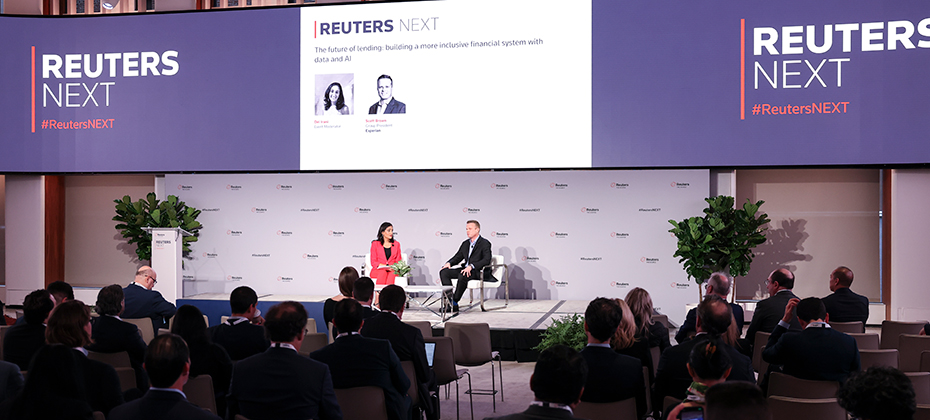
Today, we stand at the forefront of a digital revolution that is reshaping the financial services industry. And, against this backdrop, financial institutions are at vastly different levels of maturity; the world’s biggest banks are managing large-scale infrastructure migrations and making significant investments in AI while regional banks and credit unions are putting plans in place for modernization strategies, and fintechs are purpose-built and cloud native. To explore this more, I recently had the privilege of attending the annual Reuters NEXT live event in New York City. The event gathers globally recognized leaders across business, finance, technology, and government to tackle some of today’s most pressing issues. On the World Stage, I joined Del Irani, a talented anchor and broadcast journalist, to discuss the future of lending and the pivotal role of data and AI in building a more inclusive financial system. Improving financial access Our discussion highlighted the lack of access to traditional financial systems, and the impact it has on nearly 100 million people in North America alone. Globally, the problem affects over one billion people. These people, who are credit invisible, unscoreable, or have subprime credit scores, are unable to secure everyday financial products that many of us take for granted. What many don’t realize is, this is not a fringe subset of the population. Most of us, myself included, know someone who has faced the challenges of financial exclusion. Everyday Americans, including young people who are just starting out, new immigrants and people from diverse communities, often lack access to mainstream financial products. We discussed how traditional lending has a limited view of a consumer. Like looking through a keyhole, the lender’s understanding of the person in view is often incomplete and obstructed. However, with expanded data, technology, and advanced analytics, there is an opportunity to better understand the whole person, and as a result have a more inclusive financial system. At Experian, we have a unique ability to connect the power of traditional credit with alternative data, bringing a more holistic understanding of consumers and their behaviors. We are dedicated to leveraging our rich history in data and our expertise in technology to create the future of credit and ultimately bring financial power to everyone. The future of lending After spending two days with over 700 industry leaders from around the world, one thing is abundantly clear: much like the early days of the internet, today, we are at the cutting-edge of a technical revolution. Reflecting on my time at Reuters NEXT, I am particularly excited by the collective commitment to drive innovative, and smarter ways of working. We are only beginning to scratch the surface of how data and technology can transform financial services, and Experian is positioned to play a significant role. As we look to the future, I am excited about the ways we will create new opportunities for businesses and consumers alike.
The advertising ecosystem has seen significant transformation over the past few years, with increased privacy regulation, changes in available signals, and the rise of channels like connected TV and retail media. These changes are impacting the way that consumers interact with brands and how brands understand and continue to deliver relevant messages to consumers with precision. Experian has been helping marketers navigate these changes, and as a result, our marketing data and identity solutions underpin much of today’s advertising industry. We’re committed to empowering marketers and agencies to understand and reach their target audiences, across all channels. Today, we are excited to announce our acquisition of Audigent—a leading data and activation platform in the advertising industry. With Audigent’s combination of first-party publisher data, inventory and deep supply-side distribution relationships, publishers, big and small, can empower marketers to better understand their customers, expand the reach of their target audiences and activate those audiences across the most impactful inventory. I am excited to bring together Audigent’s supply-side network as a natural extension to our existing demand-side capabilities. Audigent’s ability to combine inventory with targeted audiences using first-party, third-party and contextual signals provides the best of all worlds, allowing marketers to deliver campaigns centered on consumer choices, preferences, and behaviors. The addition of Audigent further strengthens our strategy to be the premier independent provider of marketing data and identity, ultimately creating more relevant experiences for consumers. To learn more about Experian and Audigent, visit https://www.experian.com/marketing/ and https://audigent.com/.

test