
Promoting a better understanding about how the credit economy works and improving financial awareness, so that people can take control of their financial situation with positive, proactive decisions, is absolutely fundamental to our business strategy. This is encapsulated through our financial education programmes. In partnership with Young Enterprise, we have created 28 Centres of Excellence for schools to support children’s financial education. And through Experian’s Values, Money & Me, we have created the UK’s first free online teaching resource to help children develop their financial knowledge and abilities. Credit Awareness Week is, then, a natural place for us to continue that focus. And to take that conversation more widely, to our industry partners, for us all to consider how we might find better ways of working, and drive better outcomes for our customers. There’s no doubt that we are living through a period of significant financial uncertainty. At times like this it is important that consumers are aware of all the options available to them from a financial perspective. And we believe your credit score is one of the first things you should look at. It’s perhaps surprising then that our annual Credit Awareness Week consumer survey found that public awareness of credit and how it can be used to help with day to day challenges still remains relatively low, despite some signs of improvement – potentially driven by the widespread availability of free score services. The percentage of people who said they know their current credit score went up from 22% to 26%, while 47% have ever checked their credit report, up from 45% last year. However, there is still much misunderstanding coming through. 39% of those surveyed wrongly believe their own credit score can be affected by a previous resident of their address having a poor credit score, while 14% think, incorrectly, that checking their own credit report and score has an impact on their credit rating. More than a quarter (26%) are also wrong to believe having a high income can affect their score, while 14% are incorrect to think checking their own score has an impact. The number of people who believe that the system needs to provide clearer explanation about how the decision was made when credit is refused has also increased. What the results of our poll tell me is that more needs to be done in promoting a better understanding about all the options available, like the existence of eligibility and comparison services which are designed to help empower people shop around for better deals and, where credit is concerned, avoid damaging their score while they do so. So there is work to do in building a better understanding about how credit works, which is something we are committed to and that’s why we are supporting this campaign. To help, Experian and Credit Strategy have launched an improved ‘credit refusal pathfinder’ [add hyperlink] tool, to help guide people who apply for credit and get turned down. I’d encourage everyone, even those of us who think we know this business inside out, to take a look at the tool. And, in the spirit of building greater trust and transparency with our customers, let’s take this opportunity to have a think about what we in the industry can do to make things clearer for people. Helping them understand how lending decisions are made and empowering them to take control of their financial situation and make better, sustainable choices through affordable access to finance.

As any new employee knows, it takes time to adapt to a new company and set of coworkers. I recently joined Experian’s team of 56 employees in the Netherlands office after hearing about the company’s inspiring work in the community. I was eager to get to know each colleague outside of our daily tasks so I could learn what type of CSR projects could work for our office. Luckily, I arrived just in time to participate in a new volunteer partnership with Stichting Present. Stichting Present is an organization that facilitates volunteering programs to support those facing poverty, poor health and social isolation. This new partnership gave my coworkers and I the opportunity to volunteer in the community. During last year’s holiday season, the Experian team collected personal hygiene items such as shampoo and body wash to donate to homeless individuals or those with mental health issues. This past spring, we spent two full days doing renovations for Stichting Leren Doen, a program that teaches at-risk students how to fix and sell bicycles. The students’ program was, by coincidence, moving into Experian’s old office building, so my coworkers and I helped give the place a makeover – we put in new floors, painted the walls, stairs and desks, installed new computers and completed some electricity work. Working together as a team helped us connect on a deeper level as we served those in need. These experiences have given me the opportunity to get to know and appreciate my colleagues better. For example, during the project, I learned that two of my colleagues had bonded with a young woman with autism who was the only female student of Stichting Leren Doen. Although the young woman was reserved at first, she eventually opened up and mentioned that she walked three hours to and from school every day. My colleagues were surprised by this admission and informed the director of the program. Since Stichting Leren Doen is a bike repair education program, the director presented her with a new bike to help shorten her commute. Her face lit up – she loved it. I cannot imagine a more fitting welcome to Experian. Opportunities like these are exactly why I joined the firm and why I am excited for the opportunities ahead. Giving back to the community is a big passion of mine, and I cannot wait to spend more time volunteering and getting to know my colleagues. Naomi Hardeveld HR Business Partner, Netherlands

Before you read this blog post, I thought providing you with an introduction to who I am might be helpful. My name is Jennifer Schulz and I am a 46-year-old white American woman whose DNA indicates my ancestors originated mostly from Europe with a very small trace from East Asia. I am married to Bob Roback, my partner in life. I am the mother of two incredibly active boys, ages 8 and 5. I am the bonus mom to our daughter (20) and son (soon to be 18). I am a sister, daughter and friend. I am also the very proud leader of Experian’s Health, Auto and Targeting businesses in North America. As #metoo swept social and mainstream media and drove hundreds of thoughtful articles on a whole host of gender related topics, I found myself reflecting and feeling genuinely grateful to be at Experian. During my interview and onboarding process four years ago, I came to realize that Experian had a great culture full of smart and genuinely caring people. It was – and still is – a culture characterized by a strong client orientation and financial performance, and genuinely wanting to do the right thing. It continues to be an organization with a determined focus on improving its diversity at the top. Our leadership knows that to stay innovative and attract and retain talent we have to make diversity a priority. As the global sponsor of Women in Experian and a member of the North American leadership team, I have had the honor of witnessing the progress the company has made as an organization over the last couple of years. We’ve invested time and resources to build out programs, change policies and make our organization even more inclusive. We’ve made progress around the globe: In the last year, we’ve added two incredibly strong women to our Board of Directors – Caroline Donahue and Ruba Borno. They join Deirdre Mahlan who has been on the Board since 2012. With these additions, women will comprise 27% of our Board. We continue to develop a strong proportion of women through our leadership programs globally. This is feeding our future talent pipeline. We launched Women in Experian in 2016 and now have active programs in every region supporting a range of initiatives including enhancing our parental leave and flexible work policies, creating mentorship and sponsorship programs, examining and addressing pay disparity and requiring our recruiters to present diverse candidate pools. Experian was one of 28 companies globally recognized on the Anita Borg Leadership Index of organizations that show strong representation and development of women technologists. We have continued to develop and adjust family friendly policies in a number of countries, aimed at giving given greater flexibility and choice for working parents and families. Although we celebrate progress, we know that we have more work to do. We need to increase the diversity in our senior leadership ranks. We need to increase the number of women in technology. And, most importantly, we need to continue to keep diversity and inclusion a priority. The other night while I was driving my son to his soccer practice, I received a work call. He sat quietly while I talked for a few minutes, well accustomed to my attempts to balance work and life. When I hung up the call, my son asked me, “What is International Women’s Day?” I answered by telling him (reminder he’s 8) that historically women haven’t always been treated fairly and that this day is about honoring and recognizing all the men and women who are working to make things fairer. He then asked if it was my full-time job. Suppressing a laugh, I said no, it’s not my full-time job but it’s an important part of it. He asked, “Why?” Why? I looked in the rear-view mirror and said, “Because I want to try to make the world better for you, your brothers and your sister.” I believe at Experian we are doing just that … making progress. Our momentum is building and tomorrow will be better. #PressforProgress

Having a diverse workforce is vital to help us innovate and deliver on the needs of our increasingly diverse clients and consumers. Over the years, we've made some great progress, but there's so much more we can do and it's going to take the collective effort of all of us to continue to move the needle. That's why we're gearing up to celebrate International Women's Day (IWD). It's a day celebrated in many countries around the world to recognize the achievements of women and drive equality among men and women. At Experian, IWD activities are extending throughout the month of March. Have a look at what's going on around the world as Experian celebrates this important day: Asia Pacific The Asia Pacific region is hosting a range of activities across our offices in March, which will include round-table and speaker events as well as an opportunity to network and pledge their support for IWD. EMEA and UK&I EMEA and UK&I are joining together for IWD to support and celebrate diversity and inclusion. The week started with a video of employees from both regions reflecting on what diverse teams bring to our business. Employees will also be invited to a variety of events to engage and network with inspirational women and hear stories from our leaders on what diversity means to them personally. Latin America Throughout the month of March, Latin America has been running a campaign to share stories of achievements in their region and raise awareness about breast cancer prevention and other diseases more common in women. On IWD, there will be a panel of women leaders who will address issues such as the social inclusion of women in the region, women's participation in the labor market, Experian's commitment to female leadership and the importance of a work/life In Brazil, IWD is kicking off with a presentation by members of the United Nations to present their 50-50 Gender Equality program (which aims to eliminate gender inequalities by 2030) and how they are working with companies around the world to achieve this vision. Employees will have an opportunity to hear from leaders in our business about diversity and inclusion plans for the region, and listen to a panel of external speakers discuss diversity challenges and career development. North America Our employees in North America will be kicking off the week with celebrations across their ITS’ 13 offices in the region. Each office will have daily activities throughout the week, and all employees – including virtual and those based in smaller offices – will be invited to attend webinars focused on Diversity and Inclusion topics. On IWD, there will be panel discussions with senior leaders who will speak on various career development topics. To close out the week, there will be a special Book Club discussion on March 9. We will continue to update this blog post all week with pictures and other ways we’re celebrating IWD. Bookmark this page and come back.

In the United Kingdom, the Financial Inclusion Commission has previously expressed concern that 31 percent of the adult population has experienced one or more signs of financial distress, such as regularly accruing overdraft charges and using credit to pay for essentials each month. While the Bank of England has warned U.K. households about the risk and effects of their alarming, yet growing, dependence on loans and credit cards, knowing how to manage debt successfully is a vital skill many lack. While most individuals do comfortably manage their debt repayments, many unexpectedly face tough times, especially following disruptive life events that complicate financial management. Since joining Experian from university in 1992, I have been involved in a number of developments and initiatives to help people better manage their money, particularly during difficult times. Years ago, I oversaw the launch of our first telephone helpdesk for the UK public, and today I still answer questions online and occasionally on the radio from individuals worried about their credit scores and loan payments. After years of one-on-one interactions, my team and I have discovered that the key to growing our capacity to serve the community is through partnerships. To provide more effective support for U.K. consumers, Experian began to partner with debt advice charities that give free and professional guidance to people, including about credit score issues. Experian’s role is to make sure debt advisors understand the nuances of credit reporting and credit scoring when talking to and helping their clients. We provide this support in a number of ways. In the last year alone, we have trained more than 600 debt advisors through workshops and seminars, and provided free credit reports to more than 60,000 individuals through debt counselling outlets. Additionally, we have used our insight and data consultancy services to help a number of charities better understand, engage with and support their clients, for example, by identifying their clients’ preferred communications channels. This has included the Money Advice Trust, which runs National Debtline, and StepChange Debt Charity, a leading UK debt counselling provider. Our partnerships within the debt advice sector have not only enabled us to support, educate and empower more consumers to reach their financial goals, but also helped Experian better understand consumers’ greatest fears and misconceptions when it comes to finances. I have enjoyed representing Experian for the past 25 years including working with a number of great organizations and really passionate individuals – so much so that I jumped at the opportunity to join the board of a new debt advice charity, The Debt Counsellors Charitable Trust, a couple of years ago which was very much focused on helping the most vulnerable people. The relationships I’ve developed with these intelligent, ambitious debt advice advisors and charities has really inspired and humbled me. They work tirelessly every day to ensure households in the U.K. can reach their financial milestones – including, importantly, when things go wrong – and I am grateful to be a part of this important network. James Jones: Head of Consumer Affairs, U.K.

I feel that part of Experian’s responsibility as a global information services company is to build and bolster community involvement initiatives that help others. I’m currently a manager of our Fraud Resolution Team and Credit Educator Department in Allen, Texas, but I also have the honor of managing all outreach programs for our branch, bringing together Experian employees to give back to the community. Taking on a volunteer project on top of regular work can be daunting. As the point person for my office’s volunteerism, I’m in charge of communications about upcoming events and drumming up interest and excitement among employees, be it through flyers, silly videos, emails or even free t-shirts. I know a lot of my fellow employees, but I don’t know everyone, so spreading the word isn’t always easy. Despite these challenges, I continue doing this important work because I care about the impact Experian makes in its local communities. My first volunteer experience with Experian was working alongside Stop Hunger Now – an international hunger relief nonprofit – several years ago. I was amazed at the impact we had. Shortly thereafter, I also participated in a canned food drive, rallying Experian employees to visit the Texas Food Bank. After these two chaotic, inspirational, behind-the-scenes experiences, my interest was permanently piqued in on-site volunteer days within the Allen community. Since then, I’ve organized volunteer days with many other nonprofit programs. The amount of organization and work that goes into each volunteer day is much more than you might think. For every Stop Hunger Now event, we package 10,000 meals for those in need, which requires about 100 volunteers dedicating their time. When we worked with Habitat for Humanity, a nonprofit organization devoted to building homes for those who need them, our first two scheduled events were rained out – and it never rains in Texas! I was worried that no one would show up the third time, when we had to reschedule for 7 a.m. on a Saturday. Luckily, every single volunteer spot was filled. We got to meet the family we were building a house for, and we all signed a piece of wood from the house for them. Their gratitude made all the frustration and extra work worth it. It takes a village to get some of these events off the ground, but I have a strong support structure at Experian. And learning to empathize with people through volunteering helps me in my day-to-day work. People who are dealing with fraud can be very emotional, and fraud is unexpected by nature. My volunteering experience has equipped me with the skills needed to empathize with others better and think on my feet.

Read Moreio55 Button 2- Learn more Primary button Secondary button Related Posts
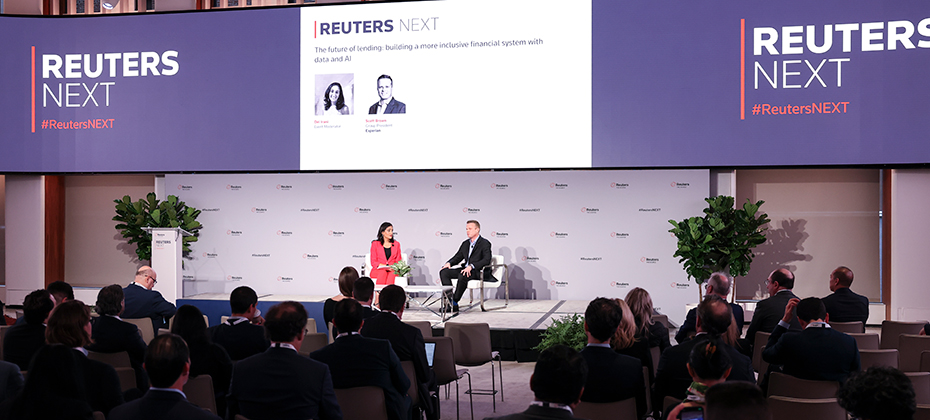
Today, we stand at the forefront of a digital revolution that is reshaping the financial services industry. And, against this backdrop, financial institutions are at vastly different levels of maturity; the world’s biggest banks are managing large-scale infrastructure migrations and making significant investments in AI while regional banks and credit unions are putting plans in place for modernization strategies, and fintechs are purpose-built and cloud native. To explore this more, I recently had the privilege of attending the annual Reuters NEXT live event in New York City. The event gathers globally recognized leaders across business, finance, technology, and government to tackle some of today’s most pressing issues. On the World Stage, I joined Del Irani, a talented anchor and broadcast journalist, to discuss the future of lending and the pivotal role of data and AI in building a more inclusive financial system. Improving financial access Our discussion highlighted the lack of access to traditional financial systems, and the impact it has on nearly 100 million people in North America alone. Globally, the problem affects over one billion people. These people, who are credit invisible, unscoreable, or have subprime credit scores, are unable to secure everyday financial products that many of us take for granted. What many don’t realize is, this is not a fringe subset of the population. Most of us, myself included, know someone who has faced the challenges of financial exclusion. Everyday Americans, including young people who are just starting out, new immigrants and people from diverse communities, often lack access to mainstream financial products. We discussed how traditional lending has a limited view of a consumer. Like looking through a keyhole, the lender’s understanding of the person in view is often incomplete and obstructed. However, with expanded data, technology, and advanced analytics, there is an opportunity to better understand the whole person, and as a result have a more inclusive financial system. At Experian, we have a unique ability to connect the power of traditional credit with alternative data, bringing a more holistic understanding of consumers and their behaviors. We are dedicated to leveraging our rich history in data and our expertise in technology to create the future of credit and ultimately bring financial power to everyone. The future of lending After spending two days with over 700 industry leaders from around the world, one thing is abundantly clear: much like the early days of the internet, today, we are at the cutting-edge of a technical revolution. Reflecting on my time at Reuters NEXT, I am particularly excited by the collective commitment to drive innovative, and smarter ways of working. We are only beginning to scratch the surface of how data and technology can transform financial services, and Experian is positioned to play a significant role. As we look to the future, I am excited about the ways we will create new opportunities for businesses and consumers alike.
The advertising ecosystem has seen significant transformation over the past few years, with increased privacy regulation, changes in available signals, and the rise of channels like connected TV and retail media. These changes are impacting the way that consumers interact with brands and how brands understand and continue to deliver relevant messages to consumers with precision. Experian has been helping marketers navigate these changes, and as a result, our marketing data and identity solutions underpin much of today’s advertising industry. We’re committed to empowering marketers and agencies to understand and reach their target audiences, across all channels. Today, we are excited to announce our acquisition of Audigent—a leading data and activation platform in the advertising industry. With Audigent’s combination of first-party publisher data, inventory and deep supply-side distribution relationships, publishers, big and small, can empower marketers to better understand their customers, expand the reach of their target audiences and activate those audiences across the most impactful inventory. I am excited to bring together Audigent’s supply-side network as a natural extension to our existing demand-side capabilities. Audigent’s ability to combine inventory with targeted audiences using first-party, third-party and contextual signals provides the best of all worlds, allowing marketers to deliver campaigns centered on consumer choices, preferences, and behaviors. The addition of Audigent further strengthens our strategy to be the premier independent provider of marketing data and identity, ultimately creating more relevant experiences for consumers. To learn more about Experian and Audigent, visit https://www.experian.com/marketing/ and https://audigent.com/.