


Tech & Innovation

At Experian, we are continually innovating and using technology to find solutions to global issues, modernize the financial services industry and increase financial access for all.
DEI

Our deep commitment to social and financial inclusion is reflected in our workplace culture, our partnerships and our efforts to break down the barriers to financial equity.
Financial Health

Our initiatives are dedicated to getting tools, resources and information to underserved communities so that consumers can best understand and improve their financial health.
Latest Posts:

New research from Experian finds that nearly a third of all Americans use at least one type of smart or connected device; 14 percent of homes are smart homes. Experian Marketing Services published a new report today that tracks the recent rise and growing interest among consumers for connected devices and smart home products. A complimentary copy of the report, The Internet of Things: Opportunities through the rise in smart devices, can be downloaded here: http://ex.pn/1r0TJVp. The report found that consumer interest in three connected device categories has shown significant growth in recent years, with no signs of stopping. In fact, according to the report, nearly a third of all Americans use at least one type of connected device. Further, at least 14 percent of U.S. households are smart homes and have a connected home device such as connected lights, locks, thermostats, or electrical outlets, among others.
 Black Friday has come and gone, and the holiday shopping season is in full swing. This year, retailers and economic experts alike have high hopes for robust spending and a needed economic boost. And so far the results look promising. On Cyber Monday, alone, the top online retail sites registered 242 million visits, followed closely by Black Friday’s 228 million visits. And according to a new survey from Experian Consumer Services, 36 percent of consumers plan to spend more on gifts this year than they did in 2013.
At Experian, everything we do is about putting insights into action. This entails formulating and analyzing insights that can help both consumers and businesses alike. We sat down with two of Experian’s leading experts, one from the consumer side of the business and another from our marketing services business, to find out more about the key trends that will define this holiday shopping season.
Guy Abramo, President, Experian Consumer Services and Matt Seeley, President, North America, Experian Marketing Services share their thoughts and insights below:
Black Friday has come and gone, and the holiday shopping season is in full swing. This year, retailers and economic experts alike have high hopes for robust spending and a needed economic boost. And so far the results look promising. On Cyber Monday, alone, the top online retail sites registered 242 million visits, followed closely by Black Friday’s 228 million visits. And according to a new survey from Experian Consumer Services, 36 percent of consumers plan to spend more on gifts this year than they did in 2013.
At Experian, everything we do is about putting insights into action. This entails formulating and analyzing insights that can help both consumers and businesses alike. We sat down with two of Experian’s leading experts, one from the consumer side of the business and another from our marketing services business, to find out more about the key trends that will define this holiday shopping season.
Guy Abramo, President, Experian Consumer Services and Matt Seeley, President, North America, Experian Marketing Services share their thoughts and insights below:
Balancing holiday marketing efforts with fraud prevention requires a coordinated approach according to survey findings from 41st Parameter, a part of Experian. The survey results from 250 marketers released today, looks at the relationship between omnichannel retailing, fraud prevention and the holiday shopping season. The findings show that few marketers understand the full benefit of fraud-prevention systems on their activities as 60 percent of marketers were unsure of the cost of fraud to their organization. The survey also indicated that 40 percent of marketers said their organization had been targeted by hackers or cybercriminals. Download the Holiday Marketing Fraud Survey: http://snip.ly/JoyF With holiday shopping in full stride, 35 percent of businesses said they planned to increase their digital spend for the 2014 holiday season. Furthermore, Experian Marketing Services reported that during 2014, 80 percent of marketers planned on running cross-channel marketing campaigns. As marketers integrate more channels into their campaigns, new challenges emerge for fraud-risk managers who face continuous pressure to adopt new approaches. Here are three steps to help marketers and risk managers maintain a frictionless experience for customers: Marketers should communicate their plans early to the fraud-risk team, especially if they are planning to target a new or unexpected audience. Making this part of the process will reduce the chances that risk management will stop or inhibit customers. Ensure that marketers understand what the risk-management department is doing with respect to fraud detection. Chances are risk managers are waiting to tell you. Marketers shouldn’t assume that fraud won’t affect their business and talk to their risk-management division to learn how much fraud truly costs their company. Then they can understand what they need to do to make sure that their marketing efforts are not thwarted. “Marketers spend a great deal of time and money bringing in new customers and increasing sales, especially this time of year, and in too many cases, those efforts are negated in the name of fraud prevention,” said David Britton, vice president of industry solutions, 41st Parameter. “Marketers can help an organization’s bottom line by working with their fraud-risk department to prevent bad transactions from occurring while maintaining a seamless customer experience. Reducing fraud is important and protecting the customer experience is a necessity.” Few marketers understand the resulting impact of declined transactions because of suspected fraud and this is even more pronounced among small businesses, with 70 percent saying they were unsure of fraud’s impact. Fifty percent of mid-sized business marketers and 67 percent of large-enterprise marketers were unsure of the impact of fraud as well. An uncoordinated approach to new customer acquisition can result in lost revenue affecting the entire organization. For example, the industry average for card-not-present declines is 15 percent. However, one to three percent of those declined transactions turn out to be valid transactions, equating to $1.2 billion in lost revenue annually. Wrongfully declined transactions can be costly as the growth of cross-channel marketing increases and a push towards omnichannel retailing pressures marketers to find new customers. “Many businesses loosen their fraud detection measures during high peak time because they don’t have the tools to review potentially risky orders manually during the higher-volume holiday shopping period,” said Britton. “Criminals look to capitalize on this and exploit these gaps in any way possible, taking an omnifraud approach to maximizing their chances of success. Striking the right balance between sales enablement and fraud prevention is the key to maximizing growth for any business at all times of the year.” Download Experian’s fraud prevention report to learn more about how businesses can address these new marketing challenges.
 The world of mobile devices is constantly changing—everything is faster, bigger and better, and consumers have become more savvy and discerning about the features and benefits that make their lives more convenient, and in many cases, more manageable.
I use my phone to do everything from simple tasks like checking email or Facebook, to downloading coupons, buying movie and concert tickets, to checking my bank balance and making deposits on the fly (which is such a great feature).
The world of mobile devices is constantly changing—everything is faster, bigger and better, and consumers have become more savvy and discerning about the features and benefits that make their lives more convenient, and in many cases, more manageable.
I use my phone to do everything from simple tasks like checking email or Facebook, to downloading coupons, buying movie and concert tickets, to checking my bank balance and making deposits on the fly (which is such a great feature).
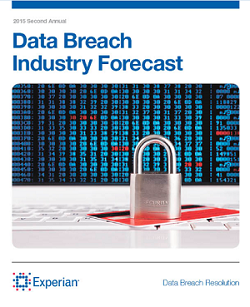 The growing prevalence of widely publicized data breaches is sparking a change in the attitudes of business leaders and consumers when it comes to cybersecurity.
Board members and the C-suite can no longer ignore the drastic impact a data breach has on company reputation, and consumers are demanding more communication and remedies from businesses after a data breach occurs. As a result, the topic is a high priority facing businesses and regulators in 2015.
The Experian Data Breach Resolution group serviced more than 3,000 breaches in 2014, the most in more than a decade of handling breach resolution. While our data breach services and identity protection products assist companies after a breach has occurred, our experience and insights help companies beforehand to plan and better protect their reputations in the aftermath.
The growing prevalence of widely publicized data breaches is sparking a change in the attitudes of business leaders and consumers when it comes to cybersecurity.
Board members and the C-suite can no longer ignore the drastic impact a data breach has on company reputation, and consumers are demanding more communication and remedies from businesses after a data breach occurs. As a result, the topic is a high priority facing businesses and regulators in 2015.
The Experian Data Breach Resolution group serviced more than 3,000 breaches in 2014, the most in more than a decade of handling breach resolution. While our data breach services and identity protection products assist companies after a breach has occurred, our experience and insights help companies beforehand to plan and better protect their reputations in the aftermath.
How does Experian use data to help people get a firmer steer on their financial lives? In this film, our Experian CreditExpert customer Claire Barron tells us how we helped her get back on her feet, and we look at what’s next for our Consumer Services business.
In Marketing Services, we help our clients understand consumers and communicate in the right way, to the right people. This film reveals how we’re helping global charity phenomenon Movember and Europe’s biggest attractions company, Merlin, to make better marketing decisions.
This film looks at how we’re helping client to expand banking services to new customers. It also uncovers how our expertise in software and analytics are helping financial services providers overcome some of their biggest challenges by making sound lending decisions.
 Experian has been named a Top Workplace by the Orange County Register.
This award means something special to us. We work really hard at making Experian a workplace where people feel good about spending their time. As you can imagine, this isn’t something that’s easy to measure. Being named as a “Top Workplace” is based on employee’s opinions of their employers.
The award validates that what we’re doing is working. It validates that Experian employees enjoy coming to work and like how things are going.
When we’re successful with our efforts to create a positive work environment, that’s a big deal. It’s important because it has a positive impact on our employees, consumers, our clients, and our community.
Experian has been named a Top Workplace by the Orange County Register.
This award means something special to us. We work really hard at making Experian a workplace where people feel good about spending their time. As you can imagine, this isn’t something that’s easy to measure. Being named as a “Top Workplace” is based on employee’s opinions of their employers.
The award validates that what we’re doing is working. It validates that Experian employees enjoy coming to work and like how things are going.
When we’re successful with our efforts to create a positive work environment, that’s a big deal. It’s important because it has a positive impact on our employees, consumers, our clients, and our community.