Loading...

JR TOC Review

Published: October 16, 2025 by joseph.rodriguez@experian.com

sdfsad sddfs sdfsdf sdsf sd sfsdfsdf s

asdf sa dsdfdsf ds dsf sdfsdf sdfsd sdf

In this article…

Loading…
Activating the Inactive

  Temperatures are dropping, leaves are falling and seasonal beverages are selling – it must mean that the holiday season is quickly approaching. And while many people get to wait in anticipation for this magical time of year, marketers are hard at work planning and creating their upcoming holiday marketing campaigns. In fact, many marketers are likely focused on developing their most creative designs and strategic promotions – critical components to any campaign. But they also need to give attention to their subscriber lists. A recent study found that as much as 50 percent of lists are inactive. If audiences are not engaging with the brand’s communications, then brands may experience diminished returns, or worse. Why reactivate? The bottom line is that it is more cost effective for marketers to retain existing customers than to acquire new ones. Past buyers represent higher open, click and transaction rates than non-buyers. By reactivating their inactive subscriber base, marketers have an opportunity to improve the return on each marketing campaign. How to reactivate? Email addresses may appear inactive for a number of reasons. The email address may no longer be in use, the subscriber does not find the content relevant, or the subscriber prefers to scan unopened emails and purchase in other channels. Marketers need to understand the cause behind each inactive address in order to strategically re-engage with past customers. Once marketers are able to identify all of their inactive subscribers, they will want to segment them into buckets. For example, those that clicked but have not purchased in the past 90 days, or those that have opened emails, but not clicked or purchased in the past 90 days. Each person is unique in their behaviors and interests, so marketers will need to engage these subscribers in a variety of tactics. Offering an incentive Using an engaging subject line Utilizing a confirmed opt-in strategy Sending more than one message as part of a reactivation strategy Marketers who strategically reactivate their inactive subscriber base have an opportunity to bring past-customers back into their sales funnel, and experience more return on their marketing campaigns. By leveraging data and insight to identify and re-engage this group, brands and marketers can also have a magical holiday season. To learn more about re-engaging your inactive email subscribers, download our e-book.  

Oct 24,2016 by

Ask the Right Questions to Gain Predictive Insight

This feature article from DMN profiles Emad Georgy, Chief Technology Officer for Experian Marketing Services, as well as his team’s approach to data and predictive analytics. According to the article, “The other drive for Georgy’s commitment to data analytics has been interactions with clients … Data can help brands ‘uniquely understand customer behavior. At Experian, with all of our expertise, we can play a role in getting data to a position where it’s actionable.’” Click here to read the full article.

Sep 30,2016 by

Experian Warns Current Accounts May Be a ‘Front Door for Fraudsters’

Experian has warned that current accounts can be a ‘front door for fraudsters’, as the company’s new ID Fraud Tracker reveals current account fraud is now nearly triple what it was two years ago, while credit card fraud has more than doubled within the same period. In both cases, the increase has been driven by fraudsters using stolen personal details of genuine individuals to attempt to open current accounts or apply for credit cards. Nick Mothershaw, fraud expert from Experian, explained:“A lot of people may see the news about current account fraud and think that it’s not as bad as having their card details stolen. But it is…in fact it could be an Achilles’ heel when it comes to their identity. Current account fraud not only presents an immediate threat of emptying someone’s overdraft facilities, but can act as a front door for fraudsters to access a wide range of financial products, including credit cards. “Current accounts and cards are tightly linked, and it’s no surprise that card fraud has grown alongside the rise in current account fraud. We urge people to be vigilant about activity on their account. “We all have a role to play in keeping our identities safe, and we’re encouraging everybody to do their bit. Even something as simple as making sure you regularly check your electronic statements can help to identify fraudulent activity before it escalates into something much worse.” More misery for ‘generation rent’ Private renters who live in shared accommodation in young urban neighbourhoods, aged 26 to 35 (known as ‘Rental Hubs’), continue to be the biggest targets for fraudsters – 18.4 per cent of all victims. However, fraudsters are particularly increasing their focus on those ‘transient renters’, mainly 18 to 25 years old, who tend to share private low-cost housing and are most likely to move more regularly. They saw the biggest rise in fraud over the last 12 months and now account for 7.1% of all fraud victims, compared to 4.9 per cent last year. Mothershaw said:“People who live in rented homes need to know that fraud is a very real and, sadly, growing danger for them in particular. What makes them easy targets for fraudsters is the fact that many share accommodation and also move regularly – within one or two years. Unless they are regularly monitoring all their credit applications, it is likely to be a while before they realise they have become victims. They are also high users of smart phones and social media, so they really are prime targets.” Experian’s new ID Fraud Tracker is a quarterly analysis of fraud rates across a variety of consumer financial products, from cards and current accounts to mortgages and car insurance. Current account fraud between April and June this year reached 128 fraudulent applications in every 10,000 applications – the fifth consecutive quarter it has exceeded 100 in every 10,000 applications. The rate of fraud in card applications reached 48 in every 10,000 applications during the same period. The analysis dates back to Q3 2013, when rates of current account and card fraud were at 48 and 21 in every 10,000 applications respectively. Experian offers some proactive steps people can take against fraud: Online passwords: There’s nothing more attractive for ID thieves than someone who uses the same password across multiple online accounts. It is crucial to have unique, secure passwords for each online account. People should consider the strength of their password; always use a combination of upper and lower case letters, numbers and symbols and – where possible – change them regularly. Security First: Be conscious of the information you share when using shared Wi-Fi networks. Public networks and open Wi-Fi hotspots can be compromised more easily by fraudsters than secure networks. Be cautious of the information you share on your social profiles such as your email address, date of birth and all other personal information that could be easily traced. Passcode protect: A lot of personal information is stored on devices that are not password protected. That’s emails, apps, messages – a vast amount of information that could be a goldmine for fraudsters if the device is lost or stolen. People should always lock their mobile device, whether it is with a passcode or a gesture, to prevent access to such information, should the worse happen. Check the post: Whilst e-banking is becoming increasingly popular, receiving unexpected, irrelevant mail, could be a warning sign of ID fraud – particularly mail that is outside of the usual purchasing sphere. Shred and destroy any documents that contain sensitive, personal details. And if you move house, make sure you re-direct your post and register to vote at your new address. Be credit wise: Being credit smart and checking your credit report to see if credit has been applied for under false pretenses, you can get a better handle on whether personal information has fallen into the wrong hands. Web monitoring tools are also useful as they scour the web for stolen details – sending people an instant notification if their information appears somewhere new online.

Sep 26,2016 by

Forbes names Experian Among Top 100 “World’s Most Innovative Companies”

  Experian has been named to Forbes Magazine’s list of the “World’s Most Innovative Companies,” securing a spot in the Top 100 list for the third year in a row. We are proud to put innovation at the forefront of what we do – driving our activations and analytics to serve our customers and secure a better, more productive future. This recognition helps affirm our goal in innovating ways to embrace data to help transform the way businesses operate and how consumers can thrive in today’s society.  We are proud to foster a culture of such innovation, including some recent milestones. These include the introduction of CrossCore, the fraud and identity industry’s first open platform designed to catch fraud faster, and Experian Marketing Services’ Audience Engine, which is enhancing the customer experience and audience management platform that changes the way the advertising industry buys and measures media. Meanwhile our DataLabs continues to achieve recognition for their tremendous work tackling the thorniest problems and finding new ways to glean insights from data. The amount of data is expected to increase up to ten times the current amount by 2020, and Experian looks to innovation to bring answers to the problems such increases can pose. We’re finding new ways to help business across a multitude of industries integrate the latest in data technology into nearly every aspect of their operations. Data is powering everything we do. We’re leveraging data to allow lenders to make responsible decisions involving their customers, helping more consumers gain access to wealth-building tools like mortgages. At Experian, we believe that data will power the future in untold ways. We know that we’ve only scratched the surface of data’s potential. It’s an honor to achieve this recognition, and I am confident that Experian will continue to chart the course for the industry with solutions that power opportunities for more people and businesses through data.    

Sep 08,2016 by

As Holidays Approach, Marketers Can Use These 5 Strategies to Boost Campaigns

With only a few more weeks until summertime officially comes to a close, marketers need to quickly begin planning for one of their busiest times of the year. The holidays. New research from Experian Marketing Services pinpoints five strategies that brands should consider incorporating into their holiday campaigns to boost performance. According to the Q2 2016 Email Benchmark Report, marketers need to consider the quality of subscriber data obtained during acquisition, social media, creative content, email personalization and a retention strategy. For a complimentary download of the report, click here. To view the full press release, visit https://www.experianplc.com/media/news/2016/q2-2016-email-benchmark-report/

Aug 25,2016 by

Experian: Seeking Out Unresolved Problems and Using Them to Find New Opportunities

This feature article from the Harvard Business Review discusses how Experian is as nimble as a start-up. According to the article, most companies try to avoid problems. “Experian actually goes looking for them. In fact, it has set up a specific unit – Experian DataLabs — to actively seek out unresolved problems its customers are having and use them as a launchpad to seek out new opportunities and create new products.”

Aug 24,2016 by

Latest Post Related Post

Read Moreio55 Button 2- Learn more Primary button Secondary button Related Posts
Mar 27,2025 by qamarketingtechnologists

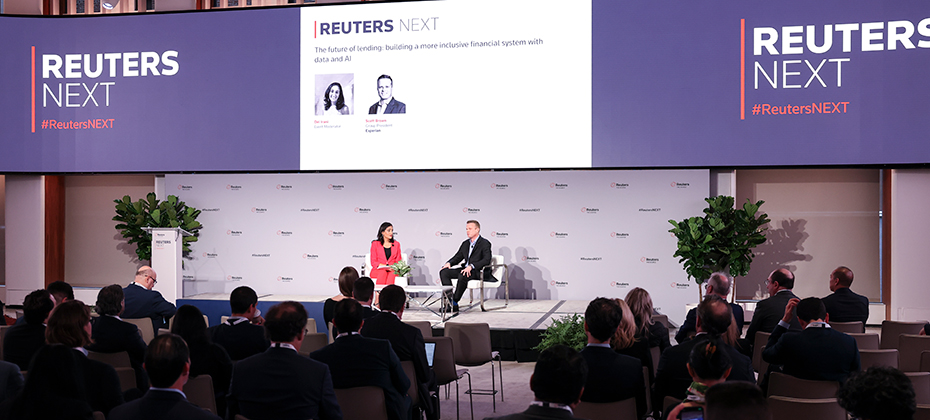
Insights from Reuters Next: Building a More Inclusive Financial System with Data and AI

Today, we stand at the forefront of a digital revolution that is reshaping the financial services industry. And, against this backdrop, financial institutions are at vastly different levels of maturity; the world’s biggest banks are managing large-scale infrastructure migrations and making significant investments in AI while regional banks and credit unions are putting plans in place for modernization strategies, and fintechs are purpose-built and cloud native.  To explore this more, I recently had the privilege of attending the annual Reuters NEXT live event in New York City. The event gathers globally recognized leaders across business, finance, technology, and government to tackle some of today’s most pressing issues.  On the World Stage, I joined Del Irani, a talented anchor and broadcast journalist, to discuss the future of lending and the pivotal role of data and AI in building a more inclusive financial system. Improving financial access Our discussion highlighted the lack of access to traditional financial systems, and the impact it has on nearly 100 million people in North America alone. Globally, the problem affects over one billion people. These people, who are credit invisible, unscoreable, or have subprime credit scores, are unable to secure everyday financial products that many of us take for granted.  What many don’t realize is, this is not a fringe subset of the population. Most of us, myself included, know someone who has faced the challenges of financial exclusion. Everyday Americans, including young people who are just starting out, new immigrants and people from diverse communities, often lack access to mainstream financial products.  We discussed how traditional lending has a limited view of a consumer. Like looking through a keyhole, the lender’s understanding of the person in view is often incomplete and obstructed. However, with expanded data, technology, and advanced analytics, there is an opportunity to better understand the whole person, and as a result have a more inclusive financial system.  At Experian, we have a unique ability to connect the power of traditional credit with alternative data, bringing a more holistic understanding of consumers and their behaviors. We are dedicated to leveraging our rich history in data and our expertise in technology to create the future of credit and ultimately bring financial power to everyone. The future of lending After spending two days with over 700 industry leaders from around the world, one thing is abundantly clear: much like the early days of the internet, today, we are at the cutting-edge of a technical revolution. Reflecting on my time at Reuters NEXT, I am particularly excited by the collective commitment to drive innovative, and smarter ways of working.  We are only beginning to scratch the surface of how data and technology can transform financial services, and Experian is positioned to play a significant role. As we look to the future, I am excited about the ways we will create new opportunities for businesses and consumers alike.    
Dec 13,2024 by Scott Brown

Powering the Advertising Ecosystem with Our Identity and Activation Capabilities

The advertising ecosystem has seen significant transformation over the past few years, with increased privacy regulation, changes in available signals, and the rise of channels like connected TV and retail media. These changes are impacting the way that consumers interact with brands and how brands understand and continue to deliver relevant messages to consumers with precision.   Experian has been helping marketers navigate these changes, and as a result, our marketing data and identity solutions underpin much of today’s advertising industry. We’re committed to empowering marketers and agencies to understand and reach their target audiences, across all channels. Today, we are excited to announce our acquisition of Audigent—a leading data and activation platform in the advertising industry.   With Audigent’s combination of first-party publisher data, inventory and deep supply-side distribution relationships, publishers, big and small, can empower marketers to better understand their customers, expand the reach of their target audiences and activate those audiences across the most impactful inventory.      I am excited to bring together Audigent’s supply-side network as a natural extension to our existing demand-side capabilities. Audigent’s ability to combine inventory with targeted audiences using first-party, third-party and contextual signals provides the best of all worlds, allowing marketers to deliver campaigns centered on consumer choices, preferences, and behaviors.    The addition of Audigent further strengthens our strategy to be the premier independent provider of marketing data and identity, ultimately creating more relevant experiences for consumers.   To learn more about Experian and Audigent, visit https://www.experian.com/marketing/ and https://audigent.com/.  

Dec 04,2024 by Scott Brown

test