
This rapid growth in data collection is creating strong demand for data scientists, and there is a shortage of data scientists with extensive experience in the field.

The second annual #SuiteLife Awards recognized brands that embody the idea of improving the customer experience through data and analytics while driving results for the business.

Serasa today launches a new service that allows Brazilian consumers to check their credit reports online for free. By visiting serasaconsumidor.com.br or by downloading the SerasaConsumidor App on Google Play or iTunes, consumers can check if they are delinquent, what led them to this status and whether it relates to bank, credit card, financial, retail, utilities, protested securities, checks without funds or lawsuits checks. Consumers will also have information about lenders, such as telephones, address, email and website as well as the value of the debt and repayment date for the delayed debt. Additionally, the consumer can renegotiate the debt directly, without intermediaries, if the company is a partner of Serasa’s free service Limpa Nome Online. People can make a free online inquiry as often as they would like. To participate in the free online program, consumers must access serasaconsumidor.com.br and fill out a registration or enter an email address and password if already registered. The service is also available on mobile Apps Android and iOS. To properly verify the user accessing the information in Serasa, after the registration, the consumer must go through an authentication process. One of the steps is to enter the mobile number and confirm the validation code received via SMS. This validation is required only on the first access. For the director of SerasaConsumidor, Fernanda Monnerat, this new service presents the opportunity for consumers to easily and safely check the existence debts in a single digital environment. "It's another tool that we provide to Brazilians so they can have access to services that make possible, above all, their financial citizenship and ability to build a more sustainable relationship with the credit. Therefore, we reaffirm once again the commitment of Serasa with the consumer,” said Monnerat. Among other free services available on the SerasaConsumidor website, consumers can opt-in to the positive data initiative, which gathers information on the consumer’s payment history, measures their payment timeliness of debts and evaluates the risk of debt distress. Through the program, it is also possible to make a document alert and stolen checks alert. Free registration in Serasa helps to reduce risk of fraud and to avoid the challenges of having personal information used by scammers. Also on the website, users will find guidelines and tests on financial education on the newly launched page www.serasaconsumidor.com.br/organizar-financas.

Who doesn’t love a new car? That new car smell, the excitement of seeing less than 8 miles on the odometer, or the invigorating rush you feel when driving your new baby off the lot. There is nothing like it!
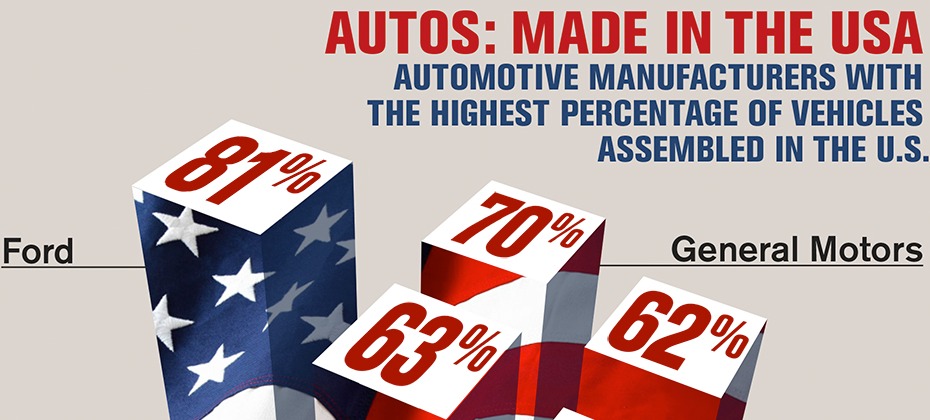
The Fourth of July is a special day to celebrate our independence and to show off American pride with parades, fireworks and barbecues spent with friends and family. In the spirit of this season, Experian Automotive recently conducted some research that looked at the vehicles on U.S. roads to see how many were manufactured in America or that were “Born in the USA.” According to our latest research, there are roughly 260 million light-duty vehicles on the road, with nearly 60 percent of them having been assembled domestically. The rest were built in Canada, Japan, Mexico, Germany, South Korea and others countries. From a manufacturer standpoint, it is not surprising that Ford, General Motors and Fiat Chrysler Automobiles had the highest percentage of U.S.-made vehicles currently on the road at 81.2 percent, 70.1 percent and 63.1 percent, respectively. However, Honda (61.9 percent) and Nissan (54.7 percent) also made the top five. In fact, many of the top import manufacturers hover around the 50 percent mark, including Mitsubishi (49.9 percent), Toyota (48.2 percent) and Subaru (47 percent) assembling vehicles in the USA. When looking at vehicle brands, the findings show that, overall, Jeep is the most American with 96.7 percent of its vehicles assembled in the USA. Rounding out the top five were Oldsmobile, Saturn, Ford and Cadillac, with 93.3 percent, 92.4 percent, 83.1 percent and 80.6 percent, respectively. In addition, nearly 93 percent of Ford F150s, the most popular model on the road, were built domestically. The remainder of the top five vehicle models assembled domestically are Honda Accord (88.3 percent), Toyota Camry (86.9 percent), Nissan Altima (100 percent) and Ford Explorer (100 percent). The analysis also looked at domestically assembled models that were most often financed with a loan rather than with a lease or paid for with cash. At the top of the list, the Ford F-150 was the most popular vehicle that was financed with a loan with 69.9 percent, followed by Nissan Altima, Toyota Camry, Honda Accord and Ford Explorer. For more information about this analysis or Experian Automotive insights, visit https://www.experian.com/automotive.

Experian’s Decision Analytics business was cited in Forrester’s 2016 “Vendor Landscape: Mobile Fraud Management Solutions” report.

Read Moreio55 Button 2- Learn more Primary button Secondary button Related Posts

Today, we stand at the forefront of a digital revolution that is reshaping the financial services industry. And, against this backdrop, financial institutions are at vastly different levels of maturity; the world’s biggest banks are managing large-scale infrastructure migrations and making significant investments in AI while regional banks and credit unions are putting plans in place for modernization strategies, and fintechs are purpose-built and cloud native. To explore this more, I recently had the privilege of attending the annual Reuters NEXT live event in New York City. The event gathers globally recognized leaders across business, finance, technology, and government to tackle some of today’s most pressing issues. On the World Stage, I joined Del Irani, a talented anchor and broadcast journalist, to discuss the future of lending and the pivotal role of data and AI in building a more inclusive financial system. Improving financial access Our discussion highlighted the lack of access to traditional financial systems, and the impact it has on nearly 100 million people in North America alone. Globally, the problem affects over one billion people. These people, who are credit invisible, unscoreable, or have subprime credit scores, are unable to secure everyday financial products that many of us take for granted. What many don’t realize is, this is not a fringe subset of the population. Most of us, myself included, know someone who has faced the challenges of financial exclusion. Everyday Americans, including young people who are just starting out, new immigrants and people from diverse communities, often lack access to mainstream financial products. We discussed how traditional lending has a limited view of a consumer. Like looking through a keyhole, the lender’s understanding of the person in view is often incomplete and obstructed. However, with expanded data, technology, and advanced analytics, there is an opportunity to better understand the whole person, and as a result have a more inclusive financial system. At Experian, we have a unique ability to connect the power of traditional credit with alternative data, bringing a more holistic understanding of consumers and their behaviors. We are dedicated to leveraging our rich history in data and our expertise in technology to create the future of credit and ultimately bring financial power to everyone. The future of lending After spending two days with over 700 industry leaders from around the world, one thing is abundantly clear: much like the early days of the internet, today, we are at the cutting-edge of a technical revolution. Reflecting on my time at Reuters NEXT, I am particularly excited by the collective commitment to drive innovative, and smarter ways of working. We are only beginning to scratch the surface of how data and technology can transform financial services, and Experian is positioned to play a significant role. As we look to the future, I am excited about the ways we will create new opportunities for businesses and consumers alike.
The advertising ecosystem has seen significant transformation over the past few years, with increased privacy regulation, changes in available signals, and the rise of channels like connected TV and retail media. These changes are impacting the way that consumers interact with brands and how brands understand and continue to deliver relevant messages to consumers with precision. Experian has been helping marketers navigate these changes, and as a result, our marketing data and identity solutions underpin much of today’s advertising industry. We’re committed to empowering marketers and agencies to understand and reach their target audiences, across all channels. Today, we are excited to announce our acquisition of Audigent—a leading data and activation platform in the advertising industry. With Audigent’s combination of first-party publisher data, inventory and deep supply-side distribution relationships, publishers, big and small, can empower marketers to better understand their customers, expand the reach of their target audiences and activate those audiences across the most impactful inventory. I am excited to bring together Audigent’s supply-side network as a natural extension to our existing demand-side capabilities. Audigent’s ability to combine inventory with targeted audiences using first-party, third-party and contextual signals provides the best of all worlds, allowing marketers to deliver campaigns centered on consumer choices, preferences, and behaviors. The addition of Audigent further strengthens our strategy to be the premier independent provider of marketing data and identity, ultimately creating more relevant experiences for consumers. To learn more about Experian and Audigent, visit https://www.experian.com/marketing/ and https://audigent.com/.