Business Credit Education
articles and videos about business credit education
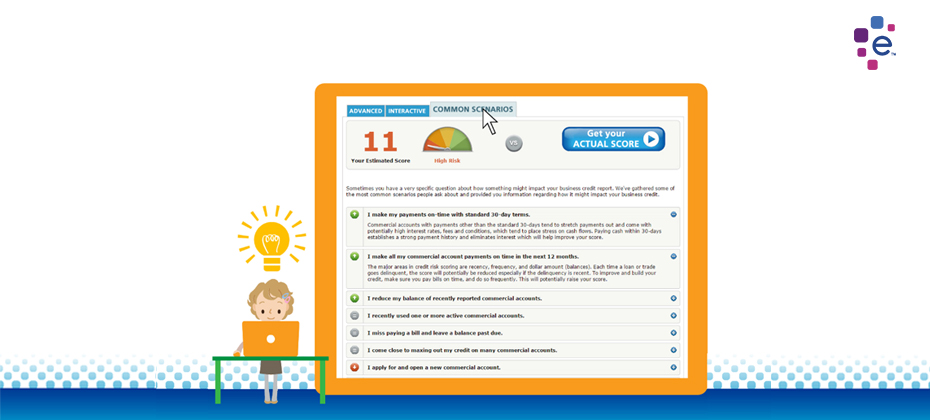
Experian has released a business credit score planner tool to help you run what-if scenarios. It helps you learn behaviors that build strong credit.

Learn more about business credit and how to build it, and why it's important to keep it separate from personal credit.
Debt Collection Scams Substantial debt can be a crippling burden to a small business, which is why they are often targeted by con artists who purport they can vastly reduce or even eliminate this debt — for a fee. This type of scam has a long and checkered history — and is showing no sign of abating. In late October of 2016, Ukrainian-born Sergiy Bezrukov — aka John Butler aka Thomas Paris aka Christopher Riley — was arrested by the FBI in upstate New York and charged with mail fraud for having allegedly duped more than 100 small business owners out of more than $500,000. His alleged scheme was simple: mass-mail an offer to reduce small business debt by up to 75 percent in just six to 12 hours. The fee for his services — required upfront — was $1,250, to be sent via wire transfer to his company, Corporate Restructure, Inc. Of course, no actual services were performed. Victims were not only out their initial $1,250, but many had their credit ratings seriously damaged — or further damaged — as a result. “Bogus credit relief schemes are not all that common, but when they do pop up, they give legitimate organizations a bad name,” said Robert Tharnish, senior vice president of ABC-Amega, Inc., a debt collection agency headquartered in Buffalo, N.Y. “There are many ways to deal with commercial debt. Owners just have to do their due diligence.” Robert Ingold, CEO of Commercial Collection Corp. in Tonawanda, N.Y., agrees. “For anyone who receives a solicitation to reduce their debt — be it commercial or consumer — be skeptical. Know who you’re dealing with.” Both Tharnish and Ingold serve on the board of the International Association of Commercial Collectors, the world’s largest international trade association for commercial debt collection professionals. Ingold noted that most companies have accountants and attorneys who should immediately raise a red flag when such sketchy offers come their way. Even so, enough small business owners either don’t have outside help or ignore their paid experts’ advice, allowing scammers like Berzukov to rake in hundreds of thousands of dollars in just a few months’ time. Dealing with a bogus agency can damage already fragile credit ratings, Ingold noted. “In most cases, a company targeted by a debt reduction scammer has debt and delinquencies that have already been noted by reporting agencies like Experian. Bezrukov’s victims weren’t just out their $1,250, but they probably fell further behind in their debt payments expecting relief, and this just decreased their business credit scores even further.” “This is an industry where all you need is a phone and list,” Ingold continued. “We see the same problem on the flip side with fraudulent collection agencies. Fly-by-night collection agencies approach lenders with wild claims of collection prowess, or buy existing paper for pennies on the dollar, then start harassing debtors in violation of all established laws and ethics.” “ Both Ingold and Tharnish noted that the legal system has numerous avenues available for businesses that find themselves over their head in debt. These include: Restructuring the debt with the existing creditors. This often includes devising a monthly payment plan that leaves the business with enough capital to keep growing. Getting an SBA or private business loan. Declaring Chapter 11 or Chapter 13 bankruptcy, which allow businesses to discharge many of their obligations and still keep their doors open. Both experts also emphasized the need for business owners to perform due diligence before hiring any debt reduction or collection agency to work on their behalf. “Ask to see their license. Their certification. Check with the Better Business Bureau,” Tharnish advised. “Also demand references. Ask, ‘Have you done business with anyone I know?’ If an agency can’t provide references, just walk away.” “When confronted with an amazing business solicitation, just remember the old saying,” Tharnish concluded. “If it sounds too good to be true, it probably is.”

A lot of small business owners pay attention to their personal credit score, unfortunately, they don't pay attention to their business's credit score.
Understanding the ins and outs of financial management is important for every consumer. Being educated on managing their credit, understanding the impact of a credit score, or grasping simple bookkeeping can be intimidating without the proper training. When it comes to business owners, it is even more important, because improper management of their finances can be detrimental to their bottom line. However, with current regulations in place, it makes it difficult for consumers and small business owners to know where to turn to seek out advice without having to pay a steep price for assistance.

If you’re regularly sending emails to your customers, then you might already know the value of email campaigns. With a low capital outlay required and a high potential for return on investment, email is one of the lowest-cost marketing mediums you can employ. There are, however, special considerations for email marketers hoping to capture the attention of users viewing their emails on mobile devices. If you don’t how many of your recipients are viewing emails in this way, then you could be missing out on sales from a critical segment of the population. By following the simple tips below, you’ll engage mobile users and convert them into buyers — thus broadening your customer base beyond the traditional email inbox. Offer both HTML and text versions of your emails. This is the simplest way to ensure that all users are able to view your messages. Survey recipients from time to time to determine their preferences for either HTML or text emails. Restate your offer or subject line within the body of the email, preferably as the first line of the message, right before “If you can’t view this message, click here.” Users will be more likely to read and act on your message if they can instantly understand your offer. Side note: Make sure your subject line is concise and that it clearly conveys your offer. Track responses. Measure which recipients are opening your messages on mobile devices, and segment them into a special group if they represent a significant portion of your audience. Incorporate social media. Customers who use smartphones likely access Facebook and Twitter and would be interested in following you on these social mediums. Include your social media URLs or icons on every email so that you’ll build a social media fan base. With consumers increasingly using their smartphones to access information, mobile marketing must be a key element of your email marketing campaigns. The good news is, it doesn’t take much to incorporate it into your business strategy and begin reaping the rewards.
Can you think of business to which you are regular, repeat customer? Why? What does that business do for you to make you loyal? Is it extraordinary customer service, quality product, personalized service, all of the above? For me it’s Dick Ponds, my local running shoe store. They understand my needs, have a great staff, extend special offers and keep me well informed on the latest trends and information on running. For small businesses, building customer loyalty translates to big business. One of the keys to building customer loyalty is through consistent communication. In my case, the running store keeps me informed through frequent, yet well-timed communications through both direct mail and email. Regular communication with your clients and potential clients is an opportunity to position yourself as an expert in your field which helps people feel more comfortable spending money with you. A recent study from Experian showed that email campaigns targeted to current loyalty program members have 40% higher open rates compared to bulk campaigns. No matter if you have an online business or a regular brick and mortar store, staying connecting with your existing and potential customers is a good approach to grow your business and develop loyalty. For more information on building customer loyalty in your small business, download Experian’s white paper, “The Loyalist: Leverage relationships with existing customers to increase return on investment.”