Best practices for secure patient portals

by Experian Health 5 min read June 11, 2019

The roll-out of patient portals has been a slow burn. While consumer finance, retail and other markets have given customers secure electronic access to their personal information for decades, healthcare has been playing catch-up. But thanks to regulatory pushes, such as the Promoting Interoperability and Meaningful Use programs and the Affordable Care Act, digitized health records are now the norm. Over half of healthcare consumers in the US use patient portals to access their health information at the click of a button – just as they do with their bank accounts or grocery deliveries.

Aside from the convenience factor, research suggests that when patients have access to their health records through patient portals, they experience better health outcomes, greater satisfaction levels, and improved communication with their provider. There’s a higher chance of spotting errors. Adherence to medications is increased, and care becomes more accessible for some otherwise hard-to-reach patients. For providers, this sense of ownership, transparency and connection contributes to elevated consumer loyalty and engagement.

As consumers embrace online portals to view their medical records and lab results, renew prescriptions, schedule appointments, and in some cases pay bills, they expect and assume their provider will keep that data secure. Providers must balance convenience and security.

Unfortunately, some patients remain unconvinced of their providers’ ability to get this balance right.

Patients worry about portal privacy and security

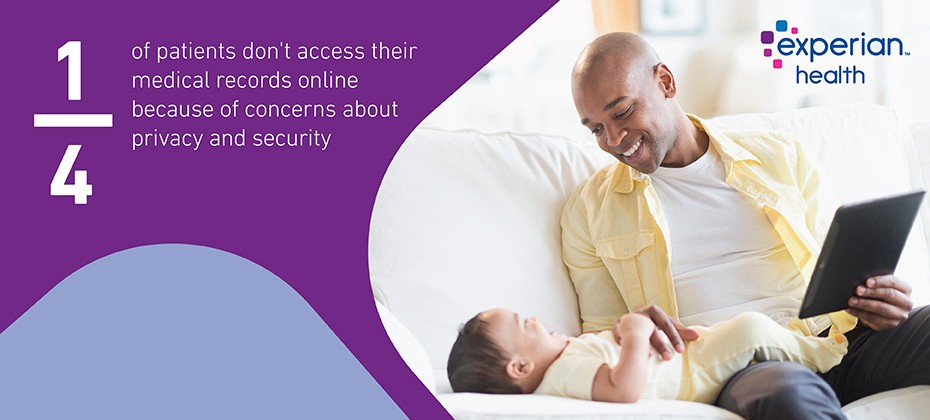
Despite the upsides, a quarter of patients with access to online portals in 2017 chose not to access them because of worries about privacy and security.

They’re right to be cautious: medical identities are said to be worth 20-50 times more than financial identities. It’s no wonder identity thieves are increasingly targeting the healthcare industry.

In 2018, the US Department of Health and Human Services’ Office for Civil Rights (OCR) reported 351 data breaches of 500 or more healthcare records, resulting in the exposure of more than 13 million patient records. Hackers are always on the lookout for vulnerabilities to exploit, with patient medical records, log-in credentials, passwords and other authentication credentials among their top five targets.

Without adequate IT security, your prized patient engagement tools – like patient portals – can become an open door for hackers.

As a provider, your job is to make it easy for patients to access and manage their own data, but hard for fraudsters to get their hands on sensitive data.​​​​​​​​​​​​​​

​​​​​​​How to keep patient portals secure

The good thing about being somewhat late to the party is that healthcare organizations can learn from other industries in how they have tackled online security challenges without creating too much of a burden for consumers.

Think about how consumers authenticate their accounts for financial services or even social media profiles. Typically, there’s an email to verify they are who they say they are, or a two-factor authentication process with a code sent to their cell phone. Most patient portals don’t have these layers of security.

At Experian Health, we recommend a multi-layered solution incorporating device recognition (especially important as more users access portals via cell phones and tablets), identity proofing and fraud management. Here are some examples:

  1. Sign-up screening

When someone enrolls in the portal, use identity proofing to ensure they are who they say they are. It’s particularly important to ask out-of-wallet questions, such as their city of birth, first car model, or previous address to make sure they’re not an imposter.

  1.     Log-in monitoring

Device intelligence will help you confirm the patient is using a cell phone or tablet your system recognizes, to minimize the risk of someone else accessing their account. This technology will tell you if the device is associated with previous fraudulent activities or potentially impersonating multiple patients. If a device fails to meet the risk threshold, identity proofing questions can be used to verify the user’s right to access the account.

  1. Additional checks on risky requests

Some patient portal activities, like downloading medical records and editing a patient’s profile, increase the risk. You’d want to add an extra layer of control here, such as additional out-of-wallet questions, to safeguard your patient’s data.

  1. Rapid response and damage containment

Given the sensitivity and richness of medical data, an attack on the portal can be devastating for patients and costly for providers. In the event of an attack, providers can put in place early warning systems to flag up which patients have been compromised and trigger rapid response measures to shut down the attack and prevent the damage from spreading.

  1. Promote interoperability

Physicians and care providers need to share information on patients in the course of providing good care. But how are they doing this? To keep that data secure and ensure it’s only seen by the right people, you can set up your systems to share data across different platforms in a safe and secure way.

Underlying all of this is the need to reassure your patients that you can be trusted with their data. Victoria Dames, Senior Director of Product Management, Experian Health, explains:

“Healthcare breaches are nothing new, and neither is hackers’ and identity thieves’ penchant for medical records. What is new, however, is the broad range of tools that organizations can now utilize to stop them from accessing that personal data. Give patients the peace of mind they deserve by taking advantage of up-to-date solutions that actually work in our ever-evolving tech climate.”

Learn more about how protect patient portals and encourage more patients to enjoy the full benefits of their patient portal, knowing that their sensitive personal details are safe.

Related Posts

Andy’s New WP Workflow Test Article Using Quick Edit

Key takeaways: Revenue cycle teams can use automation to reduce repetitive work and apply AI where data-driven prediction, matching or prioritization can improve a workflow. Experian Health’s 2025 State of Claims survey found that 41% of providers now face denial rates of 10% or higher, while 68% say submitting clean claims is more challenging than a year ago. Patient Access Curator™ (PAC) uses AI to support front-end data validation and insurance discovery, while AI Advantage™ helps teams predict denial risk and prioritize denial follow-up. Artificial intelligence (AI) and automation can support administrative work in healthcare. In the revenue cycle, teams depend on accurate information, timely decisions and efficient follow-up to keep claims moving. In revenue cycle management, AI and automation can help organizations reduce manual checks, find data gaps, predict denial risk and prioritize work queues. These tools are most useful when they support staff judgment, payer expertise and compliance oversight. They can handle repetitive, data-heavy tasks so staff can focus on exceptions and decisions that need human review. In 2023, McKinsey & Company reported that research suggests effectively deploying automation and analytics could eliminate $200 billion to $360 billion of spending in U.S. healthcare. For revenue cycle leaders, the practical question is where to apply those capabilities first. The case for applying AI and automation in healthcare Revenue cycle teams juggle many daily tasks. Staff collect and verify patient information, confirm eligibility, identify the right payer, submit clean claims, monitor status, work denials and manage collections. Small data gaps at the beginning of the process can create downstream rework and delays. Rework also consumes staff time, adding to these operational pressures. As costs rise and revenue cycles tighten, there is increasing pressure to do more with less. Experian Health’s 2025 State of Claims survey found that 54% of providers say claim errors are increasing and 90% of claim denials are reworked with at least some human review before resubmission. Providers are also managing broader financial and administrative pressures. The American Hospital Association has reported that prior authorization requirements, claim audits, denials and other payer policies add administrative burden and cost for hospitals and health systems. These requirements also consume staff time to appeal denials and manage payer processes. AI and automation are different but complementary. Automation follows defined rules to complete repeatable work. AI models can identify patterns in data, predict risk and help teams decide where to focus attention. When used together, they can support more consistent revenue cycle workflows. How AI and automation can support revenue cycle workflows Revenue cycle management automation and AI are most useful when tied to a specific workflow and a measurable operational problem. The goal is to help teams act earlier, reduce avoidable rework and focus staff time where judgment is needed most. For example, automation can complete rule-based eligibility checks. AI can help identify claims with a higher likelihood of denial. In insurance discovery workflows, AI can also help identify coverage that wasn’t captured at registration. When these tools fit into existing workflows, they can support more consistent decisions and reduce manual work. Three practical applications include: 1. Improving front-end data quality with Patient Access Curator Patient and coverage information collected early in the revenue cycle can affect downstream claim outcomes. Incomplete or outdated demographic details, eligibility responses, coordination of benefits or Medicare Beneficiary Identifier information can create problems that lead to claim delays or denials later in the cycle. Experian Health’s Patient Access Curator helps prevent claim denials by validating demographics, eligibility, insurance discovery, coordination of benefits and Medicare Beneficiary Identifier data in seconds. PAC’s AI and machine learning capabilities help improve match accuracy, coverage sequencing and data confidence by writing the validated data back into the host system and sequencing payers before the claim is created. This automates work that would otherwise require manual coverage checks. 2. Using insurance discovery to find coverage not captured at registration When active coverage isn’t identified during registration, claims may be delayed or submitted with incomplete insurance information. Insurance discovery looks for coverage that may not have been captured during registration. Patient Access Curator includes insurance discovery as part of its front-end validation workflow. It can help identify and correct missing or incorrect insurance information so claims can be submitted with more complete coverage data. 3. Using AI to prevent and prioritize denials Even with strong front-end processes, some claims still require additional attention. AI can help claims teams decide which claims to review before submission and which denials to work first after payer response. Experian Health’s AI Advantage supports two denial management use cases:1. AI Advantage – Predictive Denials uses a client’s historical claims data and Experian’s knowledge of payer rules to identify claims with a high likelihood of denial before submission so teams can take corrective action.2. AI Advantage – Denial Triage uses AI to segment denials and identify those with the highest potential for reimbursement. This approach can help teams prioritize with more confidence. Rather than treating every claim or denial the same way, teams can use predictive models to focus on the work that needs the most attention. Potential benefits of AI and automation in the revenue cycle A high-performing revenue cycle depends on timely, accurate and consistent work. AI and automation can help providers modernize that work without losing the expertise of the people who manage complex payer and patient situations every day. When applied to the right workflows, these tools can help organizations: Reduce manual data searches that take staff away from higher-value work Improve front-end data quality before claims are created Identify missing or incorrect coverage information earlier Spot claims that may be at higher risk of denial Prioritize denied claims by potential reimbursement Reduce rework caused by inaccurate or incomplete information Give staff more consistent information for follow-up decisions A focused AI strategy starts with the workflow problem, uses data that is relevant to that problem and keeps staff in control of judgment-based decisions. A more proactive approach to revenue cycle management Revenue cycle teams can move from reactive work toward a more proactive approach: catch errors earlier, validate coverage before claims are created and prioritize the claims and denials that need the most attention. Experian Health offers revenue cycle solutions that use AI and automation in targeted ways to support front-end data quality, reduce rework and manage denials. Patient Access Curator supports registration and coverage validation, while AI Advantage supports denial prediction and triage. Learn more about Experian Health’s Patient Access Curator and AI Advantage.

October 2, 2026 by Andy.Monte@experian.com
Experian Health ranked #1 in Best in KLAS for 2025

Experian Health is very pleased to announce that we've ranked #1 in the 2025 Best in KLAS: Software & Services report, for our Contract Manager and Contract Analysis product, for the third consecutive year. Contract Manager, when paired with Contract Analysis, empowers healthcare providers by ensuring payers comply with contract terms, identifying and recovering underpayments, and arming them with real claims data to negotiate contracts. This enables providers to negotiate more favorable terms and maintain financial stability.  Clarissa Riggins, Chief Product Officer at Experian Health, says, “In the ever-evolving healthcare landscape, our Contract Manager solution has once again been recognized as the #1 Revenue Cycle Management tool by KLAS for the third consecutive year. This prestigious ranking underscores the significant value our solution delivers to our clients by identifying underpayments and facilitating revenue recovery. We are honored to continue supporting our clients with innovative solutions that drive financial success and operational efficiency.”  Learn more about how Contract Manager and Contract Analysis can help your healthcare organization validate reimbursement accuracy, recover underpayments and boost revenue.   Learn more Contact us

February 5, 2025 by kelly.nguyen
How to increase patient engagement

Learn how providers can increase patient engagement, why it matters and key strategies that deliver improved end-to-end patient experiences.

January 30, 2025 by Experian Health

Spotlight test

Spotlight Description

This site is protected by reCAPTCHA and the Google Privacy Policy and Terms of Service apply.

Sticky Subscribe Title

Sticky Subscribe Description
Sticky Subscribe

Testing Spotlight Paragraph block

Testing the spotlight block header

Archive Testing

Categories