Medicaid redetermination update: what happens next?

by Experian Health 5 min read January 24, 2024

Medicaid-redetermination-update-what-happens-next

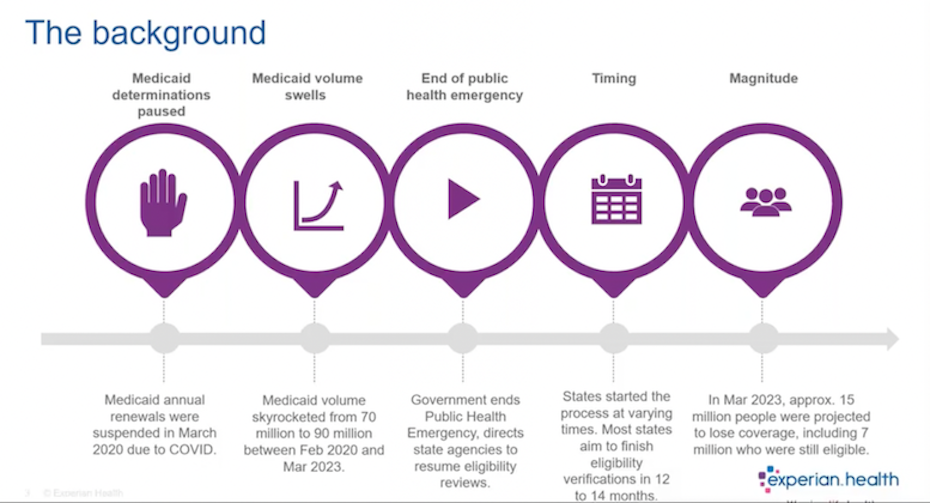
More than 13 million Americans have lost Medicaid coverage since continuous enrollment came to an end in April 2023. Unwinding the emergency provisions requires states to determine which individuals remain eligible for Medicaid, leading to widespread disenrollment. The Medicaid redetermination process created a major admin burden for agencies and providers, and now, the impact of that burden on patients has become clear: more than 7 million of those who lost coverage were disenrolled because of administrative processes, and not due to ineligibility.

While some will find coverage elsewhere, many will be left without insurance. These coverage gaps disrupt health services with adverse effects for patients and providers. In a recent webinar, Kate Ankumah and Mindy Pankoke, Product Managers at Experian Health, reflect on the Medicaid redetermination process and discuss how providers can mitigate the effects of redetermination heading into 2024.

Recap: Medicaid continuous enrollment provision timeline
medicaid-redetermination-timeline-webinar-ss

How does the Medicaid redetermination process work?

The redetermination process, led by state agencies, involves reviewing Medicaid rosters and automatically renewing coverage for individuals that still qualify, based on benefits or other government data. When coverage cannot be confirmed automatically, states need to reach out to patients to fill in the gaps. If the individual is no longer eligible (or does not provide the necessary data), they will be removed from coverage lists. Many patients are confused about the process and may not even realize they’re no longer covered, leading to delays and distress when they try to access care. This blog post breaks down the 5 things providers can do if a patient loses Medicaid coverage.

1. Tighten up insurance eligibility verification processes

During the webinar discussion, Kate Ankumah explains that implementing a reliable eligibility verification tool is essential to reduce financial risk, increase revenue and streamline staff workflows:

“With our Eligibility product, we connect to more than 900 payers with search optimization. Providers don’t need to send the same information over and over – we’ll run through the search options ourselves and find the information as quickly as possible. Then we standardize the data so front desk staff can read all the responses in the same way. We also build in alerts. A couple of clients have alerts set up for Medicaid redetermination dates that pop up if a patient is due for redetermination so the front desk staff know to have a conversation with them about it.”

Eligibility also includes an optional Medicare beneficiary identifier (MBI) lookup service, to check if any patients who may have been disenrolled from Medicaid are now eligible for Medicare.

2. Find missing coverage with Coverage Discovery

Providers may also want to automate the search for any active coverage that may have been overlooked. Coverage Discovery searches for possible billable government or commercial insurance to eliminate unnecessary write-offs and give patients peace of mind. Using advanced search heuristics, millions of data points and powerful confidence scoring, this tool checks for coverage across the entire patient journey. If the patient’s status changes, their bill won’t be sent to the wrong place.

In 2021, Coverage Discovery identified previously unknown billable coverage in more than 27.5% of self-pay accounts, preventing billions of dollars from being written off.

3. Quickly identify patients who may be eligible for Medicaid and financial assistance

The lack of clarity around enrollment and eligibility is disruptive for claims and collections teams. How can they handle reimbursements and billing efficiently if financial responsibility is unclear? Denial rates are already a top concern for providers, and staff cannot afford to waste time seeking Medicaid reimbursement for disenrolled patients. Patient collections also take a hit when accounts are wrongly designated as self-pay.

With Patient Financial Clearance, providers can quickly determine if patients are likely to qualify for financial support, then assign them to the right financial pathway, using pre- and post-service checks. Self-pay patients can be screened for Medicaid eligibility before treatment or at the point of service, and then routed to the Medicaid Enrollment team or auto-enrolled as charity care if appropriate. Post-visit, the tool evaluates payment risk to determine the most suitable collection policy for those with an amount to pay and can set up customized payment plans based on the patient’s ability to pay.

Patient Financial Clearance also runs back-end checks to catch patients who have already been sent a bill but may qualify for Medicaid or provider charity programs. This helps secure reimbursement and means patients are less likely to be chased for bills they can’t pay.

4. Screen and segment patients according to their propensity to pay

Optimizing collections processes is always a smart move for providers, but particularly now that federal support has ended. Collections Optimization Manager uses advanced analytics to segment patient accounts based on propensity to pay and send them to the appropriate collections team. Drawing on Experian’s consumer credit data, Collections Optimization Manager’s segmentation models are powered by robust and proprietary algorithms. These models screen out Medicaid and charity eligibility, so collections staff focus their time on the right accounts.

Case study: See how University of California San Diego Health (UCSDH) increased collections from around $6 million to over $21 million in just two years using Collections Optimization Manager.

5. Make it simpler for patients to manage and pay bills

The reality is that many patients affected by the unwinding of continuous enrollment will be on low incomes. When more than half of patients say they’d struggle to pay an unexpected medical bill of $500, providers should make it easier for patients to gauge their upcoming bills. Patient Financial Advisor and PatientSimple® can help patients navigate the payment process with pre-service estimates, access to payment plans and convenient payment methods they can access on a computer or mobile device.

Together, these tools can help providers manage Medicaid changes efficiently and offer extra support to patients who may be facing disenrollment.

Watch the webinar to see the full discussion on how Medicaid redetermination is affecting providers and find out how Experian Health’s digital solutions can help healthcare organizations quickly and easily verify insurance coverage.

Related Posts

Andy’s New WP Workflow Test Article Using Quick Edit

Key takeaways: Revenue cycle teams can use automation to reduce repetitive work and apply AI where data-driven prediction, matching or prioritization can improve a workflow. Experian Health’s 2025 State of Claims survey found that 41% of providers now face denial rates of 10% or higher, while 68% say submitting clean claims is more challenging than a year ago. Patient Access Curator™ (PAC) uses AI to support front-end data validation and insurance discovery, while AI Advantage™ helps teams predict denial risk and prioritize denial follow-up. Artificial intelligence (AI) and automation can support administrative work in healthcare. In the revenue cycle, teams depend on accurate information, timely decisions and efficient follow-up to keep claims moving. In revenue cycle management, AI and automation can help organizations reduce manual checks, find data gaps, predict denial risk and prioritize work queues. These tools are most useful when they support staff judgment, payer expertise and compliance oversight. They can handle repetitive, data-heavy tasks so staff can focus on exceptions and decisions that need human review. In 2023, McKinsey & Company reported that research suggests effectively deploying automation and analytics could eliminate $200 billion to $360 billion of spending in U.S. healthcare. For revenue cycle leaders, the practical question is where to apply those capabilities first. The case for applying AI and automation in healthcare Revenue cycle teams juggle many daily tasks. Staff collect and verify patient information, confirm eligibility, identify the right payer, submit clean claims, monitor status, work denials and manage collections. Small data gaps at the beginning of the process can create downstream rework and delays. Rework also consumes staff time, adding to these operational pressures. As costs rise and revenue cycles tighten, there is increasing pressure to do more with less. Experian Health’s 2025 State of Claims survey found that 54% of providers say claim errors are increasing and 90% of claim denials are reworked with at least some human review before resubmission. Providers are also managing broader financial and administrative pressures. The American Hospital Association has reported that prior authorization requirements, claim audits, denials and other payer policies add administrative burden and cost for hospitals and health systems. These requirements also consume staff time to appeal denials and manage payer processes. AI and automation are different but complementary. Automation follows defined rules to complete repeatable work. AI models can identify patterns in data, predict risk and help teams decide where to focus attention. When used together, they can support more consistent revenue cycle workflows. How AI and automation can support revenue cycle workflows Revenue cycle management automation and AI are most useful when tied to a specific workflow and a measurable operational problem. The goal is to help teams act earlier, reduce avoidable rework and focus staff time where judgment is needed most. For example, automation can complete rule-based eligibility checks. AI can help identify claims with a higher likelihood of denial. In insurance discovery workflows, AI can also help identify coverage that wasn’t captured at registration. When these tools fit into existing workflows, they can support more consistent decisions and reduce manual work. Three practical applications include: 1. Improving front-end data quality with Patient Access Curator Patient and coverage information collected early in the revenue cycle can affect downstream claim outcomes. Incomplete or outdated demographic details, eligibility responses, coordination of benefits or Medicare Beneficiary Identifier information can create problems that lead to claim delays or denials later in the cycle. Experian Health’s Patient Access Curator helps prevent claim denials by validating demographics, eligibility, insurance discovery, coordination of benefits and Medicare Beneficiary Identifier data in seconds. PAC’s AI and machine learning capabilities help improve match accuracy, coverage sequencing and data confidence by writing the validated data back into the host system and sequencing payers before the claim is created. This automates work that would otherwise require manual coverage checks. 2. Using insurance discovery to find coverage not captured at registration When active coverage isn’t identified during registration, claims may be delayed or submitted with incomplete insurance information. Insurance discovery looks for coverage that may not have been captured during registration. Patient Access Curator includes insurance discovery as part of its front-end validation workflow. It can help identify and correct missing or incorrect insurance information so claims can be submitted with more complete coverage data. 3. Using AI to prevent and prioritize denials Even with strong front-end processes, some claims still require additional attention. AI can help claims teams decide which claims to review before submission and which denials to work first after payer response. Experian Health’s AI Advantage supports two denial management use cases:1. AI Advantage – Predictive Denials uses a client’s historical claims data and Experian’s knowledge of payer rules to identify claims with a high likelihood of denial before submission so teams can take corrective action.2. AI Advantage – Denial Triage uses AI to segment denials and identify those with the highest potential for reimbursement. This approach can help teams prioritize with more confidence. Rather than treating every claim or denial the same way, teams can use predictive models to focus on the work that needs the most attention. Potential benefits of AI and automation in the revenue cycle A high-performing revenue cycle depends on timely, accurate and consistent work. AI and automation can help providers modernize that work without losing the expertise of the people who manage complex payer and patient situations every day. When applied to the right workflows, these tools can help organizations: Reduce manual data searches that take staff away from higher-value work Improve front-end data quality before claims are created Identify missing or incorrect coverage information earlier Spot claims that may be at higher risk of denial Prioritize denied claims by potential reimbursement Reduce rework caused by inaccurate or incomplete information Give staff more consistent information for follow-up decisions A focused AI strategy starts with the workflow problem, uses data that is relevant to that problem and keeps staff in control of judgment-based decisions. A more proactive approach to revenue cycle management Revenue cycle teams can move from reactive work toward a more proactive approach: catch errors earlier, validate coverage before claims are created and prioritize the claims and denials that need the most attention. Experian Health offers revenue cycle solutions that use AI and automation in targeted ways to support front-end data quality, reduce rework and manage denials. Patient Access Curator supports registration and coverage validation, while AI Advantage supports denial prediction and triage. Learn more about Experian Health’s Patient Access Curator and AI Advantage.

October 2, 2026 by Andy.Monte@experian.com
Experian Health ranked #1 in Best in KLAS for 2025

Experian Health is very pleased to announce that we've ranked #1 in the 2025 Best in KLAS: Software & Services report, for our Contract Manager and Contract Analysis product, for the third consecutive year. Contract Manager, when paired with Contract Analysis, empowers healthcare providers by ensuring payers comply with contract terms, identifying and recovering underpayments, and arming them with real claims data to negotiate contracts. This enables providers to negotiate more favorable terms and maintain financial stability.  Clarissa Riggins, Chief Product Officer at Experian Health, says, “In the ever-evolving healthcare landscape, our Contract Manager solution has once again been recognized as the #1 Revenue Cycle Management tool by KLAS for the third consecutive year. This prestigious ranking underscores the significant value our solution delivers to our clients by identifying underpayments and facilitating revenue recovery. We are honored to continue supporting our clients with innovative solutions that drive financial success and operational efficiency.”  Learn more about how Contract Manager and Contract Analysis can help your healthcare organization validate reimbursement accuracy, recover underpayments and boost revenue.   Learn more Contact us

February 5, 2025 by kelly.nguyen
How to increase patient engagement

Learn how providers can increase patient engagement, why it matters and key strategies that deliver improved end-to-end patient experiences.

January 30, 2025 by Experian Health

Spotlight test

Spotlight Description

This site is protected by reCAPTCHA and the Google Privacy Policy and Terms of Service apply.

Sticky Subscribe Title

Sticky Subscribe Description
Sticky Subscribe

Testing Spotlight Paragraph block

Testing the spotlight block header

Archive Testing

Categories