Vancouver Clinic takes a cue from manufacturing to fix healthcare inefficiencies

by Experian Health 3 min read January 8, 2019

The Vancouver Clinic was facing the same problems that all healthcare organizations grapple with: too many claims denials and too much bad debt.

So, Paul Brown, the clinic’s chief financial officer, turned to his background in manufacturing technology to see how his organization could find efficiencies. He used his experience and knowledge to inform his and the clinic’s roadmap to implement change.

The first step was looking at quality. In manufacturing, every step in the process is studied closely and tested to ensure absolute accuracy. Vancouver Clinic did the same. From a patient perspective, it wanted a seamless experience, including making appointments, reducing patient time at reception, ensuring labs were returned quickly, and making sure patients had quick access to any prescriptions they needed.

Although the improvements Vancouver Clinic wanted to make originally were seen as a technology project, it quickly became evident that improving the process would also require training for staff and defining performance indicators.

However, as technology played a key role, Paul reached out to Experian Health to implement some much-needed automation in the revenue cycle process.

One big goal for the partnership was to improve revenue and collections, which is important as U.S. healthcare spending continues to skyrocket. Spending has reached $3.5 trillion, and Medicare bad debt adds up to more than $3.69 billion. Experts predict these numbers will continue to grow, and soon, the nation will spend close to 20 percent of the gross domestic product on healthcare alone.

Vancouver Clinic was also grappling with these issues. It had higher-than-average claims denial rates, which cost the clinic $10.5 million each year. It also had higher-than-average bad debt of $3.5 million. The goal was to reduce that by 50 percent, and the numbers are going in the right direction.

To get there, Vancouver Clinic took a multifaceted approach to implementing software solutions.

One solution was Payer Alerts, which creates authorization updates that reduce errors and inconsistencies before claims are submitted. When they’re detected, the alert format is easy to read and understand so corrections can be made quickly. Other technology solutions included Eligibility, which simplifies the insurance verification process; Payment Safe®, which is an efficient and seamless way to process patient payments; and Claim Scrubber, which helps submit clean claims to payers and reduce claim denials.

The results for Vancouver Clinic were quick and dramatic. Claims denial rates dropped more than 30 percent. The denial rate, which was around 14 percent, is now under nine percent.

Vancouver Clinic also reduced bad debt through more efficient patient processing by ensuring the clinic has the right insurance and personal information on patients.

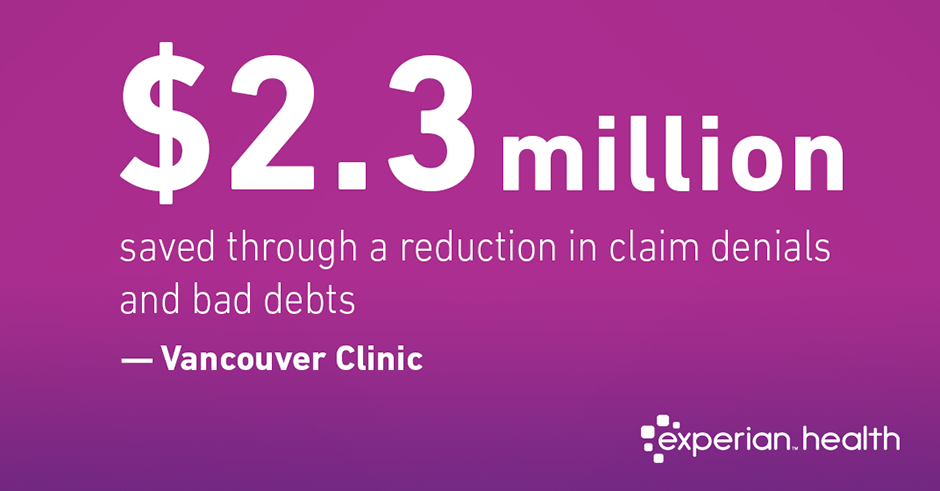
By collaborating with Experian Health, Vancouver Clinic has turned things around and has already realized a reduction in claim denials and bad debts to save them $2.3 million.

An additional benefit of implementing these software changes is the ability for patients to use the self-service portal for the clinic. It allows patients to get estimates for services, set up payment schedules, pay their bills, schedule appointments, and provide feedback to the health system.

Giving patients the ability to take control of these tasks simplifies the process for everyone, reduces busywork for staff, and improves patient satisfaction.

Another efficiency that was implemented for staff was revamping software work lists. By reducing the number of lists they had to manage, employees were able to streamline their work.

In an effort to maintain and continue to improve efficiencies, several key performance indicators are monitored to ensure quality throughout every step of the process. In much the same way that manufacturing keeps an eye on each process along the way, Vancouver Clinic has sought to improve every detail to create a seamless experience for patients. Through its continued partnership with Experian Health, it is well on its way to getting there.

Related Posts

Andy’s New WP Workflow Test Article Using Quick Edit

Key takeaways: Revenue cycle teams can use automation to reduce repetitive work and apply AI where data-driven prediction, matching or prioritization can improve a workflow. Experian Health’s 2025 State of Claims survey found that 41% of providers now face denial rates of 10% or higher, while 68% say submitting clean claims is more challenging than a year ago. Patient Access Curator™ (PAC) uses AI to support front-end data validation and insurance discovery, while AI Advantage™ helps teams predict denial risk and prioritize denial follow-up. Artificial intelligence (AI) and automation can support administrative work in healthcare. In the revenue cycle, teams depend on accurate information, timely decisions and efficient follow-up to keep claims moving. In revenue cycle management, AI and automation can help organizations reduce manual checks, find data gaps, predict denial risk and prioritize work queues. These tools are most useful when they support staff judgment, payer expertise and compliance oversight. They can handle repetitive, data-heavy tasks so staff can focus on exceptions and decisions that need human review. In 2023, McKinsey & Company reported that research suggests effectively deploying automation and analytics could eliminate $200 billion to $360 billion of spending in U.S. healthcare. For revenue cycle leaders, the practical question is where to apply those capabilities first. The case for applying AI and automation in healthcare Revenue cycle teams juggle many daily tasks. Staff collect and verify patient information, confirm eligibility, identify the right payer, submit clean claims, monitor status, work denials and manage collections. Small data gaps at the beginning of the process can create downstream rework and delays. Rework also consumes staff time, adding to these operational pressures. As costs rise and revenue cycles tighten, there is increasing pressure to do more with less. Experian Health’s 2025 State of Claims survey found that 54% of providers say claim errors are increasing and 90% of claim denials are reworked with at least some human review before resubmission. Providers are also managing broader financial and administrative pressures. The American Hospital Association has reported that prior authorization requirements, claim audits, denials and other payer policies add administrative burden and cost for hospitals and health systems. These requirements also consume staff time to appeal denials and manage payer processes. AI and automation are different but complementary. Automation follows defined rules to complete repeatable work. AI models can identify patterns in data, predict risk and help teams decide where to focus attention. When used together, they can support more consistent revenue cycle workflows. How AI and automation can support revenue cycle workflows Revenue cycle management automation and AI are most useful when tied to a specific workflow and a measurable operational problem. The goal is to help teams act earlier, reduce avoidable rework and focus staff time where judgment is needed most. For example, automation can complete rule-based eligibility checks. AI can help identify claims with a higher likelihood of denial. In insurance discovery workflows, AI can also help identify coverage that wasn’t captured at registration. When these tools fit into existing workflows, they can support more consistent decisions and reduce manual work. Three practical applications include: 1. Improving front-end data quality with Patient Access Curator Patient and coverage information collected early in the revenue cycle can affect downstream claim outcomes. Incomplete or outdated demographic details, eligibility responses, coordination of benefits or Medicare Beneficiary Identifier information can create problems that lead to claim delays or denials later in the cycle. Experian Health’s Patient Access Curator helps prevent claim denials by validating demographics, eligibility, insurance discovery, coordination of benefits and Medicare Beneficiary Identifier data in seconds. PAC’s AI and machine learning capabilities help improve match accuracy, coverage sequencing and data confidence by writing the validated data back into the host system and sequencing payers before the claim is created. This automates work that would otherwise require manual coverage checks. 2. Using insurance discovery to find coverage not captured at registration When active coverage isn’t identified during registration, claims may be delayed or submitted with incomplete insurance information. Insurance discovery looks for coverage that may not have been captured during registration. Patient Access Curator includes insurance discovery as part of its front-end validation workflow. It can help identify and correct missing or incorrect insurance information so claims can be submitted with more complete coverage data. 3. Using AI to prevent and prioritize denials Even with strong front-end processes, some claims still require additional attention. AI can help claims teams decide which claims to review before submission and which denials to work first after payer response. Experian Health’s AI Advantage supports two denial management use cases:1. AI Advantage – Predictive Denials uses a client’s historical claims data and Experian’s knowledge of payer rules to identify claims with a high likelihood of denial before submission so teams can take corrective action.2. AI Advantage – Denial Triage uses AI to segment denials and identify those with the highest potential for reimbursement. This approach can help teams prioritize with more confidence. Rather than treating every claim or denial the same way, teams can use predictive models to focus on the work that needs the most attention. Potential benefits of AI and automation in the revenue cycle A high-performing revenue cycle depends on timely, accurate and consistent work. AI and automation can help providers modernize that work without losing the expertise of the people who manage complex payer and patient situations every day. When applied to the right workflows, these tools can help organizations: Reduce manual data searches that take staff away from higher-value work Improve front-end data quality before claims are created Identify missing or incorrect coverage information earlier Spot claims that may be at higher risk of denial Prioritize denied claims by potential reimbursement Reduce rework caused by inaccurate or incomplete information Give staff more consistent information for follow-up decisions A focused AI strategy starts with the workflow problem, uses data that is relevant to that problem and keeps staff in control of judgment-based decisions. A more proactive approach to revenue cycle management Revenue cycle teams can move from reactive work toward a more proactive approach: catch errors earlier, validate coverage before claims are created and prioritize the claims and denials that need the most attention. Experian Health offers revenue cycle solutions that use AI and automation in targeted ways to support front-end data quality, reduce rework and manage denials. Patient Access Curator supports registration and coverage validation, while AI Advantage supports denial prediction and triage. Learn more about Experian Health’s Patient Access Curator and AI Advantage.

October 2, 2026 by Andy.Monte@experian.com
Experian Health ranked #1 in Best in KLAS for 2025

Experian Health is very pleased to announce that we've ranked #1 in the 2025 Best in KLAS: Software & Services report, for our Contract Manager and Contract Analysis product, for the third consecutive year. Contract Manager, when paired with Contract Analysis, empowers healthcare providers by ensuring payers comply with contract terms, identifying and recovering underpayments, and arming them with real claims data to negotiate contracts. This enables providers to negotiate more favorable terms and maintain financial stability.  Clarissa Riggins, Chief Product Officer at Experian Health, says, “In the ever-evolving healthcare landscape, our Contract Manager solution has once again been recognized as the #1 Revenue Cycle Management tool by KLAS for the third consecutive year. This prestigious ranking underscores the significant value our solution delivers to our clients by identifying underpayments and facilitating revenue recovery. We are honored to continue supporting our clients with innovative solutions that drive financial success and operational efficiency.”  Learn more about how Contract Manager and Contract Analysis can help your healthcare organization validate reimbursement accuracy, recover underpayments and boost revenue.   Learn more Contact us

February 5, 2025 by kelly.nguyen
How to increase patient engagement

Learn how providers can increase patient engagement, why it matters and key strategies that deliver improved end-to-end patient experiences.

January 30, 2025 by Experian Health

Spotlight test

Spotlight Description

This site is protected by reCAPTCHA and the Google Privacy Policy and Terms of Service apply.

Sticky Subscribe Title

Sticky Subscribe Description
Sticky Subscribe

Testing Spotlight Paragraph block

Testing the spotlight block header

Archive Testing

Categories