Apply CIS Tag

Rapid improvements in technology and the rise in online activity are driving higher consumer expectations for fast and frictionless digital experiences. And yet, only 50% of credit unions are executing on a digital strategy compared to 79% of banks.1 What can credit unions do to stand out from the competition and keep up with increasing consumer demands? 23% of consumers say their expectations for the digital experience have only somewhat or not at all been met.2 The answer lies in digital prequalification. With a frictionless digital prequalification solution, members can prequalify themselves online in real time before starting the formal application process. This puts members in the driver’s seat, allowing them to see their eligibility for credit offers and choose whether they’d like to proceed with the application. By delivering immediate feedback and offers to members online, credit unions can increase response rates, improve digital engagement and enhance the prequalification experience. Case Study: Achieving growth through a seamless digital prequalification experience Gather Federal Credit Union is the largest neighbor-island credit union in Hawaii, providing financial products and services to more than 35,000 members. Wanting to grow more loans while providing members with a seamless and efficient online experience, the credit union looked for a comprehensive solution that could improve their decisioning and enhance their prequalification strategy. They partnered with Experian and Rate Reset to implement a frictionless digital experience that enables members to opt-in for prequalified offers. Leveraging the power of Experian’s PowerCurve® and Rate Reset’s The ButtonTM, Gather had flexible access to consumer data, attributes and scores, allowing them to verify user identities and match members with loan products before their application formally went through the credit underwriting process. By gaining a better understanding of which credit options they prequalified for, members were able to opt-in instantly, creating a faster, more personalized digital prequalification experience. Within three weeks of implementation, Gather booked over $600,000 in new personal loans and credit cards. Additionally, of all the applicants that passed the credit union’s credit prequalification criteria, 54% accepted their offer and received a loan. “With a few clicks, members and non-members alike can instantly prequalify themselves for a loan. We’re extremely pleased with this offering, which has enabled us to extend our reach and grow the Gather community,” said Justin Ganaden, Executive Vice President, Gather Federal Credit Union. Read the full case study to learn more about how Experian can help grow your business with a frictionless digital prequalification experience. Download the full case study 1 https://www.big-fintech.com/Media/BIG-News/ArticleID/779/New-Digital-Banking-Platform Digital Transformation Revolution – Is it Leaving Credit Unions Behind? 2 2022 Global Insights Report, Experian, 2022.

People-based marketing connects businesses with real people, helping them understand who their customers are and how to engage them in more meaningful ways.

With the pandemic waning, now is the time for financial institutions to take action on financial inclusion. Read on to learn more!

Learn four best practices for improving consumer engagement while furthering your financial inclusion efforts. Read more!

Tips for Building a Successful Strategy for Income and Employment Verification for Mortgage
Apply CIS TagDiscover the dos and don’ts when it comes to implementing a successful strategy for income and employment verification for mortgage. Read more!

To drive growth and customer retention in today’s competitive landscape, financial services must optimize their customer acquistion strategies.

Experian recently attended Fintech Nexus USA, formally known as LendIT Fintech USA, to discuss fraud prevention and BNPL. Read more!

These days, the call for financial inclusion is being answered by a disruptive force of new financial products and services. Read more!

Learn how you can use credit attributes to identify qualified prospects, set initial limits, manage credit lines and limit credit losses. Read more!

As card issuers go head-to-head in the battle to reach and connect with new consumers, they must implement more inclusive lending strategies.

Many financial institutions have made inclusion a strategic priority to expand their reach and help more U.S. consumers access affordable financial services. To drive deeper understanding, Experian commissioned Forrester to do new research to identify key focal points for firms and how they are moving the needle. The study found that more than two-thirds of institutions had a strategy created and implemented while one-quarter reported they are already up and running with their inclusion plans.1 Tapping into the underserved The research examines the importance of engaging new audiences such as those that are new to credit, lower-income, thin file, unbanked and underbanked as well as small businesses. To tap into these areas, the study outlines the need to develop new products and services, adopt willingness to change policies and processes, and use more data to drive better decisions and reach.2 Expanded data for improved risk decisioning The research underlines the use of alternative data and emerging technologies to expand reach to new audiences and assist many who have been underserved. In fact, sixty-two percent of financial institutions surveyed reported they currently use or are planning to use expanded data to improve risk profiling and credit decisions, with focus on: Banking data Cash flow data Employment verification data Asset, investments, and wealth management data Alternative financial services data Telcom and utility data3 Join us to learn more at our free webinar “Reaching New Heights Together with Financial Inclusion” where detailed research and related tools will be shared featuring Forrester’s principal analyst on Tuesday, May 24 from 10 – 11 a.m. PT. Register here for more information. Find more financial inclusion resources at www.experian.com/inclusionforward. Register for webinar Visit us 1 Based on Forrester research 2 Ibid. 3 Ibid.

When extending firm offers of credit, lenders have relied on direct mail to reach their intended audiences. But what if there are more ways to deliver a credit offer?

What goals should you set to make financial inclusion a reality? How can success be quantified? This checklist can help you become more inclusive.
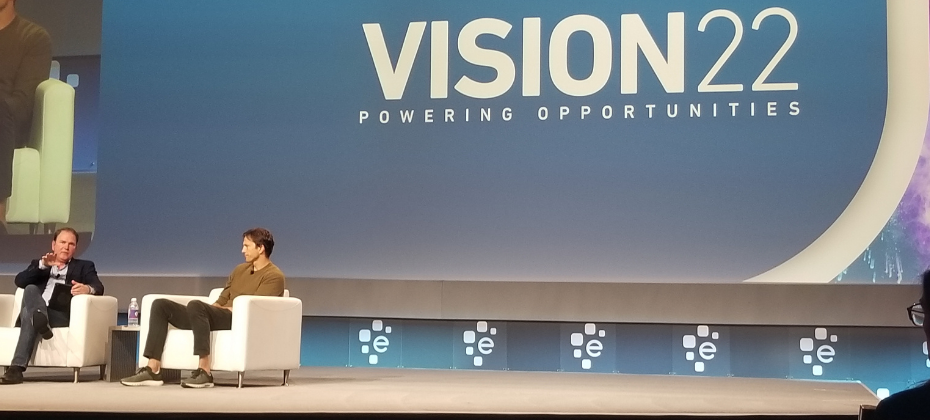
“I saw an opportunity to create change instead of asking for it.” Day 2 was charged up with new technology; new ideas; and new, clearer visions of where we can drive change across our industries. Jeff Softley, President, Direct to Consumer, Experian Consumer Services, illustrated how the consumer is at the center of Experian’s business with countless statistics and how our consumer advocacy drives our focus, growth and mission. Wil Lewis, Global Chief of Diversity, Equity and Inclusion; Hiq Lee, President of Business Information Services; and Alex Lintner, Group President, Consumer Information Services, engaged in a panel discussion centered on reimagining inclusion. Keynote: Allyson Felix Allyson Felix, five-time Olympian and most decorated Track & Field athlete, kicked off the day with an inspiring keynote touching on her athletic career, taking challenges head-on and using our platforms to make an impact. Felix, who is racing in the first race of her final season this weekend, is a tireless advocate, life-long learner, who seeks to empower others. “We can all start where we are,” she said. “Small things turn into big things.” Day 2 session highlights From the breakout sessions, the theme of disruption was evident. We dove into how prescreen and prequalification have evolved, a demand that many must adapt to deliver in the post-pandemic world. Financial inclusion was a topic covered across the board, as were the strategies to be enacted to bolster these financial inclusion drivers. One such area addressed was how the rapidly growing buy now, pay later industry advances financial access and inclusion efforts. And speaking of evolution, retention must evolve as well — we heard how retention, recapture and risk strategies are transforming, particularly in the mortgage servicing space. Rapid Model Development and Deployment - Feedback from businesses reflects organizations’ desires for flexible deployment options, flexible integration with existing tech stacks, open source technology and the ability to incorporate multiple data providers. Today’s solutions address that feedback as well as solve for the most rampant market challenges in new, innovative ways. Strategy optimization with Artificial Intelligence and Machine Learning - Over 50% of financial institutions surveyed are using AI/ML in at least one department. Challenges include data management, operation, evolving the analytics program. ML/AI starts with proper data management. For optimization, templatizing ML frameworks is a necessity. ID Verification, Authentication and Fraud - There were $56B in identity fraud losses in 2020, $13B of which were traditional identity fraud losses and $43B related to identity fraud scams. Leveraging strategies is necessary to maintain the critical balance required for identity verification and fraud – mitigating losses and risk exposure, drive optimal customer experience, maintain regulatory compliance. Maximizing Customer Value - The monthly data refresh is a thing of the past. When reimagining account review for risk and marketing purposes, remaining agile is key with increased data freshness for operational efficiency. Keynote: Ashton Kutcher The energy, insights and ideas have been reverberating throughout the venue for the past 48 hours, which set the stage for Ashton Kutcher’s closing keynote. The Chicago Bears fan talked about his career, how hard work wasn’t an option when he was growing up and how part of his assessment process for potential investments – determining whether they create efficiencies in the market – he sometimes thinks of a long-standing, personal benchmark – the air nailer. He talked about his philanthropy efforts, the mission behind his company Thorn, and the ability for people to impact change and achieve "a sense of agency" over the outcome of the future. “That’s the human spirit. That’s the spark that exists – that people understand that you can sit in despair, or you can do something,” he said. It has been an amazing two days – we can’t wait for Vision 2023!
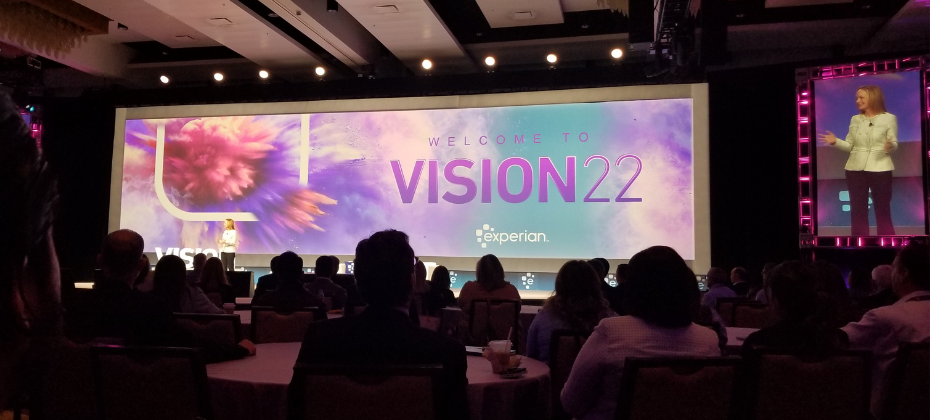
“Disruption has caused enormous amounts of innovation,” said Jennifer Schulz, CEO of Experian, North America. “We must continue to be the disruptors in our industry which takes effort, data, technology, bright minds and vision for what the future will be.” Schulz kicked off the 39th Vision conference with a future-focused keynote delivered to a crowd of more than 400 attendees. Alex Lintner, Group President, Experian Consumer Information Services, talked about the next phase of great, highlighting the digital transformation that has taken place in the generations of the past and the disruption and innovation happening today and in the future. Keynote speaker: Dr. Mohamed A. El-Erian Dr. Mohamed A. El-Erian, renowned economist and author, President of Queens’ College, Cambridge, Chief Economic Advisor at Allianz, Chair of President Obama’s Global Development Council and Former CEO and Co-Chief Investment Officer of PIMCO, spoke about the Fed, inflation, negative interest rates and the labor market, as well as the importance of inclusion. El-Erian, who said he reads the Financial Times religiously, acknowledged that we will make mistakes on the journey as we work to be even more inclusive. To navigate what’s ahead, he said we will need resilience, optionality and agility. “It’s important to connect with information, acknowledge the insecurity, in a language people understand, in order to connect,” he said. Session highlights – day 1 The conference hall was buzzing with conversations, discussions and thought leadership. Buy Now Pay Later A large audience was in attendance for a session that introduced Experian’s Buy Now Pay Later Bureau™ and explored how it’s the first and only solution of its kind — serving consumers, BNPL providers, financial institutions and regulators. Identity Identity is constantly evolving, and while biometrics and authentication may have become ubiquitous, there is much activity around the concepts of eIDs, identity wallets and identity networks. Experian is making identities personal and helping businesses to recognize, manage and connect customer identities in new ways using data, analytics and technology. Marketing In today’s hypercompetitive world, businesses need to engage the freshest data and increase velocity when it comes to time to market. An average of 120 days won’t cut it. Ascend Marketing speeds time to market and helps achieve higher ROI. Regulatory Landscape With so much happening at Capitol Hill, a panel of experts from DC discussed a number of topics and proposals (and their impacts), including the defense for risk-based pricing, the impact of suppressing negative data, and trending topics like Buy Now Pay Later and data portability. All the while, the tech showcase had a constant flow of attendees with demos ranging from data and decisioning to financial inclusion and technology. This is just the beginning. And as Schulz said, “There’s more to do.” More insights from Vision to come. Follow @ExperianVision to see more of the action.