Digital Technology
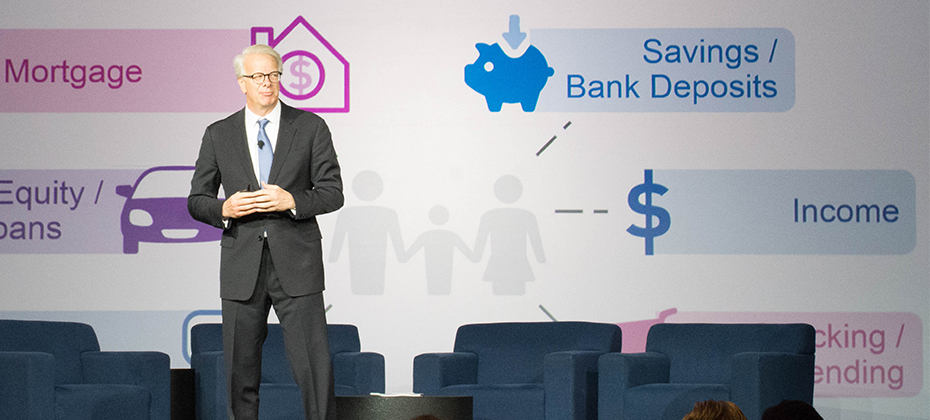
So many insights and learnings to report after the first full day of 2017 Vision sessions. From the musings shared by tech engineer and pioneer Steve Wozniak, to a panel of technology thought leaders, to countless breakout sessions on a wide array of business topics … here’s a look at our top 10 from the day. A mortgage process for the digital age. At last. In his opening remarks, Experian President of Credit Services Alex Lintner asked the audience to imagine a world when applying for a mortgage simply required a few clicks or swipes. Instead of being sent home to collect a hundred pieces of paper to verify employment, income and assets, a consumer could click on a link and provide a few credentials to verify everything digitally. Finally, lenders can make this a reality, and soon it will be the only way consumers expect to go through the mortgage process. The global and U.S. economies are stable. In fact, they are strong. As Experian Vice President of Analytics Michele Raneri notes, “the fundamentals and technicals look really solid across the countries.” While many were worried a year ago that Brexit would turn the economy upside down, it appears everything is good. Consumer confidence is high. The Dow Jones Index is high. The U.S. unemployment rate is at 4.7%. Home prices are up year-over-year. While there has been a great deal of change in the world – politically and beyond – the economy is holding strong. The rise of the micropreneur. This term is not officially in the dictionary … but it will be. What is it? A micropreneur is a business with 0 to 4 employees bringing in no more than $200k in annual revenue. But the real story is that numbers show microbusiness are improving on many fronts when it comes to contribution to the economy and overall performance compared to other small businesses. Keep an eye on these budding business people. Fraud is running fierce. Synthetic identity losses are estimated in the hundreds of millions annually, with 50% year-over year growth. Criminals are now trying to use credit cleaners to get tradelines removed from used Synthetic IDs. Oh, and it is essential for businesses to ready themselves for “Dark Web” threats. Experts advise to harden your defenses (and play offense) to keep pace with the criminal underground. As soon as you think you’ve protected everything, the criminals will find a gap. The cloud is cool and so are APIs. A panel of thought leaders took to the main stage to discuss the latest trends in tech. Experian Global CIO Barry Libenson said, “The cloud has changed the way we deliver services to our customers and clients, making it seamless and elastic.” Combine that with API, and the goal is to ultimately make all Experian data available to its customers. Experian President of Decision Analytics Steve Platt added, “We are enabling you to tap into what you need, when you need it.” No need to “rip and replace” all your tech. Expect more regulation – and less. A panel of regulatory experts addressed the fast-changing regulatory environment. With the new Trump administration settling in, and calls for change to Dodd-Frank and the Consumer Financial Protection Bureau (CFPB), it’s too soon to tell what will unfold in 2017. CFPB Director Richard Cordray may be making a run for governor of Ohio, so he could be transitioning out sooner than the scheduled close of his July 2018 term. The auto market continues to cruise. Experian’s auto expert, Malinda Zabritski, revealed the latest and greatest stats pertaining to the auto market. A few numbers to blow your mind … U.S. passenger cars and light trucks surpassed 17 million units for the second consecutive year Most new vehicle buyers in the U.S. are 45 years of age or older Crossover and sport utility vehicles remain popular, accounting for 40% of the market in 2016 – this is also driving up finance payments since these vehicles are more expensive. There are signs the auto market is beginning to soften, but interest rates are still low, and leasing is hot. Defining alternative data. As more in the industry discuss the need for alternative data to decision, it often gets labeled as something radical. But in reality, alternative data should be simple. Experian Sr. Director of Government Affairs Liz Oesterle defined it as “getting more financial data in the system that is predicted, validated and can be disputed.” #DeathtoPasswords – could it be a reality? It’s no secret we live in a digital world where we are increasingly relying on apps and websites to manage our lives, but let’s throw out some numbers to quantify the shift. In 2013, the average U.S. consumer had 26 online accounts. By 2015, that number increased to 118 online accounts. By 2020, the average person will have 207 online accounts. When you think about this number, and the passwords associated with these accounts, it is clear a change needs to be made to managing our lives online. Experian Vice President David Britton addressed his session, introducing the concept of creating an “ultimate consumer identity profile,” where multi-source data will be brought together to identify someone. It’s coming, and all of us managing dozens of passwords can’t wait. “The Woz.” I guess you needed to be there, but let’s just say he was honest, opinionated and notes that while he loves tech, he loves it even more when it enables us to live in the “human world.” Too much wonderful content to share, but more to come tomorrow …

Experian and Creative Strategies share survey results about Apple’s AirPods, Google Home, Amazon Echo and Echo Dot for consumer behavior with voice devices.

5 e-commerce fraud trends, according to Aite Group

It should come as no surprise that reaching consumers on past-due accounts by traditional dialing methods is increasingly ineffective. The new alternative, of course, is to leverage digital channels to reach and collect on debts. The Past: Dialing for dollars. Let’s take a walk down memory lane, shall we? The collection approach used for many years was to initially send the consumer a collection letter recapping the obligation and requesting payment, usually when an account was 30 days late. If the consumer failed to respond, a series of dialing attempts were then made, trying to reach the consumer and resolve the debt. Unfortunately, this approach has become less effective through the years due to several reasons: The use of traditional landlines continues to drop as consumers shift to cell and Voice Over Internet Protocol (VOIP) services. The cost of reaching consumers by cell is more costly since predictive dialers can’t be used without prior consent, and the obtaining and maintaining consent presents its own set of tricky challenges. Consumers simply aren’t answering their phones. If they think a bill collector is calling, they don’t pick up. It’s that simple. In fact, here is a breakdown by age group that Gallup published in 2015, highlighting the weakness of traditional phone-dialing. The Present: Hello payment portal. With the ability to get the consumer on the phone to negotiate a payment on the wane, the logical next step is to go digital and use the Internet or text messaging to reach the consumer. With 71 percent of consumers now using smartphones and virtually everyone having an Internet connection, this can be a cost-effective approach. Some companies have already implemented an electronic payment portal whereby a consumer can make a payment using his or her PC or smartphone. Usually this is prompted by a collection letter, or if permitted by consumer consent, a text message to their smartphone. The Future: Virtual negotiation. But what if the consumer wants to negotiate different terms or payment plans? What if they want to try and settle for less than the full amount? In the past – and for most companies operating today – this translates into a series of emails or letters being exchanged, or the consumer must actually speak to a debt collector on the phone. And let’s be honest, the consumer generally does not want to speak to a collector on the phone. Fortunately, there is a new technology involving a virtual negotiator approach coming into the market now. It works like this: The credit grantor or agency contacts the consumer by letter, email, or text reminding them of their debt and offering them a link to visit a website to negotiate their debt without a human being involved. The consumer logs onto the site, negotiates with the site and hopefully comes to terms with what is an acceptable payment plan and amount. In advance, the site would have been fed the terms by which the virtual negotiator would have been allowed to use. Finally, the consumer provides his payment information, receives back a recap of what he has agreed to and the process is complete. This is the future of collections, especially when you consider the younger generations rarely wanting to talk on the phone. They want to handle the majority of their matters digitally, on their own terms and at their own preferred times. The collections process can obviously be uncomfortable, but the thought is the virtual negotiator approach will make it less burdensome and more consumer-friendly. Learn more about virtual negotiation.

Our recent Webinar looked at the current state of e-commerce fraud, and what to prepare for in the coming year

With the recent switch to EMV and more than 4.2 billion records exposed by data breaches last year, attackers are migrating to the CNP channel.

New research from the Pew Data Center, regarding how much Americans know about cybersecurity

Adoption of EMV has pressured attackers to migrate fraud to the CNP channel. This is a major driver to the increase in e-commerce fraud attacks.

Experian recently acquired a minority stake in Finicity, a leading financial data aggregator enabling innovation in the FinTech industry through its modern RESTful API and Finicity Aggregation Platform. Steve Smith—chairman, CEO and co-founder of Finicity—has a passion and experience in developing innovative and disruptive technology, products and services that leads to efficiency for markets and, ultimately, improvements for consumers. Here he shares his thoughts about disruptive technology in the lending space and its benefits to lenders and consumers. Q: Finicity has said its objective is to take a loan application approval from weeks to minutes using its technology. That sounds pretty great, but how is that possible? How does this play out behind the scenes? A: Well, we’re living in a world where we, as consumers, expect very user-friendly experiences and we expect things to happen at digital speeds. The loan process is no exception. To deliver the experience consumers are expecting requires us to leverage the technology trends of digitization, mobility and big data. Finicity plays a foundational role by leveraging thousands of digital connections across financial institutions to aggregate consumer-permissioned account data. Once we have this data, we’re able to deliver real-time insights into an individual's financial health. This financial health assessment includes income and assets, two critical components to the loan approval process. All that’s required is the borrower to permission use of the data. Once that’s done, we’re able to gather all appropriate data across multiple accounts, rapidly analyze it and send a verification report to the lender. No papers. No multiple requests. No questions on the validity of the data. All done in minutes, not weeks. Q: This is very disruptive technology. What are the benefits for lenders? Consumers? A: Well, as we discussed, one of the major benefits is the speed to a loan. Furthermore, this reduces cost for the lender by maximizing loan officer’s time, while also freeing up loan capital as they can move through loans more quickly with a higher quality assessment. Another benefit for lenders is reduced fraud. Our information on income and assets is coming from real-time bank validated information. This eliminates the possibility of altered data. For consumers, it’s a dramatically simplified process. No need to chase down multiple documents. There are virtually no second requests for information, which we often see in the process. And they’re always in control of their information. All in all, it’s a dramatically better experience for both the lender and the borrower. Q: What sets this solution apart from others in the market? A: A few things set Finicity apart in delivering the quality of insights required. First, we are an industry leader in the number of financial institutions we connect with, ensuring broader access for more customers. Second, 95 percent of our integrations provide access to formatted data, something that’s critical to credit decisioning solutions. In these cases, we’re not screen scraping. This enhances our ability to collect bank validated transactions; we provide the financial institution transaction ID. This provides assurance of data quality. Finally, is our ability to categorize and analyze the transactions. This allows us to identify income streams and assets. Through this process, we’re also able to flag unusual transactions, like large deposits, that may skew actual assets. Q: The future of financial technology is still evolving. What lies ahead? A: We’re very excited about the future of financial technology and the impact that aggregation will have. Whether it’s financial management, digital payments or credit decisioning, real-time data will improve the experiences and the outcomes. As we’re talking about lending, this is one of the spaces that could see significant disruption. Our ability to generate a richer view of an individual’s or organization’s financial health will more accurately determine their ability to repay a loan. This will be a great benefit for those that have thin file or no credit history. We see a world where suitability for a loan will be driven by their actual financial life independent of their use of credit. One of the largest markets in the US is millennials. However, for consumers under 30, two-thirds have subprime or non-prime credit scores and one-third of millennials don't have any credit history. This is just one group underserved because legacy models don’t leverage the full extent of data available. Q: Is there anything else you can tell us about Finicity and its role changing customer experiences across financial service? A: For us, it all comes down to one thing: enabling individuals and organizations to have the information and insights they need to make smarter financial decisions. The data is there. We’re helping to unlock the potential of that data by working with innovative partners like Experian. To learn more about Experian and Finicity's account aggregation solutions, visit www.experian.com/finicity

Legitimate address discrepancies are common, which surprises most. And handling every discrepancy as high risk is expensive & inhibits customer service

Identifying an address as incorrect seems simple. But in reality, address mismatches between an application & credit bureau data aren’t uncommon. Here's how

As lenders seek to enhance their credit marketing strategies this year, they are increasingly questioning how to split their budgets between digital, direct mail and beyond. What is the ideal media mix to reach consumers in 2017? And is the solution different in the financial services space? Scott Gordon, Experian's senior director of digital credit marketing, recently tackled some of the tough questions financial services marketers are posing. Here are his responses: Q: We live in a world where consumers are receiving hundreds of messages and offers on a daily basis. How can financial services companies stand out and capture the attention of the customers they wish to engage with relevant offers? A: When it comes to the optimal marketing media mix, there is no “silver bullet.” It varies from product to product. The current post-campaign analysis is showing us that consumers react positively to coordinated multi-channel messaging. We’ve seen studies showing that marketers can see up to a 30% lift in sales by combining email with social media, for example. This makes sense, when you look at how consumers engage through devices. We are no longer a single channel culture; we check Facebook while watching TV, listen to podcasts while checking our email, etc. Consequently, marketers have had to adapt their campaign strategies accordingly – and this starts with the organizational structure. Far too often we see silo’ed groups responsible for disparate media verticals. For example, a company may have a direct mail group and a digital marketing team, and then (in extreme cases) outsource television to one agency group and social media to another. Aligning these groups and breaking down the barriers between the groups is a critical first step toward building a true multi-channel campaign strategy. This includes addressing budget concerns that are inherent with a culture where the size of a budget is tied to job security and corporate status. Aligning campaigns and finding the perfect cross channel market mix is much easier once you’ve broken down internal barriers and encouraged marketing collaboration. Q: What are some of the new best practices financial companies must embrace in 2017 in order to improve their marketing efforts? A: Thanks to tremendous efforts from industry leaders, we can now utilize regulated data with the same proficiency that they’ve been executing campaigns using non-regulated data. This presents unique challenges, as the industry races to get up-to-speed on new capabilities, take best-in-breed practices and apply them to the world of regulated campaigns. We’re seeing tremendous demand to combine programmatic advertising with people-based advertising, with cross-channel campaigns spanning mobile, video, social, and addressable TV. Measurement and analytics must play a large part in these strategies. While the industry hasn’t achieved true cross-channel measurement to identify a consumer’s path to purchase across multiple devices, it’s getting closer, thanks to technology advances. Q: Is direct mail dead? How should financial marketers be using direct mail in 2017? How can it best be combined with digital? A: Direct mail is certainly not dead. It has its place among a media mix that continues to grow as new advertising technologies come to market and are adopted by consumers. Will direct mail’s influence diminish in the future? Possibly. At Experian, we are focused on making sure that our advertisers can reach consumers where they spend time, when they are most receptive to receiving messages, and most importantly in a cost-effective manner. So no matter where consumers shift their focus in the future, we’ll be able to support comprehensive targeted advertising campaigns. How can digital be best combined with direct mail? We’ve seen encouraging results in retargeting direct mail with digital credit marketing like email and display. With that said, we haven’t seen a silver bullet solution, and we’re still advising our clients to put a heavy focus toward “test and learn” in concert with comprehensive campaign measurement and analytics protocols. Q: What are the advantages to serving up a firm offer of credit to a consumer in a digital format? Are consumers ready to embrace this type of delivery in the financial services space? A: The advantages of serving up a firm offer of credit to a consumer in a digital format are similar to those benefits for “traditional” digital marketing. Lower cost, more measurement capabilities, and greater flexibility to optimize campaigns are just some of the benefits. Early indications show that consumers are very receptive to digital credit marketing offers. It provides them with offers in the channels in which they spend time, in a consumer friendly manner which offers them numerous paths in which they can have a voice in the messages that they receive. Q: Some say digital credit marketing should largely be directed to Millennials? Do you think other generations are ready to embrace this type of digital messaging? A: We don’t view digital credit marketing as an exclusive offering just for Millennials. It is a holistic consumer offering – applicable to all generations as our parents and grandparents make the move to new channels such as addressable TV and social media. Need more info on Digital Credit Marketing? Learn More

When it comes to credit marketing, there's no magic bullet. Still, consumers have changed, so lenders should mix it up. It's time to evolve beyond direct mail.

Internet-connected devices provide endless possibilities, but they rely on technology and collected data to deliver on their promises.

Using digital technology like a big bank How was your holiday? Are the chargebacks rolling in yet? It’s no secret - digital technology like mobile device usage has increased significantly over the years, making it a breeding ground for fraudsters. As credit unions continue to grow their membership, their fraud security treatments need to grow as well. Bigger banks are constantly updating their fraud tools and strategies to fight against cybercrime and, therefore, fraudsters are setting their eyes on credit unions. Even as I write this, fraudsters are searching and targeting credit unions that don’t have their mobile channel secured. They attempt to capitalize on any weakness or opportunity: Registering stolen cards to mobile wallets Taking over an account via mobile banking apps Using a retailers’ mobile app to make fraudulent payments Disabling the SIM card in the victim’s phone and diverting the one-time password sent through text message to their own phones These are clever ways to commit fraud. But credit unions are becoming wise to these new threats and are serious about protecting their members. They are incorporating device intelligence with a solid identity authentication service. This multi-layered approach is essential to securing mobile channels, and protecting your Credit Union from chargebacks. To learn more about our fraud solutions, click here.