In this blog post…
In the American political landscape, understanding the intricacies of voters’ attitudes and behaviors has never been more crucial. With the 2024 election season on the horizon, the challenge lies in moving beyond broad categorizations like “Democrat,” “Republican,” or “Independent.” Voters seek candidates who resonate with their beliefs and values.
To meet this challenge, Experian has created political personas that offer a nuanced understanding of American voters. In this blog post, we’ll explore how these Experian audiences can help you tailor your engagement strategies for the upcoming election cycle.
Before we dive into our political personas, let’s break down what political campaign marketing is and six benefits of using digital marketing in political campaigns.
What is political campaign marketing?
Political campaign marketing is the strategic engine that drives candidates toward electoral success. It involves crafting and sending out tailored messages to effectively reach constituents to inform them about candidates’ stances on key issues. Think of it as the art of narrative construction, using various communication channels—from traditional media to digital platforms—to engage and mobilize supporters. In an era marked by information saturation, effective campaign marketing serves to cut through the noise to deliver compelling messages that inform, inspire, and spur action.
Benefits of digital marketing in political campaigns
As the 2024 election approaches, using digital marketing in political campaigns becomes paramount to effectively reach and influence voters where they spend a significant portion of their time—online.
Kamala Harris’s entry into the race has shifted spending priorities, particularly in critical states such as Ohio, where the Senate race has already attracted $300 million in ad spending. Political ad spend on connected TV (CTV) is expected to rise significantly, from 2.7% in 2020 to 12.8% this year. The Harris campaign is spearheading this trend, dedicating $200 million to digital ads, with a substantial portion directed toward streaming platforms.
Embracing digital marketing can help campaigns effectively shape opinions and mobilize support. Here are five key benefits of integrating digital marketing strategies into political campaigns:
- Unparalleled reach with targeted advertising: A well-connected digital platform partner can help you reach your target audiences across the ecosystem – from social to the open web.
- Optimization flexibility: Digital marketing allows for quick adjustments in response to real-time data and evolving circumstances.
- Interactive engagement: The interactive nature of digital channels creates meaningful engagement and dialogue between candidates and voters, building connections and community.
- Insights: Robust analytics provide valuable insights into audience behavior and preferences, facilitating continuous optimization and refinement of outreach efforts.
- Amplified messaging: Through digital marketing, political campaigns can amplify their message, mobilize support, and forge deeper connections with voters.
Data serves as the foundation for these benefits. Interactivity hinges on data to deliver the right message and creative for engagement. Insights are gained through pre-campaign research, analyzing audience attributes to grasp their interests and behaviors. Flexibility relies on real-time campaign data, a unique advantage in digital marketing.
In an era where audiences are available readily on most major activation platforms, advertisers need to understand how audiences are built to be privacy conscious and consistent in a cookieless environment.
Experian’s political personas
Digital marketing in political campaigns is crucial to reach and influence voters online. Integrating Experian’s political personas into your political campaign strategy can help you grasp the complexities of today’s American voter landscape and craft tailored engagement strategies. These personas offer invaluable insights into voter viewpoints on key political issues, enriching digital marketing efforts and empowering campaigns to connect with constituents more effectively.
Experian has created 10 political personas to help you better understand today’s American voter so you can reach consumers based on their viewpoints into key political issues.
Our political personas group voters along the political spectrum from most “committed” on the ends of the spectrum.
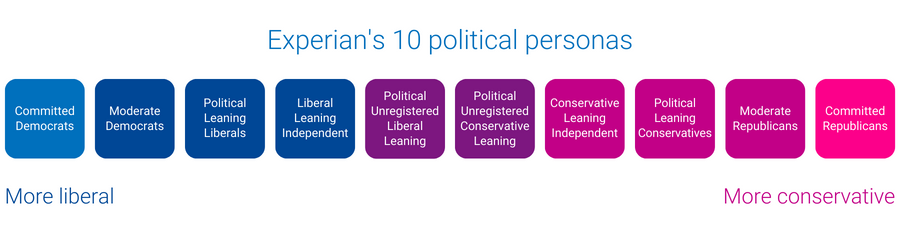
Let’s walk through how we define each persona starting from the most “committed” personas on the ends of the spectrum.
Committed Democrats
This audience contains consumers who are likely to have a “very liberal” outlook on political issues. They have strong liberal opinions on various topics including key issues and the economy and are very involved in their communities.
Committed Republicans
This audience contains consumers who are likely to have a “very conservative” outlook on political issues. They are well-informed, community-minded individuals with strong opinions that reflect their conservatism. They have very conservative attitudes regarding key social issues.
Moderate Democrats
This audience contains consumers who are likely to have a “somewhat liberal” outlook on political issues.
Moderate Republicans
This audience contains consumers who are likely to have a “somewhat conservative” outlook on political issues.
Political Leaning Liberals
This audience contains consumers who are likely to have strong opinions on key issues that may not align with the traditional Democrat point of view.
Political Leaning Conservatives
This audience contains consumers who are likely on-the-fence on traditional Republican points of view on key issues.
Liberal Leaning Independents
This audience contains consumers who are registered independents and who are likely to have a “middle of the road” outlook on political issues while tending to lean more liberal.
Conservative Leaning Independents
This audience contains consumers who are likely registered independents and likely have a “middle-of-the-road” outlook on political issues while tending to lean more conservative.
Political Unregistered Liberal Leaning
This audience contains consumers who are not likely to have aligned with a specific party, but have a more liberal attitude. They are well-informed and are aware of important political issues. They frequently align with but are not necessarily completely aligned with liberal points of view.
Political Unregistered Conservative Leaning
This audience contains consumers who are not likely to have aligned with a specific party, but have a more conservative attitude. They are well-informed and are aware of important political issues. They frequently align with but are not necessarily completely aligned with conservative points of view.
These 10 personas can help you better understand who the American voter is, but when combined with our 200 politically relevant audiences, such as watches political TV, donations to charitable causes, engagement channel preferences, hobbies, and more, the ability to study and improve engagement for each persona is considerably magnified.
How to combine our political personas with other audiences
If you’re a political candidate looking to reach an important population, Experian audiences are available on-the-shelf of major platforms. For example, if you want to reach unregistered voters and independent voters to influence green initiatives within your community, you can focus on unregistered and moderate personas in the area and combine that with audiences interested in green initiatives, like our GreenAware segments – which predict a consumer’s attitude and point of view on environmental issues.
You can use our “Political Unregistered Liberal Leaning”, “Liberal Leaning Independents,” and GreenAware “Think Greens” audience segments to reach constituents who are likely to be most interested in your message.
To reach voters based on their regional voting patterns, you can use our new battleground counties and district audiences:
- Affiliation Switcher Counties
- Battleground Counties
- House Battleground Districts
- Democrat Counties
- Republican Counties
- Independent Counties
Add Experian’s audiences to your 2024 election strategy
Political advertising spend is projected to surpass $12 billlion in the 2024 election cycle, generating the largest amount of voter outreach in the history of American elections. Experian’s audiences are available on major activation platforms allowing you to strategically reach constituents who would be most impacted and interested in your initiatives.
As we approach a cookieless future, Experian’s political personas are cookie resilient. Our data is rooted in both offline and online data that doesn’t rely on third-party cookies. The personas do not rely on an individual’s browsing behavior. Experian can help our partners understand and engage with these political audiences.
Over 200 politically relevant Experian audiences are available for activation on-the-shelf of the leading TV, demand, and supply platforms. Here are the platforms where you can find our political audiences:
- ArcSpan
- Audigent
- Cadent
- Eyeota
- Magnite
- Microsoft
- Nexxen
- Pandora
- Permutive
- Samsung Ads
- The Trade Desk
- Verizon Media
- Viant
- Videoamp
- Yieldmo
Can’t find the audience you’re looking for or need a custom audience? Connect with our audience team for more information.
Latest posts

Privacy-forward pharma media supports more informed healthcare journeys Effective pharma marketing depends on reaching patients, caregivers, and healthcare professionals (HCPs) with useful information in appropriate, privacy-forward ways. The goal is to make relevant education easier to find, support more informed conversations, and help brands understand how media contributes across the health journey. In this Ask the Expert session, Natalie Mancuso, SVP, Data Partnerships at DeepIntent, joins Sheila Wirick, who leads the health team at Experian, to discuss how to craft patient and HCP campaigns, privacy-safe activation workflows, connected TV (CTV), and measurement approaches built for pharma. Why should your media plan start with understanding the patient and provider The patient-and-provider journey should inform your media plan, as treatment decisions in pharma are increasingly informed, personal, and patient-driven. With more health information available than ever, patients are playing a more active role in understanding their options and participating in treatment conversations. As other industries become more customer-centric, pharma media planning needs to become more patient-centric. “We’ve got patients who are more informed, more involved in their treatment decisions than ever. The accessibility of data and information and the ways we can consume it with just AI alone is so vast that if we’re not arming people with the right information in real time, we’re missing the boat.”Natalie Mancuso, SVP, Data Partnerships This means media should be aligned to where a patient or provider is in the decision journey and what they need at that moment. Early on, media may play an educational role by building awareness of a condition, symptom, or treatment category. Later, it may help support more specific questions, treatment consideration, access, affordability, or adherence. The patient-provider conversation remains the key boundary. That exchange should stay private and clinically led. Media can play a valuable role before and after those moments by offering information that helps patients and providers feel more informed. How can brands connect patient and HCP messaging responsibly? It’s critical for agencies and brands to deliver relevant messaging to inform each stakeholder’s needs throughout the treatment journey, especially ahead of key clinical milestones. To execute this, brands must exercise privacy-forward activation, keeping patient and HCP identity, activation, and measurement paths separate, while using a common workflow layer to support the same brand goal. Experian helps pharma marketers do this by acting as an independent, privacy-forward identity, data, and workflow layer. We bring together high-fidelity matching, governed onboarding, and non-clinical consumer context, so patient and HCP engagement can be activated more accurately across channels and connected to reporting. The distinction is not only where each audience is reached. HCPs may be engaged in both professional and personal environments, but their needs are different from patients’. For example, an HCP may receive messaging about co-pay savings for eligible patients, while a patient may receive information about patient support programs. These are different messages for different audiences, but they ladder up to the same goal: informing both parties in a privacy-forward, relevant way. Hear from Natalie Mancuso in our 2026 State of advertising report In our 2026 State of advertising report, Natalie shares why identity serves as the connective infrastructure that links planning, activation, and measurement across connected TV (CTV), programmatic, commerce media, and walled garden environments. Download the report Watch Natalie’s Q&A What does privacy-forward activation look like in pharma? Pharma brands often start with fragmented patient and HCP signals. Privacy-forward activation turns those inputs into usable audiences by first confirming that the data can be used, then translating identity in controlled environments that protect personally identifiable information through tokenization or other methodologies. For DTC, that means building and matching audiences without relying on inferred health conditions from browsing behavior. For HCPs, it means connecting professional identity to verified sources in a way that supports activation and measurement. In a category shaped by HIPAA, state privacy laws, internal review, and consumer sensitivity, building privacy in from sourcing through activation is what makes responsible health media possible. How can CTV play a more useful role in pharma? CTV can play a more useful role in healthcare when it’s connected to a larger, privacy-forward plan and not treated as just an awareness channel. DeepIntent connects CTV and digital exposure data using identity signals, such as National Provider Identifiers (NPIs), hashed email addresses, IP addresses, device IDs, and household signals, where permitted and reviewed. That identity layer helps support sequencing and suppression across streaming, endemic, mobile, and digital settings. In practice, CTV can introduce targeted education or broad brand awareness, and later touchpoints can provide sequential information in the right channels. Instead of repeating the same message, brands can make pivots based on engagement and context. “For us, it starts with identity and not panels. When we’re resolving CTV and digital exposures to the same person, we’re leveraging signals so that every touchpoint across streaming, endemic, and mobile is recognized as the same individual, not model lookalikes.”Natalie Mancuso, SVP, Data Partnerships For pharma, campaign performance should not be measured by reach alone. A stronger approach looks at whether sequenced engagement contributes to meaningful downstream signals, including: Prescription activity Provider engagement Referral patterns Patient compliance Adherence signals, where measurement is permitted Why should messaging and reporting change in pharma? Pharma campaigns are journeys with changing information needs. Reporting should guide the campaign optimization. “If I’m launching into a market with a new class of drug, I’m asking what education needs to be put into the market – from both an HCP and a consumer standpoint – to build awareness?”Natalie Mancuso, SVP, Data Partnerships Clicks and website visits still have a place, but they can’t tell the full pharma story. DeepIntent processes data in real time, giving brands an up-to-date read on how media connects to campaign engagement. Campaign signals can help teams optimize audience logic, creative, channel mix, or sequencing during a live campaign. Heading Test for Media & Text Block Content Test for Media &Text Block Learn more Heading Test for Media & Text Block Content Test for Media &Text Block Learn more Heading Test for Media & Text Block Content Test for Media &Text Block Learn more Explore how privacy-safe pharma activation can make an impact Experian brings marketing data and identity expertise for health marketing and DeepIntent adds pharma-specific activation experience. Together, we help brands connect patient and HCP strategies responsibly, with privacy built in from the start. Watch the full video with our experts to hear Sheila Wirick and Natalie Mancuso discuss patient and HCP messaging, CTV, privacy-safe activation, and outcome measurement for pharma brands. About our experts Natalie Mancuso SVP, Data Partnerships, DeepIntent Natalie Mancuso is SVP, Data Partnerships at DeepIntent and a leader in health-focused AdTech and DSP strategy. With over 20 years of experience growing billion-dollar healthcare brands, she turns complex data into scalable, performance-driven solutions that keep marketers ahead of industry change. Sheila Wirick Director of Health Sales, Experian Sheila Wirick is the Director of Health Sales at Experian with more than 20 years of experience in data and analytics. As Director of Health Sales at Experian Marketing Services, she collaborates with healthcare, pharmaceutical, and nonprofit organizations to apply data and insights that enhance customer retention, brand awareness, and acquisition. She is committed to helping organizations use data to deliver measurable results and meaningful impact. FAQs What makes a pharma audience activation-ready? A pharma audience is activation-ready when patient or HCP inputs can be translated into usable audiences with the right accuracy, controls, interoperability, and destination readiness. For patient engagement, that may include privacy-safe cohort construction, caregiver logic, non-clinical enrichment and appropriate exclusion rules. For HCP engagement, it may include governed identity inputs such as NPI, specialty, practice location, professional address and other verified attributes where appropriate. How can pharma brands sequence messages across channels responsibly? Pharma brands can sequence messages responsibly by giving each channel a clear role and using audience logic to maintain continuity. CTV and out-of-home can support awareness, social can reinforce the message, search can capture active research and point-of-care or rep-triggered channels can support decision moments. The workflow should preserve separation between patient and HCP identity strategies. What should pharma marketers measure beyond clicks and site visits? Pharma marketers should measure whether media connects to outcomes such as audience quality, prescription activity, qualified HCP engagement, verified delivery, referral patterns, therapy starts or adherence signals where permitted. These outcomes often depend on partner-enabled workflows, clean rooms, and aggregated outputs rather than direct end-to-end tracking. How does Experian help pharma brands connect identity, activation and measurement? Experian acts as an independent privacy-first identity, data, and workflow layer for pharma marketers. We help brands bring together identity, high-fidelity matching, governed onboarding, non-clinical consumer context, and partner interoperability so patient and HCP engagement can be activated more accurately across channels and connected more cleanly to partner-enabled measurement. Latest posts
Heading This is my content Heading This is my content Title sdf sdf sdf sdf sdf sdf sdf
Use case #1: Identifying customer spending potential to boost growth for a retail chain Objective Solution Results The solution By syncing its cookies with the Digital Graph, the DSP gained access to related identifiers, including: This expanded identity universe gave the DSP a unified view of individuals and households, making it possible to connect impressions to conversions across devices and channels. With each weekly refresh, attribution models stayed accurate and up to date, turning fragmented signals into proof of performance. Results Within weeks, the DSP saw measurable improvements