
The holiday season is almost here, and knowing how each generation plans to shop can give your holiday advertising campaigns the edge you need. Our recent survey of 1,000 U.S. consumers reveals 2024 holiday shopping trends for each generation and key insights into their anticipated spending levels, preferred shopping categories, and how they look for gift ideas.
In this blog post, we’ll explore three 2024 holiday shopping trends across generations:
- Projected consumer spending
- Top categories on shoppers’ lists
- Preferred channels for researching gifts
1. Projected consumer spending
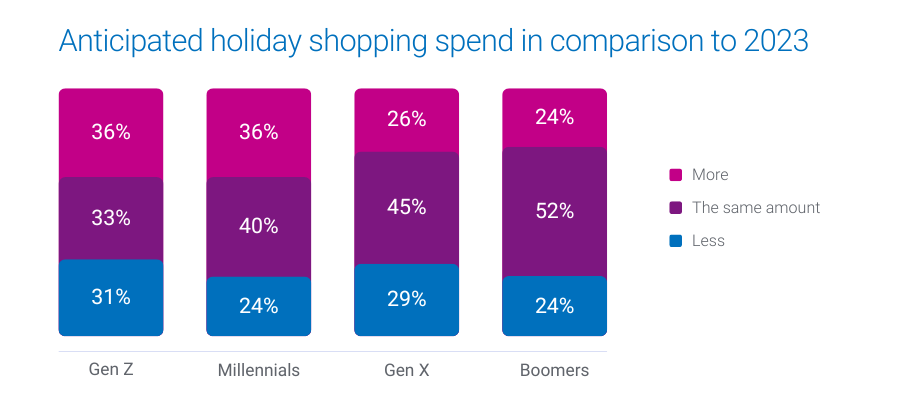
Over 1 in 3 Gen Z and Millennials are gearing up to increase their holiday budgets this year, while Gen X and Boomers are likelier to stick to last year’s budget.
- 36% of Millennials and Gen Z plan to spend more this holiday season
- 45% of Gen X and 52% of Boomers expect their spending to remain consistent with last year
What this means for marketers
These insights highlight the importance of tailoring your messaging. For Gen Z and Millennials, emphasize value and unique offerings that justify increased spending. For Gen X and Boomers, focus on trust and reliability, reinforcing their confidence in your brand.
How Experian can help you target these audiences
Experian’s custom and syndicated audience segments, including Holiday Shopper High Spenders and Holiday Shopper Moderate Spenders, enable you to connect with these diverse consumer groups. Our audiences are available on-the-shelf of leading ad platforms to help you reach people across social, TV, and mobile.
The election effect
U.S. holiday retail sales saw 4.1% YoY growth in 2016 and 8.3% YoY growth in 2020 following presidential elections. There’s a chance that holiday spending increases after the 2024 election, regardless of the outcome. Experian has 240+ politically relevant audiences that you can activate across major ad platforms ahead of the upcoming election.
2. Top categories on shoppers’ lists
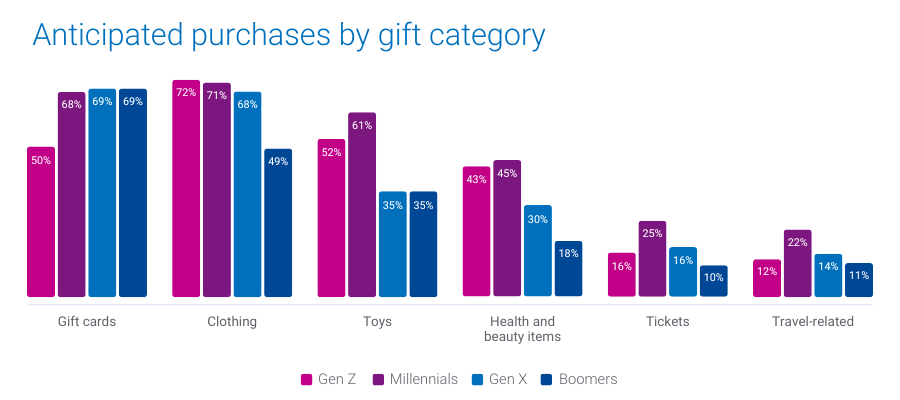
Different generations have distinct preferences when it comes to what they plan to buy. Gift cards top the list for Gen X and Boomers, while Gen Z leans toward clothing. Millennials are looking to splurge on toys, electronics, and experiences.
- 69% of Boomers and Gen X plan to purchase gift cards
- 72% of Gen Z will buy clothing
- 45% of Millennials will buy health and beauty items
- 25% of Millennials will buy tickets and 22% of Millennials will buy experiences
What this means for marketers
Align your product offerings and promotions with each generation’s preferences to capture their attention. For example, highlighting versatile gift cards may resonate more with older generations, while showcasing trendy apparel and tech gadgets will appeal to younger consumers.
How Experian can help you target these shoppers
We offer audience segments like Holiday Shoppers: Apparel, Cosmetics & Beauty Spenders, and Toys Shoppers that you can activate to connect with consumers primed to purchase in these categories.
We recently released 19 new holiday shopping audiences we recommend targeting to drive engagement and conversions. Download our audience recommendations here.
3. Preferred channels for researching gift ideas
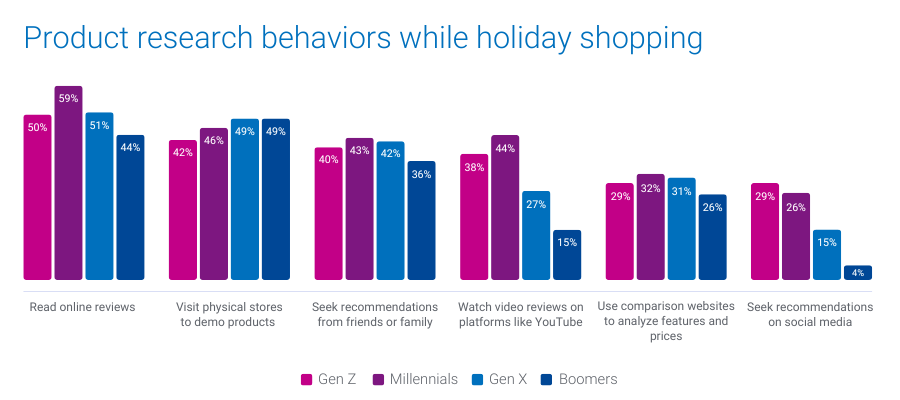
When it comes to finding the perfect gifts, Gen Z turns to social media, while Millennials prefer online reviews and video content. Boomers and Gen X are more inclined to visit physical stores for hands-on product evaluations.
- 29% of Gen Z and 26% of Millennials will look for gift ideas on social media
- 44% of Millennials will rely on video reviews and product demos on platforms like YouTube
- 49% of Gen X and Boomers plan to visit physical stores to evaluate products in person
What this means for marketers
Understanding where each generation looks for inspiration can guide your content and ad placement strategy. To engage Gen Z, focus on social media campaigns and influencer partnerships. For Millennials, consider investing in video content and reviews. For older generations, ensure your in-store experience is optimized to convert browsing into purchases.
How Experian can help you engage these shoppers
Our TrueTouchTM audiences can help you pair the perfect messaging styles with the right channels and calls to action. Our Social media channel and content engagement audiences can help you reach Gen Z who are likely to be active users on major social platforms and are Black Friday shoppers. For a full list of Experian’s syndicated audiences and activation destinations, download our syndicated audiences guide.
Download our report for five 2024 holiday shopping trends by generation
Understanding 2024 holiday shopping trends by generation can help you tailor your targeting, messaging, media planning, and creative based on the generation you’re targeting.
In addition to the insights covered here, download our 2024 Holiday spending trends and insights report to learn:
- When consumers plan to shop (hint: they’re already shopping)
- Where they plan to shop (online vs. in-store)
Download our full report to access all five of our predictions by generation, so you can address the diverse needs of this year’s holiday shoppers.
When you work with Experian for your holiday shopping campaigns, you’re getting:
- Accurate consumer insights: Better understand your customers’ behavioral and demographic attributes with our #1 ranked data covering the full U.S. population.
- Signal-agnostic identity solutions: Our deep understanding of people in the offline and digital worlds provides you with a persistent linkage of personally identifiable information (PII) data and digital IDs, ensuring you accurate cross-device targeting, addressability and measurement.
- Secure connectivity: Bring data and identity to life in a way that meets your needs by securely sharing data between partners, utilizing the integrations we have across the ecosystem, and using our marketing data in flexible ways.
Make the most of this holiday shopping season with Experian. Contact us today to get started.
Source
Online survey conducted in June, 2024 among n=1,000 U.S. adults 18+. Sample balanced to look like the general population on key demographics (age, gender, household income, ethnicity, and region).
Latest posts
Lorem ipsum dolor sit amet, consectetur adipiscing elit. Curabitur vel dolor quis elit vestibulum bibendum eu in mi. Maecenas bibendum tristique lacus, sit amet tincidunt tellus dictum et. Vestibulum ante ipsum primis in faucibus orci luctus et ultrices posuere cubilia curae; Maecenas vel diam lacinia magna efficitur congue. Aliquam tempus, lectus nec ultrices sagittis, purus ipsum imperdiet felis, ac gravida enim massa vel augue. Quisque non neque at augue volutpat sodales nec eget ipsum. In sed consectetur odio, ut tincidunt ipsum. Sed non pellentesque nulla, non iaculis mauris. Etiam faucibus sit amet mauris eu efficitur. Lorem ipsum dolor sit amet, consectetur adipiscing elit. Integer sed blandit metus, at finibus ligula. Ut non rhoncus lacus. Nulla mattis est quis cursus laoreet. Nullam porta odio eu tortor consequat vulputate. Suspendisse nec massa ac neque ultrices eleifend. Integer porta tristique tempus. Nulla aliquet, erat tincidunt imperdiet vehicula, urna tortor molestie nulla, ut porttitor erat erat ac nunc. Nulla facilisi. Etiam a tellus in lectus vulputate maximus vitae eu nisl. Fusce eget libero non ipsum pellentesque egestas. Lorem ipsum dolor sit amet, consectetur adipiscing elit. Nulla ut metus sapien. Maecenas aliquam libero et ipsum eleifend, et maximus felis sagittis. Donec id massa et massa molestie varius. Quisque dignissim placerat augue vel mollis. Mauris accumsan, mi vel elementum suscipit, eros elit malesuada justo, ut tempor mi nunc quis tortor. Nullam ut laoreet mi. Nam euismod lectus id dictum consectetur. Praesent quis lacinia ipsum. Donec lobortis massa in erat interdum, consectetur consectetur purus posuere. Nullam feugiat, erat non hendrerit rutrum, velit ante rhoncus nibh, ac laoreet felis ante ac mauris. Etiam ex erat, vulputate vel nulla non, placerat dictum tellus. Praesent orci lacus, dictum in vestibulum non, semper ut tortor. Nullam vitae ornare ipsum, a cursus quam. Vivamus vitae vulputate lorem, ac scelerisque lectus. Fusce at lacus non enim fringilla consequat. Sed laoreet mi eget vulputate auctor. Proin placerat tempor nunc vel mollis. Ut quis mi ut lorem ultrices hendrerit nec vehicula felis. Vestibulum tempus sapien vel porta aliquet. Phasellus quis auctor augue. Morbi nec tellus in massa venenatis ornare. Vivamus eleifend lacus lacus. Suspendisse ac commodo orci, vel fringilla turpis. Proin enim turpis, egestas quis nulla a, ultrices volutpat massa. Nam luctus sapien odio, ac blandit ante accumsan et. Nunc luctus ligula odio, ac faucibus urna rutrum vitae. Donec eu lorem gravida nisi pretium consectetur. Morbi vel mauris non odio iaculis aliquam sed nec leo. Vestibulum sed libero quis ante hendrerit porttitor eget eu orci. Morbi est arcu, maximus eu lobortis sit amet, suscipit et felis. Morbi sodales mattis pretium. Curabitur sodales porttitor eros vitae efficitur. Nam id turpis tristique, aliquam sapien ac, convallis mi. Sed risus sapien, dapibus euismod mauris vitae, fringilla vulputate augue. Morbi efficitur, ex vitae semper mattis, tellus sem luctus lorem, eget viverra metus nibh eu neque. In eu orci est.

YouTube Embed Yoast FAQ Block FAQ Question #1 FAQ Answer #1 FAQ Question #2 FAQ Answer #2 FAQ Question #3 FAQ Answer #3 CTA Embed Button Test InfoGram Embed

Lorem ipsum dolor sit amet, consectetur adipiscing elit. Aliquam vitae nibh eu massa cursus eleifend quis in quam. Nunc mollis aliquam eros sed laoreet. Suspendisse et elit ut metus elementum aliquet ut sit amet metus. Vestibulum ante ipsum primis in faucibus orci luctus et ultrices posuere cubilia curae; Pellentesque fringilla, nibh eget convallis scelerisque, nisl nisl vestibulum ipsum, sit amet placerat neque nunc eget nisi. Cras cursus, sapien non interdum mollis, nibh augue efficitur eros, eget congue tellus nulla id lectus. Nullam vestibulum vitae erat sit amet mollis. Sed gravida tortor nec nibh blandit ultrices. Pellentesque habitant morbi tristique senectus et netus et malesuada fames ac turpis egestas. Nam justo lectus, tempus a velit at, tempus malesuada est. Aenean dictum tellus id lorem venenatis, quis sodales nisl tempus. In quis libero id est rhoncus dictum. Praesent ipsum dui, mattis vel augue ut, lacinia ultricies ex. Suspendisse sit amet gravida purus. Vivamus tempus tellus augue, ac placerat arcu efficitur non. Nam auctor at nulla sed porta. Vivamus lobortis eu nunc a efficitur. Vestibulum condimentum ante nec nisi imperdiet vulputate. Duis varius metus ac est fermentum congue. Aenean tincidunt ut erat non pharetra. Nulla elit orci, semper sed porttitor ac, convallis vitae velit. Praesent egestas blandit ullamcorper. Praesent a porta lectus. Aliquam et pellentesque lectus. Integer placerat mauris risus, ut semper dui commodo at. Vivamus efficitur pharetra ligula id rhoncus. Pellentesque gravida purus vitae viverra luctus. Vestibulum ante ipsum primis in faucibus orci luctus et ultrices posuere cubilia curae; In vitae augue nec odio fermentum ultrices a sed libero. Nulla ullamcorper nulla id sagittis convallis. Pellentesque cursus metus et orci iaculis, non laoreet nisi aliquam. Proin porta velit risus, ac ultricies lectus tincidunt at. Pellentesque scelerisque ullamcorper euismod. Phasellus eget velit malesuada, faucibus enim a, ultrices ante. Morbi ut diam non metus interdum placerat gravida quis arcu. Integer ultricies molestie nulla sed convallis. Curabitur mi dui, aliquam vel nibh rutrum, convallis tempor lacus. Cras porttitor laoreet varius. Ut tincidunt massa congue mauris lobortis euismod. Pellentesque a odio ut est consequat tristique ut in mi. Nullam sed ultricies justo, eu varius eros. Nunc ipsum nulla, vehicula at sagittis a, ornare ut nisi. Aenean imperdiet felis at aliquet porta. Nunc sed leo ut justo efficitur aliquet. Sed et urna vel urna maximus laoreet. In facilisis porttitor nisi in sagittis. Fusce magna sapien, molestie ac maximus eu, tincidunt sit amet massa. Praesent non mauris metus. Aliquam dapibus sit amet tortor at scelerisque. Ut vel dolor at nisi rhoncus finibus auctor non velit. Integer pellentesque venenatis diam, nec eleifend ipsum pellentesque quis. Vivamus vitae mi nisl. Curabitur lectus orci, ornare et ipsum venenatis, sagittis blandit mauris. FAQs Lorem ipsum dolor sit amet, consectetur adipiscing elit. Aliquam vitae nibh eu massa cursus eleifend quis in quam. Nunc mollis aliquam eros sed laoreet. Suspendisse et elit ut metus elementum aliquet ut sit amet metus. Vestibulum ante ipsum primis in faucibus orci luctus et ultrices posuere cubilia curae; Pellentesque fringilla, nibh eget convallis scelerisque, nisl nisl vestibulum ipsum, sit amet placerat neque nunc eget nisi. Cras cursus, sapien non interdum mollis, nibh augue efficitur eros, eget congue tellus nulla id lectus. Nullam vestibulum vitae erat sit amet mollis. Sed gravida tortor nec nibh blandit ultrices. Pellentesque habitant morbi tristique senectus et netus et malesuada fames ac turpis egestas. Nam justo lectus, tempus a velit at, tempus malesuada est. Aenean dictum tellus id lorem venenatis, quis sodales nisl tempus. In quis libero id est rhoncus dictum. Praesent ipsum dui, mattis vel augue ut, lacinia ultricies ex. Suspendisse sit amet gravida purus. Vivamus tempus tellus augue, ac placerat arcu efficitur non. Nam auctor at nulla sed porta. Vivamus lobortis eu nunc a efficitur. Vestibulum condimentum ante nec nisi imperdiet vulputate. Duis varius metus ac est fermentum congue. Aenean tincidunt ut erat non pharetra. Nulla elit orci, semper sed porttitor ac, convallis vitae velit. Praesent egestas blandit ullamcorper. Praesent a porta lectus. Aliquam et pellentesque lectus. Integer placerat mauris risus, ut semper dui commodo at. Vivamus efficitur pharetra ligula id rhoncus. Pellentesque gravida purus vitae viverra luctus. Vestibulum ante ipsum primis in faucibus orci luctus et ultrices posuere cubilia curae; In vitae augue nec odio fermentum ultrices a sed libero. Nulla ullamcorper nulla id sagittis convallis.