The holiday season is almost here, and knowing how each generation plans to shop can give your holiday advertising campaigns the edge you need. Our recent survey of 1,000 U.S. consumers reveals 2024 holiday shopping trends for each generation and key insights into their anticipated spending levels, preferred shopping categories, and how they look for gift ideas.
In this blog post, we’ll explore three 2024 holiday shopping trends across generations:
- Projected consumer spending
- Top categories on shoppers’ lists
- Preferred channels for researching gifts
1. Projected consumer spending
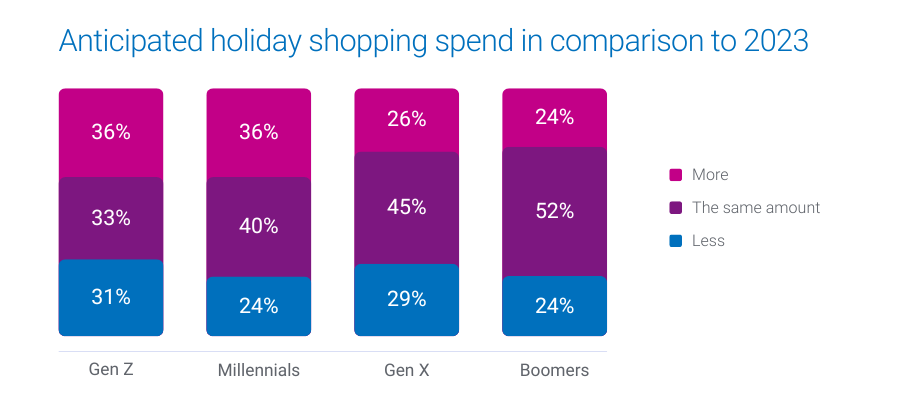
Over 1 in 3 Gen Z and Millennials are gearing up to increase their holiday budgets this year, while Gen X and Boomers are likelier to stick to last year’s budget.
- 36% of Millennials and Gen Z plan to spend more this holiday season
- 45% of Gen X and 52% of Boomers expect their spending to remain consistent with last year
What this means for marketers
These insights highlight the importance of tailoring your messaging. For Gen Z and Millennials, emphasize value and unique offerings that justify increased spending. For Gen X and Boomers, focus on trust and reliability, reinforcing their confidence in your brand.
How Experian can help you target these audiences
Experian’s custom and syndicated audience segments, including Holiday Shopper High Spenders and Holiday Shopper Moderate Spenders, enable you to connect with these diverse consumer groups. Our audiences are available on-the-shelf of leading ad platforms to help you reach people across social, TV, and mobile.
The election effect
U.S. holiday retail sales saw 4.1% YoY growth in 2016 and 8.3% YoY growth in 2020 following presidential elections. There’s a chance that holiday spending increases after the 2024 election, regardless of the outcome. Experian has 240+ politically relevant audiences that you can activate across major ad platforms ahead of the upcoming election.
2. Top categories on shoppers’ lists
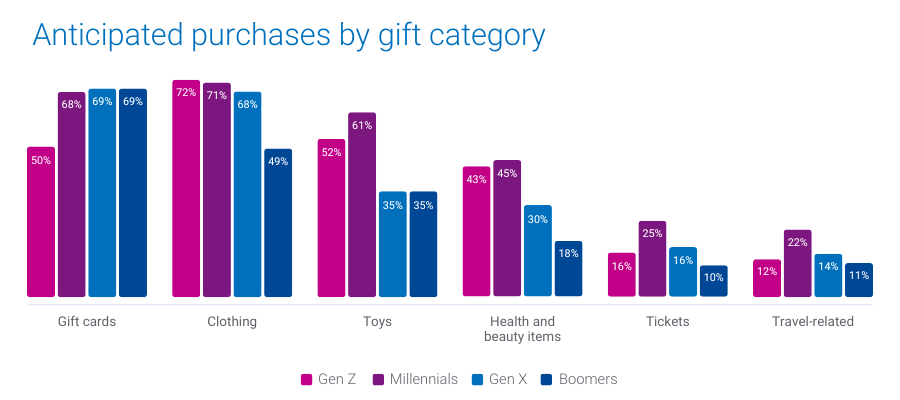
Different generations have distinct preferences when it comes to what they plan to buy. Gift cards top the list for Gen X and Boomers, while Gen Z leans toward clothing. Millennials are looking to splurge on toys, electronics, and experiences.
- 69% of Boomers and Gen X plan to purchase gift cards
- 72% of Gen Z will buy clothing
- 45% of Millennials will buy health and beauty items
- 25% of Millennials will buy tickets and 22% of Millennials will buy experiences
What this means for marketers
Align your product offerings and promotions with each generation’s preferences to capture their attention. For example, highlighting versatile gift cards may resonate more with older generations, while showcasing trendy apparel and tech gadgets will appeal to younger consumers.
How Experian can help you target these shoppers
We offer audience segments like Holiday Shoppers: Apparel, Cosmetics & Beauty Spenders, and Toys Shoppers that you can activate to connect with consumers primed to purchase in these categories.
We recently released 19 new holiday shopping audiences we recommend targeting to drive engagement and conversions. Download our audience recommendations here.
3. Preferred channels for researching gift ideas
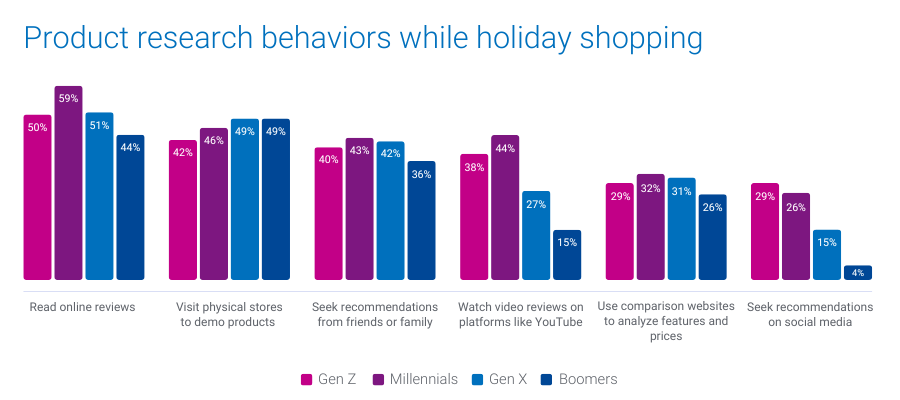
When it comes to finding the perfect gifts, Gen Z turns to social media, while Millennials prefer online reviews and video content. Boomers and Gen X are more inclined to visit physical stores for hands-on product evaluations.
- 29% of Gen Z and 26% of Millennials will look for gift ideas on social media
- 44% of Millennials will rely on video reviews and product demos on platforms like YouTube
- 49% of Gen X and Boomers plan to visit physical stores to evaluate products in person
What this means for marketers
Understanding where each generation looks for inspiration can guide your content and ad placement strategy. To engage Gen Z, focus on social media campaigns and influencer partnerships. For Millennials, consider investing in video content and reviews. For older generations, ensure your in-store experience is optimized to convert browsing into purchases.
How Experian can help you engage these shoppers
Our TrueTouchTM audiences can help you pair the perfect messaging styles with the right channels and calls to action. Our Social media channel and content engagement audiences can help you reach Gen Z who are likely to be active users on major social platforms and are Black Friday shoppers. For a full list of Experian’s syndicated audiences and activation destinations, download our syndicated audiences guide.
Download our report for five 2024 holiday shopping trends by generation
Understanding 2024 holiday shopping trends by generation can help you tailor your targeting, messaging, media planning, and creative based on the generation you’re targeting.
In addition to the insights covered here, download our 2024 Holiday spending trends and insights report to learn:
- When consumers plan to shop (hint: they’re already shopping)
- Where they plan to shop (online vs. in-store)
Download our full report to access all five of our predictions by generation, so you can address the diverse needs of this year’s holiday shoppers.
When you work with Experian for your holiday shopping campaigns, you’re getting:
- Accurate consumer insights: Better understand your customers’ behavioral and demographic attributes with our #1 ranked data covering the full U.S. population.
- Signal-agnostic identity solutions: Our deep understanding of people in the offline and digital worlds provides you with a persistent linkage of personally identifiable information (PII) data and digital IDs, ensuring you accurate cross-device targeting, addressability and measurement.
- Secure connectivity: Bring data and identity to life in a way that meets your needs by securely sharing data between partners, utilizing the integrations we have across the ecosystem, and using our marketing data in flexible ways.
Make the most of this holiday shopping season with Experian. Contact us today to get started.
Source
Online survey conducted in June, 2024 among n=1,000 U.S. adults 18+. Sample balanced to look like the general population on key demographics (age, gender, household income, ethnicity, and region).
Latest posts

Privacy-forward pharma media supports more informed healthcare journeys Effective pharma marketing depends on reaching patients, caregivers, and healthcare professionals (HCPs) with useful information in appropriate, privacy-forward ways. The goal is to make relevant education easier to find, support more informed conversations, and help brands understand how media contributes across the health journey. In this Ask the Expert session, Natalie Mancuso, SVP, Data Partnerships at DeepIntent, joins Sheila Wirick, who leads the health team at Experian, to discuss how to craft patient and HCP campaigns, privacy-safe activation workflows, connected TV (CTV), and measurement approaches built for pharma. Why should your media plan start with understanding the patient and provider The patient-and-provider journey should inform your media plan, as treatment decisions in pharma are increasingly informed, personal, and patient-driven. With more health information available than ever, patients are playing a more active role in understanding their options and participating in treatment conversations. As other industries become more customer-centric, pharma media planning needs to become more patient-centric. “We’ve got patients who are more informed, more involved in their treatment decisions than ever. The accessibility of data and information and the ways we can consume it with just AI alone is so vast that if we’re not arming people with the right information in real time, we’re missing the boat.”Natalie Mancuso, SVP, Data Partnerships This means media should be aligned to where a patient or provider is in the decision journey and what they need at that moment. Early on, media may play an educational role by building awareness of a condition, symptom, or treatment category. Later, it may help support more specific questions, treatment consideration, access, affordability, or adherence. The patient-provider conversation remains the key boundary. That exchange should stay private and clinically led. Media can play a valuable role before and after those moments by offering information that helps patients and providers feel more informed. How can brands connect patient and HCP messaging responsibly? It’s critical for agencies and brands to deliver relevant messaging to inform each stakeholder’s needs throughout the treatment journey, especially ahead of key clinical milestones. To execute this, brands must exercise privacy-forward activation, keeping patient and HCP identity, activation, and measurement paths separate, while using a common workflow layer to support the same brand goal. Experian helps pharma marketers do this by acting as an independent, privacy-forward identity, data, and workflow layer. We bring together high-fidelity matching, governed onboarding, and non-clinical consumer context, so patient and HCP engagement can be activated more accurately across channels and connected to reporting. The distinction is not only where each audience is reached. HCPs may be engaged in both professional and personal environments, but their needs are different from patients’. For example, an HCP may receive messaging about co-pay savings for eligible patients, while a patient may receive information about patient support programs. These are different messages for different audiences, but they ladder up to the same goal: informing both parties in a privacy-forward, relevant way. Hear from Natalie Mancuso in our 2026 State of advertising report In our 2026 State of advertising report, Natalie shares why identity serves as the connective infrastructure that links planning, activation, and measurement across connected TV (CTV), programmatic, commerce media, and walled garden environments. Download the report Watch Natalie’s Q&A What does privacy-forward activation look like in pharma? Pharma brands often start with fragmented patient and HCP signals. Privacy-forward activation turns those inputs into usable audiences by first confirming that the data can be used, then translating identity in controlled environments that protect personally identifiable information through tokenization or other methodologies. For DTC, that means building and matching audiences without relying on inferred health conditions from browsing behavior. For HCPs, it means connecting professional identity to verified sources in a way that supports activation and measurement. In a category shaped by HIPAA, state privacy laws, internal review, and consumer sensitivity, building privacy in from sourcing through activation is what makes responsible health media possible. How can CTV play a more useful role in pharma? CTV can play a more useful role in healthcare when it’s connected to a larger, privacy-forward plan and not treated as just an awareness channel. DeepIntent connects CTV and digital exposure data using identity signals, such as National Provider Identifiers (NPIs), hashed email addresses, IP addresses, device IDs, and household signals, where permitted and reviewed. That identity layer helps support sequencing and suppression across streaming, endemic, mobile, and digital settings. In practice, CTV can introduce targeted education or broad brand awareness, and later touchpoints can provide sequential information in the right channels. Instead of repeating the same message, brands can make pivots based on engagement and context. “For us, it starts with identity and not panels. When we’re resolving CTV and digital exposures to the same person, we’re leveraging signals so that every touchpoint across streaming, endemic, and mobile is recognized as the same individual, not model lookalikes.”Natalie Mancuso, SVP, Data Partnerships For pharma, campaign performance should not be measured by reach alone. A stronger approach looks at whether sequenced engagement contributes to meaningful downstream signals, including: Prescription activity Provider engagement Referral patterns Patient compliance Adherence signals, where measurement is permitted Why should messaging and reporting change in pharma? Pharma campaigns are journeys with changing information needs. Reporting should guide the campaign optimization. “If I’m launching into a market with a new class of drug, I’m asking what education needs to be put into the market – from both an HCP and a consumer standpoint – to build awareness?”Natalie Mancuso, SVP, Data Partnerships Clicks and website visits still have a place, but they can’t tell the full pharma story. DeepIntent processes data in real time, giving brands an up-to-date read on how media connects to campaign engagement. Campaign signals can help teams optimize audience logic, creative, channel mix, or sequencing during a live campaign. Heading Test for Media & Text Block Content Test for Media &Text Block Learn more Heading Test for Media & Text Block Content Test for Media &Text Block Learn more Heading Test for Media & Text Block Content Test for Media &Text Block Learn more Explore how privacy-safe pharma activation can make an impact Experian brings marketing data and identity expertise for health marketing and DeepIntent adds pharma-specific activation experience. Together, we help brands connect patient and HCP strategies responsibly, with privacy built in from the start. Watch the full video with our experts to hear Sheila Wirick and Natalie Mancuso discuss patient and HCP messaging, CTV, privacy-safe activation, and outcome measurement for pharma brands. About our experts Natalie Mancuso SVP, Data Partnerships, DeepIntent Natalie Mancuso is SVP, Data Partnerships at DeepIntent and a leader in health-focused AdTech and DSP strategy. With over 20 years of experience growing billion-dollar healthcare brands, she turns complex data into scalable, performance-driven solutions that keep marketers ahead of industry change. Sheila Wirick Director of Health Sales, Experian Sheila Wirick is the Director of Health Sales at Experian with more than 20 years of experience in data and analytics. As Director of Health Sales at Experian Marketing Services, she collaborates with healthcare, pharmaceutical, and nonprofit organizations to apply data and insights that enhance customer retention, brand awareness, and acquisition. She is committed to helping organizations use data to deliver measurable results and meaningful impact. FAQs What makes a pharma audience activation-ready? A pharma audience is activation-ready when patient or HCP inputs can be translated into usable audiences with the right accuracy, controls, interoperability, and destination readiness. For patient engagement, that may include privacy-safe cohort construction, caregiver logic, non-clinical enrichment and appropriate exclusion rules. For HCP engagement, it may include governed identity inputs such as NPI, specialty, practice location, professional address and other verified attributes where appropriate. How can pharma brands sequence messages across channels responsibly? Pharma brands can sequence messages responsibly by giving each channel a clear role and using audience logic to maintain continuity. CTV and out-of-home can support awareness, social can reinforce the message, search can capture active research and point-of-care or rep-triggered channels can support decision moments. The workflow should preserve separation between patient and HCP identity strategies. What should pharma marketers measure beyond clicks and site visits? Pharma marketers should measure whether media connects to outcomes such as audience quality, prescription activity, qualified HCP engagement, verified delivery, referral patterns, therapy starts or adherence signals where permitted. These outcomes often depend on partner-enabled workflows, clean rooms, and aggregated outputs rather than direct end-to-end tracking. How does Experian help pharma brands connect identity, activation and measurement? Experian acts as an independent privacy-first identity, data, and workflow layer for pharma marketers. We help brands bring together identity, high-fidelity matching, governed onboarding, non-clinical consumer context, and partner interoperability so patient and HCP engagement can be activated more accurately across channels and connected more cleanly to partner-enabled measurement. Latest posts
Heading This is my content Heading This is my content Title sdf sdf sdf sdf sdf sdf sdf
Use case #1: Identifying customer spending potential to boost growth for a retail chain Objective Solution Results The solution By syncing its cookies with the Digital Graph, the DSP gained access to related identifiers, including: This expanded identity universe gave the DSP a unified view of individuals and households, making it possible to connect impressions to conversions across devices and channels. With each weekly refresh, attribution models stayed accurate and up to date, turning fragmented signals into proof of performance. Results Within weeks, the DSP saw measurable improvements