The holiday season is almost here, and knowing how each generation plans to shop can give your holiday advertising campaigns the edge you need. Our recent survey of 1,000 U.S. consumers reveals 2024 holiday shopping trends for each generation and key insights into their anticipated spending levels, preferred shopping categories, and how they look for gift ideas.
In this blog post, we’ll explore three 2024 holiday shopping trends across generations:
- Projected consumer spending
- Top categories on shoppers’ lists
- Preferred channels for researching gifts
1. Projected consumer spending
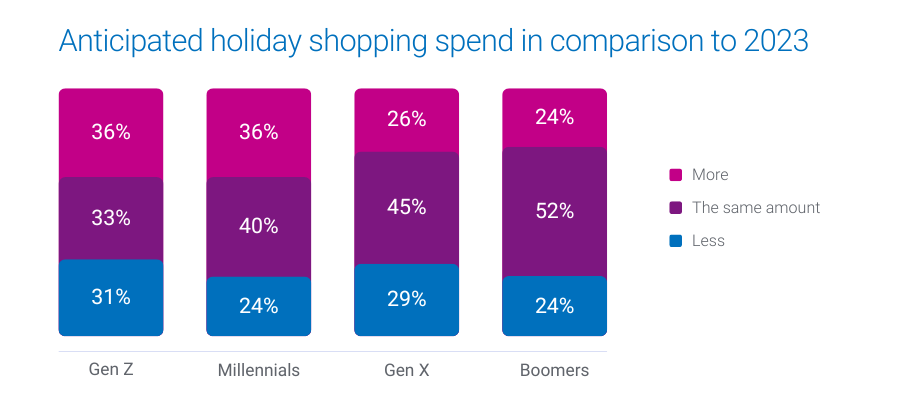
Over 1 in 3 Gen Z and Millennials are gearing up to increase their holiday budgets this year, while Gen X and Boomers are likelier to stick to last year’s budget.
- 36% of Millennials and Gen Z plan to spend more this holiday season
- 45% of Gen X and 52% of Boomers expect their spending to remain consistent with last year
What this means for marketers
These insights highlight the importance of tailoring your messaging. For Gen Z and Millennials, emphasize value and unique offerings that justify increased spending. For Gen X and Boomers, focus on trust and reliability, reinforcing their confidence in your brand.
How Experian can help you target these audiences
Experian’s custom and syndicated audience segments, including Holiday Shopper High Spenders and Holiday Shopper Moderate Spenders, enable you to connect with these diverse consumer groups. Our audiences are available on-the-shelf of leading ad platforms to help you reach people across social, TV, and mobile.
The election effect
U.S. holiday retail sales saw 4.1% YoY growth in 2016 and 8.3% YoY growth in 2020 following presidential elections. There’s a chance that holiday spending increases after the 2024 election, regardless of the outcome. Experian has 240+ politically relevant audiences that you can activate across major ad platforms ahead of the upcoming election.
2. Top categories on shoppers’ lists
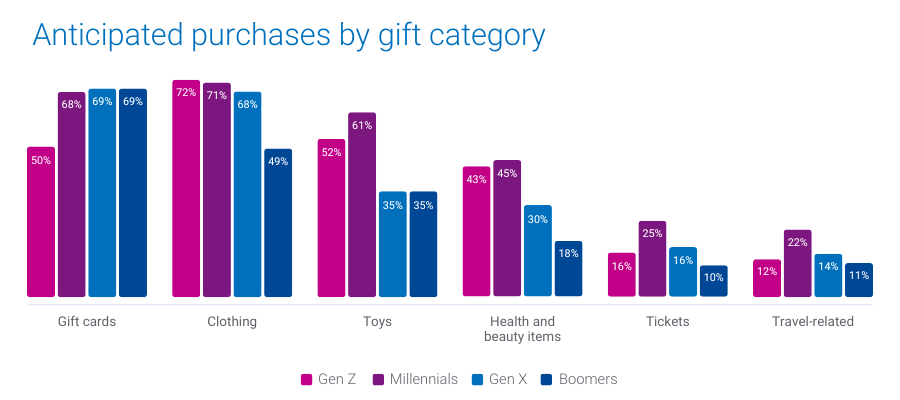
Different generations have distinct preferences when it comes to what they plan to buy. Gift cards top the list for Gen X and Boomers, while Gen Z leans toward clothing. Millennials are looking to splurge on toys, electronics, and experiences.
- 69% of Boomers and Gen X plan to purchase gift cards
- 72% of Gen Z will buy clothing
- 45% of Millennials will buy health and beauty items
- 25% of Millennials will buy tickets and 22% of Millennials will buy experiences
What this means for marketers
Align your product offerings and promotions with each generation’s preferences to capture their attention. For example, highlighting versatile gift cards may resonate more with older generations, while showcasing trendy apparel and tech gadgets will appeal to younger consumers.
How Experian can help you target these shoppers
We offer audience segments like Holiday Shoppers: Apparel, Cosmetics & Beauty Spenders, and Toys Shoppers that you can activate to connect with consumers primed to purchase in these categories.
We recently released 19 new holiday shopping audiences we recommend targeting to drive engagement and conversions. Download our audience recommendations here.
3. Preferred channels for researching gift ideas
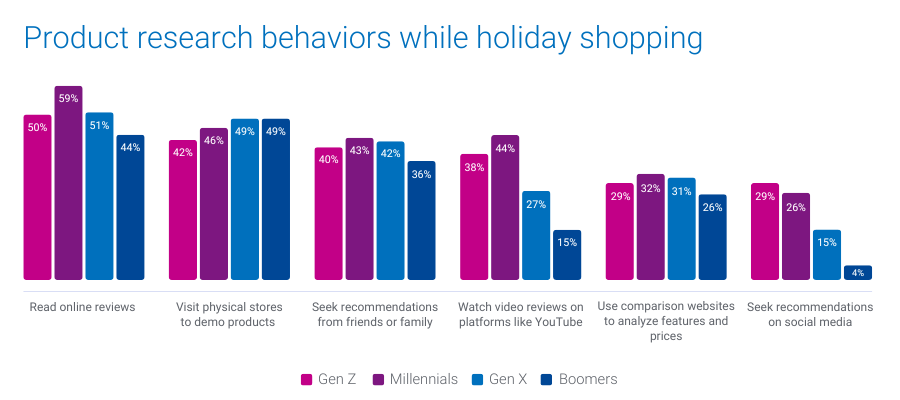
When it comes to finding the perfect gifts, Gen Z turns to social media, while Millennials prefer online reviews and video content. Boomers and Gen X are more inclined to visit physical stores for hands-on product evaluations.
- 29% of Gen Z and 26% of Millennials will look for gift ideas on social media
- 44% of Millennials will rely on video reviews and product demos on platforms like YouTube
- 49% of Gen X and Boomers plan to visit physical stores to evaluate products in person
What this means for marketers
Understanding where each generation looks for inspiration can guide your content and ad placement strategy. To engage Gen Z, focus on social media campaigns and influencer partnerships. For Millennials, consider investing in video content and reviews. For older generations, ensure your in-store experience is optimized to convert browsing into purchases.
How Experian can help you engage these shoppers
Our TrueTouchTM audiences can help you pair the perfect messaging styles with the right channels and calls to action. Our Social media channel and content engagement audiences can help you reach Gen Z who are likely to be active users on major social platforms and are Black Friday shoppers. For a full list of Experian’s syndicated audiences and activation destinations, download our syndicated audiences guide.
Download our report for five 2024 holiday shopping trends by generation
Understanding 2024 holiday shopping trends by generation can help you tailor your targeting, messaging, media planning, and creative based on the generation you’re targeting.
In addition to the insights covered here, download our 2024 Holiday spending trends and insights report to learn:
- When consumers plan to shop (hint: they’re already shopping)
- Where they plan to shop (online vs. in-store)
Download our full report to access all five of our predictions by generation, so you can address the diverse needs of this year’s holiday shoppers.
When you work with Experian for your holiday shopping campaigns, you’re getting:
- Accurate consumer insights: Better understand your customers’ behavioral and demographic attributes with our #1 ranked data covering the full U.S. population.
- Signal-agnostic identity solutions: Our deep understanding of people in the offline and digital worlds provides you with a persistent linkage of personally identifiable information (PII) data and digital IDs, ensuring you accurate cross-device targeting, addressability and measurement.
- Secure connectivity: Bring data and identity to life in a way that meets your needs by securely sharing data between partners, utilizing the integrations we have across the ecosystem, and using our marketing data in flexible ways.
Make the most of this holiday shopping season with Experian. Contact us today to get started.
Source
Online survey conducted in June, 2024 among n=1,000 U.S. adults 18+. Sample balanced to look like the general population on key demographics (age, gender, household income, ethnicity, and region).
Latest posts

Marketers have always struggled to target the right consumer with the right offer. And with more than 313 million people live in the United States according to the U.S. Census, the challenge is more difficult than ever. With the proliferation of the Internet and mobile technology, today’s consumer operates differently and expects more from their favorite brands. To adapt to that new American consumer, marketers are using highly targeted strategies to drive interest. These can be messages that are relevant to a few hundred consumers or detailed one-on-one communications that target individuals at the point of sale or online. But some marketers struggle to execute these tactics effectively. Most segmentation is currently done prior to a campaign, meaning that marketers determine which message a consumer will receive before ever interacting with that individual. Unfortunately, with the rapid nature of purchasing decisions and buying transactions, businesses often miss opportunities because it takes too long to get the right message to the right consumer. To keep up, marketers need to collect intelligence at the point of contact so they can understand each individual consumer’s habits and preferences during that connection. This intelligence can then feed modeling algorithms that enable automatic offers based on an individual’s preferences. To develop a strategy around real-time marketing intelligence, marketers should take the following steps: Clean existing data – at the root of any intelligence strategy is data. Information determines a company’s ability to reach target individuals – and understand who they are and what they’re interested in. Unfortunately, if the data that feeds intelligence efforts is inaccurate, marketers are simply unable to communicate with or understand consumers. Ensuring the validity of contact information, internal records and third-party data elements helps organizations target consumers and ensures that sophisticated analysis is as precise as possible. Identify strategies – organizations should analyze their target markets and determine which communication channels could benefit from a more personalized customer experience. Marketers should decide how they want to change each communication to help drive the desired action from each consumer. Consider personalizing website displays based on geographic regions, customizing an introductory message or revamping loyalty campaigns based on purchase history and consumer interests. Real-time intelligence – marketers should build models to help predict the best offers for each target audience. These models can be designed to take into account demographic and behavioral information, as well as purchase history and internal data. Marketers can feed these models with intelligence gained at the point of contact to prompt consumers in real time with specific, relevant offers. As marketers continue to enhance and refine targeting efforts, it’s important to gain customer insight. Those who leverage these advanced technologies and strategies will create stronger customer engagement. Segmenting customers and taking measurable action in real time are advanced techniques that appeal to many marketers today. Achieving this level of interaction allows organizations to optimize marketing efforts and provide the right offer at the right time to the right consumer.
In today’s multi-channel shopping world online behavior can’t be overlooked. Marketers need to enhance their offline marketing efforts with online data to take advantage of incorporating online behavior into targeting efforts.
Income levels are important to consider when targeting consumers, as is determining the amount of money they have left over for non-essentials after the bills are paid.