
The holiday season is almost here, and knowing how each generation plans to shop can give your holiday advertising campaigns the edge you need. Our recent survey of 1,000 U.S. consumers reveals 2024 holiday shopping trends for each generation and key insights into their anticipated spending levels, preferred shopping categories, and how they look for gift ideas.
In this blog post, we’ll explore three 2024 holiday shopping trends across generations:
- Projected consumer spending
- Top categories on shoppers’ lists
- Preferred channels for researching gifts
1. Projected consumer spending
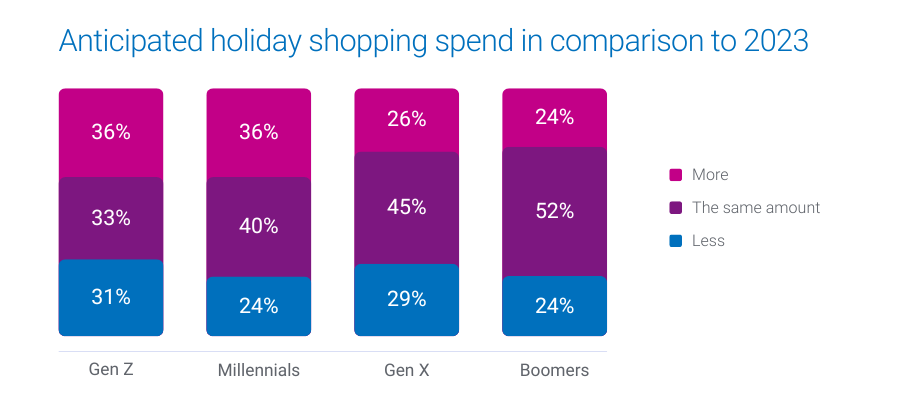
Over 1 in 3 Gen Z and Millennials are gearing up to increase their holiday budgets this year, while Gen X and Boomers are likelier to stick to last year’s budget.
- 36% of Millennials and Gen Z plan to spend more this holiday season
- 45% of Gen X and 52% of Boomers expect their spending to remain consistent with last year
What this means for marketers
These insights highlight the importance of tailoring your messaging. For Gen Z and Millennials, emphasize value and unique offerings that justify increased spending. For Gen X and Boomers, focus on trust and reliability, reinforcing their confidence in your brand.
How Experian can help you target these audiences
Experian’s custom and syndicated audience segments, including Holiday Shopper High Spenders and Holiday Shopper Moderate Spenders, enable you to connect with these diverse consumer groups. Our audiences are available on-the-shelf of leading ad platforms to help you reach people across social, TV, and mobile.
The election effect
U.S. holiday retail sales saw 4.1% YoY growth in 2016 and 8.3% YoY growth in 2020 following presidential elections. There’s a chance that holiday spending increases after the 2024 election, regardless of the outcome. Experian has 240+ politically relevant audiences that you can activate across major ad platforms ahead of the upcoming election.
2. Top categories on shoppers’ lists
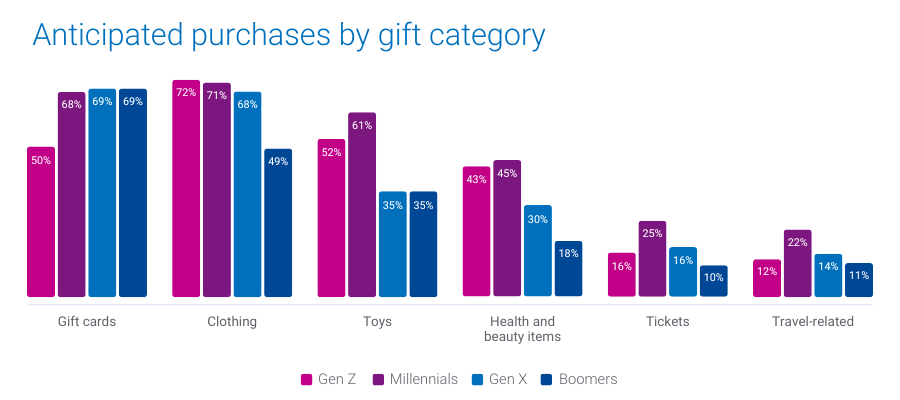
Different generations have distinct preferences when it comes to what they plan to buy. Gift cards top the list for Gen X and Boomers, while Gen Z leans toward clothing. Millennials are looking to splurge on toys, electronics, and experiences.
- 69% of Boomers and Gen X plan to purchase gift cards
- 72% of Gen Z will buy clothing
- 45% of Millennials will buy health and beauty items
- 25% of Millennials will buy tickets and 22% of Millennials will buy experiences
What this means for marketers
Align your product offerings and promotions with each generation’s preferences to capture their attention. For example, highlighting versatile gift cards may resonate more with older generations, while showcasing trendy apparel and tech gadgets will appeal to younger consumers.
How Experian can help you target these shoppers
We offer audience segments like Holiday Shoppers: Apparel, Cosmetics & Beauty Spenders, and Toys Shoppers that you can activate to connect with consumers primed to purchase in these categories.
We recently released 19 new holiday shopping audiences we recommend targeting to drive engagement and conversions. Download our audience recommendations here.
3. Preferred channels for researching gift ideas
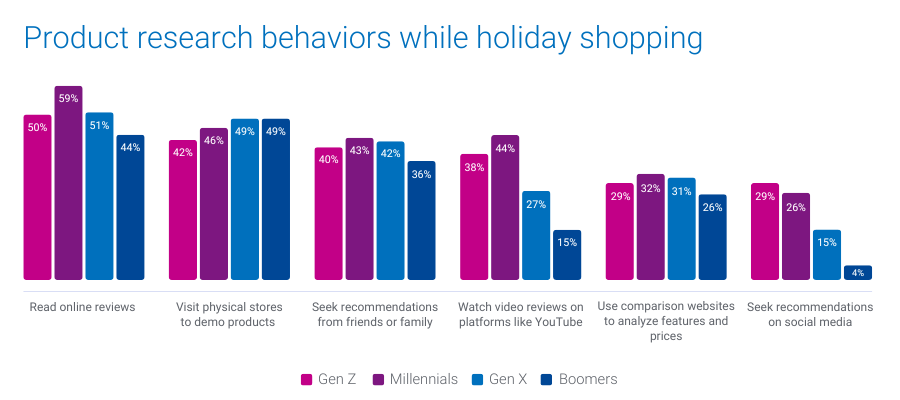
When it comes to finding the perfect gifts, Gen Z turns to social media, while Millennials prefer online reviews and video content. Boomers and Gen X are more inclined to visit physical stores for hands-on product evaluations.
- 29% of Gen Z and 26% of Millennials will look for gift ideas on social media
- 44% of Millennials will rely on video reviews and product demos on platforms like YouTube
- 49% of Gen X and Boomers plan to visit physical stores to evaluate products in person
What this means for marketers
Understanding where each generation looks for inspiration can guide your content and ad placement strategy. To engage Gen Z, focus on social media campaigns and influencer partnerships. For Millennials, consider investing in video content and reviews. For older generations, ensure your in-store experience is optimized to convert browsing into purchases.
How Experian can help you engage these shoppers
Our TrueTouchTM audiences can help you pair the perfect messaging styles with the right channels and calls to action. Our Social media channel and content engagement audiences can help you reach Gen Z who are likely to be active users on major social platforms and are Black Friday shoppers. For a full list of Experian’s syndicated audiences and activation destinations, download our syndicated audiences guide.
Download our report for five 2024 holiday shopping trends by generation
Understanding 2024 holiday shopping trends by generation can help you tailor your targeting, messaging, media planning, and creative based on the generation you’re targeting.
In addition to the insights covered here, download our 2024 Holiday spending trends and insights report to learn:
- When consumers plan to shop (hint: they’re already shopping)
- Where they plan to shop (online vs. in-store)
Download our full report to access all five of our predictions by generation, so you can address the diverse needs of this year’s holiday shoppers.
When you work with Experian for your holiday shopping campaigns, you’re getting:
- Accurate consumer insights: Better understand your customers’ behavioral and demographic attributes with our #1 ranked data covering the full U.S. population.
- Signal-agnostic identity solutions: Our deep understanding of people in the offline and digital worlds provides you with a persistent linkage of personally identifiable information (PII) data and digital IDs, ensuring you accurate cross-device targeting, addressability and measurement.
- Secure connectivity: Bring data and identity to life in a way that meets your needs by securely sharing data between partners, utilizing the integrations we have across the ecosystem, and using our marketing data in flexible ways.
Make the most of this holiday shopping season with Experian. Contact us today to get started.
Source
Online survey conducted in June, 2024 among n=1,000 U.S. adults 18+. Sample balanced to look like the general population on key demographics (age, gender, household income, ethnicity, and region).
Latest posts

If the time spent on the Internet for personal computers was distilled into an hour then 27 percent of it would be spent on social networking and forums across the United States, United Kingdom and Australia. In the U.S., 16 minutes out of every hour online is spent on social networking and forums, nine minutes on entertainment sites and five minutes shopping. Global comparison In the UK, 13 minutes out of every hour online is spent on social networking and forums, nine minutes on entertainment sites and six minutes shopping. Australian Internet users spend 14 minutes on social sites, nine on entertainment and four minutes shopping online. Across all three markets, time spent shopping online grew year-over-year, but the UK market emerged as having the most prolific online shoppers, spending proportionally more time on retail Websites than online users in the U.S. or Australia. British Internet users spent 10 percent of all time online shopping in 2012, compared to nine percent in the U.S. and six percent in Australia. This was in part due to a bumper winter holiday season in the UK where 370 million hours were spent shopping online, 24 percent higher than the monthly average. Consumption of news content also increased across all three markets with Australian users emerging as the most voracious consumers of news online. Six percent of all time spent online in Australia in 2012 was on a news Website, compared to five percent in the UK and four percent in the U.S. Meanwhile, the time spent on social media proportionate to other online activities declined across all three regions. The U.S., which has been the most dominant market for social media consumption in the last three years dropped from 30 percent of all time spent online to 27 percent. In Australia time spent on social dropped from 27 percent to 24 percent while in the UK it dipped from 25 percent to 22 percent year-over-year. This highlights the rise in access via 3G and 4G networks as consumers spend increasingly more time online while on the move. "Understanding consumer behavior across channels is more important than ever as more visits are being made on the move, particularly among social networking and email,” says Bill Tancer, general manager of global research for Experian Marketing Services. "With smartphones and tablets becoming more powerful, our data clearly indicates the difference between mobile and traditional desktop usage further enabling the ‘always on’ consumer mentality. Marketers need to understand these differences, as well as regionally, to ensure campaigns can be tailored for better and more effective engagement.” Mobile browsing When looking at the U.S. browsing data for mobile devices, email accounted for the largest time spent on average, for the same categories for Q1 2013. Email made up 23 percent of time spent on mobile devices for Q1-13, while social networking accounted for 15 percent. Entertainment had the third highest time spent with 13 percent, followed by shopping with 11 percent and travel with 9 percent. The mobile data does not include app usage, but does include mobile browsing within an app. Read more of the latest consumer trends in The 2013 Digital Marketer Report Learn more about consumer online behavior by visiting our Online Trends page Learn more about the author, Matt Tatham

The 2013 Digital Marketer Report is almost here. One section of the report includes key segments of the consumer landscape. In a previous post we looked at budget and luxury travelers and in this excerpt we focus on millennials – specifically tactics to target early adopter millennials: The generation of 18- to 34-year-olds known as millennials is an increasingly influential group that impacts many aspects of the American lifestyle, including fashion, technology, entertainment and beyond. Almost one-quarter (24 percent) of millennials have a college degree, 34 percent are married and many (60 percent) own a home. They have an average discretionary spend of $11,317 annually. Brands and marketers are taking notice of millennials and the fact that they communicate and behave differently than other generations. Marketers increasingly understand that they need innovative marketing programs in order to engage this important segment of the population Early adopter millennials Fifty-two percent of millennials rank far above or above average when it comes to being early adopters of technology. That means more than half of adults ages 18 to 34 want to be the first to have the latest electronic equipment, are willing to pay almost anything for an electronic product and actively want to be a source of information on electronic equipment to others Marketers trying to reach this group can look at the types of Websites driving millennials to online retailers in order to understand other sites that would be effective partners, advertising outlets and content providers: Millennials are more likely than the online population to visit search and social Websites before visiting a retail Website They are less likely to look at email or visit reward and directory sites before visiting a retail Website They are more likely to visit fashion content and portal sites before visiting a retail Website There is a major opportunity to reach early adopter millennials via mobile, as they spend 14 percent more time engaged with their mobile devices in an average week than their generational peers. Early adopter millennials are 20 percent more likely to use a tablet and 32 percent more likely to IM/chat than the average millennial. Other top activities include reading media, listening to music and email. Source: Experian Marketing Services’ Simmons® Source: Experian Marketing Services’ Simmons Source: Experian Marketing Services’ Simmons For more insights on millennials and other key consumer segments, pre-order The 2013 Digital Marketer Report.

The 2013 Digital Marketer Report is almost here. In anticipation of its release, here’s an excerpt from the online display advertising section: Here’s what marketers and advertisers need in order to lay the groundwork for success in their online advertising campaigns: Solid audience-based data is the foundation for display advertising success. Start with your CRM file and work with the right partners who can best leverage it and enhance your audience definition with robust data assets to create a highly targeted display audience. Actionable, value-based segmentation is a key campaign driver. Value-based segmentation assigns predicted economic values to customer or prospect audience targets – based upon the campaign objective – for the more cost-efficient real time display ad buying. Applying value-based segmentation to an audience according to sound consumer insights and analytics allows for more dynamic and cost-effective display media bidding. Scalability to drive campaign efficiency. You’ve defined your target audience with value-based segments. Now you need to reach that specific audience at scale to maximize campaign efficiency and get the most from your media budget. High-quality creative to drive engagement and conversion. Developing the right audience, targeting parameters and media strategy is only as good as the creative message displayed so the importance of highly relevant, targeted creative cannot be underestimated. Work with a partner who understands your target audience and campaign objectives to develop and deliver the most compelling message. Approaching your online display campaign set up this way will ensure it is built on a solid foundation, greatly increasing the likelihood of your program’s success. Keep in mind that data-driven, audience-based campaigns typically take a little more ramp-up time than more traditional advertising. Sometimes, if companies don’t see results right away, they might change or abandon their strategy too quickly. This new, digital path truly requires a shift in advertiser behavior and thinking. All is not lost if you don’t see results right out of the gate. The systems need time to use the data to target the best audience, hone in on the right media for that audience and bid on it accurately. All of these steps take time but are needed to drive performance. Marketers in the trenches may get comfortable as they start to see results, but they sometimes struggle with getting their senior leadership to accept the longer time frame and keep spending on display programs. Brand advertisers tend to buy into display better than performance-based advertisers because they are used to the time required to create repeated exposure that builds awareness, consideration, favorability and intent. The key takeaway is that you need to go into these campaigns feeling comfortable about the longer timeline required to allow traction and drive the results you seek. Pre-order The 2013 Digital Marketer Report today and be one of the first to get more great data, trends and insights.